 Preview
 Send
Send Share
Share
 Details

 Download
 Similars
 X-Ray
X-Ray Diaporama
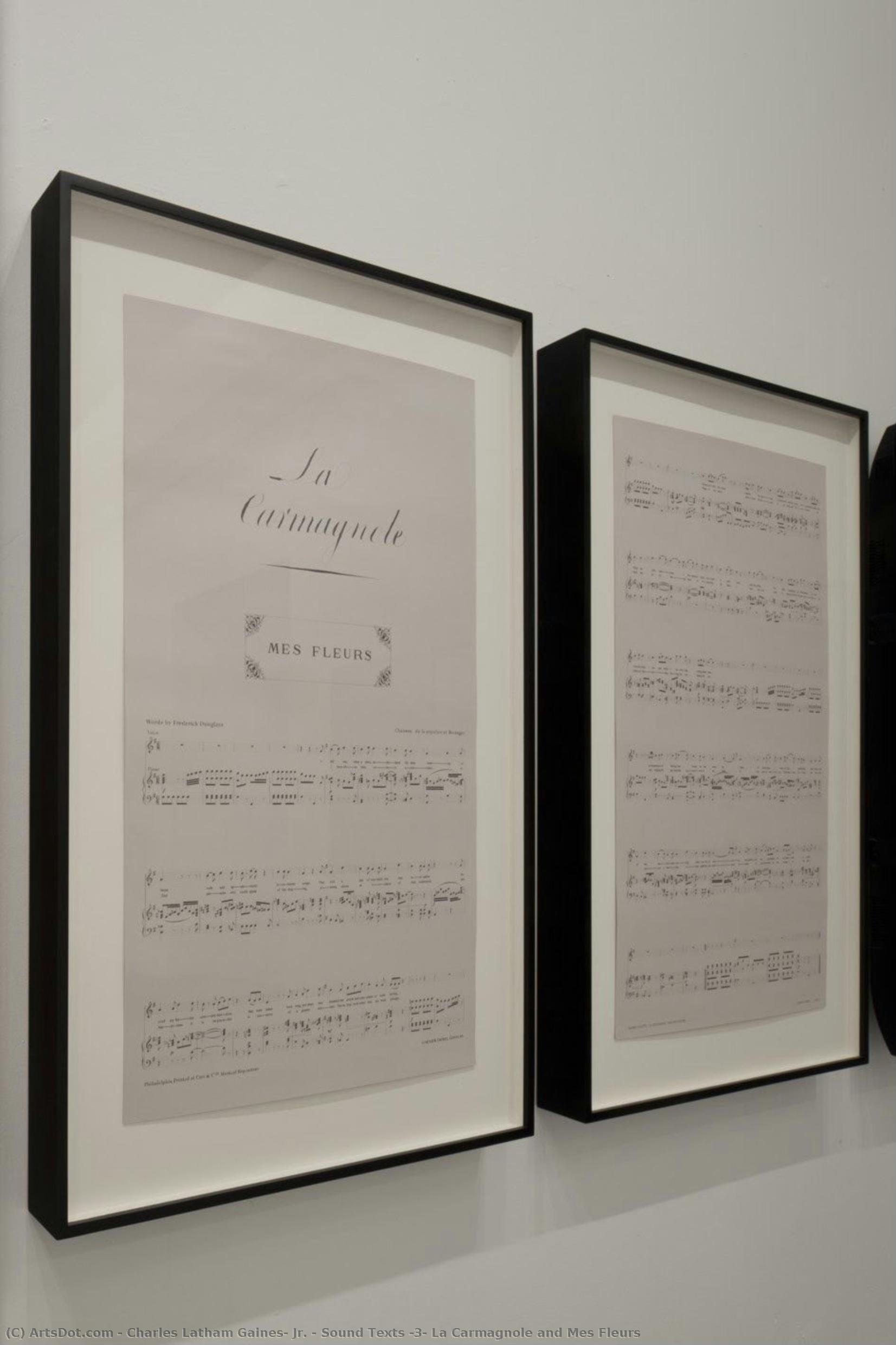
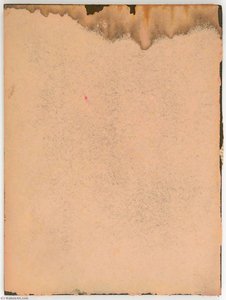
Sound Texts #3: La Carmagnole and Mes Fleurs


 Read More
Giclée / Art Print
Museum-quality giclée or canvas print with fast production and flexible finish options. ( Buy Hand Made Painting Buy Image)




P118B $10

P118H $10

P118W $10

P438Z $10

P508JH $12

P508YH $12

P805H $10

P805Z $10

P919BZ $10

P919G $10

P919XJ $10

P959ZH $10

P968JZ $12

W106C $8

W218G $10

W218JH $8

W218Y $10

W307PJ $10

W316G $10

W316PJ $8

W316Y $10

W398PJ $8

W4111J $10

W500HY $15

W500JH $15

W692G $12

W849H $8

W940BG $15

W953PJ $8




Pick from our preset sizes that match the artwork's original proportions.

You may enter your own dimensions to fit a specific frame or space. If your selected size does not match the original image's proportions, we will either crop the artwork or extend the image with a mirrored or solid-fill edge. A digital mockup will be sent for your approval before production begins.
Please note that the on-screen preview does not reflect the actual cropping or extension. Only the mockup will accurately show the final composition.
While custom sizes are available, we recommend selecting a dimension from the predefined list to preserve the original proportions.
Worldwide Delivery () in 2 weeks instead of standard 4/5 weeks. (23 August)

Free Worldwide Express Shipping

High-Quality Linen Canvas

Full Shipping Insurance

Customs Tax Refund Guarantee

True Color Matching Guarantee

60-Day Return Policy (Defects Only)

100% Money-Back Guarantee

Bulk Discount Offer
 Glass option is only available in size under 110 CM

Sound Texts #3: La Carmagnole and Mes Fleurs
Giclée / Art Print
Reproduction Size
-


Total Price
$ 63
Collectible Description
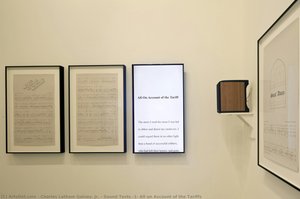
The Resonance of Silence and Script
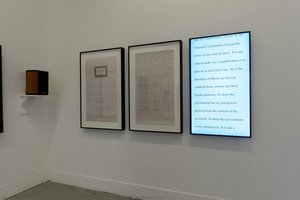
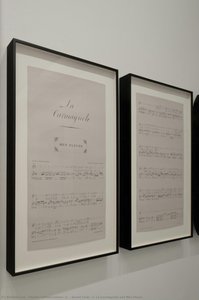
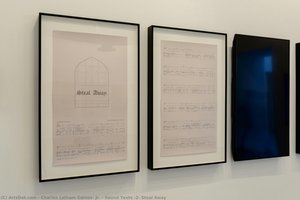
In the profound and cerebral world of Charles Gaines, art is not merely something to be seen, but something to be heard through the eyes. His work Sound Texts #3: La Carmagnole and Mes Fleurs stands as a breathtaking testament to the intersection of linguistic meaning and musical structure. At first glance, the viewer is met with a minimalist, monochromatic landscape—two framed sheets of music that appear almost like relics from a lost era of classical composition. Yet, beneath this serene, black-and-white surface lies a complex, rule-based system that transforms political discourse into atonal melody. This piece does not simply sit upon the wall; it vibrates with the latent energy of the words it encodes, inviting the observer to contemplate the rhythmic pulse of social justice.
The technique employed by Gaines is nothing short of revolutionary, bridging the gap between conceptual art and sonic experimentation. By translating specific letters from historical texts into corresponding musical notes—assigning C, D, E, F, G, A, and B to their alphabetical counterparts—Gaines creates a literal bridge between literature and sound. In this particular series, the artist draws upon the echoes of activism and historical literary references, such as La Carmagnole. The resulting visual notation is a meticulous dance of ink on paper, where every stem, flag, and rest serves a dual purpose: to represent a musical moment and to preserve a fragment of human struggle. This systematic approach strips away the purely expressive in favor of a detached, structural examination that forces the viewer to confront the raw data of history.
A Symphony of Social Consciousness
Beyond its formalist beauty, the artwork carries a heavy symbolic weight, deeply informed by Gaines’s own journey through the complexities of race and identity in the American art landscape. The choice of subject matter—texts that touch upon activism and the rights of the individual—infuses the minimalist aesthetic with a sense of urgency. There is a poignant tension here between the impersonal, rigid structure of the musical staff and the deeply personal, often volatile content of the political manifestos being encoded. This duality mirrors the experience of many social movements: the attempt to find order, rhythm, and a collective voice amidst the chaos of systemic inequality.
For the discerning collector or interior designer, this piece offers a sophisticated focal point that transcends mere decoration. Its monochromatic palette and clean, geometric lines make it an ideal centerpiece for modern, minimalist, or contemporary spaces, providing a sense of intellectual depth and quiet authority. The artwork does not demand attention through loud colors or chaotic forms; instead, it commands the room through its profound stillness and the intellectual curiosity it provokes. To possess a reproduction of this work is to invite a conversation about the enduring power of voice, the structure of thought, and the beautiful, haunting melody that emerges when history is set to music.
Related Artworks

Artist Biography
Charles Latham Gaines Jr.: A Life Bridging Words, Nature, and Art
- Born: Charleston, United States of America (1942)
- Status: Living
Charles Latham Gaines Jr., often known as Charles Gaines, is a multifaceted American figure celebrated for his contributions as a writer, outdoorsman, and conservationist. His career spans diverse fields, leaving an indelible mark on literature, bodybuilding culture, and environmental stewardship. Born in 1942, Gaines’s work consistently explores the intersection of human experience with the natural world, often infused with intellectual depth and philosophical inquiry.
Early Life and Literary Beginnings
Gaines was born in Charleston, South Carolina, later moving to Birmingham, Alabama as a child. He pursued higher education at Washington and Lee University before transferring to Birmingham-Southern College, where he earned his BA and an MFA in writing from the University of Iowa. His early life experiences fostered a deep appreciation for the outdoors, which would become a recurring theme throughout his literary career.
"Pumping Iron" and Bodybuilding's Golden Age
- Notable Work: Pumping Iron: The Art and Sport of Bodybuilding (1974)
Gaines achieved widespread recognition as the co-author, alongside George Butler, of "Pumping Iron." This groundbreaking journalistic work provided an unprecedented look into the world of competitive bodybuilding during its “Golden Age.” The book not only brought this specialized subculture to a broader audience but also played a pivotal role in launching the career of Arnold Schwarzenegger. Gaines's narration and contribution to the documentary film adaptation further solidified his influence, capturing the intensity, dedication, and artistry inherent in the sport.
Conservation Efforts and Environmental Advocacy
Beyond his literary achievements, Gaines is deeply committed to environmental conservation. He has been actively involved in the stewardship of North American Atlantic salmon fisheries, demonstrating a profound concern for ecological preservation. His service on the board of directors of the Atlantic Salmon Federation underscores his dedication to protecting natural resources and promoting sustainable practices.
Artistic Exploration and Intellectual Legacy
While not primarily known as a visual artist himself, Gaines’s work frequently intersects with artistic realms, particularly through its exploration of the human relationship with nature. His writings offer a unique perspective on how we perceive and interact with the environment, prompting reflection on our place within the natural world. His "Sound Texts" series, utilizing musical scores derived from political texts, exemplifies his conceptual approach to art, transforming language into auditory experiences that challenge conventional modes of understanding. Gaines’s legacy lies in his ability to bridge seemingly disparate fields—literature, sports, conservation, and art—creating a rich tapestry of intellectual inquiry and practical engagement.

charles latham gaines, jr.
1942 - , United States of America
Quick Facts
- Date Of Birth: January 6, 1942
- Full Name: Charles Latham Gaines Jr.
- Nationality: American
- Notable Artworks:
- Pumping Iron: The Art and Sport
- Sound Texts #1
- Sound Texts #2
- Sound Texts #4
- Place Of Birth: Charleston, United States
Related Articles

White on Canvas: 10 Masterpieces & Timeless Elegance for Your Home Decor
Explore 10 iconic white paintings by Monet, Whistler & Rothko! Discover the stories behind these serene masterpieces and their impact on art history. Find museum-quality reproductions for your home decor at .

Dark Masterpieces: 10 Iconic Paintings Dominated by Black Tones |
Explore 10 iconic paintings dominated by black tones, from Rembrandt’s chiaroscuro to Goya's dark expressions. Discover the stories behind these masterpieces & find museum-quality art reproductions for your home at .
Harmonies on Canvas: Exploring the Visual Representation of Music in Art History
Explore the fascinating history of music's visual representation in art! From ancient symbolism to modern abstraction, discover how artists have captured sound and emotion on canvas. Expert insights & stunning examples.

Monochrome Visions: Exploring the Aesthetic & Historical Significance of Black & White Photography
Explore the rich history & artistic power of black and white photography. From early techniques to iconic masters like Ansel Adams, discover why monochrome continues to captivate art lovers today. Expert insights for collectors.

Timeless & Chic: Elevating Your New Home with the Sophistication of Black and White Photography
Transform your new home with the timeless allure of black and white photography. ArtsDot.com specializes in elegant monochrome decor and custom hand-painted wedding portraits that turn cherished milestones into lasting, soulful masterpieces. Elevate your space with ease.