 Preview
 Send
Send Share
Share
 Details

 Download
 Similars
 X-Ray
X-Ray Diaporama
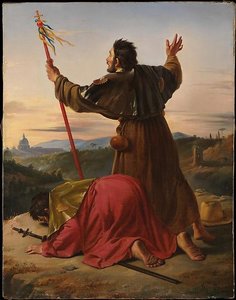
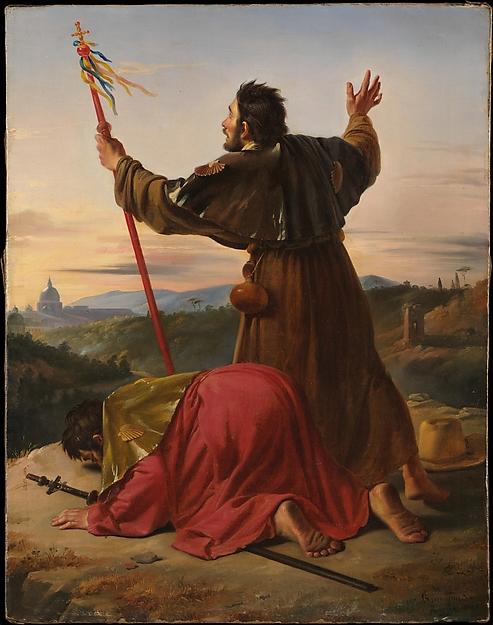
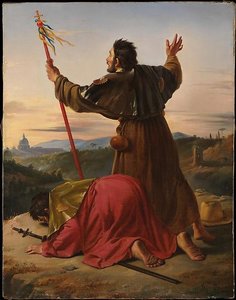
Pilgrims Arriving at Rome during the Jubilee
 1826
1826 46.0 x 37.0 cm
 Read More
Hand Made Oil Reproduction
Hand-painted oil on canvas in your size and frame, made to order by our artists. ( Buy Print Buy Image)




































Pick from our preset sizes that match the artwork's original proportions.

You may enter your own dimensions to fit a specific frame or space. If your selected size does not match the original image's proportions, we will either crop the artwork or extend the painting with additional hand-painted elements. A digital mockup will be sent for your approval before production begins.
Please note that the on-screen preview does not reflect the actual cropping or extension. Only the mockup will accurately show the final composition.
While custom sizes are available, we recommend selecting a dimension from the predefined list to preserve the original proportions.
After order, ArtsDot.com team will email client for instructions and provide a mockup preview
Worldwide Delivery () in 3/4 weeks instead of standard 5 weeks. (28 August). No compromise on quality.

Free Worldwide Express Shipping

High-Quality Linen Canvas

Full Shipping Insurance

Customs Tax Refund Guarantee

True Color Matching Guarantee

60-Day Return Policy (Defects Only)

100% Money-Back Guarantee

Bulk Discount Offer
 Glass option is only available in size under 110 CM

Pilgrims Arriving at Rome during the Jubilee
Reproduction Medium
Reproduction Size
-


Total Price
$ 263
Related Artworks








Artist Biography
The Luminous Legacy of Claude Bonnefond
In the heart of nineteenth-century France, a period defined by the sweeping emotional tides of Romanticism, the works of Claude Bonnefond emerged as a tender bridge between classical precision and atmospheric soul. Born in Lyon in 1796 to a family rooted in the humble artisan traditions of baking, Bonnefond’s early life was marked by both the discipline of his upbringing and the profound loss of his father. Yet, from the ashes of personal hardship, a brilliant artistic trajectory took flight. Supported by the generosity of his mother’s second husband, he entered the École nationale supérieure des beaux-arts de Lyon at the tender age of twelve. Under the watchful eyes of masters like Pierre Revoil and Alexis Grognard, the young prodigy began to absorb the rigorous tenets of Neo-Classicism, laying a foundation of technical excellence that would later allow him to breathe life into the most delicate landscapes.
The true metamorphosis of Bonnefond’s vision occurred not in the studios of France, but under the golden sun of Italy. His journey to the Italian peninsula in 1816 acted as a spiritual and aesthetic awakening. Immersed in the light of Rome, Campania, and Tuscany, he found himself profoundly moved by the luminist traditions of Claude Lorrain. This encounter fundamentally altered his palette; the cool, structured tones of his youth gave way to a warm, evocative spectrum dominated by sun-drenched yellows and deep, resonant reds. As he wandered through the Italian countryside, he became a chronicler of the ephemeral, capturing the soft haze of atmospheric perspective and the quiet dignity of pastoral existence. His work during this period was not merely a depiction of scenery, but an attempt to capture the very breath of the landscape.
A Master of Rural Narrative and Pedagogy
As his career matured, Bonnefond’s focus shifted toward a profound devotion to the essence of rural life, particularly the rugged yet beautiful Provençal countryside. He possessed a rare ability to elevate the mundane—the toil of the peasant, the stillness of a sunlit field, the rustic charm of village life—into something monumental and poetic. While his contemporaries like Corot and Millet often explored different facets of the landscape, Bonnefond carved out a unique niche through his meticulous attention to detail and a luminous color palette that seemed to radiate from within the canvas itself. His art became a sanctuary for the beauty of the common world, rendered with a precision that honored the subject matter.
Beyond his individual canvases, Bonnefond’s influence extended deep into the institutional fabric of French art. In 1830, he accepted the prestigious directorship of the École des Beaux-arts de Lyon, a position he held for three decades. His tenure was marked by an extraordinary commitment to fostering new generations of talent, most notably through the establishment of a renowned school of engraving. Under his guidance, the institution became a crucible of excellence, producing seventeen laureates of the prestigious Prix de Rome between 1831 and 1860. This period of leadership solidified his role not just as a painter, but as a cornerstone of the Lyonnaise artistic community, ensuring that the technical rigor he had learned would be passed down to the masters of the future.
The later years of his life saw a subtle shift in subject matter; around 1840, the sweeping landscapes and Italian echoes began to yield to more intimate portraits of the local bourgeoisie. Despite this change in focus, the fundamental warmth and light that defined his earlier work remained present. When he passed away in Lyon in 1860, he left behind a legacy that remains a testament to the power of Romanticism to find beauty in the humble. Today, his works serve as a window into a vanished era, reminding us of a time when the interplay of light and landscape could capture the very heart of human experience.
claude bonnefond
1796 - 1860
Quick Facts
- Artistic Movement Or Style: Nazarene Movement
- Artists Or Movements Influenced By This Artist: ['Claude Lorrain']
- Artists Who Influenced This Artist:
- Pierre Revoil
- Alexis Grognard
- Date Of Birth: March 27, 1796
- Date Of Death: June 27, 1860
- Full Name: Jean-Claude Bonnefond
- Nationality: French
- Notable Artworks:
- The Messenger
- The Fortune Teller
- A farrier near a forge
- The Vow to the Madonna
- Place Of Birth: Lyon, France