 Preview
 Send
Send Share
Share
 Details

 Download
 Similars
 X-Ray
X-Ray Diaporama
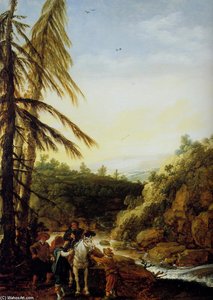
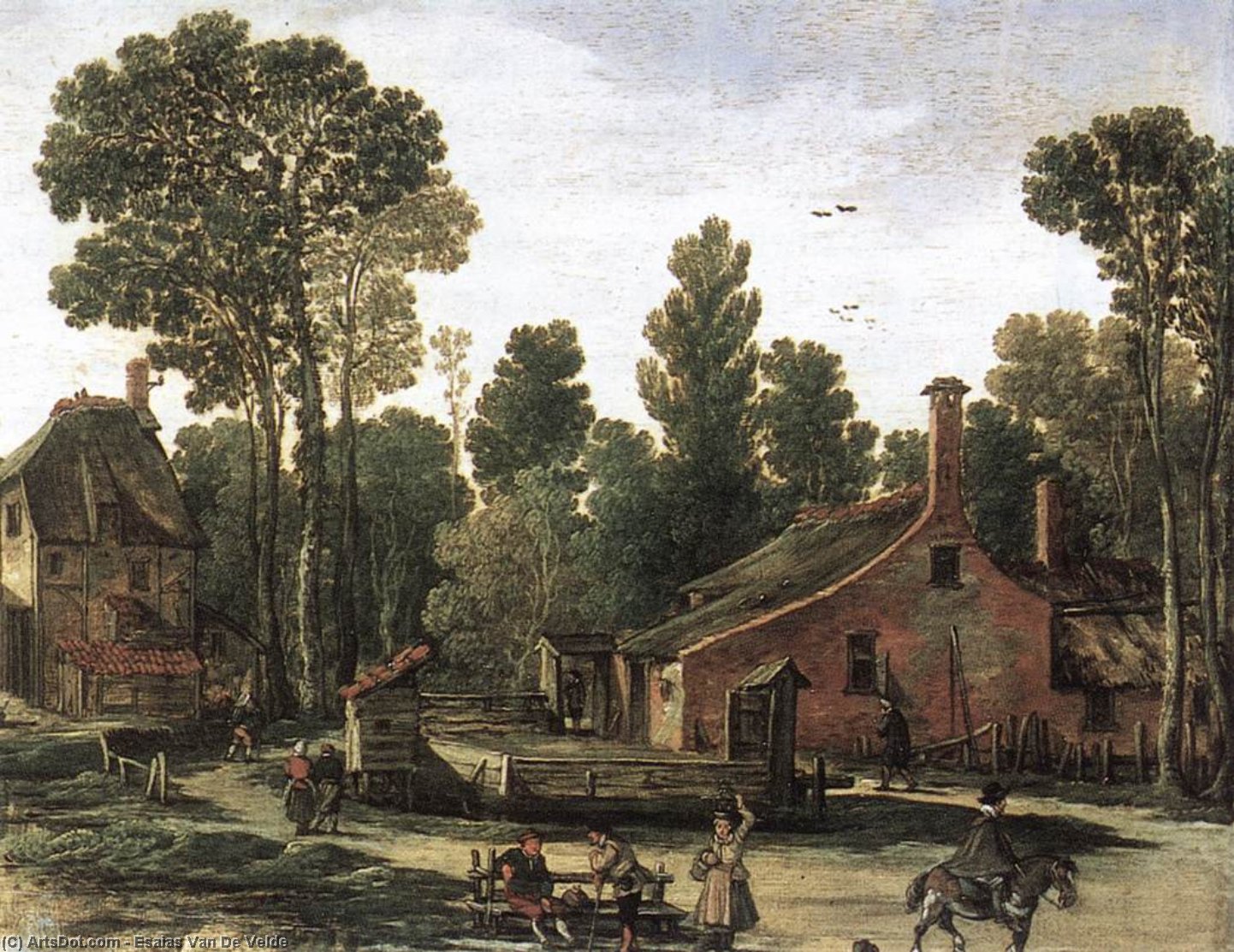
Ferry Boat (detail)


 Read More
Hand Made Oil Reproduction
Hand-painted oil on canvas in your size and frame, made to order by our artists. ( Buy Print Buy Image)




P118B $10

P118H $10

P118W $10

P438Z $10

P508JH $12

P508YH $12

P805H $10

P805Z $10

P919BZ $10

P919G $10

P919XJ $10

P959ZH $10

P968JZ $12

W106C $8

W218G $10

W218JH $8

W218Y $10

W307PJ $10

W316G $10

W316PJ $8

W316Y $10

W398PJ $8

W4111J $10

W500HY $15

W500JH $15

W692G $12

W849H $8

W940BG $15

W953PJ $8




Pick from our preset sizes that match the artwork's original proportions.

You may enter your own dimensions to fit a specific frame or space. If your selected size does not match the original image's proportions, we will either crop the artwork or extend the painting with additional hand-painted elements. A digital mockup will be sent for your approval before production begins.
Please note that the on-screen preview does not reflect the actual cropping or extension. Only the mockup will accurately show the final composition.
While custom sizes are available, we recommend selecting a dimension from the predefined list to preserve the original proportions.
After order, ArtsDot.com team will email client for instructions and provide a mockup preview
Worldwide Delivery () in 3/4 weeks instead of standard 5 weeks. (17 August). No compromise on quality.

Free Worldwide Express Shipping

High-Quality Linen Canvas

Full Shipping Insurance

Customs Tax Refund Guarantee

True Color Matching Guarantee

60-Day Return Policy (Defects Only)

100% Money-Back Guarantee

Bulk Discount Offer
 Glass option is only available in size under 110 CM

Ferry Boat (detail)
Reproduction Medium
Reproduction Size
-


Total Price
$ 263
Artwork Description
A Glimpse into Golden Age Tranquility
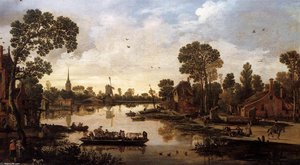
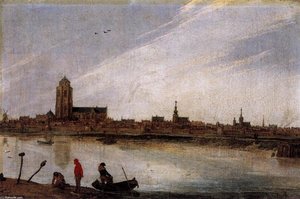
To gaze upon Esaias van de Velde's Ferry Boat (detail) is to step directly across the threshold of 17th-century Dutch life. This painting is not merely a depiction of a waterway; it is a meticulously composed meditation on community, commerce, and the enduring peace found within the pastoral heartland. The scene unfolds with an almost palpable stillness, broken only by the implied movement of the river itself and the gentle activity of the figures gathered along the bank. Van de Velde masterfully captures that fleeting moment when daily life settles into a rhythm of quiet industry—a perfect tableau for any admirer of historical ambiance or serene domesticity.
Mastery of Dutch Landscape Technique
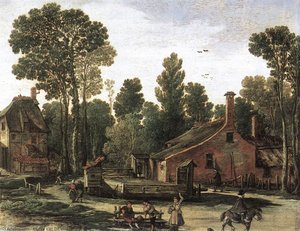
Van de Velde, deeply rooted in the traditions established by masters like Pieter Brueghel the Elder, showcases an astonishing technical proficiency. Observe the foreground: the arrangement of figures—some seated on simple benches, others engaged in conversation or passage—lends immediate narrative weight to the composition. The attention paid to the textures, from the rough-hewn wood to the soft thatch atop the prominent red brick house, speaks volumes about his skill. His handling of light is particularly noteworthy; the sky, filled with voluminous clouds, does not merely illuminate the scene but seems to breathe life into it, casting a soft, diffused glow over the entire village cluster nestled among the verdant trees.
The Symbolism of Passage and Community
At the very heart of this tranquil setting lies the river, traversed by the ferry boat. In the context of Dutch art, water bodies were potent symbols—they represented connection, trade routes, and the flow of life itself. The presence of the boat suggests journeys undertaken, goods exchanged, and lives connected beyond the immediate view. Complementing this sense of movement is the solidity of the architecture; the substantial brick house anchors the scene, symbolizing rootedness and established community wealth. It is a harmonious dialogue between transience (the river) and permanence (the homes), all observed under the vast, encompassing sky.
Creating an Atmosphere for Modern Spaces
For those seeking to infuse a room with the sophisticated patina of history, this reproduction offers unparalleled depth. The dominant palette—earth tones enriched by the vibrant accents of deep green foliage and rich brick red—is inherently grounding yet visually complex. It speaks to a taste that values narrative over mere decoration. Whether placed in a library evoking scholarly contemplation or a drawing-room desiring an air of cultivated European history, this piece acts as a visual anchor, inviting quiet reflection upon the enduring beauty of human endeavor.
Related Artworks
Artist Biography
Esaias van de Velde: A Master of Dutch Landscape
Esaias van de Velde (17 May 1587 – 18 November 1630) stands as a pivotal figure in the development of landscape painting within the Dutch Golden Age. Born in Amsterdam, his artistic lineage traced back to his father, Hans van de Velde, a Protestant refugee from Flanders who had sought refuge in the Netherlands following the religious upheavals of the late 16th century. This familial connection to the Flemish tradition profoundly shaped Esaias’s early artistic education, initially under his father and later with Gillis van Coninxloo, a landscape painter deeply influenced by the works of Pieter Brueghel the Elder. His upbringing amidst this confluence of artistic influences laid the groundwork for his distinctive style – one that would ultimately redefine the possibilities of depicting the natural world on canvas.Early Influences and Haarlem’s Artistic Landscape
Van de Velde's career began in Haarlem, a vibrant center of art and commerce during the 17th century, from 1610 to 1618. This period proved crucial for his artistic evolution. He joined the prestigious Haarlem Guild of St. Luke in 1612 alongside Hercules Segers, an event that marked a significant shift in the perception of landscape painting within the region. Prior to this, landscapes were often considered secondary genres, relegated to decorative roles. Van de Velde’s inclusion elevated them to a respected and independent artistic category, mirroring a broader trend across the Netherlands. Notably, he was influenced by Adam Elsheimer, a German painter known for his dramatic lighting and atmospheric effects, which encouraged him to move away from the more rigid conventions of his tutor and embrace a lower viewpoint – a technique that offered viewers an expansive, almost immersive perspective on the scenes before them. This deliberate choice, combined with a triangular compositional structure, became hallmarks of his distinctive style.Genre and Military Scenes: Expanding Artistic Horizons
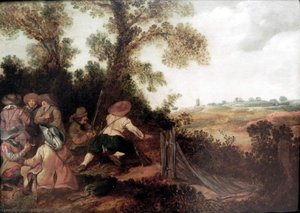
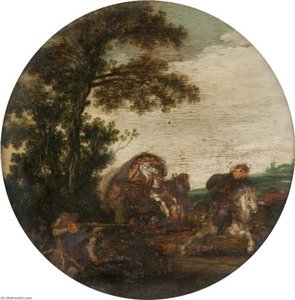
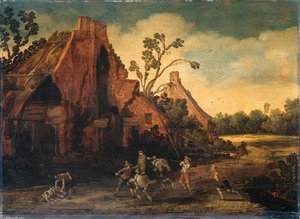
While primarily celebrated for his landscapes, Van de Velde’s artistic repertoire extended beyond the purely naturalistic. He skillfully incorporated genre scenes – depictions of everyday life – and military paintings into his oeuvre. These works demonstrate a keen observational eye and an ability to capture the dynamism and drama of human activity within both rural and urban settings. His “The Ambush of a Wagon Train” (circa 1618) exemplifies this versatility, showcasing not only his mastery of landscape but also his talent for portraying action and narrative with compelling detail. These diverse subjects reveal a painter who was comfortable navigating the complexities of representing human experience in all its forms.Court Painter and Artistic Legacy
In his later years, Van de Velde secured a prestigious position as court painter to Prince Maurits and Frederick Henry in The Hague. This appointment solidified his reputation and provided him with access to a wider range of commissions, including the creation of elaborate battle scenes and ceremonial depictions. His work during this period reflects a refined artistic sensibility, characterized by meticulous detail, subtle color palettes, and an increasingly sophisticated understanding of light and shadow. He was influenced by Roelant Savery and Jan van de Velde, demonstrating a clear lineage within his family’s artistic tradition.Pupils and Lasting Influence
Esaias van de Velde's impact extended beyond his own creations; he served as a mentor to several promising young artists, including Pieter van Laer, Jan Martszen de Jonge, and Anthony van de Velde (II). His influence can be seen in the works of Palamedes Palamedesz, Nicolaes de Quade van Ravesteyn, and Adriaen Adriaensz Ghibons – artists who adopted elements of his style and compositional techniques. Furthermore, he was a cousin of Jan van de Velde, adding another layer to the family’s artistic legacy. Esaias's death in The Hague in 1630 marked the end of an era, but his contributions to Dutch landscape painting remained significant, shaping the course of the genre and inspiring generations of artists to come. His work continues to be admired for its realism, dramatic lighting, and evocative portrayal of the natural world.
Esaias van de Velde
1587 - 1630 , Netherlands
Quick Facts
- Artistic Movement Or Style: Haarlem School, Landscape
- Artists Or Movements Influenced By This Artist:
- Palamedes Palamedesz
- Jan Martszen de Jonge
- Artists Who Influenced This Artist:
- Adam Elsheimer
- Roelant Savery
- Date Of Birth: 1587-05-17 (baptized)
- Date Of Death: 1630-11-18
- Full Name: Esaias van de Velde
- Nationality: Dutch
- Notable Artworks:
- Winter Landscape
- The Ambush
- The robbery
- Place Of Birth: Amsterdam, Netherlands
Related Articles

John Constable's Masterpieces: Explore 25 Iconic Landscapes for Your Home
Journey through John Constable's 25 most celebrated landscapes. Explore Romanticism, Dedham Vale & his masterful use of light in iconic paintings like 'Hay Wain'. Find museum-quality art reproductions and elevate your home decor on ArtsDot.com.

Beyond the Horizon: 10 Landscape Masterpieces for Your Home Decor
Journey through 10 breathtaking landscape paintings by Monet, Van Gogh & more! Explore iconic artworks, artistic techniques & find inspiration for your home decor. Museum-quality reproductions at ArtsDot.com. Discover all masterpieces on ArtsDot.com

Dutch Baroque Masters: 10 Paintings That Shaped an Era | ArtsDot
Journey through the Golden Age with our guide to the Top 10 Dutch Baroque masterpieces! Explore iconic paintings by Rembrandt, Vermeer & Frans Hals. Find museum-quality art reproductions and elevate your home decor at ArtsDot.com.

Golden Age Reflections: Dutch Baroque Painting & Cultural Innovation
Explore the Dutch Golden Age of painting! Discover key artists like Vermeer & ter Borch, their innovative techniques, and the rich cultural context behind these Baroque masterpieces. Learn about collecting & appreciating this iconic art period.
Boats on Canvas: 10 Masterpieces of Maritime Art for Your Home Decor
Sail away with 10 iconic boat paintings! Explore masterpieces by Monet, Van Gogh & Turner. Discover the stories behind these timeless seascapes and find museum-quality art reproductions for your home decor at ArtsDot.com.