 Preview
 Send
Send Share
Share
 Details

 Download
 Similars
 X-Ray
X-Ray Diaporama
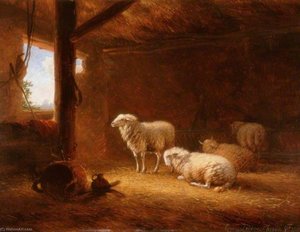
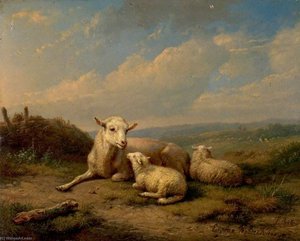
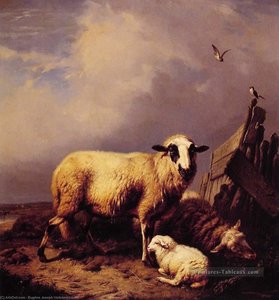
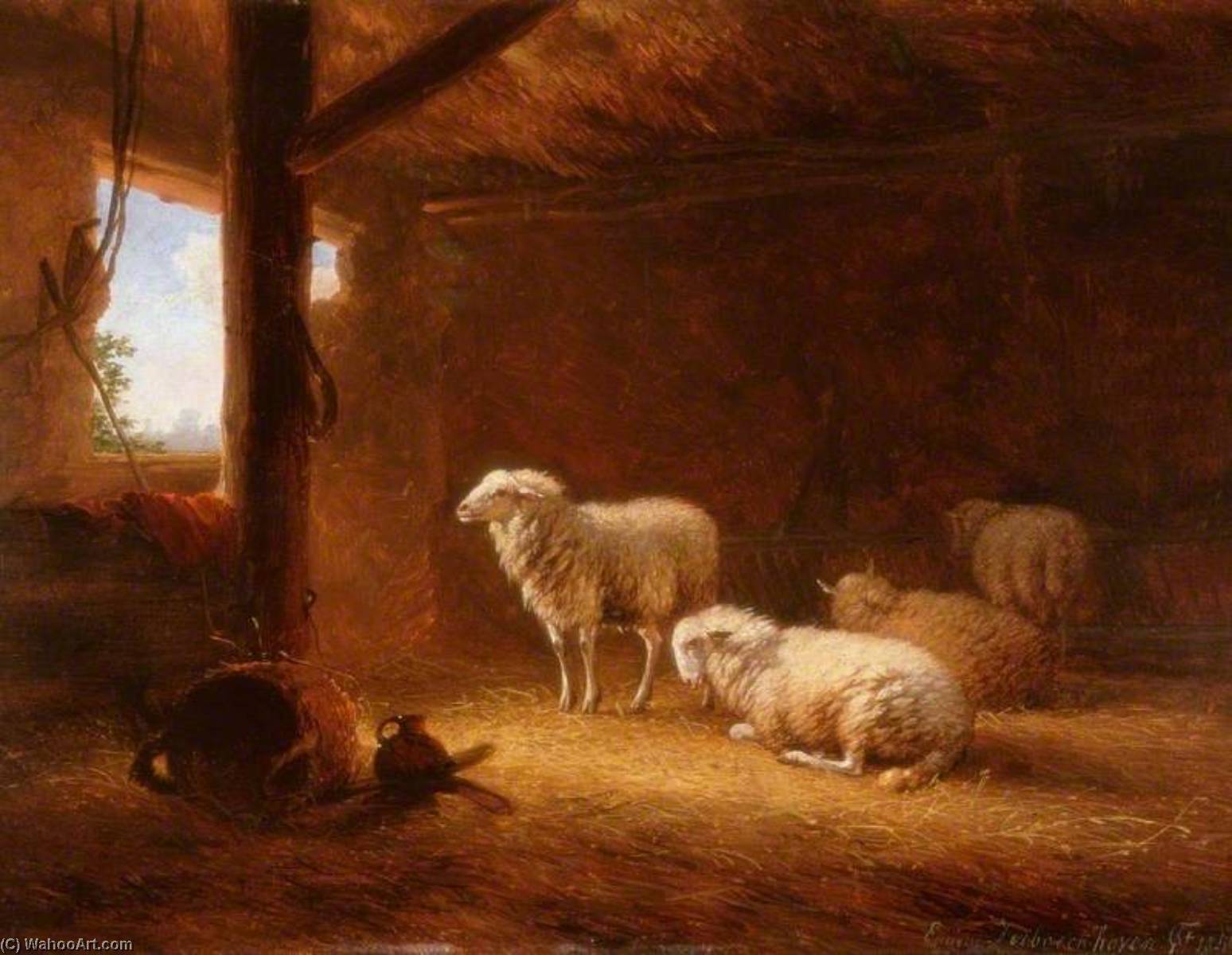
Sheep in a Byre
 Oil
Oil- WallArt
- Romanticism
 1856
1856- 19th Century
 18.0 x 24.0 cm
 Laing Art Gallery
 Read More
Hand Made Oil Reproduction
Hand-painted oil on canvas in your size and frame, made to order by our artists. ( Buy Print Buy Image)




































Pick from our preset sizes that match the artwork's original proportions.

You may enter your own dimensions to fit a specific frame or space. If your selected size does not match the original image's proportions, we will either crop the artwork or extend the painting with additional hand-painted elements. A digital mockup will be sent for your approval before production begins.
Please note that the on-screen preview does not reflect the actual cropping or extension. Only the mockup will accurately show the final composition.
While custom sizes are available, we recommend selecting a dimension from the predefined list to preserve the original proportions.
After order, ArtsDot.com team will email client for instructions and provide a mockup preview
Worldwide Delivery () in 3/4 weeks instead of standard 5 weeks. (17 August). No compromise on quality.

Free Worldwide Express Shipping

High-Quality Linen Canvas

Full Shipping Insurance

Customs Tax Refund Guarantee

True Color Matching Guarantee

60-Day Return Policy (Defects Only)

100% Money-Back Guarantee

Bulk Discount Offer
 Glass option is only available in size under 110 CM

Sheep in a Byre
Reproduction Medium
Reproduction Size
-


Total Price
$ 263
Artwork Description
A Sanctuary of Stillness: The Pastoral Charm of Verboeckhoven
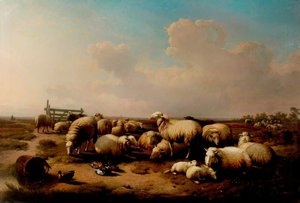
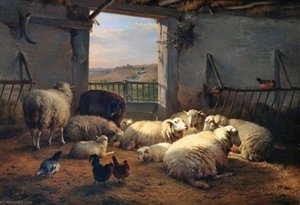
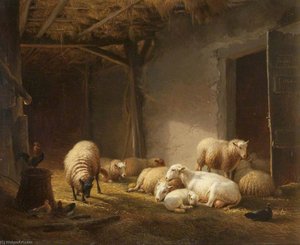
In the quiet corners of nineteenth-century Belgian art, few masters captured the soul of rural existence as tenderly as Eugène Joseph Verboeckhoven. His 1856 masterpiece, Sheep in a Byre, serves as a profound window into a bygone era of pastoral simplicity and rhythmic peace. The painting invites the viewer into the intimate, shadowed sanctuary of a thatched-roof barn, where the outside world fades into insignificance. At its heart, the composition focuses on a group of sheep, their woolly forms rendered with such tactile precision that one can almost feel the warmth of their bodies against the cool, earthen atmosphere of the stable. This is not merely a depiction of livestock; it is an evocative study of tranquility, capturing a moment of profound stillness that resonates deeply with the modern soul seeking refuge from the frantic pace of contemporary life.
The technical brilliance of Verboeckhoven lies in his ability to manipulate light and shadow to create a sense of dramatic intimacy. Utilizing a masterful oil technique, the artist employs a palette dominated by rich, warm earth tones—deep ochres, burnt umbers, and soft beiges—which ground the scene in a sense of organic reality. A singular, powerful light source, seemingly filtering through an unseen opening in the upper right, pierches the gloom of the byre. This chiaroscuro effect does more than just illuminate the sheep; it sculpts the very texture of the environment, highlighting the rugged grain of wooden beams and the coarse, layered thatch of the roof. The interplay between the brilliant whites of the sheep’s fleece and the deep, velvety shadows creates a three-dimensional depth that draws the eye inward, making the small 18 x 24 cm canvas feel like an expansive, breathing world.
Symbolism and the Romantic Spirit
Beyond its surface beauty, Sheep in a Byre is steeped in the symbolic language of the Romantic movement. During an era of significant industrial and political upheaval in Belgium, Verboeckhoven looked backward to the idealized traditions of the seventeenth century, finding divinity in the mundane. The sheep, often symbols of innocence, peace, and security, represent a harmonious connection to nature and the cyclical stability of agricultural life. The barn itself acts as a metaphor for protection and the sanctity of the domestic sphere. There is a palpable sense of safety within these walls, an emotional resonance that makes the piece particularly compelling for collectors who value art that evokes nostalgia and emotional comfort.
For the discerning interior designer or art enthusiast, this work offers more than just aesthetic pleasure; it provides a focal point of warmth and historical weight. The organic lines and naturalistic shapes found within the composition allow it to integrate seamlessly into various decor styles, from rustic farmhouse elegance to sophisticated classical settings. As a high-quality reproduction, this painting carries the legacy of Verboeckhoven’s meticulous realism, offering a timeless piece of Belgian heritage that can transform a room into a space of reflection and quiet grandeur.
Related Artworks
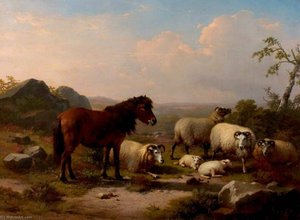
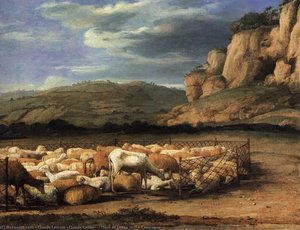
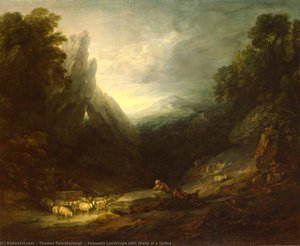
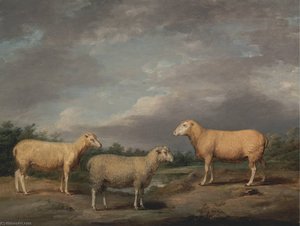
Artist Biography
The Master of Pastoral Tranquility
In the grand tapestry of nineteenth-century European art, few threads are as delicately woven as those spun by Eugène Joseph Verboeckhoven. Born in 1798 in the Belgian town of Warneton, Verbockhoven emerged as a painter who could bridge the gap between the fading echoes of the seventeenth-century pastoral tradition and the burgeoning, sharp-eyed realism of his own era. His life was set against a period of profound transformation; he witnessed the Belgian Revolution of 1830 and saw his nation find its identity, much as he helped define a specific aesthetic identity for Belgian landscape and animal painting. To look upon a Verboeckhoven canvas is to step into a world where time slows down, where the rhythmic grazing of sheep and the quiet dignity of cattle serve as anchors in an ever-changing world.
His artistic foundation was built upon a legacy of meticulous craftsmanship. Initially studying under his father, Barthélemy Verboeckhoven—a sculptor—he gained an early appreciation for form and anatomical precision. This training was further refined in the vibrant artistic hubs of Ghent and Antwerp, where he worked under masters such as Louis-Pierre Verwee and Voituron. These formative years instilled in him a reverence for the Old Masters, particularly the Dutch and Flemish traditions of Paulus Potter and Rembrandt. He did not merely seek to imitate them; rather, he sought to breathe new life into their techniques, using their mastery of light and texture to elevate the humble subjects of farm life to the level of high art.
A Journey Through Light and Landscape
Verboeckhoven’s artistry was profoundly shaped by his restless spirit and his desire to capture the atmospheric nuances of the natural world. Between 1826 and 1841, he embarked on extensive travels that would become the lifeblood of his compositions. From the rugged beauty of the Ardennes to the sun-drenched landscapes of Italy, and through the forests of Germany and France, each region left an indelible mark on his palette. These expeditions allowed him to observe how light interacts with different terrains—how it softens a misty morning in a Belgian meadow or casts dramatic shadows across a mountain pass. This sensitivity to atmosphere is what elevates his work from mere documentation to evocative storytelling.
His technical prowess was most evident in his ability to render the textures of the animal kingdom. Whether it was the coarse wool of a sheep, the sleek coat of a horse, or the delicate features of a hare, Verboeckhoven approached every subject with an almost scientific accuracy paired with a romantic soul. His skill was so highly regarded that he became a sought-after collaborator; many contemporary landscape painters would specifically commission him to provide the staffage—the lively animals and figures—that breathed life into their scenery. This collaborative spirit highlights his central role in the nineteenth-century art market, where his ability to populate a scene with realistic, emotive creatures was unparalleled.
Legacy of the Belgian Realist
As his career progressed, Verboeckhoven became a pillar of the European art establishment. His frequent presence at the prestigious Salons of Brussels and Ghent, as well as his membership in the academies of Antwerp, St. Petersburg, and Amsterdam, speaks to a reputation that transcended national borders. He was not merely a local talent but an international figure whose works were collected by royalty and connoisseurs alike. Even as art movements shifted toward more radical forms of expression, Verboeckhoven remained a steadfast guardian of the idyllic, providing a sense of continuity and comfort through his beautifully rendered scenes of rural peace.
The historical significance of Eugène Joseph Verboeckhoven lies in his role as a stylistic bridge. He successfully synthesized the classical ideals of composition and idealized beauty with a modern commitment to observational realism. His paintings, which continue to grace museums worldwide, serve as a poignant reminder of a lost era of pastoral harmony. Through his brush, the simple act of sheep grazing or a quiet moment in a barn becomes a profound meditation on the enduring beauty of the natural world, ensuring that his name remains etched in the annals of art history as one of the most accomplished animal painters to ever live.
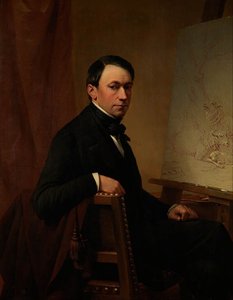
eugène joseph verboeckhoven
1798 - 1881 , Belgium
Quick Facts
- Artistic Movement Or Style: Romanticism
- Artists Or Movements Influenced By This Artist: ['']
- Artists Who Influenced This Artist:
- Balthasar Paul Ommeganck
- Thomas Sidney Cooper
- Date Of Birth: 1798
- Date Of Death: 1881
- Full Name: Eugène Joseph Verboeckhoven
- Nationality: Belgian
- Notable Artworks:
- Good Friends
- Landscape with Sheep
- Group of Sheep
- Place Of Birth: Warneton, Belgium
Related Articles

Romantic Landscapes: 10 Masterpieces for Your Home | ArtsDot
Journey through 10 Romantic landscape masterpieces by Friedrich, Turner & Cole. Explore emotional art, sublime nature scenes & iconic 19th-century paintings. Find museum-quality reproductions for your home at ArtsDot.com – discover the full collection online!

John Constable's Masterpieces: Explore 25 Iconic Landscapes for Your Home
Journey through John Constable's 25 most celebrated landscapes. Explore Romanticism, Dedham Vale & his masterful use of light in iconic paintings like 'Hay Wain'. Find museum-quality art reproductions and elevate your home decor on ArtsDot.com.

Beyond the Horizon: 10 Landscape Masterpieces for Your Home Decor
Journey through 10 breathtaking landscape paintings by Monet, Van Gogh & more! Explore iconic artworks, artistic techniques & find inspiration for your home decor. Museum-quality reproductions at ArtsDot.com. Discover all masterpieces on ArtsDot.com
Cultivating Visions: A Historical Journey Through Rural Landscapes in Art
Explore the rich history of rural landscape painting with ArtsDot. Discover Impressionist masterpieces, key artists & movements. Find your perfect serene artwork and bring nature's beauty home.

Evocations of Place: A Historical Journey Through Landscape Art
Explore the rich history of landscape art with ArtsDot. Discover renowned artists, movements like Impressionism & Romanticism, and expert guidance for collecting timeless pieces. Find your perfect serene escape today!