 Preview
 Send
Send Share
Share
 Details

 Download
 Similars
 X-Ray
X-Ray Diaporama
Femme aux Deux Paons Avec Aquarium
 Watercolor
- WallArt
- Surrealism
 Contemporary
 66.0 x 92.0 cm
 Barjeel Art Foundation
 Read More
Hand Made Oil Reproduction
Hand-painted oil on canvas in your size and frame, made to order by our artists. ( Buy Print Buy Image)




P118B $10

P118H $10

P118W $10

P438Z $10

P508JH $12

P508YH $12

P805H $10

P805Z $10

P919BZ $10

P919G $10

P919XJ $10

P959ZH $10

P968JZ $12

W106C $8

W218G $10

W218JH $8

W218Y $10

W307PJ $10

W316G $10

W316PJ $8

W316Y $10

W398PJ $8

W4111J $10

W500HY $15

W500JH $15

W692G $12

W849H $8

W940BG $15

W953PJ $8




Pick from our preset sizes that match the artwork's original proportions.

You may enter your own dimensions to fit a specific frame or space. If your selected size does not match the original image's proportions, we will either crop the artwork or extend the painting with additional hand-painted elements. A digital mockup will be sent for your approval before production begins.
Please note that the on-screen preview does not reflect the actual cropping or extension. Only the mockup will accurately show the final composition.
While custom sizes are available, we recommend selecting a dimension from the predefined list to preserve the original proportions.
After order, ArtsDot.com team will email client for instructions and provide a mockup preview
Worldwide Delivery () in 3/4 weeks instead of standard 5 weeks. (1 September). No compromise on quality.

Free Worldwide Express Shipping

High-Quality Linen Canvas

Full Shipping Insurance

Customs Tax Refund Guarantee

True Color Matching Guarantee

60-Day Return Policy (Defects Only)

100% Money-Back Guarantee

Bulk Discount Offer
 Glass option is only available in size under 110 CM

Femme aux Deux Paons Avec Aquarium
Reproduction Medium
Reproduction Size
-


Total Price
$ 263
A Dreamscape of Algerian Surrealism
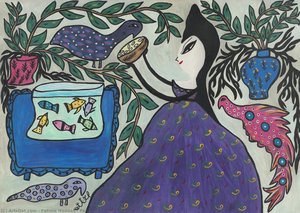
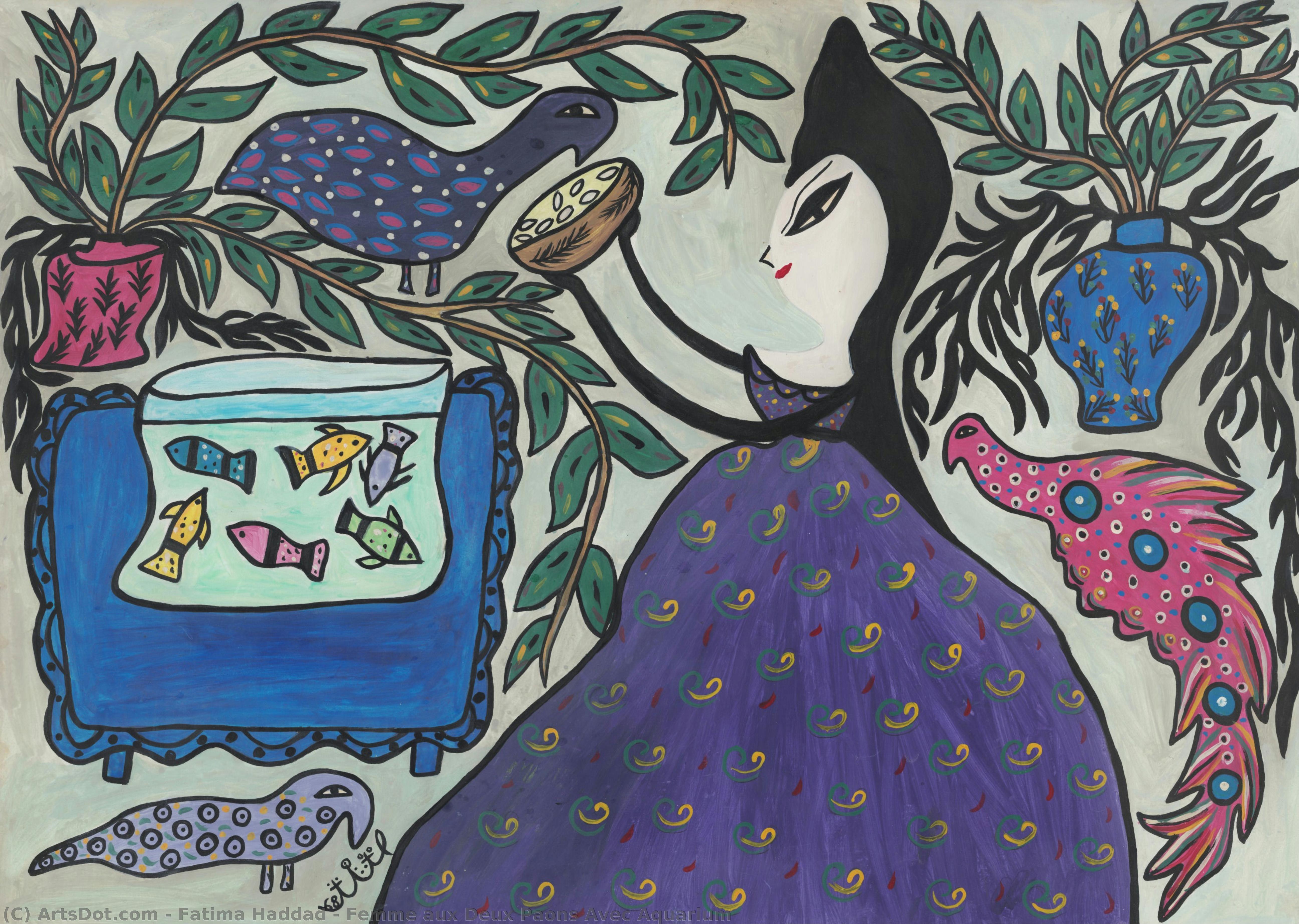
In the enchanting realm of Fatima Haddad, known to the world by her evocative moniker Baya, reality dissolves into a vibrant tapestry of myth and memory. Her masterpiece, Femme aux Deux Paons Avec Aquarium, serves as a breathtaking window into a subconscious landscape where the boundaries between the human, animal, and botanical worlds are beautifully blurred. The painting presents a central female figure, draped in regal shades of purple, who exists in a state of serene communion with nature. As she cradles a bird with tender precision, she stands beside an aquarium that pulses with life, creating a composition that feels less like a static portrait and more like a captured moment from a lucid dream. The scene is populated by a delicate choreography of birds and flora, all rendered with a sense of rhythmic movement that invites the viewer to lose themselves in its intricate details.
The technique employed in this work breathes life into the surrealist tradition through the medium of watercolor. The artist utilizes the inherent translucency of the pigment to create layers of depth and luminosity, allowing light to appear as if it is emanating from within the subjects themselves. This fluidity is essential to the piece's emotional resonance; the soft edges and bleeding hues suggest a world in constant flux, where the air is thick with magic and the scent of blooming jasmine. For the discerning collector or interior designer, this watercolor approach offers a sophisticated texture that avoids the heaviness of traditional oils, instead providing a luminous quality that can transform a room into a sanctuary of tranquility and wonder.
Symbolism and Cultural Resonance
Beyond its visual splendor, Femme aux Deux Paons Avec Aquarium is steeped in the rich cultural symbolism characteristic of Baya’s visionary style. The peacock, often a symbol of immortality, beauty, and rebirth, acts as a majestic guardian within the composition, mirroring the artist's own themes of resilience and transformation. The presence of the aquarium—a contained microcosm of aquatic life—contrasts beautifully with the freedom of the birds in flight, perhaps reflecting the delicate balance between domesticity and the wild spirit of the Algerian landscape. Through these motifs, Haddad explores profound themes of identity and femininity, weaving together the personal history of an artist who found strength in the face of early tragedy to create a universal language of grace.
To possess a reproduction of this work is to bring more than just decoration into a living space; it is to invite a narrative of survival and poetic beauty. The painting’s palette, ranging from deep violets to vibrant botanical greens, offers a versatile centerpiece for high-end interior curation, working harmoniously with both contemporary minimalist settings and lush, eclectic decors. It stands as a testament to the power of Naive Art to transcend borders, offering an emotional depth that resonates with anyone who finds beauty in the intersection of the real and the imagined.
Related Artworks
Artist Biography
The Radiant Dreamscapes of Baya: A Visionary from Algeria
In the vibrant tapestry of twentieth-century art, few names resonate with as much pure, unadulterated magic as Baya. Born Fatima Haddad in 1931 within the coastal town of Bordj El Kiffan, Algeria, her life was a profound journey of resilience and creative triumph. The early years of her childhood were marked by the heavy shadow of tragedy; orphaned at the tender age of five after the loss of both parents, she was raised by her paternal grandmother. This period of profound loss did not stifle her spirit but rather seemed to turn her gaze inward, toward a world of boundless imagination. Growing up in rural Algeria under French colonial rule, Baya’s early environment—a blend of traditional Algerian folklore and the stark realities of a changing society—provided the fertile soil from which her unique visual language would grow.
Her artistic awakening was as spontaneous as it was extraordinary. Without formal schooling or classical training, she began by sculpting figures from raw clay found near her home. It was through the kindness of Marguerite Caminat, who recognized the burgeoning genius in the young girl, that Bya was introduced to the tools of a painter: paper, gouache, and proper modeling clay. This self-taught path allowed her to bypass the rigid constraints of academic realism, leading her to develop what she playfully referred to as "Baya-ism." Her work became a sanctuary of color and life, a "dreamscape" where the boundaries between reality and fantasy dissolved into luminous patterns and exuberant flora.
A Universe of Femininity and Flora
The aesthetic language of Baya is one of captivating enchantment, often categorized by critics as a blend of Surrealism and Naïve art. Her canvases are populated by a distinct cast of characters: women of extraordinary grace, adorned in ornate, patterned dresses, inhabiting paradisical landscapes. These female figures are rarely passive; they are bold, spirited, and often gaze directly at the viewer with large, soulful, and almost audaciously contoured eyes. They engage in serene, communal activities—playing musical instruments, tending to exotic plants, or admiring butterflies—creating a sense of eternal, peaceful coexistence. Through these depictions, Baya explored profound themes of femininity, motherhood, and cultural heritage, offering an idyllic respite from the often turbulent political realities of her homeland.
Technically, her work is a masterclass in the use of vibrant, saturated hues and intricate ornamentation. Her compositions are dense with life, where birds, fish, and blooming flowers intertwine with human figures to create a rhythmic, pulsating energy. This density of detail serves to immerse the viewer in a world that feels both ancient and modern. While her subject matter often leaned toward the decorative and the beautiful, there was an underlying strength in her brushstrokes—a deliberate use of color to convey emotion and narrative weight. Her ability to weave together the domestic and the cosmic, the everyday object and the mythical creature, remains one of her most enduring artistic legacies.
Global Recognition and Lasting Legacy
Baya’s ascent to international prominence was nothing short of meteoric. At only sixteen years old, she held her first solo exhibition in Paris, an event that sent shockwaves through the European art world. The giants of modernism were captivated by her raw, unmediated vision; Pablo Picasso and André Breton were among those who recognized her singular talent. Breton, the father of Surrealism, famously penned a preface for her exhibition catalog, proclaiming her as a "queen" of a new beginning. This recognition led to even more extraordinary opportunities, including an invitation to work alongside Picasso in the pottery studios of Vallauris in 1948, where she could further refine her skills in ceramics.
Despite the allure of the Parisian art scene, Baya’s heart remained anchored to her Algerian identity. She famously declined offers to relocate to France, choosing instead to live and create within the cultural landscape that informed her soul. Her life was not without its interruptions; a decade spent devoted to raising her six children saw a temporary pause in her painting, yet when she returned to her art in 1963, her work had only deepened in complexity, incorporating new domestic motifs like bowls of fruit and musical instruments. Today, Baya is celebrated as a cornerstone of North African modernism. Her influence persists not only in the museums that house her masterpieces but also in the very way we perceive the power of the self-taught artist to reshape the boundaries of the human imagination.
fatima haddad
1931 - , Algeria
Quick Facts
- Artistic Movement Or Style: Surrealism & Naive art
- Date Of Birth: 1931
- Full Name: Fatima Haddad
- Nationality: Algerian
- Notable Artworks:
- Femme aux Deux Paons Avec Aquarium
- Trois Femmes et un Palmier
- Place Of Birth: Bordj El-Kiffan, Algeria
Related Articles

Watercolor Wonders: 10 Masterpieces That Redefined Art History | ArtsDot
Journey through 10 legendary watercolor masterpieces by Sargent, Turner & Homer! Explore iconic landscapes, portraits & floral art that redefined history. Find museum-quality reproductions and curated decor ideas at ArtsDot.com.

Ephemeral Visions: Exploring the Artistic Legacy & Contemporary Practice of Watercolor Painting
Explore the captivating world of watercolor painting! Discover its rich history, essential techniques, influential artists & collecting tips. A comprehensive guide for art enthusiasts from ArtsDot.

Ephemeral Visions: Exploring the History & Emotional Resonance of Watercolor Painting
Explore the captivating history of watercolor painting, from ancient techniques to modern masters like Kandinsky & Blake. Discover essential artists, collecting tips & the emotional power of this luminous medium. Expert insights for art enthusiasts.
Ephemeral Visions: Exploring the Artistic Legacy & Nuances of Watercolor Painting
Explore the captivating world of watercolor painting! Discover its rich history, essential techniques, influential artists & collecting tips from art experts. A comprehensive guide for enthusiasts.
The Enduring Appeal of Watercolor: History, Techniques & Contemporary Practice
Explore the captivating world of watercolor painting! Discover its rich history, essential techniques, influential artists, and collecting tips. A comprehensive guide for art enthusiasts.