 Preview
 Send
Send Share
Share
 Details

 Download
 Similars
 X-Ray
X-Ray Diaporama
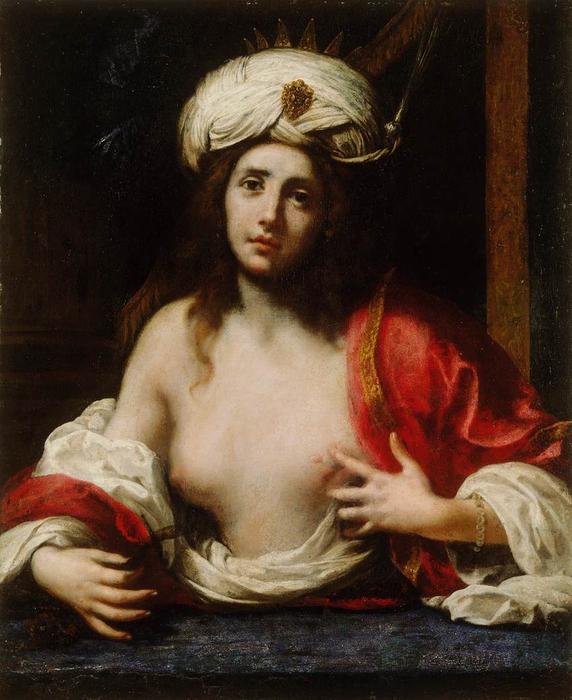
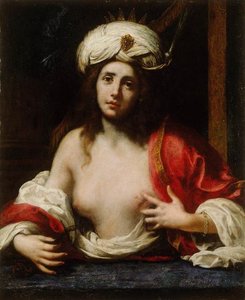
The Death of Cleopatra
 1650
1650 71.0 x 87.0 cm
 Galerie Nationale de Slovénie
 Read More
Giclée / Art Print
Museum-quality giclée or canvas print with fast production and flexible finish options. ( Buy Hand Made Painting Buy Image)




































Pick from our preset sizes that match the artwork's original proportions.

You may enter your own dimensions to fit a specific frame or space. If your selected size does not match the original image's proportions, we will either crop the artwork or extend the image with a mirrored or solid-fill edge. A digital mockup will be sent for your approval before production begins.
Please note that the on-screen preview does not reflect the actual cropping or extension. Only the mockup will accurately show the final composition.
While custom sizes are available, we recommend selecting a dimension from the predefined list to preserve the original proportions.
Worldwide Delivery () in 2 weeks instead of standard 4/5 weeks. (25 August)

Free Worldwide Express Shipping

High-Quality Linen Canvas

Full Shipping Insurance

Customs Tax Refund Guarantee

True Color Matching Guarantee

60-Day Return Policy (Defects Only)

100% Money-Back Guarantee

Bulk Discount Offer
 Glass option is only available in size under 110 CM

The Death of Cleopatra
Giclée / Art Print
Reproduction Size
-


Total Price
$ 63
Related Artworks
![Life Of Saint Francis - [04] - Death And Ascension Of St Francis — Giotto Di Bondone, Italian Renaissance](/media/artworks/images-thumb/08/8b/088b102b13c1a379233690905590f156.jpg)
Artist Biography
The Quiet Master of the Tuscan Baroque
In the heart of Tuscany, amidst the rolling landscapes of San Gimignano, a painter was born around 1605 who would eventually leave an indelible mark on the Baroque era. Felice Ficherelli, known to his contemporaries by the endearing moniker "Felice Riposo"—a name reflecting his calm and quiet demeanor—was an artist whose life and work embodied the dramatic tension and spiritual depth of the seventeenth century. Though much of his early personal history remains shrouded in the mists of time, his presence in the Florentine artistic circles was unmistakable. Under the benevolent protection of Count Alberto d'Ottavio Bardi di Vernio, Ficherelli found more than just a patron; he found a sanctuary that allowed his talent to flourish within the prestigious workshops of Jacopo da Empoli.
It was through this apprenticeship that Ficher and the principles of Renaissance perspective and humanist ideals became woven into his artistic DNA. From Empoli, Ficherelli inherited a fascination with rich, sumptuous fabrics and a meticulous approach to detail that would become a hallmark of his mature style. His early years were spent mastering the art of the copy, recreating the works of Renaissance masters, a process that refined his technical command over light and shadow. This foundation enabled him to transition seamlessly into the Baroque idiom, where he began to infuse his canvases with a new, visceral emotional intensity, moving beyond mere imitation toward a profound, original expression of human and divine drama.
A Tapestry of Devotion and Drama
Ficherelli’s oeuvre is a captivating dialogue between the sacred and the profane, characterized by a masterful use of chiaroscuro to illuminate the spiritual struggles of his subjects. His religious compositions, often destined for the altars of prominent Florentine churches such as the Basilica of Santo Spirito and the Church of Sant'Egidio, demonstrate a deep engagement with the theological currents of his time. In these works, the Madonna and various saints are not merely icons but living, breathing figures caught in moments of profound grace or quiet contemplation. His ability to render the heavy folds of velvet and the delicate shimmer of silk served to ground these celestial narratives in a tangible, sensory reality that resonated deeply with the faithful.
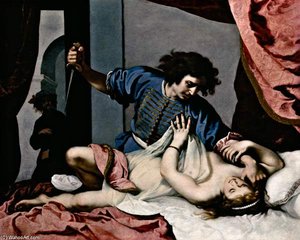
Yet, Ficherelli was equally adept at navigating the turbulent waters of classical mythology and historical tragedy. His treatment of subjects like The Death of Cleopatra showcases a sensitive command over human pathos, where the interplay of light and shadow heightens the sense of inevitable doom. Perhaps most striking is his contribution to the legendary narrative of Tarquin and Lucretia. In these depictions of Roman tragedy, Ficherelli captures the terrifying moment of confrontation with a realism that borders on the cinematic, utilizing the dramatic tension inherent in the Baroque style to evoke empathy and horror in equal measure. His work often blurs the line between historical record and emotional experience, inviting the viewer to witness the raw vulnerability of his protagonists.
Legacy and Scholarly Enigmas
The legacy of Felice Ficherelli is as much defined by mystery as it is by his visible achievements. One of the most enduring enigmas in art history involves his painting Saint Praxedis. The existence of two versions of this work has sparked intense debate among scholars; one version is traditionally linked to Guido Cagnacci, while another carries a signature and date that some attribute to the legendary Johannes Vermeer. This controversial connection, though unproven, serves to highlight the high level of technical sophistication present in Ficherelli’s work, placing him in conversation with the greatest masters of the age.
As his career progressed through the mid-17th century, Ficherelli continued to contribute significantly to the decorative and religious landscape of Florence. His life came to a close in 1660, and he was laid to rest in the Church of Santa Maria dei Bardi, a site that once stood as a testament to his connection with the Bardi family. Today, Ficherelli is remembered not merely as an apprentice to the greats, but as a significant voice in the Tuscan Baroque—an artist who could capture the stillness of a soul at rest and the violent upheaval of a legend with equal, breathtaking mastery.
Felice Ficherelli
1605 - 1660 , Italy
Quick Facts
- Artistic Movement Or Style: Baroque
- Artists Or Movements Influenced By This Artist: ['Johannes Vermeer']
- Artists Who Influenced This Artist: ['Jacopo da Empoli']
- Date Of Birth: August 30, 1605
- Date Of Death: March 5, 1660
- Full Name: Felice Ficherelli
- Nationality: Italian
- Notable Artworks:
- Saint Praxedis
- Tarquin and Lucretia
- Place Of Birth: San Gimignano, Italy