 Preview
 Send
Send Share
Share
 Details

 Download
 Similars
 X-Ray
X-Ray Diaporama
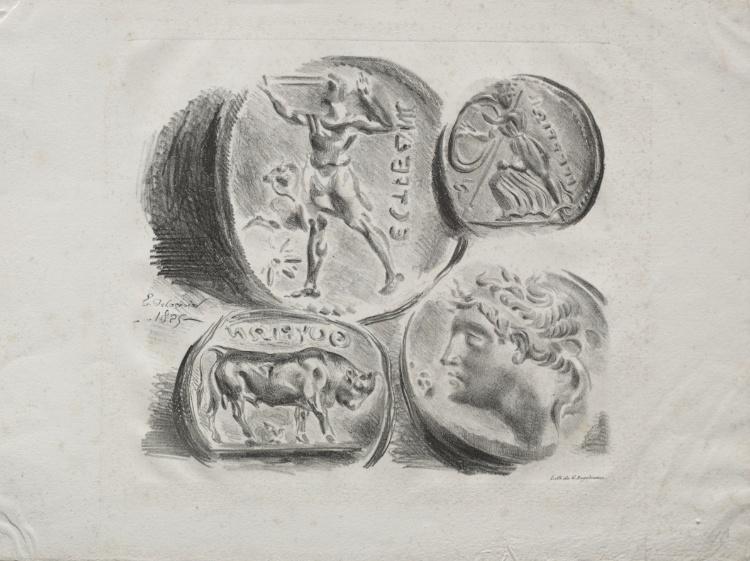
Sheet of Four Antique Medals

 Read More
Hand Made Oil Reproduction
Hand-painted oil on canvas in your size and frame, made to order by our artists. ( Buy Print Buy Image)




P118B $10

P118H $10

P118W $10

P438Z $10

P508JH $12

P508YH $12

P805H $10

P805Z $10

P919BZ $10

P919G $10

P919XJ $10

P959ZH $10

P968JZ $12

W106C $8

W218G $10

W218JH $8

W218Y $10

W307PJ $10

W316G $10

W316PJ $8

W316Y $10

W398PJ $8

W4111J $10

W500HY $15

W500JH $15

W692G $12

W849H $8

W940BG $15

W953PJ $8




Pick from our preset sizes that match the artwork's original proportions.

You may enter your own dimensions to fit a specific frame or space. If your selected size does not match the original image's proportions, we will either crop the artwork or extend the painting with additional hand-painted elements. A digital mockup will be sent for your approval before production begins.
Please note that the on-screen preview does not reflect the actual cropping or extension. Only the mockup will accurately show the final composition.
While custom sizes are available, we recommend selecting a dimension from the predefined list to preserve the original proportions.
After order, ArtsDot.com team will email client for instructions and provide a mockup preview
Worldwide Delivery () in 3/4 weeks instead of standard 5 weeks. (22 August). No compromise on quality.

Free Worldwide Express Shipping

High-Quality Linen Canvas

Full Shipping Insurance

Customs Tax Refund Guarantee

True Color Matching Guarantee

60-Day Return Policy (Defects Only)

100% Money-Back Guarantee

Bulk Discount Offer
 Glass option is only available in size under 110 CM

Sheet of Four Antique Medals
Reproduction Medium
Reproduction Size
-


Total Price
$ 263
Artwork Description
A Glimpse into Antiquity: Delacroix’s Study of Ancient Medals
This exquisite pencil drawing by Eugène Delacroix offers a fascinating window into the artistic process and intellectual curiosity of one of France's leading Romantic masters. Far removed from his grand historical paintings, *Sheet of Four Antique Medals* reveals Delacroix’s meticulous attention to detail and deep appreciation for classical art – elements that subtly informed even his most dynamic compositions.Subject & Composition
The artwork presents a carefully arranged study of three ancient coins, rendered with remarkable precision. The circular composition draws the eye inward, inviting close examination of each artifact. Each coin depicts distinct mythological scenes: a powerful bull, a heroic warrior, and a graceful female deity – hinting at narratives steeped in classical lore. While seemingly straightforward, this arrangement wasn’t merely about replication; it was an act of *studying* antiquity, absorbing its forms and stories for potential future use.Style & Technique
Delacroix's Romantic sensibility is evident even within the constraints of a representational study. Unlike the cool precision of his Neoclassical contemporaries like Ingres, Delacroix’s approach emphasizes texture and tonal variation. He masterfully employs graphite to simulate the worn surfaces of the coins, capturing the subtle imperfections accumulated over centuries. The technique relies on delicate layering of pencil strokes, building up depth and form with a sensitivity that transcends mere imitation. This isn't simply *drawing* coins; it’s an attempt to understand their materiality and history through tactile representation.Historical Context & Delacroix’s Influences
Born in 1798, Eugène Delacroix became a pivotal figure in the French Romantic movement. He rejected the rigid rules of Neoclassicism, embracing instead drama, emotion, and vibrant color – influences drawn from artists like Rubens and Titian. While celebrated for his large-scale paintings such as *Liberty Leading the People*, Delacroix consistently engaged with classical sources throughout his career. These studies of antique medals were not isolated exercises; they represent a continuous dialogue with the past that enriched his artistic vocabulary. The Musée Eugène Delacroix in Paris, dedicated to his life and work, further illuminates this connection.Symbolism & Emotional Resonance
Though devoid of overt narrative or emotional expression, *Sheet of Four Antique Medals* carries a subtle symbolic weight. The coins themselves represent fragments of lost civilizations, embodying the enduring power of myth and history. Delacroix’s act of meticulously documenting these artifacts suggests a reverence for the past and a desire to connect with its artistic legacy. For collectors and interior designers, this artwork offers not only aesthetic appeal but also a tangible link to the rich cultural heritage that inspired one of art history's most influential figures.Considerations for Display & Reproduction
- Interior Design: The monochromatic palette and refined detail make this drawing exceptionally versatile, complementing both traditional and contemporary interiors.
- Framing: A simple, elegant frame will best showcase the artwork’s delicate lines and tonal subtleties. Consider a neutral tone to avoid distracting from the drawing itself.
- Reproduction Quality: When considering a reproduction, prioritize high-resolution printing on archival paper to accurately capture the nuances of Delacroix's pencil work. The texture and shading are crucial elements that should be faithfully reproduced.
- This piece is an excellent choice for those seeking artwork with intellectual depth and historical resonance – a subtle yet powerful statement of artistic appreciation.
Related Artworks
Artist Biography
A Revolutionary Brush: The Life and Legacy of Eugène Delacroix
Ferdinand Victor Eugène Delacroix, born in Charenton-Saint-Maurice near Paris in 1798, was more than just a painter; he was the embodiment of Romanticism’s fervent spirit. Emerging as a leading figure in French art during a period of societal upheaval and shifting aesthetic ideals, Delacroix rejected the rigid formalism of Neoclassicism, instead embracing drama, emotion, and a vibrant palette that would forever alter the course of painting. His life, though marked by personal tragedy, became inextricably linked with his artistic vision—a quest to capture the sublime, explore exotic realms, and express the raw power of human experience.
Delacroix’s early years were shaped by a complex family history and a somewhat fragile health. Orphaned at sixteen, he found guidance in the influential figure of Charles-Maurice de Talleyrand-Périgord, who many believed to be his true father. This connection provided him with crucial patronage and access to the Parisian art world. He initially studied under Pierre-Narcisse Guérin, a respected academic painter, but it was the work of Théodore Géricault—particularly his monumental *The Raft of the Medusa*—that truly ignited Delacroix’s artistic passion. He even posed for Géricault, absorbing the elder artist's commitment to realism and emotional intensity.
From Historical Scenes to Exotic Visions
Delacroix burst onto the Salon scene in 1822 with *Dante and Virgil in Hell*, a work that immediately signaled his departure from established norms. Inspired by Dante Alighieri’s *Inferno*, the painting showcased a bold use of color, dynamic composition, and a palpable sense of psychological turmoil. This marked the beginning of a career dedicated to exploring themes of passion, conflict, and the human condition. While initially met with mixed reactions—some critics lauded his originality, others dismissed his work as chaotic and lacking in classical refinement—Delacroix persevered, developing a distinctive style characterized by loose brushwork, rich textures, and an emphasis on movement.
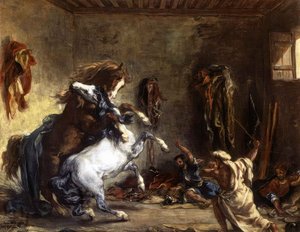
His fascination extended beyond historical and literary subjects. A pivotal journey to North Africa in 1832 profoundly impacted his artistic trajectory. Immersing himself in the vibrant culture of Morocco, Delacroix was captivated by the exotic landscapes, the nomadic lifestyle of the Arab tribes, and the intensity of their traditions. This experience infused his paintings with a newfound sense of color, light, and energy, as seen in works like *Arab Horses Fighting* and numerous studies of Algerian life. He wasn’t merely documenting these scenes; he was seeking to understand the underlying spirit of a culture vastly different from his own.
The Power of Color and Political Engagement
Delacroix's mastery of color is arguably his most enduring legacy. He drew inspiration from the Baroque exuberance of Rubens and the Venetian Renaissance masters, prioritizing chromatic intensity over precise draftsmanship. He understood that color could evoke emotion, create atmosphere, and convey meaning in ways that line alone could not. This innovative approach profoundly influenced subsequent generations of artists, paving the way for Impressionism and Post-Impressionism.
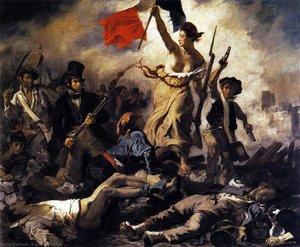
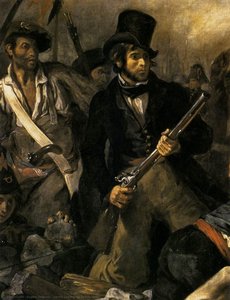
Beyond his aesthetic innovations, Delacroix was a politically engaged artist. His most iconic work, *Liberty Leading the People* (1830), is not simply a depiction of the July Revolution; it’s a powerful allegory for freedom and rebellion. The painting's dynamic composition, allegorical figures, and raw emotional power cemented its place in art history as a symbol of French national identity and revolutionary ideals. It wasn’t just about documenting an event; it was about capturing the spirit of a nation fighting for its liberty.
A Lasting Influence
Delacroix continued to paint prolifically throughout his life, exploring diverse themes ranging from Shakespearean tragedies to biblical narratives. He also made significant contributions as a lithographer, illustrating works by literary giants like William Scott and Johann Wolfgang von Goethe. His studio became a hub for artistic exchange, attracting aspiring painters who were drawn to his unconventional approach.
By the time of his death in 1863, Delacroix had firmly established himself as one of France’s greatest artists. His influence extended far beyond the Romantic movement, shaping the development of modern painting and inspiring countless artists with his bold use of color, dynamic compositions, and unwavering commitment to emotional expression. He remains a pivotal figure in art history—a testament to the power of individual vision and the enduring allure of the sublime.
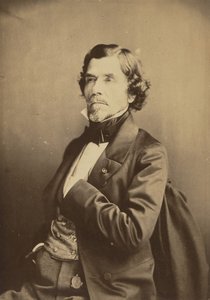
Eugène Delacroix
1798 - 1863 , France
Quick Facts
- Artistic Movement Or Style: Romanticism
- Artists Or Movements Influenced By This Artist:
- Impressionism
- Post-Impressionism
- Artists Who Influenced This Artist:
- Rubens
- Venetian Renaissance painters
- Date Of Birth: April 26, 1798
- Date Of Death: August 13, 1863
- Full Name: Eugène Delacroix
- Nationality: French
- Notable Artworks:
- Liberty Leading the People
- The Death of Sardanapalus
- Arab Horses Fighting
- Place Of Birth: Chantonnay, France
Related Articles
Ferdinand Delacroix: Romanticism's Revolutionary Brush – A Study of Passion, Politics, and Painterly Innovation
Explore the revolutionary art of Eugène Delacroix, leader of French Romanticism. Discover his masterful use of color, political engagement, and lasting influence on modern painting. Learn about key works & history.
Romantic Realism's Finest: 10 Masterpieces for Your Home | ArtsDot
Explore 10 defining masterpieces of Romantic Realism! Discover Courbet, Millet & Daumier's powerful paintings—capturing emotion and social realities. Find museum-quality reproductions for your home at ArtsDot.com.
The Alchemy of Graphite: An Expert Guide to Mastering Detail and Depth in Pencil Sketching
Unlock the secrets of graphite sketching with our expert guide for art students. Learn to master pencil grades, create realistic depth, and capture intricate textures through professional techniques designed to elevate your observational drawing skills.

Leonardo da Vinci's Masterpieces: Explore 25 Iconic Artworks for Your Home | ArtsDot
Journey through Leonardo da Vinci's genius with our curated selection of 25 iconic artworks. Explore the stories behind Mona Lisa, The Last Supper & more Renaissance masterpieces. Find museum-quality art reproductions for your home at ArtsDot.com.

Romantic Landscapes: 10 Masterpieces for Your Home | ArtsDot
Journey through 10 Romantic landscape masterpieces by Friedrich, Turner & Cole. Explore emotional art, sublime nature scenes & iconic 19th-century paintings. Find museum-quality reproductions for your home at ArtsDot.com – discover the full collection online!