 Preview
 Send
Send Share
Share
 Details

 Download
 Similars
 X-Ray
X-Ray Diaporama
The Fruit Basket
 Acrylic On Canvas
- WallArt
- Baroque
 1633
1633 153.0 x 214.0 cm
 Museo del Prado
 Read More
Hand Made Oil Reproduction
Hand-painted oil on canvas in your size and frame, made to order by our artists. ( Buy Print Buy Image)




P118B $10

P118H $10

P118W $10

P438Z $10

P508JH $12

P508YH $12

P805H $10

P805Z $10

P919BZ $10

P919G $10

P919XJ $10

P959ZH $10

P968JZ $12

W106C $8

W218G $10

W218JH $8

W218Y $10

W307PJ $10

W316G $10

W316PJ $8

W316Y $10

W398PJ $8

W4111J $10

W500HY $15

W500JH $15

W692G $12

W849H $8

W940BG $15

W953PJ $8




Pick from our preset sizes that match the artwork's original proportions.

You may enter your own dimensions to fit a specific frame or space. If your selected size does not match the original image's proportions, we will either crop the artwork or extend the painting with additional hand-painted elements. A digital mockup will be sent for your approval before production begins.
Please note that the on-screen preview does not reflect the actual cropping or extension. Only the mockup will accurately show the final composition.
While custom sizes are available, we recommend selecting a dimension from the predefined list to preserve the original proportions.
After order, ArtsDot.com team will email client for instructions and provide a mockup preview
Worldwide Delivery () in 3/4 weeks instead of standard 5 weeks. (17 August). No compromise on quality.

Free Worldwide Express Shipping

High-Quality Linen Canvas

Full Shipping Insurance

Customs Tax Refund Guarantee

True Color Matching Guarantee

60-Day Return Policy (Defects Only)

100% Money-Back Guarantee

Bulk Discount Offer
 Glass option is only available in size under 110 CM

The Fruit Basket
Reproduction Medium
Reproduction Size
-


Total Price
$ 263
Artwork Description
The Fruit Basket: A Baroque Ode to Abundance
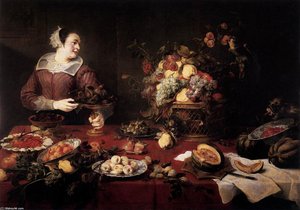
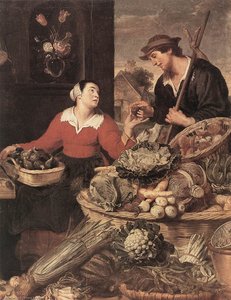
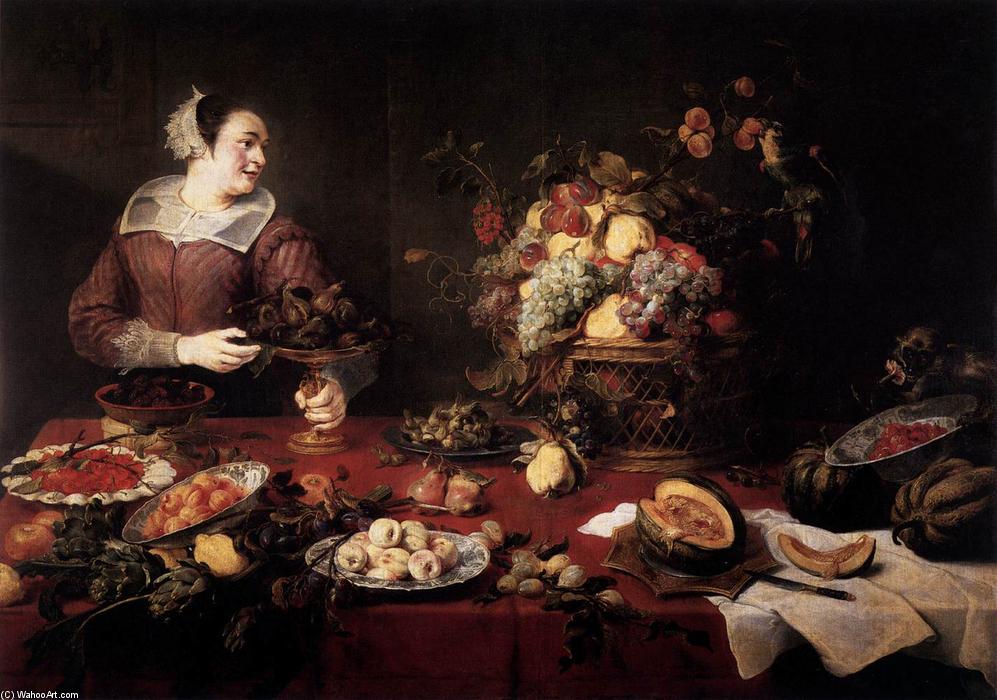
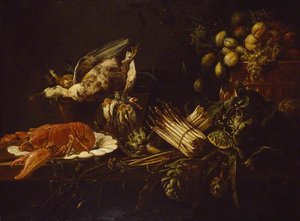
Frans Snyders’ “The Fruit Basket,” completed in 1633, transcends mere depiction; it embodies the very spirit of Baroque art—a celebration of opulent detail and dramatic visual impact. Housed within the Museo del Prado in Madrid, Spain, this oil on canvas masterpiece isn't simply a still life; it’s a carefully constructed tableau designed to stimulate contemplation and evoke a profound appreciation for earthly beauty. The painting immediately draws the eye with its vibrant palette—deep reds dominate the apples and oranges, contrasted by lush greens representing the foliage and vegetables. These colors aren’t merely decorative; they were painstakingly chosen to convey emotion and heighten the sense of realism achieved through masterful chiaroscuro lighting.- Composition & Technique: Snyders employs a pyramidal composition, anchoring the eye on the basket itself while subtly guiding it across the table towards the woman holding it. The artist’s meticulous brushwork captures the textures of fruit skins—the velvety sheen of peaches and plums alongside the rough surface of apples—creating an illusion of palpable physicality. Notice how light sculpts the forms, emphasizing volume and depth, mirroring the grandeur of Baroque artistic ideals.
- Historical Context: Created during Philip IV’s reign, “The Fruit Basket” reflects the prevailing fascination with naturalism within European art circles. The Baroque period prioritized portraying the world as it appeared to the senses—a reaction against the stylized conventions of Mannerism. Snyders' work aligns perfectly with this trend, demonstrating a commitment to capturing fleeting moments of sensory experience.
- Symbolism & Narrative: Beyond its visual splendor, “The Fruit Basket” carries symbolic weight. The basket itself represents fertility and nourishment—themes central to Baroque iconography. The woman’s gesture suggests generosity and hospitality, embodying the humanist values championed during this era. Furthermore, the inclusion of a knife hints at preparation and transformation, subtly referencing the cycle of life and death.
- Influence & Legacy: Snyders' meticulous realism profoundly impacted subsequent still life painters. His influence can be seen in works by artists like Jacob Jordaens and Willem Claeszoon Heda who adopted similar techniques to convey a sense of immediacy and grandeur. “The Fruit Basket” remains an enduring testament to Baroque artistry, inspiring admiration for its technical prowess and emotional resonance.
Related Artworks
Artist Biography
A Master of Abundance: The Life and Art of Frans Snyders
Frans Snyders, born in Antwerp in 1579, occupies a unique and vibrant niche within the pantheon of Flemish Baroque painters. While names like Rubens and Van Dyck often dominate discussions of the era, Snyders’ contribution—a dazzling specialization in still life, animal painting, and bustling market scenes—was no less significant. He wasn't merely depicting objects; he was celebrating abundance, reveling in texture, and capturing a fleeting moment of earthly delight. His father, Jan Snijders, ran a popular wine inn frequented by artists, immersing the young Frans in a world of creative energy from an early age. This environment undoubtedly fostered his artistic inclinations, and it’s even said that the renowned painter Frans Floris once squandered his fortune within those walls—a colorful anecdote hinting at the lively atmosphere surrounding Snyders' upbringing. He initially trained with Pieter Brueghel the Younger, absorbing lessons in composition and detail, before refining his skills under Hendrick van Balen, who also mentored Anthony van Dyck. This solid foundation allowed him to become a master within the Antwerp Guild of Saint Luke by 1602, marking the formal beginning of his prolific career.Collaboration and Innovation: Snyders’ Artistic Development
Snyders' artistic journey wasn’t one of solitary pursuit; collaboration was central to his practice. He quickly established himself as a sought-after partner for leading artists of the time, most notably Peter Paul Rubens. Their relationship proved remarkably fruitful, with Snyders frequently tasked with painting the animals and still life elements within Rubens’ grand compositions. The Torre de la Parada hunting pavilion in Spain stands as a testament to their combined genius—Snyders executing over sixty animal paintings based on designs by Rubens. This partnership wasn't simply about fulfilling commissions; it was a dynamic exchange of ideas, pushing both artists toward new levels of technical and expressive achievement. Beyond Rubens, Snyders collaborated with Anthony van Dyck, Jacob Jordaens, and Abraham Janssens, demonstrating his versatility and adaptability. However, he didn’t merely serve as an accessory to these masters. He pioneered a distinct style characterized by dynamic compositions, masterful rendering of textures—from the sheen of fruit to the rough hide of game—and a vibrant sense of realism that breathed life into his subjects. Snyders essentially invented the independent animal still life genre, moving beyond traditional depictions of hunting trophies to explore the inherent beauty and vitality of the natural world.A Feast for the Eyes: Themes and Techniques
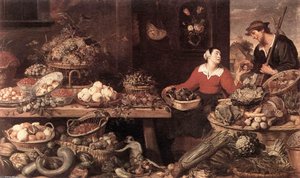
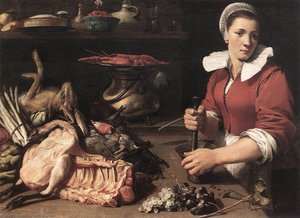
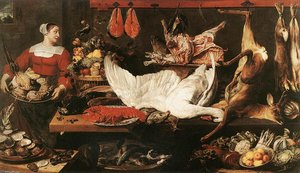
The core themes in Snyders’ work revolve around earthly pleasures—the bounty of the market, the thrill of the hunt, the simple elegance of a well-stocked pantry. His market scenes are particularly captivating, teeming with figures, overflowing baskets, and an almost palpable sense of energy. He doesn't shy away from depicting the realities of food production; alongside pristine fruits and vegetables, one might find plucked fowl or freshly caught fish, reminding viewers of the cycle of life and sustenance. His still lifes aren’t static arrangements but rather dynamic displays that seem to invite interaction. Snyders possessed an extraordinary ability to capture light and shadow, creating a sense of depth and volume that makes his subjects appear almost tangible. He employed a loose, painterly brushstroke, particularly in rendering fur and feathers, achieving a remarkable level of realism without sacrificing artistic expression. The Pantry, for example, is a stunning showcase of this technique—a chaotic yet harmonious arrangement of foodstuffs and kitchen utensils bathed in dramatic light. The artist’s attention to detail is meticulous, but it never feels overly fussy; instead, it contributes to the overall sense of abundance and vitality.Legacy and Enduring Influence
Frans Snyders' impact on the development of still life and animal painting extends far beyond his own lifetime. He established a new standard for realism and dynamism in these genres, influencing generations of artists who followed. His work paved the way for later masters like Jean-Baptiste Oudry and François Desportes, who further refined the art of animal portraiture. Snyders’ influence can also be seen in the Dutch Golden Age still life tradition, where artists like Willem Claeszoon Heda and Pieter Claesz embraced a similar focus on texture, light, and composition. He was not only a skilled technician but also an astute observer of the natural world, capturing its beauty and complexity with remarkable sensitivity. His paintings continue to captivate audiences today, offering a glimpse into the vibrant artistic landscape of 17th-century Antwerp and reminding us of the enduring power of art to celebrate life’s simple pleasures. His extensive collection, acquired by Matthijs Musson after his death in 1657, ensured that his legacy would continue to inspire artists for centuries to come.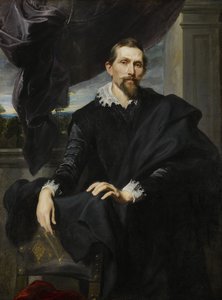
Frans Snyders
1579 - 1657 , Belgium
Quick Facts
- Artistic Movement Or Style: Baroque
- Artists Or Movements Influenced By This Artist:
- Jean-Baptiste Oudry
- François Desportes
- Artists Who Influenced This Artist:
- Pieter Brueghel II
- Hendrick van Balen
- Date Of Birth: 1579
- Date Of Death: 1657
- Full Name: Frans Snyders
- Nationality: Flemish
- Notable Artworks:
- The Pantry
- Market Scenes
- Hunting Scenes
- Place Of Birth: Antwerp, Belgium
Related Articles
The Bountiful Still Life: Symbolism & Artistic Representation of Fruit Across Art History
Explore the rich history of still life painting & the symbolism of fruit across art movements. Discover masterpieces from Caravaggio to Cézanne with ArtsDot – expert guidance & museum-quality reproductions.
The Enduring Appeal of Still Life: A Historical & Contemporary Exploration
Explore the rich history & symbolism of still life painting with ArtsDot. Discover masterpieces from the Dutch Golden Age, learn about vanitas art, and find expert guidance for collecting timeless artworks.

Baroque Masterpieces: 10 Paintings That Defined an Era |
Journey through the drama & grandeur of Baroque art! Explore 10 masterpieces by Caravaggio, Rembrandt, Rubens & more. Discover stunning oil paintings, rich colors & timeless stories. Find museum-quality reproductions at .
Silent Narratives: Exploring the Enduring Appeal of Still Life Painting Across Centuries
Explore the rich history of still life painting with ArtsDot. Discover Dutch Masters, decode vanitas symbolism & learn about collecting timeless art. Expert insights and museum-quality reproductions.

The Dramatic Flourish: Exploring the Baroque Movement's Enduring Legacy in Art History
Explore the dramatic world of Baroque art! Discover iconic artists like Caravaggio & Rubens, defining techniques, and its lasting impact on art history. Expert insights for collectors & enthusiasts at ArtsDot.