 Preview
 Send
Send Share
Share
 Details

 Download
 Similars
 X-Ray
X-Ray Diaporama
Saint Julian l'Hospitalier


 Read More
Hand Made Oil Reproduction
Hand-painted oil on canvas in your size and frame, made to order by our artists. ( Buy Print Buy Image)




P118B $10

P118H $10

P118W $10

P438Z $10

P508JH $12

P508YH $12

P805H $10

P805Z $10

P919BZ $10

P919G $10

P919XJ $10

P959ZH $10

P968JZ $12

W106C $8

W218G $10

W218JH $8

W218Y $10

W307PJ $10

W316G $10

W316PJ $8

W316Y $10

W398PJ $8

W4111J $10

W500HY $15

W500JH $15

W692G $12

W849H $8

W940BG $15

W953PJ $8




Pick from our preset sizes that match the artwork's original proportions.

You may enter your own dimensions to fit a specific frame or space. If your selected size does not match the original image's proportions, we will either crop the artwork or extend the painting with additional hand-painted elements. A digital mockup will be sent for your approval before production begins.
Please note that the on-screen preview does not reflect the actual cropping or extension. Only the mockup will accurately show the final composition.
While custom sizes are available, we recommend selecting a dimension from the predefined list to preserve the original proportions.
After order, ArtsDot.com team will email client for instructions and provide a mockup preview
Worldwide Delivery () in 3/4 weeks instead of standard 5 weeks. (16 August). No compromise on quality.

Free Worldwide Express Shipping

High-Quality Linen Canvas

Full Shipping Insurance

Customs Tax Refund Guarantee

True Color Matching Guarantee

60-Day Return Policy (Defects Only)

100% Money-Back Guarantee

Bulk Discount Offer
 Glass option is only available in size under 110 CM

Saint Julian l'Hospitalier
Reproduction Medium
Reproduction Size
-


Total Price
$ 263
Artwork Description
A Vision in Blue: The Spiritual Resonance of Saint Julian l'Hospitalier
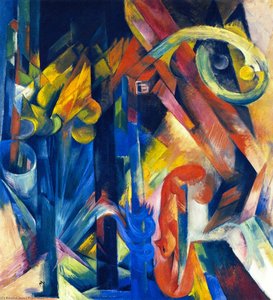
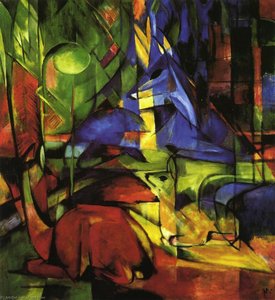
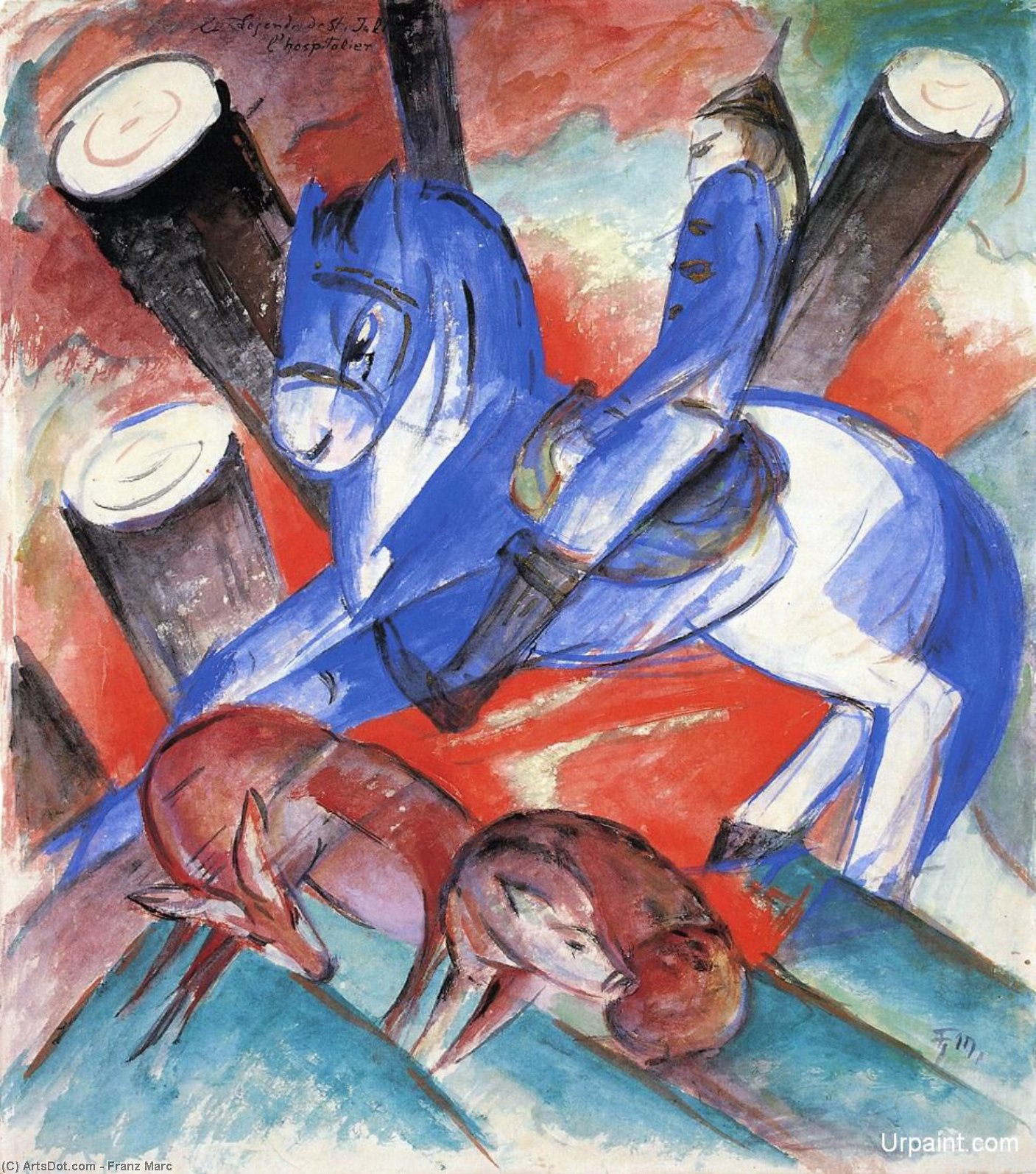
In the pantheon of German Expressionism, few artists captured the primal rhythm of nature with as much spiritual fervor as Franz Marc. His 1913 masterpiece, Saint Julian l'Hospitalier, serves as a breathtaking window into a world where the boundaries between the physical and the metaphysical dissolve. At first glance, the viewer is met with a striking, almost otherworldly palette; a magnificent blue horse commands the center of the composition, its form rendered with the rhythmic, geometric precision characteristic of Marc’s unique fusion of Cubism and Expressionism. This is not merely a depiction of an animal, but an exploration of essence, where color serves as a direct conduit to the soul.
The painting breathes with a dynamic energy, pulling the observer into a landscape that feels both ancient and immediate. Alongside the central blue figure, two deer—rendered in warm, earthy tones of brown and red—emerge from the foreground, creating a profound chromatic tension against the cool, ethereal blue of the horse. This interplay of colors is far from accidental; for Marc, colors were imbued with specific emotional and spiritual weights. The presence of trees, scattered thoughtfully across the canvas, provides a structural anchor to the scene, their forms echoing the movement of the animals and guiding the eye through a composition that feels as much like a dance as it does a landscape.
Symbolism and the Sacred Narrative
While the visual impact is undeniably striking, the deeper layers of Saint Julian l'Hospitalier invite a more contemplative engagement. The title references the legendary figure of Saint Julian, a patron of travelers and those in need, suggesting a narrative of compassion and sanctuary. Through this lens, the animals in the painting cease to be mere subjects of nature and become symbols of an innocent, uncorrupted existence. Marc’s fascination with the animal kingdom was rooted in his belief that animals possessed a spiritual purity that humanity had lost. By placing these creatures within a sacred narrative, he elevates the natural world to a state of divine grace.
< p>The use of flat, geometric shapes and bold, saturated hues allows the artist to strip away the distractions of realism, focusing instead on the emotional truth of the moment. The blue horse, a recurring motif in Marc's oeuvre, acts as a totem of transcendence, inviting the viewer to look past the surface of the material world. For the collector or the interior designer, this piece offers more than just aesthetic beauty; it provides a focal point of profound depth, capable of anchoring a room with its intense color and quiet, powerful storytelling.An Eternal Legacy for the Modern Collector
To possess a reproduction of such a significant work is to hold a fragment of art history. Franz Marc’s career was tragically cut short by the violence of World War I, yet his ability to infuse the canvas with life and light remains undiminished by time. Saint Julian l'Hospitalier stands as a testament to a moment in history when art sought to redefine the human experience through color and form. Whether displayed in a contemporary gallery setting or as a centerpiece in a curated home collection, this painting continues to inspire awe, evoking a sense of wonder and a longing for the spiritual harmony that Marc so masterfully depicted.
Artist Biography
A Life Immersed in Color and Spirit
Franz Moritz Wilhelm Marc, born in Munich in 1880, was a painter whose brief but intensely focused career irrevocably altered the course of German Expressionism. His story is one of profound spiritual seeking translated into a vibrant visual language, a quest to understand the essence of life through the purity he found in the natural world—particularly within the animal kingdom. Initially influenced by his father, Wilhelm Marc, a landscape painter, young Franz’s artistic path wasn't immediately certain. He briefly considered theology, grappling with questions of faith and existence before ultimately dedicating himself to art at the Academy of Fine Arts in Munich. These early explorations into religious thought would remain deeply embedded within his work, shaping his belief that art could be a conduit for spiritual experience. His academic training provided him with technical foundations, but it was encounters with the works of Vincent van Gogh during visits to Paris that truly ignited his artistic vision. Van Gogh’s emotive use of color and raw expression resonated profoundly with Marc, liberating him from conventional techniques and setting him on a path toward a more subjective and emotionally charged style.The Blue Rider and a New Artistic Vision
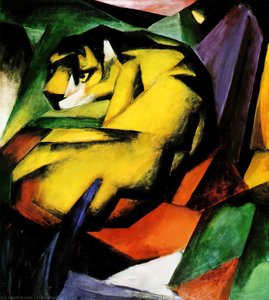
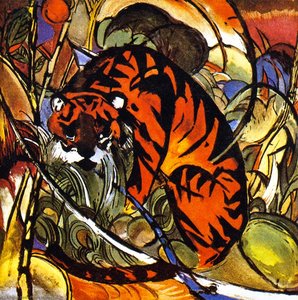
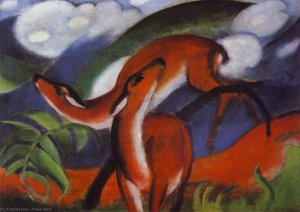
Marc's artistic development wasn’t solitary; it flourished within the dynamic context of early 20th-century Munich. He experimented with various artist groups, including the Neue Künstlervereinigung München, before co-founding *Der Blaue Reiter* (The Blue Rider) in 1911 alongside Wassily Kandinsky. This wasn’t merely a group or an exhibition series; it was a philosophical and artistic revolution. *Der Blaue Reiter* sought to move beyond mere representation, aiming instead to express inner spiritual truths through abstraction and symbolic color. The journal of the same name became a platform for disseminating these ideas, showcasing not only their own work but also that of other forward-thinking artists and exploring diverse cultural influences from folk art to primitive sculpture. Marc’s contributions during this period were pivotal. He moved away from depicting landscapes as static scenes, instead focusing on animals—horses, deer, foxes—as vessels of spiritual energy. These weren't simply animal portraits; they were symbolic representations of innocence, harmony, and a connection to the natural world that he believed humanity had lost. The influence of Robert Delaunay’s exploration of abstract forms and vibrant colors further propelled Marc toward simplification and heightened emotional expression in his work. Paintings like *The Tiger* (1912) and *Red Deer* (1912) exemplify this shift, showcasing bold color choices and a growing focus on the inherent qualities of his subjects rather than realistic depiction.Symbolism, Color, and the Essence of Being
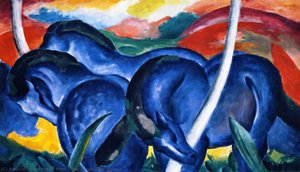
Marc’s artistic style is immediately recognizable for its distinctive use of color and form. He didn't employ color descriptively; instead, he imbued it with symbolic meaning. Blue represented spirituality and masculinity, yellow signified joy and femininity, and red embodied violence and materiality. These weren’t arbitrary choices but a carefully constructed system designed to convey specific emotional and philosophical ideas. His animals aren’t merely subjects; they are embodiments of these concepts. The simplification of forms—reducing figures to their essential shapes—further emphasized the underlying spiritual essence he sought to capture. *The Tower of Blue Horses* (1913), sadly lost during World War II, is perhaps the most iconic example of this approach, a powerful and evocative composition that encapsulates his artistic vision. He believed animals possessed an inherent purity and connection to nature that humans had forfeited through societal constraints and intellectualization. By portraying them with such reverence and symbolic weight, Marc sought to remind viewers of this lost harmony and inspire a deeper appreciation for the natural world. His work wasn’t about depicting *what* he saw but rather *how* he felt—a deeply personal and spiritual response to his surroundings.A Tragic End and Lasting Legacy
The outbreak of World War I in 1914 dramatically altered Marc's life and artistic trajectory. Despite seeking exemption due to his status as an artist, he was drafted into the German army, serving as a cavalryman. The horrors of war deeply affected him, yet even amidst the chaos, he continued to paint, finding solace and meaning in his art. Tragically, Franz Marc died on March 4, 1916, at the Battle of Verdun, a devastating loss for the art world. His untimely death cut short a career brimming with potential, but it also cemented his place as a pivotal figure in modern art history. His work continues to resonate today, influencing generations of artists and captivating audiences with its emotional depth and spiritual resonance. Marc’s paintings are exhibited in major museums worldwide, including the Lenbachhaus in Munich, which holds an extensive collection of his work. He is remembered not only as a pioneer of German Expressionism but also as a visionary artist who dared to explore the profound connection between art, spirituality, and the natural world—a legacy that continues to inspire awe and contemplation. His artistic vision remains a testament to the power of art to transcend the material realm and touch upon something deeper within the human spirit.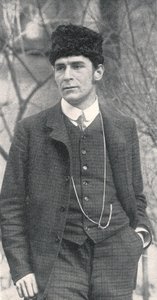
Franz Marc
1880 - 1916 , Germany
Quick Facts
- Artistic Movement Or Style: German Expressionism
- Artists Or Movements Influenced By This Artist:
- Abstract art
- Der Blaue Reiter
- Artists Who Influenced This Artist:
- Van Gogh
- Delaunay
- Date Of Birth: February 8, 1880
- Date Of Death: March 4, 1916
- Full Name: Franz Moritz Wilhelm Marc
- Nationality: German
- Notable Artworks:
- The Tiger
- Red Deer
- Tower of Blue Horses
- Place Of Birth: Munich, Germany
Related Articles

Watercolor Wonders: 10 Masterpieces That Redefined Art History | ArtsDot
Journey through 10 legendary watercolor masterpieces by Sargent, Turner & Homer! Explore iconic landscapes, portraits & floral art that redefined history. Find museum-quality reproductions and curated decor ideas at ArtsDot.com.

Ephemeral Visions: Exploring the Artistic Legacy & Contemporary Practice of Watercolor Painting
Explore the captivating world of watercolor painting! Discover its rich history, essential techniques, influential artists & collecting tips. A comprehensive guide for art enthusiasts from ArtsDot.
Marc Chagall's Masterpieces: 25 Paintings That Define a Dreamlike Vision | ArtsDot
Journey into the dreamlike world of Marc Chagall! Explore 25 iconic paintings, from 'I and the Village' to his vibrant surrealist masterpieces. Discover the stories & techniques behind these timeless artworks – find museum-quality Chagall reproductions on ArtsDot.com.

Ephemeral Visions: Exploring the History & Emotional Resonance of Watercolor Painting
Explore the captivating history of watercolor painting, from ancient techniques to modern masters like Kandinsky & Blake. Discover essential artists, collecting tips & the emotional power of this luminous medium. Expert insights for art enthusiasts.
Ephemeral Visions: Exploring the Artistic Legacy & Nuances of Watercolor Painting
Explore the captivating world of watercolor painting! Discover its rich history, essential techniques, influential artists & collecting tips from art experts. A comprehensive guide for enthusiasts.