 Preview
 Send
Send Share
Share
 Details

 Download
 Similars
 X-Ray
X-Ray Diaporama
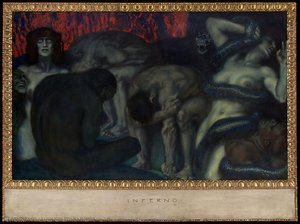
Inferno
 Oil On Canvas
- WallArt
- German Symbolism
 1908
1908 129.0 x 210.0 cm
 Metropolitan Museum of Art
 Read More
Hand Made Oil Reproduction
Hand-painted oil on canvas in your size and frame, made to order by our artists. ( Buy Print Buy Image)




P118B $10

P118H $10

P118W $10

P438Z $10

P508JH $12

P508YH $12

P805H $10

P805Z $10

P919BZ $10

P919G $10

P919XJ $10

P959ZH $10

P968JZ $12

W106C $8

W218G $10

W218JH $8

W218Y $10

W307PJ $10

W316G $10

W316PJ $8

W316Y $10

W398PJ $8

W4111J $10

W500HY $15

W500JH $15

W692G $12

W849H $8

W940BG $15

W953PJ $8




Pick from our preset sizes that match the artwork's original proportions.

You may enter your own dimensions to fit a specific frame or space. If your selected size does not match the original image's proportions, we will either crop the artwork or extend the painting with additional hand-painted elements. A digital mockup will be sent for your approval before production begins.
Please note that the on-screen preview does not reflect the actual cropping or extension. Only the mockup will accurately show the final composition.
While custom sizes are available, we recommend selecting a dimension from the predefined list to preserve the original proportions.
After order, ArtsDot.com team will email client for instructions and provide a mockup preview
Worldwide Delivery () in 3/4 weeks instead of standard 5 weeks. (17 August). No compromise on quality.

Free Worldwide Express Shipping

High-Quality Linen Canvas

Full Shipping Insurance

Customs Tax Refund Guarantee

True Color Matching Guarantee

60-Day Return Policy (Defects Only)

100% Money-Back Guarantee

Bulk Discount Offer
 Glass option is only available in size under 110 CM

Inferno
Reproduction Medium
Reproduction Size
-


Total Price
$ 263
Artwork Description
The Genesis of Darkness: Inferno and Dante’s Vision
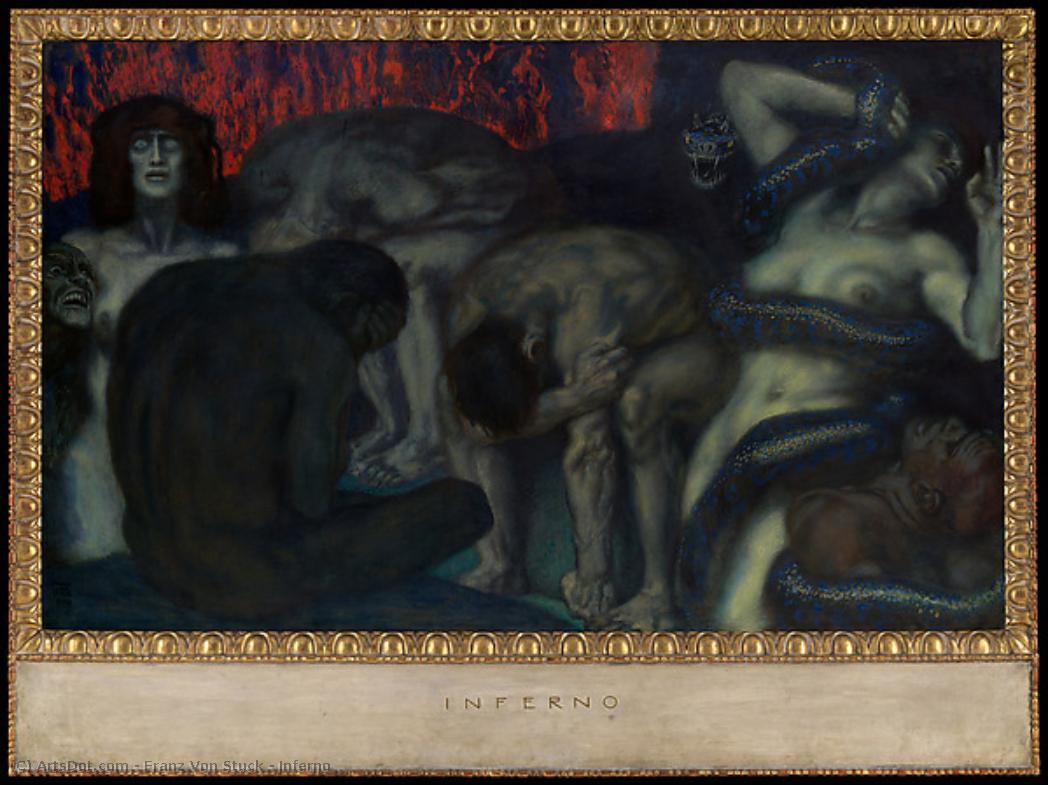
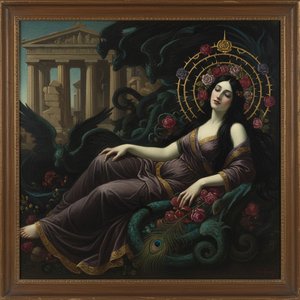
Franz Ritter von Stuck's "Inferno," painted in 1908, isn’t merely a depiction of hell; it’s a visceral plunge into the darkest recesses of the human psyche. Born from the fertile ground of German Symbolism, this monumental oil on canvas transcends simple illustration, becoming a profound meditation on sin, guilt, and the inescapable consequences of moral transgression. Stuck, deeply influenced by the haunting imagery of Auguste Rodin's "The Gates of Hell," particularly the figure of The Thinker – a potent symbol of intellectual torment – crafted an artwork that resonates with both classical precision and unsettling modernity. The painting’s title directly references Dante Alighieri’s epic poem “Inferno,” serving as a visual embodiment of its core themes, but Stuck's interpretation diverges significantly from the medieval text, injecting a jarring dissonance into the traditional symbols of the underworld.
A Symphony of Discord: Style and Technique
Stuck’s masterful technique is immediately striking. He abandons the typically somber, muted palette associated with depictions of hell, instead employing a vibrant, almost hallucinatory range of colors – searing reds, sickly yellows, and bruised purples – that create an atmosphere of intense unease. The figures themselves are rendered in a deliberately stylized manner, their poses exaggerated and distorted to amplify the drama and psychological impact. This departure from academic realism is characteristic of Symbolism, prioritizing emotional expression over photographic accuracy. Notice how the musculature of the damned writhes with agony, not through anatomical correctness but through an almost sculptural intensity. The composition itself is dynamic, drawing the viewer’s eye relentlessly through a chaotic landscape of torment, punctuated by moments of stark clarity and unsettling detail.
- Color Palette: A jarring blend of vibrant reds, yellows, and purples creates a sense of unease and psychological intensity.
- Stylization: Figures are deliberately exaggerated and distorted to heighten the emotional impact.
- Composition: Dynamic and chaotic, guiding the viewer through a landscape of torment.
Decoding the Descent: Symbolism and Allegory
“Inferno” is rich in symbolic imagery, drawing heavily from Dante’s poem but also incorporating elements of Rodin's influence. The snake represents temptation, the demon embodies corruption, and the flaming pit signifies eternal damnation. However, Stuck doesn’t simply replicate these traditional symbols; he imbues them with a distinctly modern sensibility. The central figure, often interpreted as a representation of humanity itself, is caught in a moment of profound despair, mirroring The Thinker's contemplation. The inclusion of a book suggests the loss of knowledge and virtue, while the upward gaze hints at a desperate yearning for redemption – a hope that remains tragically elusive within this realm of eternal suffering. The overall effect is not one of simple horror but of a deeply unsettling exploration of human fallibility.
A Legacy of Vision: Context and Impact
“Inferno” debuted at an exhibition of contemporary German art in 1909, immediately generating considerable controversy and critical acclaim. Critics lauded its “sovereign brutality,” recognizing Stuck’s willingness to confront the darker aspects of the human condition – a boldness that solidified his reputation as a visionary artist. The painting's powerful imagery resonated with audiences grappling with anxieties about modernity, industrialization, and the perceived decline of traditional values. It stands as a testament to Stuck’s ability to translate complex philosophical ideas into a visually arresting and emotionally resonant work of art, cementing his place as a pivotal figure in the transition from Symbolism to Expressionism. Today, reproductions of “Inferno” continue to captivate viewers with their raw intensity and enduring exploration of the human soul.
Related Artworks
Artist Biography
A Life Steeped in Myth and Symbol
Franz Ritter von Stuck, a name synonymous with the evocative power of German Symbolism, emerged from the rural landscapes of Bavaria in 1863 to become one of the most influential artists of his generation. Born in Tettenweis, initially destined for a life following his father as a forester, young Franz demonstrated an undeniable artistic inclination that would irrevocably alter his path. This early aptitude led him to Munich, first to the School of Applied Arts in 1878 and then to the Academy of Fine Arts from 1882-1884, where he fell under the spell of Arnold Böcklin’s hauntingly beautiful mythological scenes – a formative influence that would deeply shape his artistic vision. Stuck wasn't merely an artist; he was a cultural phenomenon, a “Prince of Art” as he became known during his lifetime, bridging the gap between 19th-century academic tradition and the burgeoning currents of modernism.The Rise of a Symbolist Master
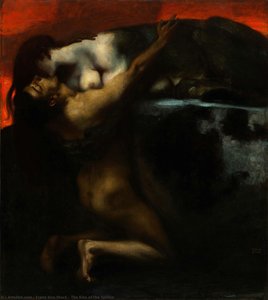
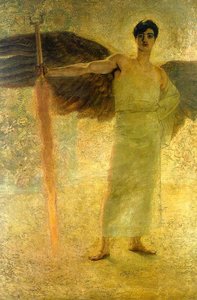
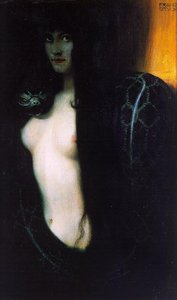
Stuck’s ascent to prominence was remarkably swift. His breakthrough arrived in 1889 with The Guardian of Paradise, exhibited at the Munich Glass Palace, instantly garnering critical acclaim and a gold medal. This painting wasn't simply a display of technical skill; it announced a new artistic voice – one that blended classical precision with mythological subject matter and an undercurrent of Symbolist mystery. He quickly became a central figure in challenging established norms, co-founding the Munich Secession in 1892 alongside like-minded artists determined to break free from conservative constraints and champion modern art. This act of artistic rebellion coincided with his exploration into sculpture, debuting with Athlete, demonstrating an impressive versatility. However, it was The Sin (1893) that truly cemented his reputation as a master of Symbolist painting, captivating audiences with its dramatic intensity and psychological depth. This period marked the full flowering of Stuck’s unique style – a potent combination of sensuality, classical form, and symbolic resonance.Themes and Influences: A World of Desire and Myth
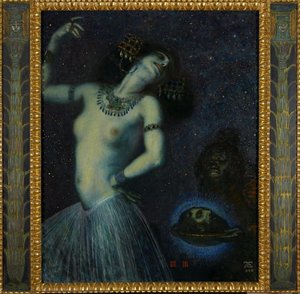
The artistic universe of Franz von Stuck is populated by recurring motifs that reveal his profound engagement with timeless themes. Mythology served as a constant source of inspiration, drawing from Greek, Roman, and biblical narratives which he reimagined with a distinctly personal flair. These weren’t mere retellings; they were explorations of the human condition filtered through the lens of ancient stories. Equally prominent was his fascination with sensuality and the femme fatale, powerfully embodied in his numerous depictions of Salome – a figure representing desire, danger, and moral ambiguity. These paintings weren’t simply about physical beauty; they delved into the psychological complexities of female power and its potential for both allure and destruction. Underlying all this was a deep reverence for classical art, evident in his meticulous technique, anatomical accuracy, and compositional rigor. Beyond Böcklin, Stuck acknowledged influences from the Pre-Raphaelites and Gustave Moreau, but he wasn’t merely an imitator; he synthesized these influences into something uniquely his own, profoundly impacting subsequent generations of artists.Legacy and Influence: A Teacher and a Knight
In 1895, Franz von Stuck took on another crucial role – that of teacher at the Munich Academy. He became a highly respected instructor, not only imparting technical skills but also encouraging his students to explore their individual artistic visions. Among those who benefited from his guidance were luminaries such as Paul Klee, Hans Purrmann, and Josef Albers, demonstrating the breadth of his influence. His dedication to art was further recognized in 1905 when he was ennobled, becoming “Ritter von Stuck” – a testament to his growing prestige and contribution to German culture. He continued to receive accolades throughout Europe, solidifying his position as one of the leading artists of his time. His Villa Stuck in Munich, now a museum, stands as a lasting monument to his life and work, offering invaluable insights into his artistic vision and the cultural milieu of late 19th and early 20th-century Germany. His legacy endures not only through his paintings and sculptures but also through the countless artists he inspired, ensuring that the spirit of Franz von Stuck continues to resonate within the art world today.Major Works and Enduring Significance
- The Spring (1886): A vibrant depiction showcasing his early mastery of color and composition.
- Dissonance (1893): An unsettling portrayal embodying emotional turmoil through a woman playing the violin.
- Salome (various versions): Perhaps his most iconic work, depicting the biblical story with striking sensuality and psychological depth.
- Athlete (1892): A powerful sculpture demonstrating his skill in three-dimensional form.
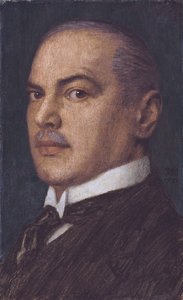
Franz Ritter von Stuck
1863 - 1928 , Germany
Quick Facts
- Artistic Movement Or Style: Symbolism, Art Nouveau
- Artists Or Movements Influenced By This Artist:
- Paul Klee
- Wassily Kandinsky
- Artists Who Influenced This Artist:
- Arnold Böcklin
- Pre-Raphaelites
- Gustave Moreau
- Date Of Birth: February 23, 1863
- Date Of Death: August 30, 1928
- Full Name: Franz Ritter von Stuck
- Nationality: German
- Notable Artworks:
- The Guardian of Paradise
- Salome
- The Sin
- Athlete
- Dissonance
- Place Of Birth: Tettenweis, Germany
Related Articles
Dante Gabriel Rossetti's 25 Masterpieces: A Journey Through Victorian Art & Symbolism | ArtsDot
Explore 25 iconic artworks by Dante Gabriel Rossetti, a leading Pre-Raphaelite artist. Discover the stories behind masterpieces like 'Proserpine' & 'Beata Beatrix'. Find museum-quality art reproductions and elevate your home decor with ArtsDot.com.
Franz von Stuck: Symbolism, Decadence & the Pursuit of Ideal Beauty
Explore the captivating world of Franz von Stuck, a leading Symbolist painter. Discover his mythological masterpieces, decadent themes, & investment potential. Expert analysis for discerning collectors.

The Enduring Legacy of Oil on Canvas: Technique, History & Aesthetic Impact
Explore the rich history & techniques of oil painting – from Renaissance masters to Impressionism. Discover pigments, layering methods, and why this timeless medium endures. Expert insights for artists & art enthusiasts.

Oil on Canvas: A Historical & Technical Exploration of a Timeless Artistic Medium
Explore the rich history & enduring techniques of oil painting on canvas. Discover the science behind its longevity, conservation practices, and contemporary relevance. Expert insights for art enthusiasts.

The Enduring Power of Painting: A Historical & Contemporary Exploration of Form and Emotion
Explore the rich history & enduring techniques of oil painting with ArtsDot. Discover masterpieces, learn about art collecting, and find authentic handmade reproductions crafted by skilled artists.