 Preview
 Send
Send Share
Share
 Details

 Download
 Similars
 X-Ray
X-Ray Diaporama
Wild Chase
 Oil
Oil- WallArt
- Symbolism
 1889
1889- 19th Century
 53.0 x 84.0 cm
 Read More
Hand Made Oil Reproduction
Hand-painted oil on canvas in your size and frame, made to order by our artists. ( Buy Print Buy Image)




P118B $10

P118H $10

P118W $10

P438Z $10

P508JH $12

P508YH $12

P805H $10

P805Z $10

P919BZ $10

P919G $10

P919XJ $10

P959ZH $10

P968JZ $12

W106C $8

W218G $10

W218JH $8

W218Y $10

W307PJ $10

W316G $10

W316PJ $8

W316Y $10

W398PJ $8

W4111J $10

W500HY $15

W500JH $15

W692G $12

W849H $8

W940BG $15

W953PJ $8




Pick from our preset sizes that match the artwork's original proportions.

You may enter your own dimensions to fit a specific frame or space. If your selected size does not match the original image's proportions, we will either crop the artwork or extend the painting with additional hand-painted elements. A digital mockup will be sent for your approval before production begins.
Please note that the on-screen preview does not reflect the actual cropping or extension. Only the mockup will accurately show the final composition.
While custom sizes are available, we recommend selecting a dimension from the predefined list to preserve the original proportions.
After order, ArtsDot.com team will email client for instructions and provide a mockup preview
Worldwide Delivery () in 3/4 weeks instead of standard 5 weeks. (17 August). No compromise on quality.

Free Worldwide Express Shipping

High-Quality Linen Canvas

Full Shipping Insurance

Customs Tax Refund Guarantee

True Color Matching Guarantee

60-Day Return Policy (Defects Only)

100% Money-Back Guarantee

Bulk Discount Offer
 Glass option is only available in size under 110 CM

Wild Chase
Reproduction Medium
Reproduction Size
-


Total Price
$ 263
Artwork Description
A Cinematic Descent into Symbolism
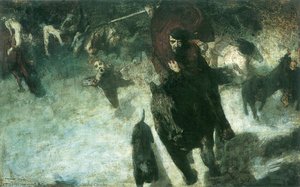
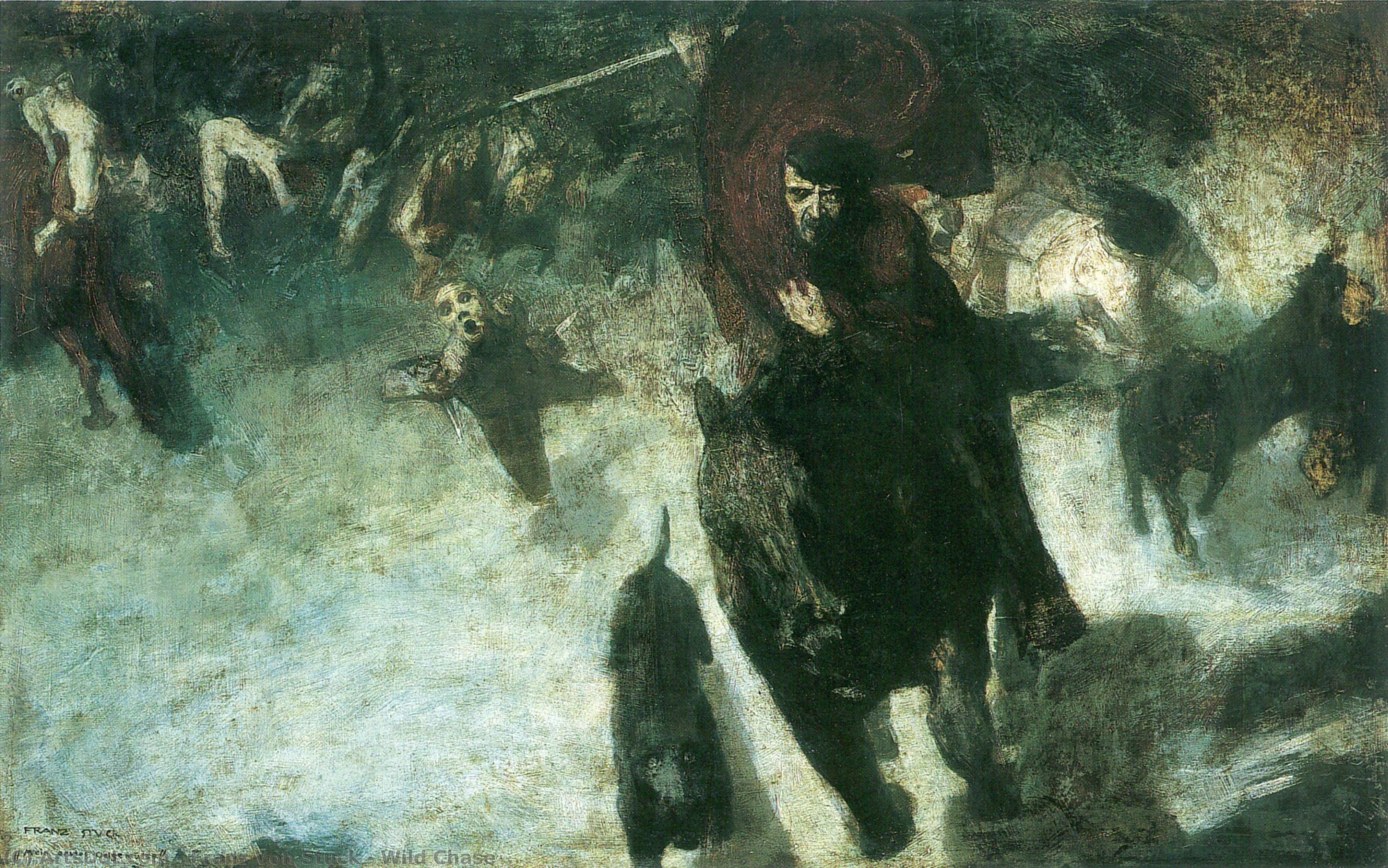
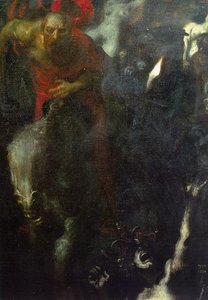
In the evocative masterpiece Wild Chase, created in 1889, Franz Ritter von Stuck invites the viewer into a realm where reality and myth collide with breathtaking intensity. The scene captures a moment of raw, kinetic energy: a central figure, mounted upon a powerful horse, surges through a crowd of onlookers, a sword gripped firmly in hand. This is not merely a depiction of a hunt or a skirmiment; it is a visceral exploration of movement, tension, and the primal human instinct for pursuit. The composition vibrates with the chaos of the chase, drawing the eye into a swirling vortex of figures that seem to emerge from the shadows of the subconscious. As a quintessential work of German Symbolism, the painting transcends its literal subject matter to touch upon the deeper, more turbulent layers of the human psyche.
The technical prowess displayed in this work reflects Stuck’s rigorous academic training, yet it is infused with a revolutionary spirit that anticipates the modern era. Through a masterful command of light and shadow—often rendered in a stark, dramatic palette—the artist sculpts the forms of man and beast, giving them a monumental presence. The interplay of dark tones and sudden highlights creates a sense of depth and atmosphere, making the air itself feel thick with the dust of the pursuit. For the discerning collector or interior designer, this piece offers a profound sense of drama; its monochromatic intensity provides a sophisticated focal point that can anchor a room, lending an air of historical gravity and intellectual depth to any curated space.
The Echoes of Myth and Subconscious Desire
To understand Wild Chase, one must look toward the broader movement of the Munich Secession and the influence of Arnold Böcklin. Stuck was a master at weaving classical precision with dreamlike, often unsettling imagery. In this work, the sword and the horse serve as potent symbols of power, virility, and the untamed forces of nature. The surrounding figures, caught in various states of observation and reaction, act as a chorus to the central drama, representing the collective human response to the sudden intrusion of violence or passion into the social order. There is an inherent tension between the controlled technique of the brushwork and the uncontrolled subject matter, a duality that defines much of Stuck’s legendary career.
For those seeking to bring a piece of art history into their private collections, this reproduction offers more than just aesthetic beauty; it offers a window into the late 19th-century fascination with the darker side of the soul. The emotional impact of the painting is immediate and haunting, evoking feelings of adrenaline, uncertainty, and awe. Whether placed in a contemporary gallery setting or a classic study, Wild Chase serves as a powerful testament to the enduring allure of the symbolic, making it an incomparable choice for those who value art that speaks to the eternal mysteries of life and legend.
Related Artworks
Artist Biography
A Life Steeped in Myth and Symbol
Franz Ritter von Stuck, a name synonymous with the evocative power of German Symbolism, emerged from the rural landscapes of Bavaria in 1863 to become one of the most influential artists of his generation. Born in Tettenweis, initially destined for a life following his father as a forester, young Franz demonstrated an undeniable artistic inclination that would irrevocably alter his path. This early aptitude led him to Munich, first to the School of Applied Arts in 1878 and then to the Academy of Fine Arts from 1882-1884, where he fell under the spell of Arnold Böcklin’s hauntingly beautiful mythological scenes – a formative influence that would deeply shape his artistic vision. Stuck wasn't merely an artist; he was a cultural phenomenon, a “Prince of Art” as he became known during his lifetime, bridging the gap between 19th-century academic tradition and the burgeoning currents of modernism.The Rise of a Symbolist Master
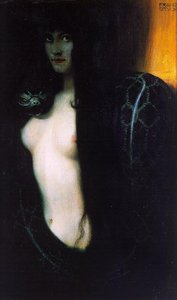
Stuck’s ascent to prominence was remarkably swift. His breakthrough arrived in 1889 with The Guardian of Paradise, exhibited at the Munich Glass Palace, instantly garnering critical acclaim and a gold medal. This painting wasn't simply a display of technical skill; it announced a new artistic voice – one that blended classical precision with mythological subject matter and an undercurrent of Symbolist mystery. He quickly became a central figure in challenging established norms, co-founding the Munich Secession in 1892 alongside like-minded artists determined to break free from conservative constraints and champion modern art. This act of artistic rebellion coincided with his exploration into sculpture, debuting with Athlete, demonstrating an impressive versatility. However, it was The Sin (1893) that truly cemented his reputation as a master of Symbolist painting, captivating audiences with its dramatic intensity and psychological depth. This period marked the full flowering of Stuck’s unique style – a potent combination of sensuality, classical form, and symbolic resonance.Themes and Influences: A World of Desire and Myth
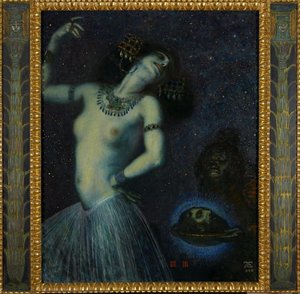
The artistic universe of Franz von Stuck is populated by recurring motifs that reveal his profound engagement with timeless themes. Mythology served as a constant source of inspiration, drawing from Greek, Roman, and biblical narratives which he reimagined with a distinctly personal flair. These weren’t mere retellings; they were explorations of the human condition filtered through the lens of ancient stories. Equally prominent was his fascination with sensuality and the femme fatale, powerfully embodied in his numerous depictions of Salome – a figure representing desire, danger, and moral ambiguity. These paintings weren’t simply about physical beauty; they delved into the psychological complexities of female power and its potential for both allure and destruction. Underlying all this was a deep reverence for classical art, evident in his meticulous technique, anatomical accuracy, and compositional rigor. Beyond Böcklin, Stuck acknowledged influences from the Pre-Raphaelites and Gustave Moreau, but he wasn’t merely an imitator; he synthesized these influences into something uniquely his own, profoundly impacting subsequent generations of artists.Legacy and Influence: A Teacher and a Knight
In 1895, Franz von Stuck took on another crucial role – that of teacher at the Munich Academy. He became a highly respected instructor, not only imparting technical skills but also encouraging his students to explore their individual artistic visions. Among those who benefited from his guidance were luminaries such as Paul Klee, Hans Purrmann, and Josef Albers, demonstrating the breadth of his influence. His dedication to art was further recognized in 1905 when he was ennobled, becoming “Ritter von Stuck” – a testament to his growing prestige and contribution to German culture. He continued to receive accolades throughout Europe, solidifying his position as one of the leading artists of his time. His Villa Stuck in Munich, now a museum, stands as a lasting monument to his life and work, offering invaluable insights into his artistic vision and the cultural milieu of late 19th and early 20th-century Germany. His legacy endures not only through his paintings and sculptures but also through the countless artists he inspired, ensuring that the spirit of Franz von Stuck continues to resonate within the art world today.Major Works and Enduring Significance
- The Spring (1886): A vibrant depiction showcasing his early mastery of color and composition.
- Dissonance (1893): An unsettling portrayal embodying emotional turmoil through a woman playing the violin.
- Salome (various versions): Perhaps his most iconic work, depicting the biblical story with striking sensuality and psychological depth.
- Athlete (1892): A powerful sculpture demonstrating his skill in three-dimensional form.
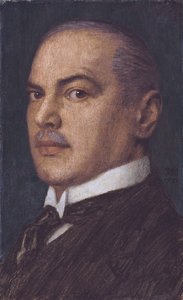
Franz Ritter von Stuck
1863 - 1928 , Germany
Quick Facts
- Artistic Movement Or Style: Symbolism, Art Nouveau
- Artists Or Movements Influenced By This Artist:
- Paul Klee
- Wassily Kandinsky
- Artists Who Influenced This Artist:
- Arnold Böcklin
- Pre-Raphaelites
- Gustave Moreau
- Date Of Birth: February 23, 1863
- Date Of Death: August 30, 1928
- Full Name: Franz Ritter von Stuck
- Nationality: German
- Notable Artworks:
- The Guardian of Paradise
- Salome
- The Sin
- Athlete
- Dissonance
- Place Of Birth: Tettenweis, Germany
Related Articles
German Expressionism's 10 Defining Masterpieces | Art for Your Home
Explore 10 defining German Expressionism masterpieces – from Munch's 'The Scream' to Kandinsky’s abstracts. Discover the artists, stories & bold colors behind this powerful art movement. Find museum-quality reproductions at ArtsDot.com.
The Noble Steed on Canvas: A Historical & Artistic Exploration of Horse Painting Across Cultures
Explore the rich history of horse painting! Discover masterpieces from Stubbs to Munnings & learn about symbolism, techniques & artists. Find museum-quality reproductions at ArtsDot.
Echoes of Olympus: Mythological Narratives in Western Art Through the Ages
Explore the captivating history of mythological narratives in Western art! From ancient Greece to modern masterpieces, discover iconic artworks & symbolism. Expert analysis and high-quality reproductions at ArtsDot.
The Equine Muse: A Historical & Artistic Exploration of Horses in Painting
Explore the captivating history of horses in painting! Discover Renaissance masterpieces, Baroque grandeur & expert insights for collecting equestrian art. Learn about symbolism, techniques & lasting value with ArtsDot.
The Noble Steed: A Historical and Artistic Exploration of Horses in Fine Art
Explore the rich history of horses in fine art! From ancient depictions to Renaissance masterpieces & beyond, discover iconic artworks and artists. Learn about symbolism, techniques, and find museum-quality reproductions at ArtsDot.