 Preview
 Send
Send Share
Share
 Details

 Download
 Similars
 X-Ray
X-Ray Diaporama
Design for a City Gate


 Read More
Hand Made Oil Reproduction
Hand-painted oil on canvas in your size and frame, made to order by our artists. ( Buy Print Buy Image)




































Pick from our preset sizes that match the artwork's original proportions.

You may enter your own dimensions to fit a specific frame or space. If your selected size does not match the original image's proportions, we will either crop the artwork or extend the painting with additional hand-painted elements. A digital mockup will be sent for your approval before production begins.
Please note that the on-screen preview does not reflect the actual cropping or extension. Only the mockup will accurately show the final composition.
While custom sizes are available, we recommend selecting a dimension from the predefined list to preserve the original proportions.
After order, ArtsDot.com team will email client for instructions and provide a mockup preview
Worldwide Delivery () in 3/4 weeks instead of standard 5 weeks. (17 August). No compromise on quality.

Free Worldwide Express Shipping

High-Quality Linen Canvas

Full Shipping Insurance

Customs Tax Refund Guarantee

True Color Matching Guarantee

60-Day Return Policy (Defects Only)

100% Money-Back Guarantee

Bulk Discount Offer
 Glass option is only available in size under 110 CM

Design for a City Gate
Reproduction Medium
Reproduction Size
-


Total Price
$ 263
Artwork Description
A Vision of Neoclassical Grandeur
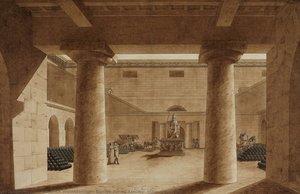
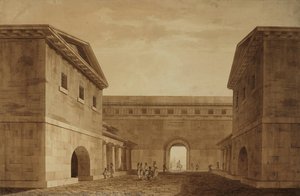
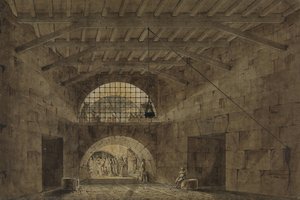
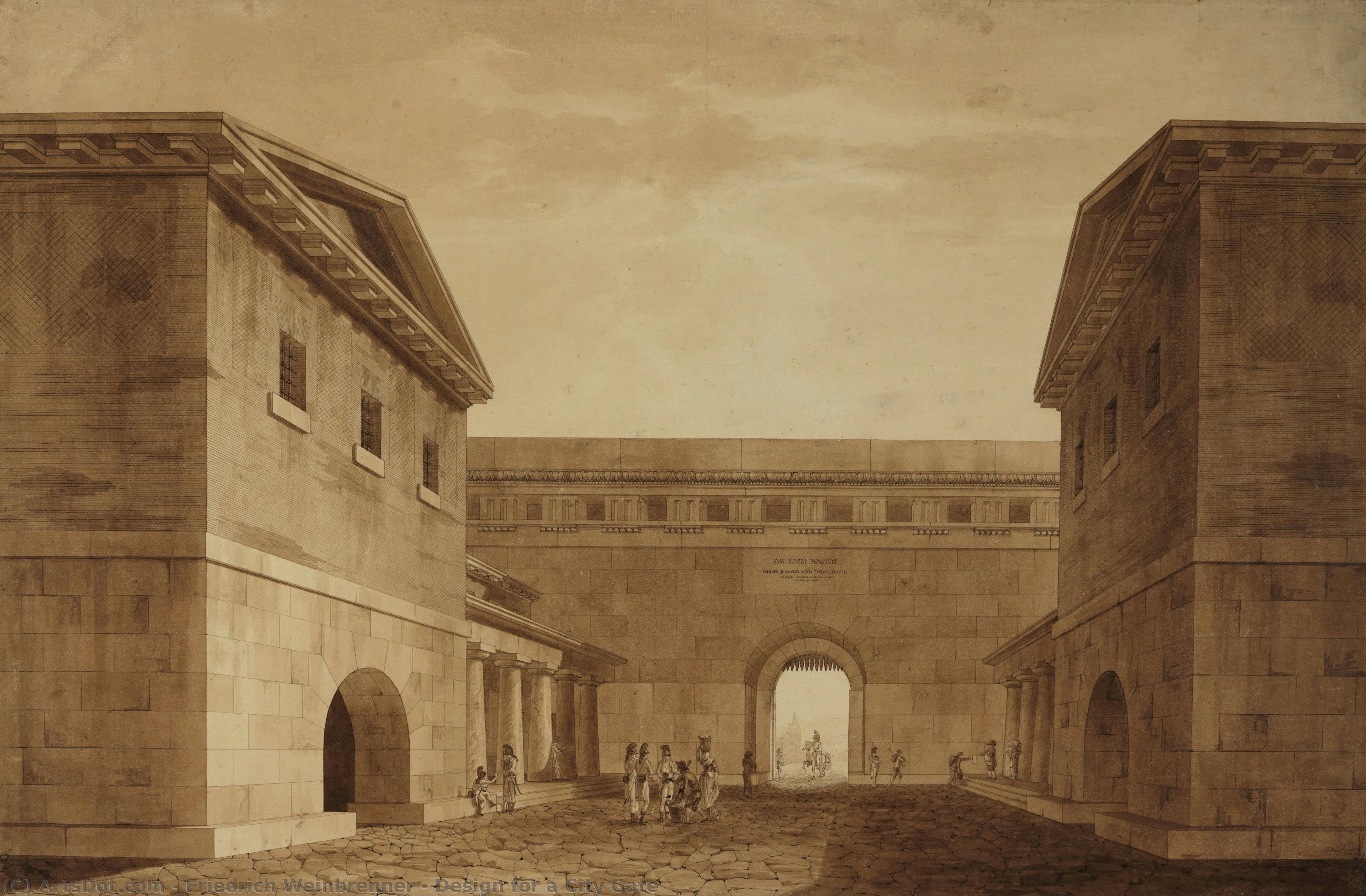
In the delicate interplay of line and light captured within Design for a City Gate, we find ourselves transported to the twilight of the eighteenth century. Created in 1794 by the master German architect and urban planner Friedrich Weinbrenner, this exquisite work serves as more than a mere architectural blueprint; it is a window into an era defined by the pursuit of classical order and civic pride. The composition centers on a magnificent city gate, flanked by two imposing towers that stand as silent sentinels of stability. Through the sweeping archway, the viewer is invited to peer into the heart of a bustling urban landscape, where the rhythmic movement of figures and the gentle presence of a boat upon the water suggest a world in harmonious motion. The piece breathes with the quiet dignity of an age seeking to reconstruct its identity through the timeless language of antiquity.
The technical mastery displayed in this work reflects Weinbrenner’s profound immersion in the architectural traditions of the past. Having traveled extensively through Italy, studying the weathered majesty of Pompeii and Paestum, Weinbrenner infused his designs with a Neoclassical precision that is palpable even in this early drawing. The artist utilizes a delicate, controlled technique to define the structural integrity of the gate, emphasizing the strength of the masonry and the mathematical elegance of the arch. There is a subtle, atmospheric quality to the way the light interacts with the scene, creating a sense of depth that draws the eye from the immediate foreground toward the distant, hazy horizon of the city. For the discerning collector or interior designer, this piece offers a sophisticated textural element, providing a focal point that balances structural strength with ethereal grace.
Beyond its architectural significance, Design for a City Gate resonates with a deep emotional and symbolic resonance. The gate itself acts as a powerful metaphor for transition—a threshold between the wilder, external world and the structured, civilized interior of the city. It represents security, progress, and the human desire to create lasting monuments that defy the passage of time. The inclusion of small, scattered figures adds a layer of narrative intimacy, reminding us that these grand structures are built to house the pulse of human life. To display a high-quality reproduction of this work is to invite an atmosphere of intellectual curiosity and historical reverence into a space. It serves as an evocative conversation piece, perfect for those who appreciate the intersection of fine art, urban history, and the enduring beauty of classical aesthetics.
Related Artworks

Artist Biography
Friedrich Weinbrenner: Life and Legacy
Early Life and Education
- Friedrich Weinbrenner was born on November 24, 1766, in Karlsruhe, Germany.
- He initially trained as a carpenter under his father before pursuing a career in architecture and urban planning.
- From 1788, he gained practical experience working as a builder in Zürich and Lausanne.
- In 1790, Weinbrenner moved to Vienna to study architecture, largely self-taught, before formalizing his education at the Bauakademie in Vienna and Dresden (1790–91).
- Further exposure to Palladian architecture came during a period in Berlin (1791–92), influenced by architects like Carl Gotthard Langhans and David Gilly.
- A pivotal experience was his time in Italy from 1792 to 1797, where he studied ancient Roman buildings – particularly at Pompeii, Herculaneum, and Paestum – profoundly shaping his aesthetic sensibilities.
Artistic Development and Influences
- Weinbrenner’s architectural style is firmly rooted in Neoclassicism, emphasizing classical elements such as columns, arches, and domes.
- His work reflects a commitment to simplicity, elegance, and meticulous detail.
- Key influences included Carl Ludwig Fernow during his Italian period, and earlier architects like Langhans and Gilly who introduced him to Palladian principles.
- He was among the first German architects to thoroughly study early Doric temples at Paestum, which significantly impacted his designs.
Major Achievements and Notable Works
- Upon returning to Karlsruhe, Weinbrenner became the city’s official architect, playing a crucial role in its development.
- Some of his most significant works include:
- Karlsruhe Synagogue (1798–1800)
- Palace (1803–14) – partially reconstructed after WWII
- Karlsruhe Court Theater (1804–08)
- City Hall (1821–25)
- Protestant Church (Stadtkirche) (1807–16)
- St Stephan Catholic Church (1808-14)
- He also designed various other buildings, including museums, gates, and bathhouses within Karlsruhe.
- In 1825, he helped establish the Polytechnic School in Karlsruhe, contributing to architectural education.
Historical Significance and Legacy
- Weinbrenner is considered a pivotal figure in establishing a distinct “Weinbrenner style” of Classicism.
- His work was instrumental in shaping Karlsruhe as a classically designed city.
- He trained a generation of architects who continued to propagate his aesthetic principles.
- Many of his buildings were destroyed during World War II but have been reconstructed, demonstrating their enduring importance.
- His designs continue to inspire architects and urban planners today, solidifying his place in architectural history.
Death
- Friedrich Weinbrenner passed away on March 1, 1826, in Karlsruhe, leaving behind a lasting legacy of Neoclassical architecture and urban planning.
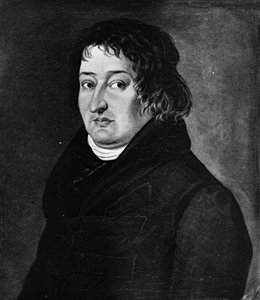
Friedrich Weinbrenner
1766 - 1826 , Germany
Quick Facts
- Birth Date: 1766
- Birth Place: Karlsruhe, Germany
- Death Date: 1826
- Influenced By:
- Carl Gotthard Langhans
- David Gilly
- Hans Christian Genelli
- Carl Ludwig Fernow
- Movement: Neoclassical architecture
- Name: Friedrich Weinbrenner
- Nationality: German
- Notable Works:
- Karlsruhe Synagogue
- Palace (Karlsruhe)
- City Hall (Karlsruhe)
- Protestant Church (Karlsruhe)
Related Articles

The Nuances of Graphite: Exploring Emotional Depth & Technical Mastery in Pencil Drawing
Explore the captivating world of graphite drawing! Discover its rich history, master essential techniques like chiaroscuro, and learn how artists evoke emotion through this timeless medium. Expert insights for art enthusiasts.
Neoclassical Art: 10 Masterpieces That Shaped History |
Explore 10 defining Neoclassical masterpieces by David, Ingres & Canova. Discover the history, symbolism & artistry behind these iconic paintings and sculptures. Find museum-quality art reproductions at – elevate your home with timeless beauty.

The Enduring Power of Line: Exploring Themes & Techniques in Drawing Across Art History
Explore the rich history of drawing! Discover key techniques like linear perspective & iconic artists from the Renaissance to modern times. Enhance your art appreciation with ArtsDot.
Frederick Bridgman: Anatomical Mastery & the Evolution of Figure Drawing Instruction
Explore the anatomical mastery of George B. Bridgman & his revolutionary figure drawing techniques. Discover how his methods transformed art instruction and continue to inspire artists today. Learn more at ArtsDot.

The Revival of Antiquity: Exploring Neoclassical Art's Ideals & Enduring Legacy
Explore the revival of classical ideals in Neoclassical art! Discover Jacques-Louis David & the movement's impact on painting, sculpture & architecture. Expert insights & high-quality reproductions at ArtsDot.