 Preview
 Send
Send Share
Share
 Details

 Download
 Similars
 X-Ray
X-Ray Diaporama
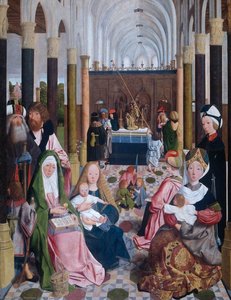
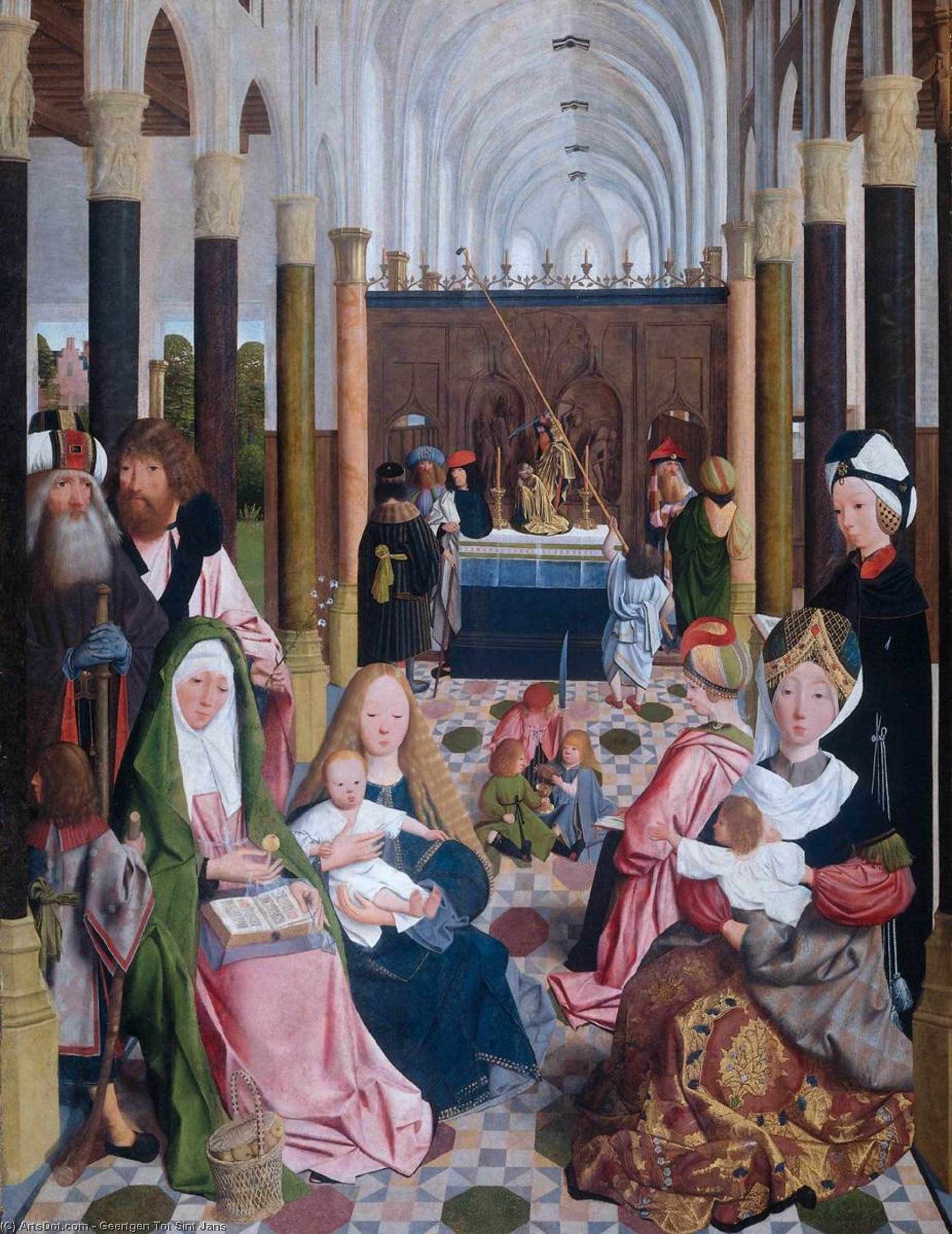
The Holy Kinship
 Oil On Panel
- Early Netherlandish Painting
 1485
1485 137.0 x 105.0 cm
 Rijksmuseum
 Read More
Hand Made Oil Reproduction
Hand-painted oil on canvas in your size and frame, made to order by our artists. ( Buy Print Buy Image)




P118B $10

P118H $10

P118W $10

P438Z $10

P508JH $12

P508YH $12

P805H $10

P805Z $10

P919BZ $10

P919G $10

P919XJ $10

P959ZH $10

P968JZ $12

W106C $8

W218G $10

W218JH $8

W218Y $10

W307PJ $10

W316G $10

W316PJ $8

W316Y $10

W398PJ $8

W4111J $10

W500HY $15

W500JH $15

W692G $12

W849H $8

W940BG $15

W953PJ $8




Pick from our preset sizes that match the artwork's original proportions.

You may enter your own dimensions to fit a specific frame or space. If your selected size does not match the original image's proportions, we will either crop the artwork or extend the painting with additional hand-painted elements. A digital mockup will be sent for your approval before production begins.
Please note that the on-screen preview does not reflect the actual cropping or extension. Only the mockup will accurately show the final composition.
While custom sizes are available, we recommend selecting a dimension from the predefined list to preserve the original proportions.
After order, ArtsDot.com team will email client for instructions and provide a mockup preview
Worldwide Delivery () in 3/4 weeks instead of standard 5 weeks. (16 August). No compromise on quality.

Free Worldwide Express Shipping

High-Quality Linen Canvas

Full Shipping Insurance

Customs Tax Refund Guarantee

True Color Matching Guarantee

60-Day Return Policy (Defects Only)

100% Money-Back Guarantee

Bulk Discount Offer
 Glass option is only available in size under 110 CM

The Holy Kinship
Reproduction Medium
Reproduction Size
-


Total Price
$ 263
Artwork Description
A Moment of Shared Humanity – The Genesis of Geertgen’s Masterpiece
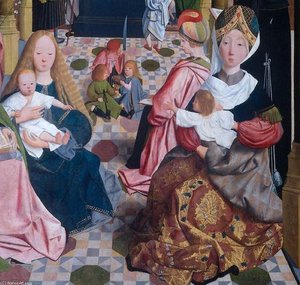
Geertgen tot Sint Jans' “The Holy Kinship,” painted in 1485, isn’t merely a religious scene; it’s a meticulously crafted tableau vivant—a snapshot of everyday life imbued with profound spiritual significance. This panel, now housed within the Rijksmuseum in Amsterdam, transports us to an imagined medieval church interior, a space brimming with activity and a palpable sense of community. The painting immediately draws the eye to the central grouping: the Virgin Mary cradling the infant Jesus, her mother Anne seated beside her, and Joachim, their husband, standing respectfully behind. Yet, it’s not just this core family that dominates the composition; surrounding them is a vibrant tapestry of figures – Elizabeth, John the Baptist, and his mother Salome, all connected through familial ties, forming what we now recognize as the Holy Kinship.
The scene unfolds within a richly detailed architectural setting. High ceilings suggest a sense of grandeur, while scattered books, cups, bowls, and vases hint at a social gathering alongside the religious observance. Notice the deliberate inclusion of objects – a book held by Anne, a chalice being poured into by young children – elements that elevate this depiction beyond a simple devotional image, suggesting a moment of shared fellowship and domesticity. The artist’s masterful use of light and shadow creates depth and atmosphere, guiding our gaze across the crowded room and emphasizing the emotional resonance of each figure.
The Mystery of the Artist and His Patronage
The identity of Geertgen tot Sint Jans remains shrouded in intriguing mystery. Our knowledge of his life is largely pieced together from the writings of Karel van Mander, a Dutch art historian writing over a century after the artist’s death. Van Mander suggests a connection to the Knights Hospitaller of Saint John in Haarlem, lending the artist his distinctive surname – “little Gerard of Saint John.” While the precise nature of this association remains debated, it undoubtedly shaped his artistic output, influencing both subject matter and stylistic choices.
The panel’s creation coincided with a period of significant religious and social change in the Netherlands. The Knights Hospitaller were a powerful order, deeply involved in civic life and possessing considerable wealth. It's plausible that this commission was intended as an altarpiece for their chapel within Haarlem, reflecting both their piety and their commitment to fostering community. The inclusion of children playing – a detail often overlooked – adds a layer of complexity, suggesting a deliberate engagement with the future generation and perhaps even a subtle critique of worldly pursuits.
Symbolism Woven into Everyday Life
“The Holy Kinship” is rich in symbolic details that invite interpretation. The central act of pouring wine into a chalice represents the Eucharist, a cornerstone of Christian faith. The presence of Abraham’s sacrifice of Isaac on an altar subtly alludes to Christ's own sacrificial death, reinforcing the overarching theme of redemption and divine grace. Even the seemingly mundane – the books, the cups – carry symbolic weight, representing knowledge, hospitality, and the values of the medieval household.
The depiction of the children engaged in playful activity is particularly noteworthy. These aren’t simply children; they are depicted as future martyrs, their game a poignant reminder of the promise of eternal life for those who remain faithful. This deliberate inclusion elevates the scene beyond a simple family portrait, transforming it into a meditation on faith, hope, and the enduring power of community. The panel's composition invites viewers to contemplate not just the divine narrative but also the human experience within that narrative.
A Timeless Masterpiece – Reproduction Possibilities
ArtsDot offers meticulously crafted hand-painted reproductions of “The Holy Kinship,” allowing you to bring this extraordinary artwork into your home or office. Our skilled artists replicate Geertgen’s masterful technique, capturing the subtle nuances of light, shadow, and color with breathtaking accuracy. Whether you choose a large-scale statement piece for a grand room or a smaller, more intimate reproduction for a study, our reproductions provide an authentic representation of this iconic work.
More than just a beautiful image, “The Holy Kinship” is a window into the medieval world—a testament to faith, family, and the enduring power of human connection. Explore our collection today and discover how you can own a piece of art history.
Related Artworks
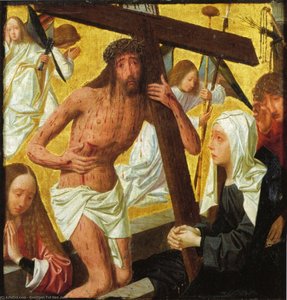
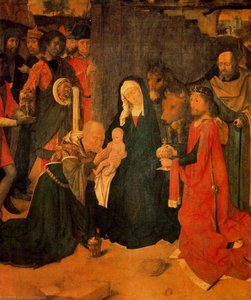
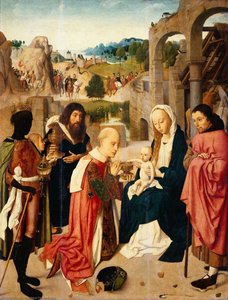
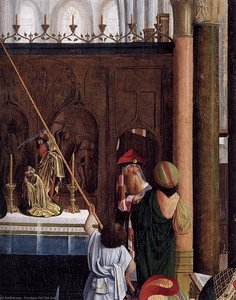
Artist Biography
A Life Shrouded in Mystery: Unveiling Geertgen tot Sint Jans
The name Geertgen tot Sint Jans resonates softly within the annals of Early Netherlandish painting, a whisper of brilliance from an artist whose life remains frustratingly obscure. Flourishing in Haarlem during the latter half of the 15th century—roughly between 1460 and 1490—Geertgen’s existence is pieced together primarily through the writings of Karel van Mander, a Dutch art historian writing over a century after his death. Van Mander suggests a connection to the Knights Hospitaller of Saint John in Haarlem, lending the artist his distinctive surname, meaning “little Gerard of Saint John.” Whether he was a lay brother within the order or simply affiliated with them remains uncertain, yet this association profoundly shaped his artistic output. The scant documentary evidence surrounding Geertgen’s life contributes to an aura of mystique, allowing us to focus intently on the remarkable quality and spiritual depth of his surviving works. It is believed that he may have been a student of Albert van Ouwater, a pivotal figure in the development of painting within Haarlem, though concrete proof remains elusive.The Fragmentary Legacy: Surviving Masterpieces
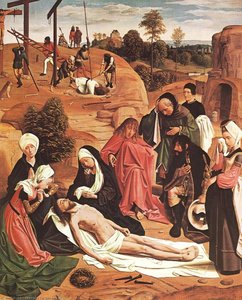
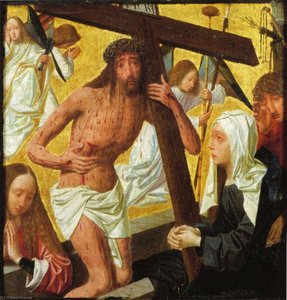
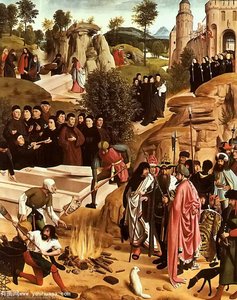
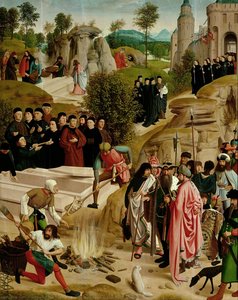
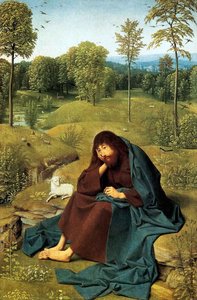
Tragically, much of Geertgen’s oeuvre has been lost to time and circumstance. The tumultuous history of Haarlem, particularly the siege of 1573 during the Eighty Years' War, resulted in the destruction of numerous artworks, including a significant portion of his production. What remains offers tantalizing glimpses into an exceptional talent. The most celebrated surviving pieces are fragments of a large triptych originally created for the altar of the Knights of Saint John. These panels—The Legend of Saint John the Baptist and The Lamentation of Christ—now reside in Vienna’s Kunsthistorisches Museum, their separation from the original structure a poignant reminder of art's vulnerability to historical forces. The Lamentation, particularly, is renowned for its serene emotionality and innovative landscape, foreshadowing developments that would characterize Dutch painting in the centuries to come. Other attributed works include John the Baptist in the Wilderness, a contemplative depiction of spiritual isolation, and Man of Sorrows, a powerfully moving portrayal of Christ’s suffering. Each surviving panel is a testament to Geertgen's mastery of oil painting techniques, his delicate handling of light, and his ability to imbue religious scenes with profound psychological resonance.Innovation in Landscape and Spirituality
Geertgen tot Sint Jans distinguished himself through several key artistic innovations. He possessed an exceptional sensitivity to landscape, integrating it seamlessly into the narrative structure of his paintings. Unlike many of his contemporaries who used landscapes merely as backdrops, Geertgen’s settings are imbued with symbolic meaning and contribute significantly to the overall emotional impact of the work. His landscapes aren't simply realistic depictions; they evoke a sense of spiritual tranquility and reflect the inner state of the figures within them. Furthermore, Geertgen demonstrated a remarkable ability to convey emotion through subtle gestures and facial expressions. His figures are not grand or theatrical but possess an intimate humanity that draws the viewer into their world of faith and sorrow. The use of chiaroscuro—the dramatic interplay of light and shadow—is also notable, enhancing the emotional intensity of his scenes and creating a sense of depth and realism. This technique is particularly evident in The Nativity at Night, where darkness envelops the scene, punctuated by the radiant glow emanating from the infant Christ.A Lasting Influence: Geertgen’s Place in Art History
Despite the limited number of securely attributed works, Geertgen tot Sint Jans occupies a significant position within the history of Early Netherlandish art. His influence can be detected in the work of later Dutch masters, particularly those associated with the Haarlem school. His innovative approach to landscape and his sensitive portrayal of human emotion paved the way for developments that would define Dutch painting in the 17th century. The impact of The Lamentation, as evidenced by Jacob Matham’s engraving and accompanying poetry, demonstrates the profound effect Geertgen's work had on his contemporaries. While overshadowed by more prolific artists like Jan van Eyck or Rogier van der Weyden during his lifetime, modern scholarship has increasingly recognized Geertgen’s unique contributions to the Northern Renaissance. He represents a crucial link between the International Gothic style and the burgeoning realism of the 16th century, embodying a delicate balance between spiritual devotion and artistic innovation. His legacy endures not only through his surviving masterpieces but also through the enduring mystery that surrounds his life—a testament to the power of art to transcend the limitations of historical knowledge.Rediscovering a Master
- Early Netherlandish Painting: Geertgen’s work is firmly rooted in the traditions of Early Netherlandish painting, characterized by meticulous detail, realistic depictions, and a focus on religious themes.
- Haarlem School: He played a key role in establishing the Haarlem school of painting, influencing subsequent generations of artists working in the region.
- Spiritual Depth: His paintings are notable for their profound spiritual depth and emotional resonance, inviting viewers to contemplate themes of faith, suffering, and redemption.
- Landscape Innovation: Geertgen’s innovative use of landscape as an integral part of the narrative structure set him apart from many of his contemporaries.
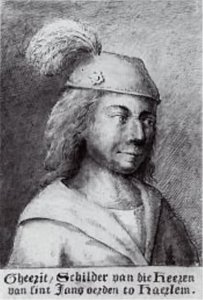
Geertgen tot Sint Jans
1460 - 1490 , Netherlands
Quick Facts
- Artistic Movement Or Style: Early Netherlandish painting
- Artists Or Movements Influenced By This Artist:
- Rembrandt
- Frans Hals
- Artists Who Influenced This Artist: ['Albert van Ouwater']
- Date Of Birth: 1460
- Date Of Death: 1490
- Full Name: Geertgen tot Sint Jans
- Nationality: Dutch
- Notable Artworks:
- Lamentation of Christ
- The Legend of St. John
- John the Baptist in Wilderness
- Man of Sorrows
- Place Of Birth: Leiden, Netherlands
Related Articles

Early Netherlandish Masters: 10 Paintings That Revolutionized Art & Decor
Journey into the world of Early Netherlandish painting! Explore 10 masterpieces by Jan van Eyck, Rogier van der Weyden & more. Discover stunning detail, symbolism & Renaissance art for your home decor. Find museum-quality reproductions on ArtsDot.com
Jan Gossart: Bridging Netherlandish Realism & Renaissance Humanism – A Comprehensive Exploration
Explore the captivating world of Jan Gossart, a pivotal figure bridging Netherlandish realism & Renaissance humanism. Discover his masterpieces, patronage, and lasting influence – an essential guide for discerning art collectors.
Jan Gossaert (Mabuse): Pioneering Renaissance Style & the Birth of Netherlandish Antiquity
Explore the groundbreaking art of Jan Gossaert (Mabuse), a pioneer of Renaissance painting in the Low Countries. Discover his Romanist style, stunning portraits, and influence on Northern European art history.
Illuminating Realism: A Comprehensive Exploration of the Early Netherlandish Renaissance Movement
Explore the captivating world of Early Netherlandish painting! Discover Jan van Eyck & other Flemish masters, their revolutionary techniques, hidden symbolism, and lasting legacy. A comprehensive guide for art enthusiasts.
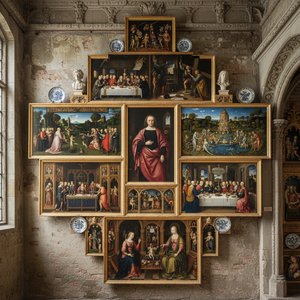
Early Netherlandish Masters: 10 Paintings That Revolutionized Art & Decor
Journey into the Early Netherlandish Renaissance! Explore 10 iconic paintings by Jan van Eyck, Rogier van der Weyden & more. Discover stunning detail, symbolism, and oil painting techniques. Find museum-quality art reproductions for your home at ArtsDot.com.