 Preview
 Send
Send Share
Share
 Details

 Download
 Similars
 X-Ray
X-Ray Diaporama
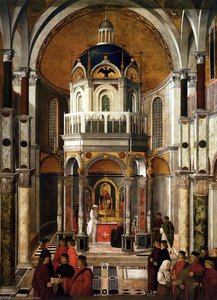
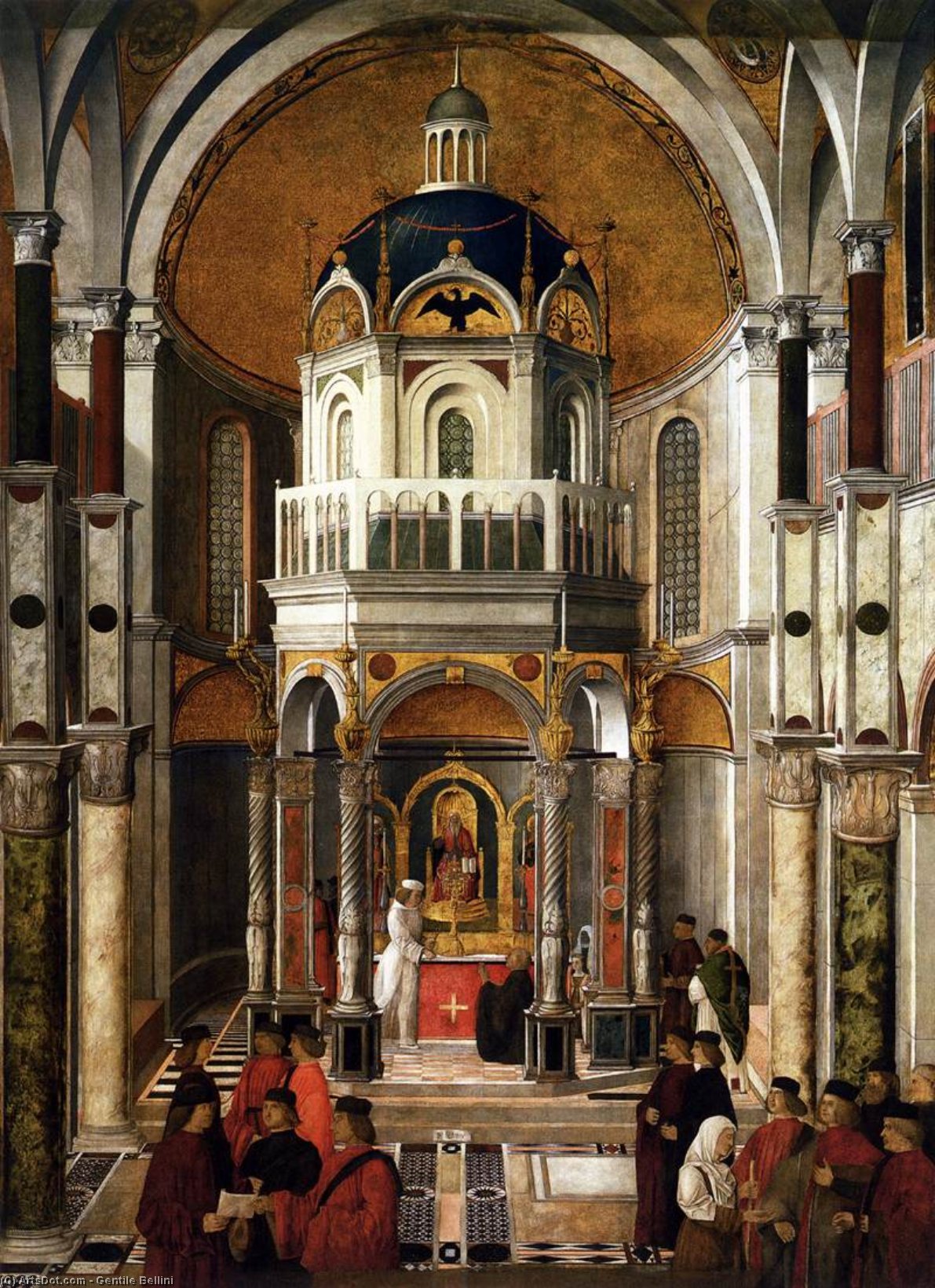
The Healing of Pietro dei Ludovici
 Oil On Canvas
- WallArt
- Renaissance
 1501
1501 369.0 x 259.0 cm
 Gallerie dell'Accademia
 Read More
Hand Made Oil Reproduction
Hand-painted oil on canvas in your size and frame, made to order by our artists. ( Buy Print Buy Image)




P118B $10

P118H $10

P118W $10

P438Z $10

P508JH $12

P508YH $12

P805H $10

P805Z $10

P919BZ $10

P919G $10

P919XJ $10

P959ZH $10

P968JZ $12

W106C $8

W218G $10

W218JH $8

W218Y $10

W307PJ $10

W316G $10

W316PJ $8

W316Y $10

W398PJ $8

W4111J $10

W500HY $15

W500JH $15

W692G $12

W849H $8

W940BG $15

W953PJ $8




Pick from our preset sizes that match the artwork's original proportions.

You may enter your own dimensions to fit a specific frame or space. If your selected size does not match the original image's proportions, we will either crop the artwork or extend the painting with additional hand-painted elements. A digital mockup will be sent for your approval before production begins.
Please note that the on-screen preview does not reflect the actual cropping or extension. Only the mockup will accurately show the final composition.
While custom sizes are available, we recommend selecting a dimension from the predefined list to preserve the original proportions.
After order, ArtsDot.com team will email client for instructions and provide a mockup preview
Worldwide Delivery () in 3/4 weeks instead of standard 5 weeks. (2 September). No compromise on quality.

Free Worldwide Express Shipping

High-Quality Linen Canvas

Full Shipping Insurance

Customs Tax Refund Guarantee

True Color Matching Guarantee

60-Day Return Policy (Defects Only)

100% Money-Back Guarantee

Bulk Discount Offer
 Glass option is only available in size under 110 CM

The Healing of Pietro dei Ludovici
Reproduction Medium
Reproduction Size
-


Total Price
$ 263
A Miracle in Red and Gold: Unveiling Gentile Bellini’s “The Healing of Pietro dei Ludovici”
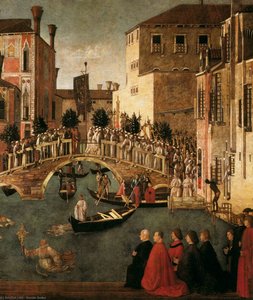
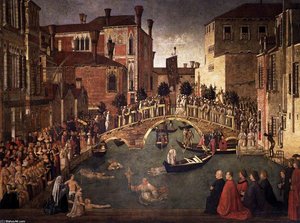
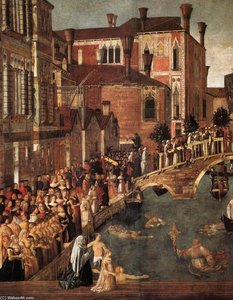
Gentile Bellini's "The Healing of Pietro dei Ludovici," painted around 1501, is more than just a religious scene; it’s a vibrant window into the heart of Venetian Renaissance society and a testament to the artist’s mastery of color, composition, and narrative. This captivating work, now housed in a high-quality reproduction, transports us to a moment of profound faith and miraculous healing within the serene confines of a Venetian chapel. The painting immediately draws the eye with its rich palette – deep reds dominate, echoing the robes of Pietro and his companion, contrasted beautifully against the luminous gold of the altar and architectural details. Bellini’s signature style is evident here: a masterful blend of realism and idealized beauty, creating figures that are both deeply human and imbued with an ethereal quality.
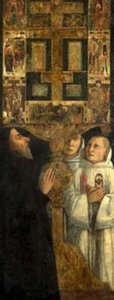
- Subject Matter: The scene depicts Pietro dei Ludovici, a man afflicted by illness, receiving miraculous healing through contact with a relic of the Holy Cross. This event, rooted in Christian legend, speaks to themes of divine intervention, faith’s power, and the alleviation of suffering – potent subjects for devotional art in Renaissance Venice.
- Composition: Bellini employs a carefully balanced composition, guiding the viewer's eye through the scene with converging lines and strategic placement of figures. The central focus is on Pietro and his companion, rendered with exquisite detail, while surrounding figures—including attendants and onlookers—add depth and context to the miracle.
- Technique: Executed in tempera on canvas, Bellini demonstrates a remarkable command of color and texture. His use of layering and glazing creates a luminous effect, capturing the play of light and shadow with breathtaking realism. The artist’s skillful rendering of architectural elements—the chapel's interior, complete with altar and ciborium—adds to the painting’s immersive quality.
The Venetian Context: Patronage, Faith, and Artistic Innovation
To fully appreciate “The Healing of Pietro dei Ludovici,” it’s crucial to understand its historical context within Venice. The city was a thriving center of trade, art, and religious fervor during the 15th and 16th centuries. Wealthy Venetian families, known as *scuole grandi*, commissioned elaborate devotional paintings to adorn their chapels and demonstrate their piety. These paintings were not merely decorative; they served as powerful symbols of faith and social status. Bellini’s work exemplifies this trend, reflecting the patronage of a prominent religious confraternity. Furthermore, Bellini was one of the first Venetian painters to fully embrace oil paint, allowing for richer colors and greater detail than previously possible with tempera.
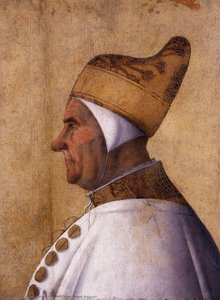
Gentile Bellini's role as official painter of the Doges solidified his position at the heart of Venetian power and society. This prestigious commission shaped his artistic trajectory, placing him at the center of Venetian life and influencing his style and subject matter.Symbolism and Spiritual Resonance
Beyond its narrative content, “The Healing of Pietro dei Ludovici” is rich in symbolic meaning. The red robes worn by Pietro and his companion represent their devotion and sacrifice. The relic of the Holy Cross itself symbolizes divine grace and redemption. The architectural details—particularly the altar and ciborium—evoke a sense of sacred space and spiritual transcendence. Bellini’s use of light and shadow further enhances the painting's emotional impact, creating an atmosphere of reverence and awe. The inclusion of Pietro’s self-portrait within the scene adds a layer of intimacy and invites the viewer to connect with the miracle on a personal level.
A Timeless Masterpiece: Reproduction and Artistic Legacy
Today, “The Healing of Pietro dei Ludovici” continues to captivate audiences with its beauty and spiritual depth. High-quality reproductions offer an accessible way to experience this remarkable work of art, bringing its vibrant colors and compelling narrative into any space. Bellini’s influence can be seen in the works of subsequent Venetian painters, and his painting remains a cornerstone of Renaissance art history. Its enduring appeal lies not only in its technical brilliance but also in its ability to evoke profound emotions and inspire contemplation on themes of faith, healing, and the power of divine grace.
Related Artworks
Artist Biography
A Venetian Renaissance Master
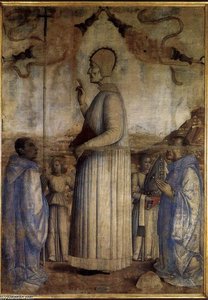
Gentile Bellini, born in Venice in 1429, emerged from a family deeply entrenched in the artistic heart of the city. His father, Jacopo Bellini, was a pioneering figure who embraced the relatively new medium of oil paint, and his younger brother, Giovanni, would later achieve renown as one of Venice’s most celebrated masters. Gentile's initial training unfolded within his father’s workshop, where he mastered the techniques that would define his career. One of Venice’s oldest surviving oil paintings, The Blessed Lorenzo Giustinian (1445), stands as a testament to this early skill and is now housed in the Accademia Museum. From these beginnings, Gentile quickly distinguished himself, earning recognition for his remarkable talent in portraiture and securing his position as the official painter of the Doges – the rulers of Venice. This prestigious role would profoundly shape his artistic trajectory, placing him at the center of Venetian power and society.Influences and Artistic Development
Gentile Bellini’s style was a fascinating synthesis of diverse influences. The rich traditions of the Byzantine Empire cast a long shadow over Venetian art, imbuing it with a distinctive aesthetic that resonated in Gentile's work through stylized figures and opulent color palettes. However, his artistic horizons expanded dramatically following an extraordinary journey to Constantinople in 1479. Invited by Sultan Mehmed II himself, Bellini spent time at the Ottoman court, an experience that proved pivotal in shaping his later creations. This encounter with a different culture, architecture, and way of life infused his paintings with a unique perspective. His portrait of Mehmed II, now residing in the National Gallery, London, is a striking example of this influence – a compelling depiction of power and personality informed by firsthand observation. Gentile’s compositions often feature grand scale scenes populated with numerous figures, reflecting the demands of commissions from Venice's powerful Scuole Grandi, major confraternities that played a vital role in civic life.Masterpieces and Artistic Legacy
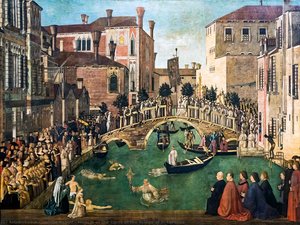
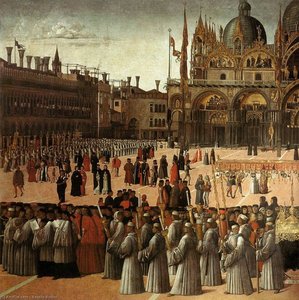
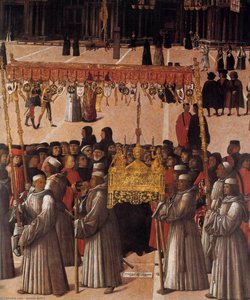
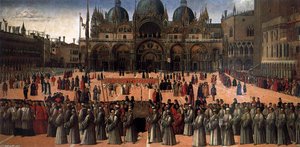
Among Gentile Bellini’s most celebrated works are two monumental paintings: The Procession of the True Cross in Piazza San Marco (1496) and The Miracle of the True Cross at the S. Lorenzo Bridge (c. 1500). The former is a breathtaking panorama of Venetian life, capturing the energy and spectacle of a religious procession with meticulous detail. It showcases his ability to portray large crowds and intricate architectural settings with remarkable precision. The Miracle of the True Cross at the S. Lorenzo Bridge is particularly noteworthy for its inclusion of self-portraits – both Gentile’s own likeness and that of his brother, Giovanni Bellini. This subtle artistic collaboration offers a fascinating glimpse into their relationship and creative dialogue. Beyond individual paintings, Gentile Bellini holds an important place in art history as one of the founders of Orientalist art—a movement characterized by depictions of Eastern cultures and settings.Historical Significance
Gentile Bellini’s legacy rests on several key achievements. His pioneering use of oil paint solidified its position as the dominant medium in Venetian painting, allowing for greater detail, luminosity, and realism. Furthermore, his exposure to Ottoman culture and subsequent incorporation of Eastern motifs into his work established him as a significant figure in the development of Orientalist art—a trend that would captivate European artists for centuries. While often overshadowed by the fame of his brother Giovanni, Gentile Bellini’s contributions are now widely recognized as essential to understanding the evolution of Western painting. He skillfully blended Venetian artistic traditions with influences from both the Byzantine Empire and Ottoman culture, creating a unique and compelling style that resonated throughout Europe. His work stands as a testament not only to his exceptional skill and talent but also to the power of cultural exchange in shaping artistic innovation.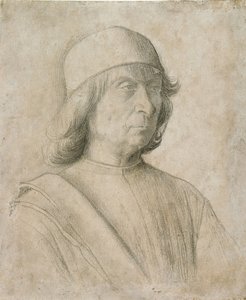
Gentile Bellini
1429 - 1507 , Italy
Quick Facts
- Artistic Movement Or Style: Renaissance
- Artists Or Movements Influenced By This Artist: ['Orientalist art']
- Artists Who Influenced This Artist:
- Jacopo Bellini
- Gentile da Fabriano
- Date Of Birth: 1429
- Date Of Death: 1507
- Full Name: Gentile Bellini
- Nationality: Italian
- Notable Artworks:
- Procession in Piazza San Marco
- Miracle of the True Cross
- Portrait of Mehmed II
- Place Of Birth: Venice, Italy
Related Articles
Pietro Longhi's Venetian Scenes: A Study of Rococo Society & Domestic Life
Explore the captivating world of Pietro Longhi's Venetian scenes! Discover insightful analysis of his Rococo masterpieces & social commentary on 18th-century life. Learn about this 'Venetian Hogarth' and his lasting artistic legacy.

Jacopo Tintoretto's Masterpieces: 25 Paintings That Define Venetian Drama | ArtsDot
Explore 25 breathtaking masterpieces by Jacopo Tintoretto, the Venetian master of drama and light. Discover the stories behind iconic Renaissance paintings & find museum-quality art reproductions to elevate your home decor on ArtsDot.com.
Vittore Carpaccio: Venetian Renaissance Narrative & the Poetics of Detail
Explore the captivating world of Vittore Carpaccio, a master storyteller of the Venetian Renaissance. Discover his intricate details, narrative cycles like 'The Legend of St. Ursula,' and unique artistic style.
The Golden Light of Innovation: Exploring the Venetian Renaissance Art Movement (1430–1580)
Explore the Golden Age of Venetian art (1430–1580). Discover Giorgione, Titian & Tintoretto's techniques, the 'colorito' revolution, and lasting influence. Expert insights for collectors & enthusiasts.
Paolo Veronese: A Renaissance Master of Color, Composition, and Venetian Splendor
Explore the vibrant world of Paolo Veronese, a Renaissance master renowned for his opulent compositions, masterful use of color, and dramatic Venetian scenes. Discover key artworks & legacy.