

 Preview
 Send
Send Share
Share
 Details

 Download
 Similars
 X-Ray
X-Ray Diaporama
JEAN PIERRE THENOT (1803 1857)


 Read More
Purchase a high-resolution, enhanced digital image, far superior to the online preview.
Each file is meticulously prepared by our in-house specialists using advanced tools and expert manual retouching. We ensure every image has exceptional clarity, precise color accuracy, and fine detail.
The final file is delivered via email within 72 hours, optimized for immediate use in professional, editorial, and print environments. This is the same quality trusted by top-tier design studios, publishers, and galleries.
Digital Image
Download a high-resolution file for personal display, printing, and creative projects. ( Buy Print Buy Hand Made Painting)
Included in Every Digital Image Order
Expert Digital Delivery, Guaranteed
When you choose ArtsDot.com, you're not just getting an image - you're receiving a professionally enhanced digital artwork, crafted with precision and backed by a satisfaction guarantee. Here's everything that comes with your order, automatically:

Fast Email Delivery
Your high-resolution digital image file will be emailed to you within 72 hours of ordering - ready for immediate use.

AI-Enhanced Digital File
Your artwork is professionally optimized using advanced AI tools and manual editing, ensuring maximum detail, clarity, and color accuracy.

Free Lifetime Re-Delivery
Accidentally deleted or lost your file? No worries - we'll resend it to you anytime, free of charge.

No Import Fees - Ever
Enjoy your artwork instantly with zero customs, duties, or delivery fees - digital downloads are always tax-free.

Color Accuracy Guarantee
We ensure your digital image reflects the original colors as closely as possible using professional tools and color management.

60-Day Satisfaction Guarantee
If you're not satisfied with your digital image, we'll revise it or refund 100% within 60 days - no questions asked.

100% Money-Back Guarantee
Not satisfied? Get a full refund within 60 days of receiving your digital file - no questions asked.

Bulk Order Discounts
Buy 3 images, save 10% - Buy 5, save 15% - Buy 10+, save 20%. Great for creative projects, galleries, and agencies.
Collectible Description
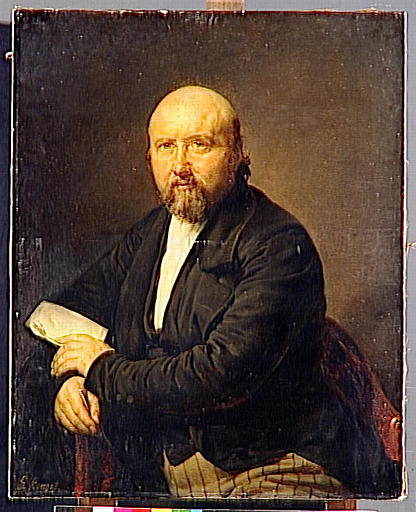
A Portrait of Dignified Resolve: Jean Pierre Thenot by Georges Rouget
The canvas before you presents not merely a likeness, but an embodiment of the 19th century’s fascination with portraiture – a meticulously rendered study in dignity and quiet authority. Painted by Georges Rouget between 1803 and 1857, this depiction of Jean Pierre Thenot is more than just a representation; it's a window into a specific moment in French history, imbued with the formal elegance and restrained emotion characteristic of his era.
Rouget’s style firmly anchors the painting within the Neoclassical tradition, deeply influenced by the legacy of David. The composition is deliberately balanced, drawing the eye to Thenot's upper body and face – a deliberate choice that elevates him as a figure of importance. A subtle three-quarter angle lends dynamism to the portrait, preventing it from feeling static or overly formal. The background, rendered in muted browns and blacks, serves not as a distraction but as a carefully constructed stage for the subject’s presence, emphasizing his isolation and contemplative nature.
A Palette of Restraint: Color and Light
The color palette is remarkably restrained, dominated by earthy tones – deep browns, charcoal grays, and subtle whites. This deliberate lack of vibrant hues contributes to a sense of solemnity and gravitas, mirroring the subject’s demeanor. Rouget masterfully employs shading and modeling to create a palpable sense of volume and texture; the folds of his clothing, the contours of his face, and even the implied roughness of the document he holds are all rendered with painstaking detail. The lighting is soft and diffused, casting gentle highlights on Thenot's features while leaving much of the background shrouded in shadow – a technique that enhances depth and creates an atmosphere of quiet contemplation.
Symbolism Within Form: Document and Dignity
The inclusion of the document held in Thenot’s left hand is particularly significant. It suggests a profession, perhaps legal or administrative, hinting at a life dedicated to order and governance. More profoundly, it symbolizes responsibility and engagement with the affairs of state – qualities highly valued during the Napoleonic era. His serious expression, coupled with his formal attire—a dark coat and vest indicative of respectability—conveys an air of dignified authority, projecting an image of intelligence and unwavering resolve. The slight tilt of his head adds a touch of introspection, suggesting a man burdened by thought or perhaps reflecting on past decisions.
A Window to the Past: Context and Craft
Georges Rouget’s career was inextricably linked to the ambitions of Napoleon Bonaparte, and this portrait exemplifies the artistic sensibilities of that period. He wasn't a flamboyant figure like David, but rather a diligent craftsman who consistently delivered commissioned portraits for prominent figures. The painting itself is likely executed in oil on canvas, utilizing a controlled brushstroke technique—a hallmark of Rouget’s style—to achieve smooth transitions and subtle gradations of tone. The meticulous attention to detail, combined with the restrained color palette and balanced composition, speaks volumes about the artist's skill and his commitment to capturing both likeness and character.
A Timeless Portrait: Reproduction Possibilities
Reproducing this evocative portrait offers a remarkable opportunity to bring a piece of 19th-century French history into your home or office. ArtsDot’s high-quality reproductions, available in various sizes and formats, faithfully capture the painting's nuanced details and atmospheric depth. Whether you seek a statement piece for a grand salon or a subtle accent for a more intimate space, this portrait of Jean Pierre Thenot by Georges Rouget promises to be a timeless addition to any collection.
Related Artworks
Artist Biography
The Apprentice of Grandeur
Born into the burgeoning energy of late 18th-century Paris, Marie-Georges Louis Rouget was destined to become a silent architect of visual history. His journey began within the prestigious halls of the École des Beaux-Arts, where he first learned the rigors of classical form under masters such as Jean-Victor Carrier Sabre and Alexandre François Bouchardy. Yet, it was his entry into the legendary atelier of Jacques-Louis David in 1797 that would irrevocably alter the course of his life and art. In this crucible of Neoclassicism, Rouget did not merely learn to paint; he learned to breathe the very spirit of an era. As David’s most trusted assistant, he became a vital conduit for the master's revolutionary vision, absorbing a technique defined by dramatic lighting, idealized anatomy, and a profound commitment to heroic narrative. This formative period instilled in him an unwavering dedication to portraying monumental historical events with a sense of scale and conviction that would define his entire career.A Canvas of Empire
As Napoleon Bonaparte ascended the throne, Rouget’s brush became an instrument of imperial grandeur and historical record. His career was inextricably woven into the fabric of the First Empire, earning him the evocative reputation as the painter of Napoleon. This was not a role of mere imitation, but one of profound creative symbiosis between student and master. Working alongside David, Rouget contributed to some of the most iconic imagery of the age, including meticulously crafted interpretations of Bonaparte at the Grand Saint Bernard and the monumental The Coronation of Napoleon. His work captured the tension between the weight of history and the soaring ambition of a single man, utilizing a palette of deep blues, regal reds, and earthen tones to evoke a sense of permanence and power. Through his hands, the fleeting triumphs of the battlefield and the political maneuvers of the court were transformed into eternal monuments of oil and canvas, much of which eventually adorned the hallowed halls of Versailles.The Legacy of Neoclassical Precision
Beyond the sweeping historical panoramas, Rouget found his greatest expression in the intimate dignity of portraiture. His ability to capture the essence of the era's leading figures—from military commanders like François Chasseloup Laubat to the quiet authority of the French elite—demonstrated a mastery of Neoclassical realism. In these works, one finds an exquisite attention to texture and light; the subtle sheen of gold embroidery, the heavy drape of a uniform, and the soft, diffused glow that sculpts a subject's features are all rendered with breathtaking precision. While he may not have shared the singular, household fame of David or Ingres, Rouget’s presence in the annals of French art is undeniable. His legacy remains a testament to an age where art served as the ultimate mirror to human ambition, leaving behind a visual lexicon of strength, formality, and grace that continues to resonate with the spirit of the Napoleonic era.
Georges Rouget
1783 - 1869
Quick Facts
- Artistic Movement Or Style: Neoclassical
- Artists Or Movements Influenced By This Artist: Versailles
- Artists Who Influenced This Artist: David
- Date Of Birth: August 26, 1783
- Date Of Death: April 9, 1869
- Full Name: Georges Rouget
- Nationality: French
- Notable Artworks:
- Marriage of Napoleon and Marie Louise
- Cupid pleading Venus to forgive Psyche
- Leonidas at Thermopylae
- Place Of Birth: Paris, France

