 Preview
 Send
Send Share
Share
 Details

 Download
 Similars
 X-Ray
X-Ray Diaporama
The Last Supper
 Oil On Canvas
- WallArt
- Baroque
 1664
1664 100.0 x 142.0 cm
 Rijksmuseum
 Read More
Hand Made Oil Reproduction
Hand-painted oil on canvas in your size and frame, made to order by our artists. ( Buy Print Buy Image)




P118B $10

P118H $10

P118W $10

P438Z $10

P508JH $12

P508YH $12

P805H $10

P805Z $10

P919BZ $10

P919G $10

P919XJ $10

P959ZH $10

P968JZ $12

W106C $8

W218G $10

W218JH $8

W218Y $10

W307PJ $10

W316G $10

W316PJ $8

W316Y $10

W398PJ $8

W4111J $10

W500HY $15

W500JH $15

W692G $12

W849H $8

W940BG $15

W953PJ $8




Pick from our preset sizes that match the artwork's original proportions.

You may enter your own dimensions to fit a specific frame or space. If your selected size does not match the original image's proportions, we will either crop the artwork or extend the painting with additional hand-painted elements. A digital mockup will be sent for your approval before production begins.
Please note that the on-screen preview does not reflect the actual cropping or extension. Only the mockup will accurately show the final composition.
While custom sizes are available, we recommend selecting a dimension from the predefined list to preserve the original proportions.
After order, ArtsDot.com team will email client for instructions and provide a mockup preview
Worldwide Delivery () in 3/4 weeks instead of standard 5 weeks. (17 August). No compromise on quality.

Free Worldwide Express Shipping

High-Quality Linen Canvas

Full Shipping Insurance

Customs Tax Refund Guarantee

True Color Matching Guarantee

60-Day Return Policy (Defects Only)

100% Money-Back Guarantee

Bulk Discount Offer
 Glass option is only available in size under 110 CM

The Last Supper
Reproduction Medium
Reproduction Size
-


Total Price
$ 263
Artwork Description
Gerbrand van den Eeckhout’s “The Last Supper”: A Masterpiece of Baroque Sensitivity
Gerbrand van den Eeckhout (1621 – 1674) stands as a pivotal figure in the Dutch Golden Age, inextricably linked to the legacy of Rembrandt Harmenszoon van Rijn. While overshadowed by his celebrated mentor, Eeckhout carved out a distinctive artistic path, producing exquisitely detailed portraits and genre scenes that captured the nuances of everyday life with remarkable sensitivity – a testament to Rembrandt’s profound influence on his technique and vision.
Born in Amsterdam during a period of unprecedented cultural flourishing, Eeckhout's early training was overseen by Rembrandt himself. This formative relationship instilled within him a meticulous approach to observation and rendering light—a hallmark of Rembrandt’s groundbreaking style—which would permeate throughout his oeuvre. Unlike Rembrandt’s dramatic chiaroscuro contrasts, Eeckhout favored softer gradations of tone, prioritizing atmospheric perspectiv
Composition and Symbolism: An Intimate Drama
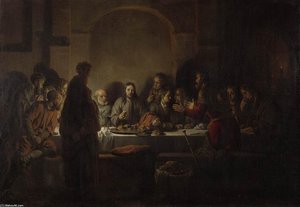
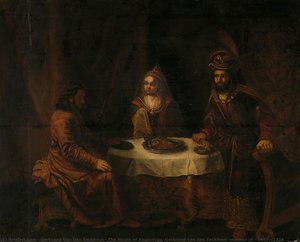
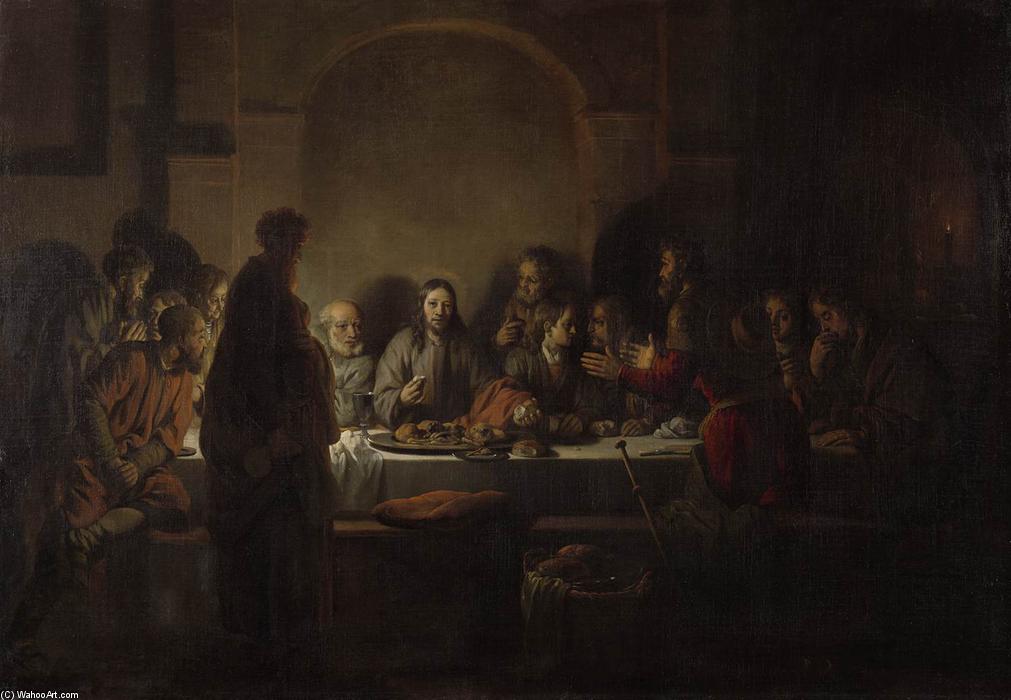
“The Last Supper,” painted in 1664, depicts the final meal shared by Jesus Christ and his twelve apostles before his crucifixion. The composition is deliberately understated yet powerfully evocative, centering on Jesus at the heart of the scene—a deliberate departure from Rembrandt’s bolder explorations of light and shadow. He sits prominently at the table, breaking bread and holding a cup, gestures that convey both solemn reverence and palpable human emotion.
Surrounding him are twelve figures engaged in various activities: some gaze intently at Jesus, others listen attentively to his words, while others partake in the meal itself. Each apostle is rendered with meticulous detail—notice the subtle variations in facial expressions and posture—reflecting Eeckhout’s commitment to capturing psychological realism. The artist skillfully employs light and shadow to create depth and heighten the dramatic tension of the moment, subtly illuminating Jesus' face and hands.
Baroque Style: Atmospheric Realism
Eeckhout’s artistic style embodies the core tenets of Baroque art—characterized by a fervent embrace of realism alongside theatrical grandeur. He eschewed Rembrandt’s stark contrasts for a more nuanced palette dominated by earthy hues, creating an atmosphere of warmth and solemn contemplation. The artist's meticulous attention to detail extends beyond mere representation; he strives to convey not just what is seen but also how it feels—a hallmark of Baroque painters who sought to engage the viewer emotionally.
Influenced by Caravaggio’s dramatic lighting techniques, Eeckhout skillfully utilizes chiaroscuro – though less pronounced than Rembrandt's – to sculpt form and emphasize key elements within the composition. The muted colors contribute to a sense of stillness and contemplation, inviting viewers to immerse themselves in the scene’s profound spiritual significance.
A Legacy Enduring Inspiration
“The Last Supper” resides at the Rijksmuseum in Amsterdam, alongside other masterpieces by Federico Fiori Barocci and Ferdinand Bol. Its enduring appeal stems from Eeckhout's ability to distill complex theological ideas into a visually arresting portrayal of human experience—a testament to his artistic genius and Rembrandt’s indelible influence. Explore reproductions at ArtsDot.com for a glimpse into this iconic artwork.
Furthermore, delve deeper into the Rijksmuseum's collection at /art/list/?Filter=A@D3BL6T-The-Museum-Rijksmuseum-Twenthe-(Enschede-Netherlands) to discover other treasures of Dutch Baroque.
Related Artworks

Artist Biography
The Legacy of a Master's Protégé
In the vibrant, bustling heart of seventeenth-century Amsterdam, a period defined by unparalleled cultural and economic prosperity, the name Gerbrand van den Eeckhout emerged as a significant voice within the Dutch Golden Age. While history often casts him in the long, dramatic shadow of his mentor, the legendary Rembrandt van Rijn, to view Eeckhout merely as a student is to overlook the profound sensitivity and technical refinement he brought to the canvas. Born in 1621, Eeckhout was shaped by the very atmosphere of the Dutch Baroque, an era where light, texture, and human emotion were captured with a devotion that bordered on the divine. His journey was one of deep connection to the masters of his time, yet it was marked by a persistent effort to find a visual language that was uniquely his own.
The foundation of Eeckhout’s artistry was laid within the walls of Rembrandt’s studio. As an apprentice, he did not simply learn the mechanics of paint application; he absorbed a philosophy of observation. From Rembrandt, he inherited a reverence for the interplay of light and shadow, yet as his career matured, Eeckhout began to diverge from the heavy, dramatic chiaroscuro that defined his teacher's most famous works. Instead, he developed a preference for softer gradations of tone and a more delicate atmospheric perspective. This subtle shift allowed him to create scenes that felt less like theatrical confrontations and more like intimate, quiet moments captured in time, imbuing his subjects with a psychological depth that resonated with the burgeoning middle class of the Netherlands.
Mastery of Portraiture and Genre
Eeckhout’s oeuvre is a testament to his versatility, ranging from the solemnity of formal portraiture to the narrative charm of genre scenes. His portraits are celebrated for their remarkable realism, particularly in the way he rendered the tactile qualities of fabric, lace, and skin. He possessed an uncanny ability to translate the social standing and inner character of his sitters through understated visual cues. In works such as A Young Woman Reading, one can witness his mastery of mood; the light does not merely illuminate the subject but seems to wrap around her, creating a sense of contemplative solitude that draws the viewer into her private world.
Beyond the individual portrait, Eeckhout excelled in capturing the pulse of everyday life. His genre paintings often depicted biblical or historical narratives, yet he grounded these grand themes in the domestic reality of his era. This technique bridged the gap between the epic and the intimate, making the divine feel accessible and human. His ability to compose complex scenes with a sense of naturalistic flow remains one of his most significant achievements. Even when depicting larger groups, there is a rhythmic balance to his compositions that prevents chaos, guiding the eye through a carefully orchestrated landscape of light and shadow.
Historical Significance and Artistic Spirit
The historical importance of Gerbrand van den Eeckhout lies in his role as a bridge between the intense emotionalism of the early Baroque and the more refined, observational style that would characterize later Dutch art. He was an artist who understood the power of nuance. While he could evoke the grandeur of the past, his true strength lay in the subtle: the glint of light on a silver goblet, the soft fold of a linen sleeve, or the fleeting expression of a thought passing through a subject's mind.
Though his life ended in 1674, leaving behind a legacy that continues to fascinate historians and art lovers alike, Eeckhout remains a vital figure for understanding the evolution of Dutch painting. His work serves as a reminder that greatness is not always found in the loudest shadows, but often in the most delicate light. To study his paintings is to experience the soul of the Dutch Golden Age—a period where the boundaries between the mundane and the magnificent were beautifully blurred by the brush of a master.
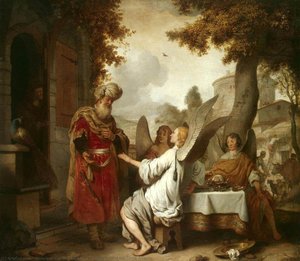
gerbrand van den eeckhout
1621 - 1674 , Netherlands
Quick Facts
- Artistic Movement Or Style: Dutch Baroque
- Artists Or Movements Influenced By This Artist: ['Dutch Portraiture']
- Artists Who Influenced This Artist: ['Rembrandt']
- Date Of Birth: 1621
- Full Name: Gerbrand van den Eeckhout
- Nationality: Dutch
- Notable Artworks:
- The Astronomer
- Portrait of a Young Man
- Place Of Birth: Amsterdam, Netherlands
Related Articles
Van Gogh's Masterpieces: Explore 25 Iconic Paintings & Art for Your Home
Journey through Vincent van Gogh's 25 most iconic paintings! Explore 'Starry Night', 'Sunflowers,' and more—discover the stories, techniques & emotions behind these Post-Impressionist masterpieces. Find museum-quality art reproductions for your home at ArtsDot.com.

Dutch Baroque Masters: 10 Paintings That Shaped an Era | ArtsDot
Journey through the Golden Age with our guide to the Top 10 Dutch Baroque masterpieces! Explore iconic paintings by Rembrandt, Vermeer & Frans Hals. Find museum-quality art reproductions and elevate your home decor at ArtsDot.com.

Rembrandt's Masterpieces: Explore 25 Iconic Paintings & Prints | ArtsDot
Journey through Rembrandt van Rijn's 25 most iconic paintings & etchings. Explore Dutch Golden Age masterpieces, dramatic chiaroscuro, and timeless portraits. Find museum-quality art reproductions to elevate your home decor on ArtsDot.com.
Cornelis van Poelenburch: Bridging Mannerism & the Dutch Baroque Landscape
Discover Cornelis van Poelenburch, a pivotal Dutch Baroque landscape painter bridging Mannerism & Italianate styles. Explore his life, key works, and lasting influence on 17th-century art with ArtsDot.

Golden Age Reflections: Dutch Baroque Painting & Cultural Innovation
Explore the Dutch Golden Age of painting! Discover key artists like Vermeer & ter Borch, their innovative techniques, and the rich cultural context behind these Baroque masterpieces. Learn about collecting & appreciating this iconic art period.