 Preview
 Send
Send Share
Share
 Details

 Download
 Similars
 X-Ray
X-Ray Diaporama
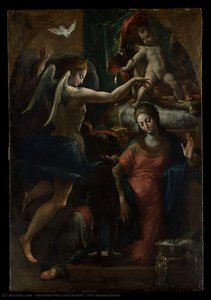
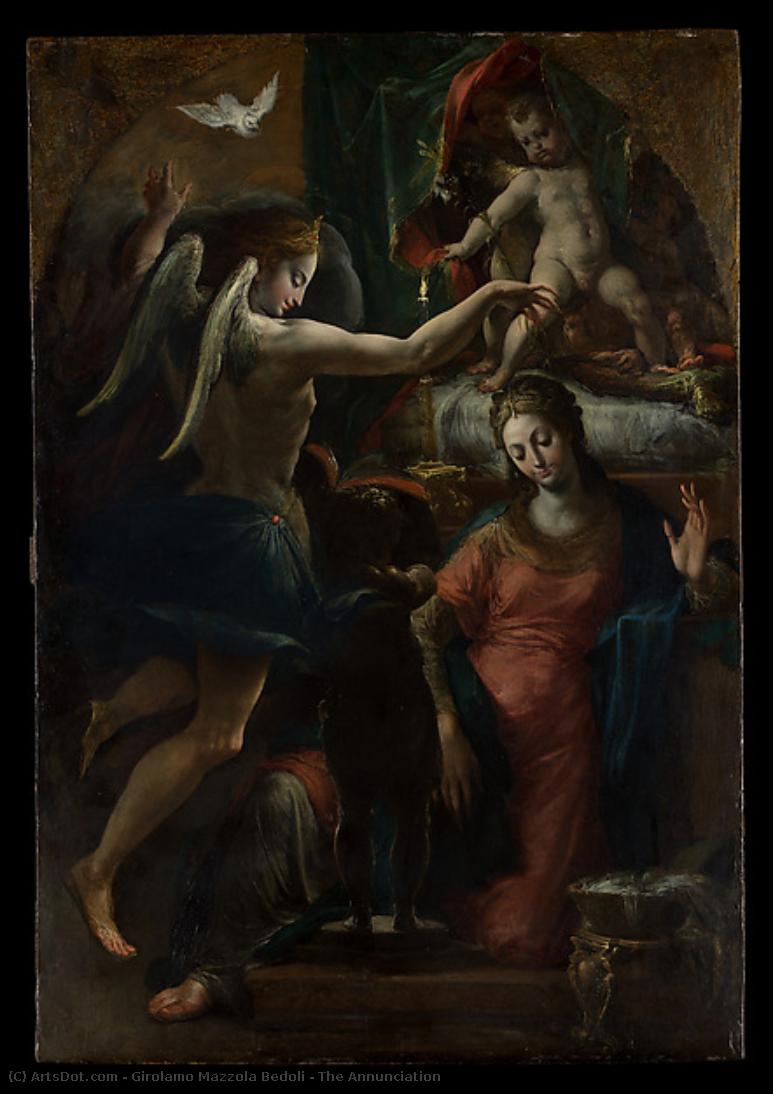
The Annunciation
 Oil On Canvas
- WallArt
- Italian Mannerism
 85.0 x 59.0 cm
 Metropolitan Museum of Art
 Read More
Hand Made Oil Reproduction
Hand-painted oil on canvas in your size and frame, made to order by our artists. ( Buy Print Buy Image)




P118B $10

P118H $10

P118W $10

P438Z $10

P508JH $12

P508YH $12

P805H $10

P805Z $10

P919BZ $10

P919G $10

P919XJ $10

P959ZH $10

P968JZ $12

W106C $8

W218G $10

W218JH $8

W218Y $10

W307PJ $10

W316G $10

W316PJ $8

W316Y $10

W398PJ $8

W4111J $10

W500HY $15

W500JH $15

W692G $12

W849H $8

W940BG $15

W953PJ $8




Pick from our preset sizes that match the artwork's original proportions.

You may enter your own dimensions to fit a specific frame or space. If your selected size does not match the original image's proportions, we will either crop the artwork or extend the painting with additional hand-painted elements. A digital mockup will be sent for your approval before production begins.
Please note that the on-screen preview does not reflect the actual cropping or extension. Only the mockup will accurately show the final composition.
While custom sizes are available, we recommend selecting a dimension from the predefined list to preserve the original proportions.
After order, ArtsDot.com team will email client for instructions and provide a mockup preview
Worldwide Delivery () in 3/4 weeks instead of standard 5 weeks. (17 August). No compromise on quality.

Free Worldwide Express Shipping

High-Quality Linen Canvas

Full Shipping Insurance

Customs Tax Refund Guarantee

True Color Matching Guarantee

60-Day Return Policy (Defects Only)

100% Money-Back Guarantee

Bulk Discount Offer
 Glass option is only available in size under 110 CM

The Annunciation
Reproduction Medium
Reproduction Size
-


Total Price
$ 263
Artwork Description
Girolamo Mazzola Bedoli: A Parma Mannerist Master
Girolamo Mazzola Bedoli (c. 1500 – 1569) stands as a pivotal figure in the flourishing artistic landscape of Parma during the High Renaissance and Mannerist period, largely overshadowed by his more celebrated cousin Parmigianino but nonetheless possessing a distinctive style that deserves recognition. Born in Viadana, Lombardy—a region known for its artistic heritage—Bedoli’s formative years were steeped in the traditions of Venetian painting, which profoundly impacted his aesthetic sensibilities. However, he swiftly established himself as an independent artist deeply rooted in Parma’s cultural milieu. His output is notable for its sensitivity to color and form, reflecting a profound understanding of humanist ideals while simultaneously embracing the stylistic innovations characteristic of Mannerism. Bedoli's work embodies a masterful blend of observation and imagination—a hallmark of the era—resulting in images that resonate with both intellectual depth and emotional intensity.Early Life and Training: Parmigianino’s Influence
Bedoli’s artistic journey began under the tutelage of his father-in-law, Pier Ilaro Mazzola—a cousin of Parmigianino—who oversaw the studio in Parma. This association proved invaluable, exposing Bedoli to the stylistic currents shaping Venetian painting and fostering a collaborative spirit that would define much of his subsequent career. Parmigianino’s influence is palpable throughout Bedoli's oeuvre, particularly evident in his elongated figures and refined drapery folds—techniques borrowed directly from Parmigianino’s groundbreaking compositions. However, Bedoli skillfully adapted these influences to Parma’s artistic traditions, forging a unique visual language that distinguishes him from his cousin while retaining the elegance and sophistication of Mannerist aesthetics. The Mazzola family's patronage ensured Bedoli had access to resources vital for honing his craft and developing his distinctive style—a circumstance that undoubtedly contributed to his enduring legacy as one of Parma’s foremost painters.Notable Commissions and Collaborations: Shaping Parma’s Artistic Identity
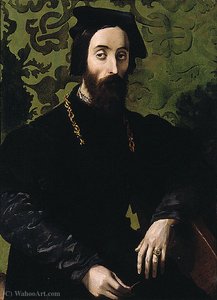
Bedoli undertook numerous commissions throughout his lifetime, decorating churches and palaces across Parma and its environs. Among his most significant achievements is the monumental fresco cycle adorning the Cappella Maggiore of Parma Cathedral—a project undertaken in collaboration with Alessandro Farnese—which exemplifies Bedoli's mastery of architectural painting and his ability to convey complex theological narratives through visual symbolism. Furthermore, he served as artistic director for several civic projects, overseeing the design and construction of public buildings and shaping Parma’s visual culture during a period of considerable artistic dynamism. These commissions not only cemented Bedoli’s reputation as a leading artist but also underscored his role in fostering Parma’s cultural identity—a legacy that continues to inspire admiration and scholarly inquiry today. Collaborations with other artists broadened Bedoli's creative horizons, allowing him to explore diverse stylistic approaches and refine his artistic vision.Style and Technique: Mannerist Precision
Bedoli’s style is characterized by a meticulous attention to detail and an unwavering commitment to classical ideals—traits that define the Mannerist movement as a whole. He employed a technique of painting directly on rough panels, minimizing preparatory sketches and prioritizing textural richness—a deliberate departure from the smoother surfaces favored by earlier Renaissance painters. Bedoli's palette was subdued yet luminous, utilizing subtle gradations of color to create atmospheric effects and imbue his figures with an ethereal quality. The artist’s mastery of perspective—particularly in architectural renderings—demonstrates a profound understanding of mathematical principles and contributes to the illusionistic depth of his compositions. Like Parmigianino, Bedoli favored elongated figures and stylized drapery folds—techniques that heighten visual drama and convey psychological complexity—reflecting the Mannerist preoccupation with emotional expression and intellectual contemplation.Legacy and Significance: An Enduring Influence
Girolamo Mazzola Bedoli’s artistic legacy extends far beyond his individual works—which are now housed in prestigious museums worldwide—to encompass a broader influence on Parma’s artistic heritage and the development of Mannerist painting. His cousin Parmigianino, arguably Bedoli's most celebrated pupil, carried forward Bedoli’s stylistic innovations into subsequent generations of artists—establishing Bedoli as a cornerstone of Parma’s artistic tradition. Bedoli’s meticulous observation of nature combined with imaginative embellishment—a hallmark of his oeuvre—continues to inspire admiration and scholarly study today. His paintings serve as poignant reminders of the High Renaissance's final flowering, capturing both its intellectual rigor and its emotional fervor—a testament to Bedoli’s enduring contribution to Western art history.Related Artworks
Artist Biography
The Grace of Parma: The Life and Art of Girolamo Mazzola Bedoli
In the vibrant, swirling currents of the Italian Mannerist period, few names capture the elegance and stylistic complexity of the Parma school quite like Girolamo Mazzola Bedoli. Born in Viadana around 1500, Bedoli emerged from a landscape deeply enriched by the artistic legacies of Lombardy and the sophisticated atmosphere of Parma. While history often casts him in the long, graceful shadow of his more famous cousin, Parmigianino, Bedoli was far more than a mere follower. He was a master in his own right, a painter whose brush captured the tension, movement, and psychological nuance that defined an era of transition from the balanced ideals of the High Renaissance to the expressive distortions of Mannerism.
Bedoli’s artistic identity was forged within the prestigious studio of his father-in-law, Pier Iancu Mazzola. This connection provided him with a front-row seat to the most cutting-edge stylistic innovations of the sixteenth century. Through this lineage, Bedoli absorbed the fluid lines and ethereal beauty championed by Parmigianino, yet he infused these influences with a distinct sensibility shaped by his early exposure to Venetian traditions. His training allowed him to master a diverse array of disciplines, ranging from the monumental scale of fresco painting to the intimate precision of portraiture and the architectural elegance of tomb design. This versatility made him an indispensable figure in the cultural fabric of Parma, capable of decorating both the grandest cathedrals and the most private devotional spaces.
Mastery of Form and Mannerist Expression
The true essence of Bedoli’s work lies in his ability to manipulate form to evoke emotion. As a practitioner of Mannerism, he moved away from the static perfection of the previous century, instead embracing asymmetry, elongated limbs, and unsettling gazes that challenged the viewer's perception. His technique often utilized vibrant, sometimes jarring color palettes to heighten the drama of his compositions. In works such as The Annunciation, one can witness his mastery of light and shadow; his oil sketches reveal a profound ability to depict divine encounters through atmospheric depth and a sense of nocturnal mystery.
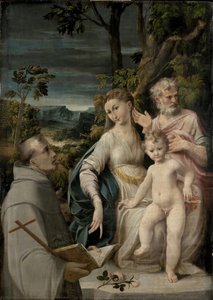
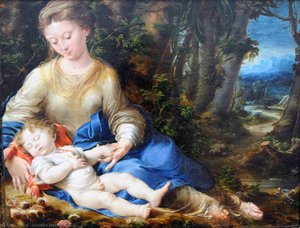
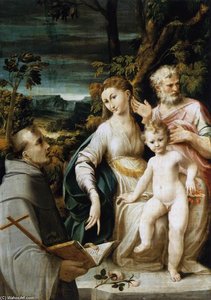
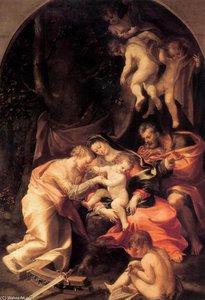
His religious commissions further demonstrate this command over narrative and symbolism. Whether depicting the tender intimacy of The Holy Family or the spiritual fervor found in The Holy Family with Saint Francis of Assisi, Bedoli utilized the characteristic Mannerist "serpentine" line to guide the eye through complex arrangements of figures. His ability to blend the sacred with the strikingly human allowed his altarpieces to resonate deeply with the faithful, offering a visual language that was both intellectually sophisticated and emotionally accessible.
Legacy within the Italian Renaissance
The significance of Girolamo Mazzola Bedoli extends beyond the individual canvases he left behind. He represents a vital link in the evolution of Italian art, serving as a bridge between the classical stability of the early 1500s and the more experimental, emotive styles that would follow. His contributions to the decoration of landmarks like the Santa Maria della Steccata underscore his role as a cornerstone of Parma’s artistic golden age.
Though often categorized alongside the great masters of his era, Bedoli’s legacy is defined by his unique ability to synthesize disparate influences into a cohesive, decorative, and deeply expressive style. He remains a testament to the richness of the Parma school—an artist who took the grace of his predecessors and transformed it into something uniquely his own, ensuring that the spirit of Mannerism would continue to flourish through his enduring works.
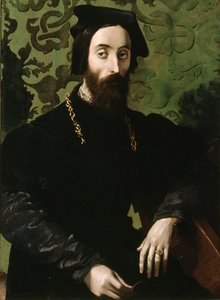
Girolamo Mazzola Bedoli
1500 - 1569 , Italy
Quick Facts
- Artistic Movement Or Style: Mannerist Painting
- Artists Or Movements Influenced By This Artist: ['Bronzino']
- Artists Who Influenced This Artist: ['Parmigianino']
- Date Of Birth: c. 1500
- Date Of Death: 1569
- Full Name: Girolamo Mazzola Bedoli
- Nationality: Italian
- Notable Artworks:
- The Holy Family
- Virgin and Child in a Landscape
- Alessandro Farnese
- Place Of Birth: Viadana, Italy
Related Articles

The Enduring Legacy of Oil on Canvas: Technique, History & Aesthetic Impact
Explore the rich history & techniques of oil painting – from Renaissance masters to Impressionism. Discover pigments, layering methods, and why this timeless medium endures. Expert insights for artists & art enthusiasts.

Oil on Canvas: A Historical & Technical Exploration of a Timeless Artistic Medium
Explore the rich history & enduring techniques of oil painting on canvas. Discover the science behind its longevity, conservation practices, and contemporary relevance. Expert insights for art enthusiasts.

The Enduring Power of Painting: A Historical & Contemporary Exploration of Form and Emotion
Explore the rich history & enduring techniques of oil painting with ArtsDot. Discover masterpieces, learn about art collecting, and find authentic handmade reproductions crafted by skilled artists.

The Enduring Legacy of Oil on Canvas: Technique, History & Contemporary Practice
Explore the rich history & enduring techniques of oil painting on canvas. Discover the science behind its longevity, conservation practices, and contemporary relevance. Expert insights for art enthusiasts.

Turn Your Digital Art Into Hand‑Painted Oil Masterpieces—Earn Big on Every Sale and Build an Enduring Legacy
Transform your NFT collection into hand‑painted oil masterpieces with ArtsDot’s expert artisans. Enjoy museum‑grade quality, free worldwide shipping, and a 100% satisfaction guarantee—turn digital art into a lasting legacy that earns you real value.