 Preview
 Send
Send Share
Share
 Details

 Download
 Similars
 X-Ray
X-Ray Diaporama
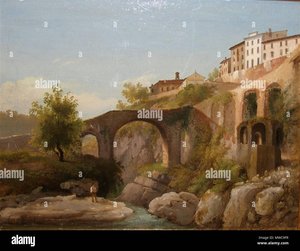
B.go del Naviglio


 Read More
Hand Made Oil Reproduction
Hand-painted oil on canvas in your size and frame, made to order by our artists. ( Buy Print Buy Image)




P118B $10

P118H $10

P118W $10

P438Z $10

P508JH $12

P508YH $12

P805H $10

P805Z $10

P919BZ $10

P919G $10

P919XJ $10

P959ZH $10

P968JZ $12

W106C $8

W218G $10

W218JH $8

W218Y $10

W307PJ $10

W316G $10

W316PJ $8

W316Y $10

W398PJ $8

W4111J $10

W500HY $15

W500JH $15

W692G $12

W849H $8

W940BG $15

W953PJ $8




Pick from our preset sizes that match the artwork's original proportions.

You may enter your own dimensions to fit a specific frame or space. If your selected size does not match the original image's proportions, we will either crop the artwork or extend the painting with additional hand-painted elements. A digital mockup will be sent for your approval before production begins.
Please note that the on-screen preview does not reflect the actual cropping or extension. Only the mockup will accurately show the final composition.
While custom sizes are available, we recommend selecting a dimension from the predefined list to preserve the original proportions.
After order, ArtsDot.com team will email client for instructions and provide a mockup preview
Worldwide Delivery () in 3/4 weeks instead of standard 5 weeks. (17 August). No compromise on quality.

Free Worldwide Express Shipping

High-Quality Linen Canvas

Full Shipping Insurance

Customs Tax Refund Guarantee

True Color Matching Guarantee

60-Day Return Policy (Defects Only)

100% Money-Back Guarantee

Bulk Discount Offer
 Glass option is only available in size under 110 CM

B.go del Naviglio
Reproduction Medium
Reproduction Size
-


Total Price
$ 263
Artwork Description
A Window into Nineteenth-Century Parma
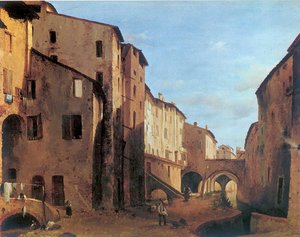
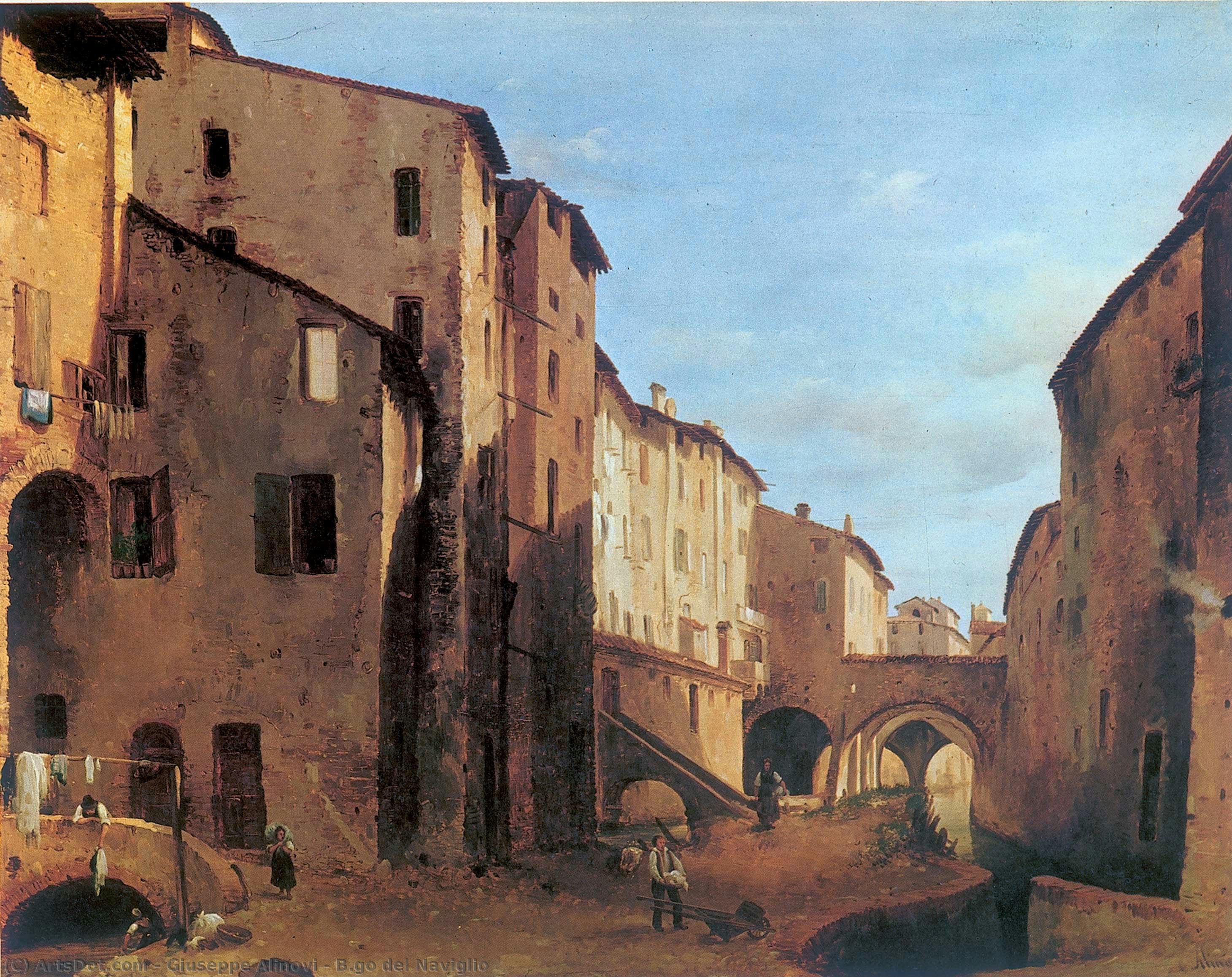
In the delicate brushstrokes of Giuseppe Alinovi’s 1845 masterpiece, B.go del Naviglio, we are transported to a vanished era of Italian urban life. The painting captures a poignant moment at the confluence of the Maggiore and Comune canals, where the waters once flowed from the Apennine slopes to nourish the heart of Parma. This is not merely a landscape; it is a historical document rendered in oil, preserving the memory of a waterway that served as a vital artery for trade and life since the 12th century. As the viewer gazes upon this scene, they are invited to witness the final stretch of an urban route that once connected the city to Coenzo and Colorno, long before the canal lost its navigability in the early 19th century.
The composition breathes with the rhythmic vitality of a bustling cityscape. Alinovi masterfully populates the street with a sense of spontaneous movement, guiding the eye through a tapestry of human activity. A solitary figure, burdened by a large bag slung over his shoulder, traverses the lane, embodying the daily toil and transient nature of urban existence. Nearby, horses and various passersby populate the periphery, creating a layered depth that suggests a world much larger than the frame itself. Even the placement of a single chair on the left side of the street whispers stories of forgotten afternoon rests and the quiet social rituals of a bygone age.
Technique and Atmospheric Elegance
Alinovi’s technique is characterized by an exquisite ability to manipulate light and shadow to evoke a specific atmospheric mood. The artist employs a subtle, painterly approach that avoids harsh outlines, opting instead for soft transitions that mimic the hazy, humid air of the Italian lowlands. This mastery of light allows the architecture of the buildings lining the street to feel integrated with the environment rather than imposed upon it. The play of light across the cobblestones and the reflective surfaces near the canal edges creates a sense of luminosity that is both soothing and intellectually stimulating.
For the discerning collector or interior designer, this piece offers a profound emotional resonance. It possesses a nostalgic charm that can anchor a room, providing a sophisticated focal point that sparks conversation about history, urban evolution, and the beauty of the mundane. The painting’s palette—earthy, warm, and grounded—makes it an ideal selection for spaces seeking a sense of timelessness and classical elegance. To possess a reproduction of B.go del Naviglio is to hold a fragment of Parma's soul, bringing the quiet dignity of the 19th-century Italian landscape into the modern home.
Related Artworks
Artist Biography
Henry John Boddington: Painter of English Light
Born in London in 1811, Henry John Boddington emerged as a significant figure within the vibrant landscape painting scene of Victorian England. A member of the esteemed Williams family of painters – a lineage deeply rooted in artistic tradition – Boddington’s career unfolded against a backdrop of evolving artistic tastes and a burgeoning interest in capturing the beauty of the British countryside. Unlike many artists of his era who sought fame through grand, historical subjects or exotic locales, Boddington dedicated himself to portraying the familiar landscapes of Surrey, the Thames Valley, and eventually, the dramatic vistas of North Wales and Scotland.
His early artistic training was largely informal, guided by his father, Edward Williams. This familial connection instilled in him a deep appreciation for depicting natural light and atmosphere – a hallmark of his distinctive style. Boddington’s technique wasn't rooted in academic precision but rather in an intuitive understanding of how light interacted with the environment. He famously employed a ‘broken’ brushstroke approach, layering thin glazes to create a shimmering effect reminiscent of sunlight filtering through trees or mist rising from a lake. This method, as Jan Reynolds noted in her study of the Williams family, produced “a warm day, with the sun just out of the picture, giving a filmy, hazy atmosphere to the landscape, with deep blue shadows adding greater value to the opposing tone of yellow.” His paintings weren’t simply representations of scenery; they were carefully constructed evocations of mood and feeling.
- Key Characteristics: Boddington's work is characterized by a masterful manipulation of light and shadow, creating atmospheric depth and a sense of tranquility.
- Subject Matter: Primarily focused on English landscapes – woodlands, villages, rivers, lakes, and mountains.
- Technique: Employed a ‘broken’ brushstroke technique with thin glazes to achieve luminous effects.
A Family Legacy and Royal Recognition
The Williams family's artistic heritage profoundly shaped Boddington’s trajectory. His father, Edward Williams, was a respected landscape painter who instilled in him not only technical skills but also a deep love for the English countryside. This familial connection to established artists like James Ward and George Morland provided a foundation of artistic knowledge and influence. Notably, Boddington adopted his wife's maiden name – Clarissa Eliza Boddington – a common practice within the family to establish individual identity amidst a cluster of talented relatives. This strategic move helped solidify his own artistic brand.
In 1842, at the age of 31, Boddington achieved a significant milestone when he was admitted as a member of the Royal Society of British Artists (RBA). This prestigious honor, reserved for only a select few artists, signaled recognition of his talent and established him within the highest echelons of the British art world. The RBA membership brought with it increased visibility and opportunities to exhibit his work at prominent venues such as the Royal Academy and the British Institution.
Collaborations and Artistic Networks
Boddington’s career was interwoven with those of other notable artists, most notably John Frederick Herring Sr., a fellow member of the RBA. Herring frequently contributed to Boddington's landscapes by painting horses and animals into the scenes – a collaborative practice common among artists of the time. This partnership not only enriched Boddington’s compositions but also provided him with valuable exposure within the artistic community.
His work was exhibited extensively throughout his lifetime, showcasing a consistent output of approximately ten paintings annually at the Royal Academy and RBA. Notable works include *On the Thames near Weybridge* (1837), *The Gyspy Camp* (1843), *A Quiet Morning – North Wales* (1851), *Tintern Abbey – Evening* (1859) and *The Lake of Tal-y-llyn, North Wales* (1853). These paintings are now held in prestigious collections across the globe, including the Victoria & Albert Museum, the National Museum of Wales, and the City Art Gallery, Glasgow.
A Lasting Impression
Henry John Boddington’s legacy extends beyond his individual works. He represents a pivotal figure in Victorian landscape painting, embodying a shift towards capturing the subtle nuances of English light and atmosphere. His paintings continue to resonate with viewers today, offering a glimpse into a bygone era and a profound appreciation for the beauty of the British countryside. His dedication to portraying familiar landscapes with such sensitivity and skill cemented his place as a respected artist within his time and ensured that his work would be appreciated for generations to come.
Boddington died in Barnes, London, on April 11, 1865, leaving behind a substantial body of work that reflects both his artistic talent and his deep connection to the English landscape.
giuseppe alinovi
1811 - 1848 , Italy
Quick Facts
- Artistic Movement Or Style: Romantic Landscape
- Artists Who Influenced This Artist: ['Edward Williams],\n "Artists or movements influenced by this artist": ["Williams family of painters"]\n}']
- Date Of Birth: 1811
- Date Of Death: 1865
- Full Name: Henry John Boddington
- Nationality: English
- Notable Artworks:
- On the Thames near Weybridge
- The Gyspy Camp
- A Quiet Morning – North Wales
- Tintern Abbey – Evening
- Place Of Birth: London, England
Related Articles

19th Century Masterpieces: 10 Paintings That Defined an Era | ArtsDot
Journey through 19th century art with ArtsDot! Explore 10 iconic paintings – from Monet & Renoir to Courbet – and discover the stories behind Romanticism, Realism & Impressionism. Find museum-quality reproductions for your home decor. Explore the full collection online!
Beyond Graffiti: Exploring the Evolution & Cultural Impact of Street Art for Collectors
Explore the evolution of street art from rebellious origins to a respected fine art form. Discover key artists like Banksy & learn how to collect urban art with confidence. Expert insights for discerning investors.
Beyond the Gallery Walls: The Rise of Contemporary Street Art
Explore the captivating world of contemporary street art! Discover its history, influential artists like Banksy, and evolving role in urban culture. Expert insights & analysis.
Echoes of Urban Life: A Visual Exploration of Street Scenes in Art History
Explore the captivating world of realism in art history! Discover iconic street scenes & genre paintings from masters like Courbet & Brown. Expert analysis & museum-quality reproductions at ArtsDot.
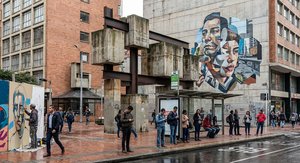
Concrete Narratives: Exploring Urban Life in Modern & Contemporary Art
Explore the evolution of cityscape painting with ArtsDot. Discover key artists from Realism to contemporary movements & invest in timeless urban visions. Expert guidance, museum-quality reproductions.