Preview
 Send
Send Share
Share
 Details

 Download
 Similars
 X-Ray
X-Ray Diaporama
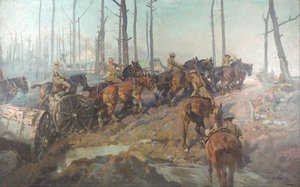
Bringing up the ammunition, Flanders, Autumn 1917
 1920
1920 53.0 x 244.0 cm
 Australian War Memorial
 Read More
Hand Made Oil Reproduction
Hand-painted oil on canvas in your size and frame, made to order by our artists. ( Buy Print Buy Image)




































Pick from our preset sizes that match the artwork's original proportions.

You may enter your own dimensions to fit a specific frame or space. If your selected size does not match the original image's proportions, we will either crop the artwork or extend the painting with additional hand-painted elements. A digital mockup will be sent for your approval before production begins.
Please note that the on-screen preview does not reflect the actual cropping or extension. Only the mockup will accurately show the final composition.
While custom sizes are available, we recommend selecting a dimension from the predefined list to preserve the original proportions.
After order, ArtsDot.com team will email client for instructions and provide a mockup preview
Worldwide Delivery () in 3/4 weeks instead of standard 5 weeks. (27 August). No compromise on quality.

Free Worldwide Express Shipping

High-Quality Linen Canvas

Full Shipping Insurance

Customs Tax Refund Guarantee

True Color Matching Guarantee

60-Day Return Policy (Defects Only)

100% Money-Back Guarantee

Bulk Discount Offer
 Glass option is only available in size under 110 CM

Bringing up the ammunition, Flanders, Autumn 1917
Reproduction Medium
Reproduction Size
-


Total Price
$ 263
Related Artworks




Artist Biography
Harold Septimus Power: A Life in Art
Early Life and Education
- Born on December 31, 1877, in Dunedin, New Zealand, to Peter Power, an Irish-born hatter, and Jane Amers, his Scottish wife.
- The family migrated to Australia when Harold was six years old.
- Initially pressured by his father to study veterinary surgery for four years, he pursued his artistic inclinations with the encouragement of Walter Withers.
- He began his art studies in Adelaide after leaving home as a teenager.
Early Career and Artistic Development
- Exhibited with the Melbourne Art Club in 1899, marking an early step in his artistic journey.
- Worked as an illustrator and political cartoonist for Adelaide newspapers – *The Adelaide Observer*, *South Australian Register*, and *The Adelaide Critic*.
- In 1904, received a commission from the Art Gallery of South Australia to paint an animal scene.
- Married Isabel Laura Butterworth in September 1904.
- Between 1905 and 1907, studied at the Académie Julian in Paris, refining his skills and broadening his artistic horizons.
London Years and Artistic Recognition
- Settled in London after studying in Paris, becoming a member of both the Royal Institute of Oil Painters and the Society of Animal Painters.
- Exhibited at the prestigious Royal Academy of Arts, gaining recognition within the British art scene.
- Held his first one-man exhibition at the Guild Hall in Melbourne, Australia, in June 1913, showcasing oils and watercolors featuring rural landscapes used as backdrops for equine scenes and hunting subjects.
World War I and Official War Artist
- Appointed as an official war artist by the Australian government in 1917.
- Attached to the 1st Division, A.I.F., from September to December 1917, and again in August 1918.
- Became renowned for his powerful depictions of animals – particularly horses – on the battlefield, capturing their role and suffering during wartime.
Post-War Career and Legacy
- Continued to work with the Australian War Records Section for two decades after the war, documenting and commemorating the conflict.
- Painted the ceremonial opening of the Federal parliament in 1927 alongside W. B. McInnes.
- Maintained a successful career exhibiting both in Australia and overseas, even during the Depression era.
- Married Margery Isabel Desmazures in Adelaide in 1936.
- Associated with conservative art movements, including Robert Menzies' Australian Academy of Art.
- Continued teaching art at his Melbourne School of Art, influencing a new generation of artists.
Artistic Style and Influences
- Power’s style blended elements of Realism and Impressionism, particularly in his landscape backgrounds.
- His work is characterized by detailed depictions of animals, especially horses, combined with atmospheric landscapes.
- He was influenced by artists like Walter Withers who encouraged him to pursue art.
Historical Significance
- Harold Septimus Power’s wartime paintings provide a valuable visual record of the Australian Imperial Force's experiences during World War I.
- His depictions of horses on the battlefield offer a poignant perspective on the often-overlooked role of animals in warfare.
- He remains an important figure in Australian art history, celebrated for his skill as an animal painter and his contribution to war art.
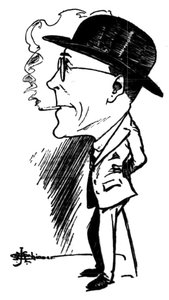
Harold Septimus Power
1877 - 1951 , New Zealand
Quick Facts
- Birth Date: 1877-12-31
- Birth Place: Dunedin, New Zealand
- Death Date: 1951-01-03
- Influenced By: Walter Withers
- Movement: Realism, Impressionism
- Name: Harold Septimus Power
- Nationality: New Zealander, Australian
- Notable Works:
- Bringing up the ammunition, Flanders, Autumn 1917
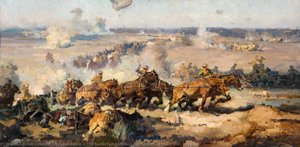
- The battle before Villers Bretonneux, August 8th, 1918