 Preview
 Send
Send Share
Share
 Details

 Download
 Similars
 X-Ray
X-Ray Diaporama
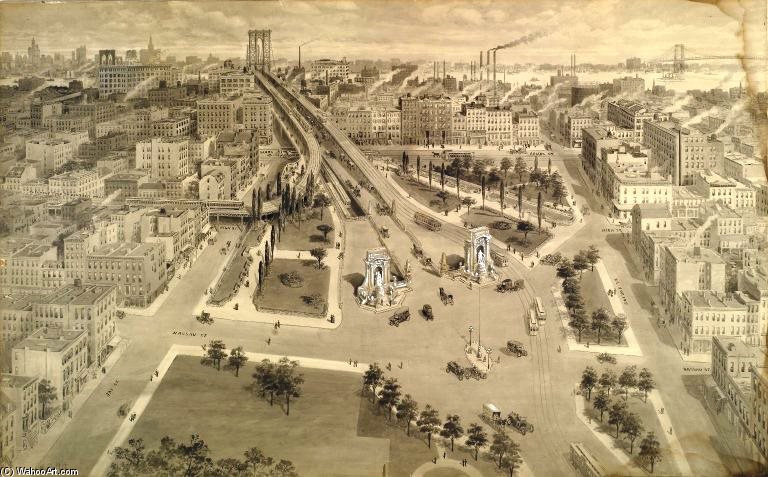
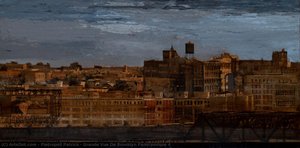
Brooklyn Plaza Of The Manhattan Bridge

 Read More
Hand Made Oil Reproduction
Hand-painted oil on canvas in your size and frame, made to order by our artists. ( Buy Print Buy Image)




P118B $10

P118H $10

P118W $10

P438Z $10

P508JH $12

P508YH $12

P805H $10

P805Z $10

P919BZ $10

P919G $10

P919XJ $10

P959ZH $10

P968JZ $12

W106C $8

W218G $10

W218JH $8

W218Y $10

W307PJ $10

W316G $10

W316PJ $8

W316Y $10

W398PJ $8

W4111J $10

W500HY $15

W500JH $15

W692G $12

W849H $8

W940BG $15

W953PJ $8




Pick from our preset sizes that match the artwork's original proportions.

You may enter your own dimensions to fit a specific frame or space. If your selected size does not match the original image's proportions, we will either crop the artwork or extend the painting with additional hand-painted elements. A digital mockup will be sent for your approval before production begins.
Please note that the on-screen preview does not reflect the actual cropping or extension. Only the mockup will accurately show the final composition.
While custom sizes are available, we recommend selecting a dimension from the predefined list to preserve the original proportions.
After order, ArtsDot.com team will email client for instructions and provide a mockup preview
Worldwide Delivery () in 3/4 weeks instead of standard 5 weeks. (21 August). No compromise on quality.

Free Worldwide Express Shipping

High-Quality Linen Canvas

Full Shipping Insurance

Customs Tax Refund Guarantee

True Color Matching Guarantee

60-Day Return Policy (Defects Only)

100% Money-Back Guarantee

Bulk Discount Offer
 Glass option is only available in size under 110 CM

Brooklyn Plaza Of The Manhattan Bridge
Reproduction Medium
Reproduction Size
-


Total Price
$ 263
Related Artworks
Artist Biography
Harry Pettit: Architect of Brooklyn’s Skyline
Harry Pettit (1867 – 1941) stands as a pivotal figure in the history of American architectural illustration and urban planning, particularly during the Art Deco era. Born on Rock Island, Illinois, Pettit possessed an innate fascination with engineering and design principles that would shape his lifelong career.
Early influences included Jules Verne’s fantastical tales and the burgeoning interest in technological advancements—themes that resonated deeply within his artistic sensibilities. He honed his skills initially through sketching landscapes and architectural studies before gravitating towards a more focused practice of creating detailed renderings for engineering firms and city planners.
Pettit's breakthrough came with his prolific output during the 1930s, when he collaborated extensively with George Platt Lynes to produce breathtaking depictions of New York City landmarks. Their partnership resulted in iconic images of the Brooklyn Bridge, Grand Central Terminal, Chrysler Building, and countless other urban vistas—works that captured not only the physical grandeur of these structures but also their spirit and dynamism.
His technique was characterized by meticulous observation combined with masterful draughtsmanship. Pettit employed a combination of watercolor and ink washes to achieve remarkable tonal range and textural detail, faithfully reproducing the architectural forms with astonishing accuracy. He meticulously studied blueprints and photographs, translating technical information into visually compelling representations that conveyed both precision and artistic beauty.
Beyond his celebrated illustrations, Pettit contributed significantly to urban planning discussions during a period marked by ambitious civic projects. His advocacy for thoughtful design and accessibility reflected a humanist perspective—a belief that architecture should serve the needs of its inhabitants and enhance the quality of life within cities.
Pettit’s legacy extends far beyond his artistic creations; he established the Pettit School of Architecture in Brooklyn, fostering generations of talented students who embraced similar principles of observation and craftsmanship. His influence can be seen in the work of numerous subsequent illustrators and architects—a testament to his enduring contribution to American art and urban culture.
- Notable Works: Brooklyn Bridge Renderings (1932), Grand Central Terminal Illustrations (1936), Chrysler Building Drawings (1930s)
- Technique: Watercolor & Ink Wash Rendering – Precise Observation & Blueprint Study
- Influences: Jules Verne, Technological Advancements
- Educational Contributions: Pettit School of Architecture - Brooklyn
Harry Pettit’s enduring appeal lies in his ability to transform technical diagrams into evocative artworks—a feat that cemented his place as one of the most influential architects of his time and ensured his images continue to inspire awe and admiration.
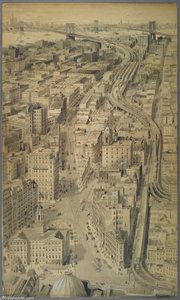
harry pettit
1867 - 1941 , United States of America
Quick Facts
- Artistic Movement Or Style: Urban Planning
- Artists Or Movements Influenced By This Artist: ['Bauhaus']
- Artists Who Influenced This Artist: ['Frank Lloyd Wright']
- Date Of Birth: 1867
- Full Name: Harry Pettit
- Nationality: American
- Notable Artworks: ['Brooklyn Bridge Renderings']
- Place Of Birth: Rock Island, United States of America
Related Articles
Urban Visions: A Historical & Artistic Exploration of the Cityscape in Painting
Explore the evolution of cityscape painting from historical maps to Impressionist masterpieces. Discover artists like Caillebotte & Utrillo. Find museum-quality reproductions at ArtsDot.
Concrete Narratives: Exploring Urban Life in Modern & Contemporary Art
Explore the evolution of cityscape painting with ArtsDot. Discover key artists from Realism to contemporary movements & invest in timeless urban visions. Expert guidance, museum-quality reproductions.
Concrete Visions: Exploring the Urban Landscape in Painting – From Realism to Contemporary Art
Explore the evolution of cityscape painting from Realism to contemporary art with ArtsDot. Discover key artists & invest in timeless urban visions. Expert guidance, museum-quality reproductions.
Urban Visions: A Historical & Artistic Exploration of the Cityscape in Painting
Explore the evolution of cityscape painting from historical maps to Impressionist masterpieces. Discover artists like Caillebotte, Utrillo & Matsumoto Shunsuke. Find museum-quality reproductions at ArtsDot.

Concrete Visions: Exploring Representations of Urban Life in Modern & Contemporary Art
Explore the evolution of cityscape painting from Realism to contemporary art. Discover key artists & invest in timeless urban visions with ArtsDot's expert guidance and museum-quality reproductions.