 Preview
 Send
Send Share
Share
 Details

 Download
 Similars
 X-Ray
X-Ray Diaporama
The Last Supper


 Read More
Hand Made Oil Reproduction
Hand-painted oil on canvas in your size and frame, made to order by our artists. ( Buy Print Buy Image)




P118B $10

P118H $10

P118W $10

P438Z $10

P508JH $12

P508YH $12

P805H $10

P805Z $10

P919BZ $10

P919G $10

P919XJ $10

P959ZH $10

P968JZ $12

W106C $8

W218G $10

W218JH $8

W218Y $10

W307PJ $10

W316G $10

W316PJ $8

W316Y $10

W398PJ $8

W4111J $10

W500HY $15

W500JH $15

W692G $12

W849H $8

W940BG $15

W953PJ $8




Pick from our preset sizes that match the artwork's original proportions.

You may enter your own dimensions to fit a specific frame or space. If your selected size does not match the original image's proportions, we will either crop the artwork or extend the painting with additional hand-painted elements. A digital mockup will be sent for your approval before production begins.
Please note that the on-screen preview does not reflect the actual cropping or extension. Only the mockup will accurately show the final composition.
While custom sizes are available, we recommend selecting a dimension from the predefined list to preserve the original proportions.
After order, ArtsDot.com team will email client for instructions and provide a mockup preview
Worldwide Delivery () in 3/4 weeks instead of standard 5 weeks. (16 August). No compromise on quality.

Free Worldwide Express Shipping

High-Quality Linen Canvas

Full Shipping Insurance

Customs Tax Refund Guarantee

True Color Matching Guarantee

60-Day Return Policy (Defects Only)

100% Money-Back Guarantee

Bulk Discount Offer
 Glass option is only available in size under 110 CM

The Last Supper
Reproduction Medium
Reproduction Size
-


Total Price
$ 263
Artwork Description
A Divine Encounter in Shadow and Light
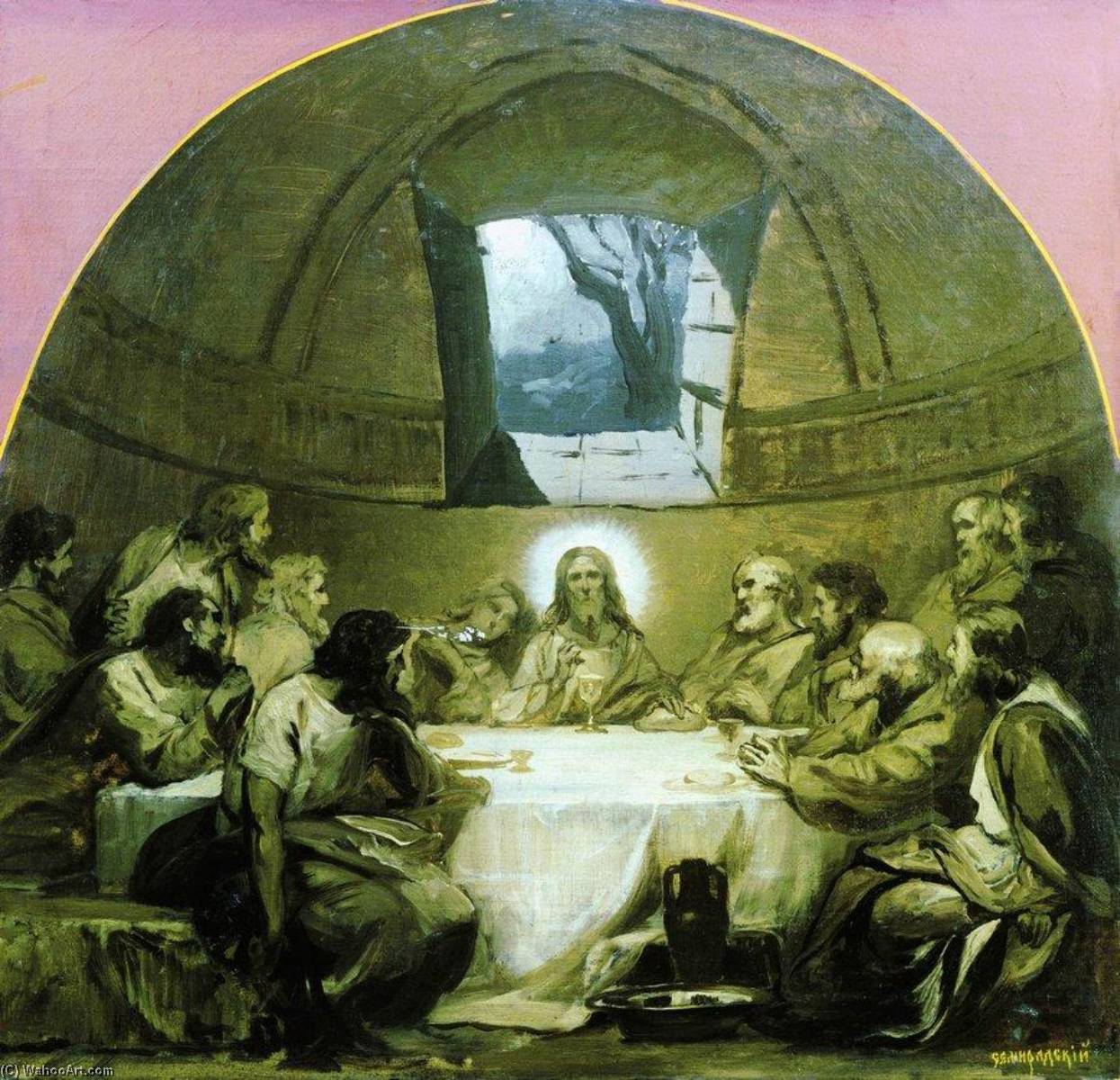
In the profound stillness of a cave-like sanctuary, Henryk Siemiradzki captures one of the most transformative moments in human history. The Last Supper, painted around 1876, is not merely a depiction of a meal, but a masterclass in dramatic tension and spiritual intimacy. As the eye wanders across the long dining table, it encounters Jesus at the very heart of the composition, serving as the calm, luminous anchor amidst a sea of human emotion. The artist utilizes a chiaroscuro-inspired approach, where the deep, enveloping shadows of the setting contrast sharply with the warm, flickering light that dances upon the faces of the twelve apostles. This interplay of light and dark does more than define form; it breathes life into the heavy atmosphere, suggesting a world caught in the breathless moment before a great storm breaks.
The composition is meticulously orchestrated to guide the viewer through a narrative of devotion and trepidation. While the table occupies much of the visual field, Siemiradzki avoids the static nature often found in religious iconography by introducing a sense of movement and psychological depth. On either side of the central figure, the apostles are captured in various states of contemplation, shock, and whispered discourse. Some lean inward, drawn by the gravity of Christ's presence, while others appear lost in their own internal struggles. A solitary cup rests at the far end of the table, a subtle yet potent symbol of the sacrifice to come, reminding the observer that this gathering is both a celebration of fellowship and a precursor to profound loss.
The Mastery of Academic Grandeur
As a pioneer of Academicism, Siemiradzki brings a level of technical precision to this canvas that is nothing short of breathtaking. His ability to render textures—the heavy drapery of robes, the subtle sheen of ceramic, and the rugged stone of the surroundings—demonstrates the rigorous training characteristic of the late 19th-century European masters. The use of oil on iron, a choice that lends a unique density to the pigments, allows for a rich, saturated color palette that enhances the painting's theatricality. Every brushstroke serves the purpose of monumentalism, elevating the biblical scene into something that feels both historically grounded and eternally significant.
For the discerning collector or interior designer, this reproduction offers more than just a visual centerpiece; it provides an emotional anchor for a room. The painting’s somber tones and dramatic lighting make it an exquisite choice for sophisticated spaces—perhaps a study lined with leather-bound books or a formal dining hall where conversation and reflection are encouraged. It is a piece that commands attention through its quiet power, inviting anyone who gazes upon it to pause, reflect, and lose themselves in the timeless drama of the human spirit facing the divine.
Related Artworks
Artist Biography
Hendryk Siemiradzki: A Pioneer of Academic Painting
Henryk Siemiradzki (1843 – 1902) stands as a pivotal figure in the history of Polish and European art, recognized primarily for his monumental canvases depicting scenes from antiquity and biblical narratives—works that exemplify the tenets of Academic Art. Born to Hipolit Siemiradzki, a Polish noble officer serving in the Imperial Russian Army, and Michalina Prószyńska, he resided in Pieczeniegi (now Pechenegi), Kharkiv Oblast, Ukraine. His formative years instilled within him a deep appreciation for Polish heritage and patriotism, shaping his artistic vision throughout his life. Siemiradzki’s early education commenced at Kharkiv Gymnasium where he honed his artistic skills under the tutelage of Dmitry Bezperchy, a descendant of Karl Briullov—a connection that would prove influential in establishing his stylistic trajectory. He pursued formal studies at Kharkov University's Physics-Mathematics Faculty alongside continuing his painting instruction with Bespechy. This dual focus underscored Siemiradzki’s commitment to both scientific rigor and artistic excellence – a characteristic that would permeate his oeuvre. His academic pursuits culminated in obtaining the degree of Kandidat (equivalent to Ph.D.) and subsequently abandoning a career in science for the pursuit of art, relocating to Saint Petersburg where he enrolled at the Imperial Academy of Arts in 1864-1870. Under the guidance of Karl von Piloty, Siemiradzki absorbed the principles of Academic Art—characterized by meticulous realism, idealized forms, and adherence to classical conventions—solidifying his reputation as a master craftsman. The academy’s rector Fiodor Bruni recognized Siemiradzki's talent and supported his artistic endeavors generously. A formative encounter with Stanisław Witkiewicz, a fellow artist who championed Impressionism, sparked a significant debate regarding stylistic approaches. While Witkiewicz advocated for capturing fleeting moments of emotion and atmosphere, Siemiradzki remained steadfast in upholding the tenets of Academic Art—a distinction that reflected broader tensions within the artistic landscape of late 19th-century Russia. Despite this divergence, Siemiradzki maintained an enduring friendship with Witkiewicz, demonstrating a willingness to engage constructively with opposing viewpoints. Siemiradzki’s artistic journey reached its zenith in Rome, where he immersed himself in the study of Renaissance masters and cultivated a profound fascination for classical art. He achieved considerable acclaim for his monumental canvases—particularly “The Last Supper” and “An Italian Courtyard”—which captured the grandeur and solemnity of biblical scenes with unparalleled detail and compositional sophistication. These works secured Siemiradzki’s place among the foremost artists of his era, earning him recognition from prominent critics and securing commissions for prestigious theaters and institutions. Notably, he created curtains for the Lviv Opera House and Juliusz Słowacki Theatre in Kraków—testaments to his artistic prowess and enduring legacy. Siemiradzki's artistic output is distinguished by its meticulous attention to detail, masterful use of color palettes, and unwavering commitment to classical ideals. His canvases embody a profound understanding of anatomy, perspective, and sculptural form—skills honed through rigorous observation and disciplined practice. Siemiradzki’s paintings are not merely representations of historical events or biblical narratives; they are imbued with symbolic meaning and convey an emotional depth that transcends mere visual spectacle. He remains celebrated as one of the most influential figures in Polish Academic Art, whose work continues to inspire admiration and scholarly inquiry today.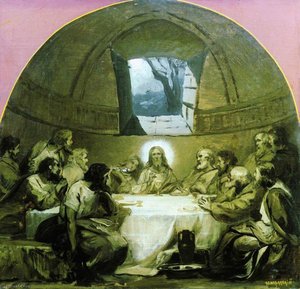
hendryk siemiradzki
1843 - 1902
Quick Facts
- Artistic Movement Or Style: Academic Art
- Artists Or Movements Influenced By This Artist: ['Romanticism']
- Artists Who Influenced This Artist: ['Karl Briullov']
- Date Of Birth: October 24, 1843
- Date Of Death: August 23, 1902
- Full Name: Henryk Hektor Siemiradzki
- Nationality: Polish & Russian
- Notable Artworks:
- The Last Supper
- An Italian Courtyard
- Place Of Birth: Novobelgorod (Pechenihy), Ukraine
Related Articles

Jacopo Tintoretto's Masterpieces: 25 Paintings That Define Venetian Drama | ArtsDot
Explore 25 breathtaking masterpieces by Jacopo Tintoretto, the Venetian master of drama and light. Discover the stories behind iconic Renaissance paintings & find museum-quality art reproductions to elevate your home decor on ArtsDot.com.
Dramatic Art: 10 Masterpieces That Stir the Soul |
Explore 10 dramatic artworks by masters like Rembrandt & Munch that stir deep emotion. Discover art history, techniques & find museum-quality reproductions for your home at . Explore the full collection online.

The Golden Age Reforged: Dramatic Realism & Religious Zeal in Spanish Baroque Art
Explore the dramatic world of Spanish Baroque art! Discover masters like Zurbarán & the powerful influence of religious zeal on painting techniques – a guide for collectors and enthusiasts.
Dramatic Masterpieces: 10 Artworks for a Powerful Home Decor Statement |
Explore 10 dramatic artworks by masters like Caravaggio, Van Gogh & Munch. Uncover the stories behind these powerful paintings and find museum-quality reproductions to transform your home decor. Discover all masterpieces on .

Illuminating Faith: Biblical Narrative & Artistic Expression Through the Ages
Explore the rich history of biblical art from Giotto to the Renaissance masters with ArtsDot. Discover symbolism, techniques & enduring legacies. Museum-quality reproductions & expert insights.