 Preview
 Send
Send Share
Share
 Details

 Download
 Similars
 X-Ray
X-Ray Diaporama
Portrait of a Woman
 Acrylic On Canvas
- WallArt
- Naïve/Primitive Art
 1895
1895 115.0 x 198.0 cm
 Musée d'Orsay
 Read More
Giclée / Art Print
Museum-quality giclée or canvas print with fast production and flexible finish options. ( Buy Hand Made Painting Buy Image)




P118B $10

P118H $10

P118W $10

P438Z $10

P508JH $12

P508YH $12

P805H $10

P805Z $10

P919BZ $10

P919G $10

P919XJ $10

P959ZH $10

P968JZ $12

W106C $8

W218G $10

W218JH $8

W218Y $10

W307PJ $10

W316G $10

W316PJ $8

W316Y $10

W398PJ $8

W4111J $10

W500HY $15

W500JH $15

W692G $12

W849H $8

W940BG $15

W953PJ $8




Pick from our preset sizes that match the artwork's original proportions.

You may enter your own dimensions to fit a specific frame or space. If your selected size does not match the original image's proportions, we will either crop the artwork or extend the image with a mirrored or solid-fill edge. A digital mockup will be sent for your approval before production begins.
Please note that the on-screen preview does not reflect the actual cropping or extension. Only the mockup will accurately show the final composition.
While custom sizes are available, we recommend selecting a dimension from the predefined list to preserve the original proportions.
Worldwide Delivery () in 2 weeks instead of standard 4/5 weeks. (16 August)

Free Worldwide Express Shipping

High-Quality Linen Canvas

Full Shipping Insurance

Customs Tax Refund Guarantee

True Color Matching Guarantee

60-Day Return Policy (Defects Only)

100% Money-Back Guarantee

Bulk Discount Offer
 Glass option is only available in size under 110 CM

Portrait of a Woman
Giclée / Art Print
Reproduction Size
-


Total Price
$ 63
Collectible Description
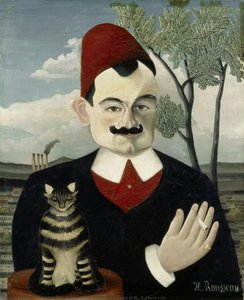
A Silent Gaze: Henri Rousseau’s ‘Portrait of a Woman’ (1895)
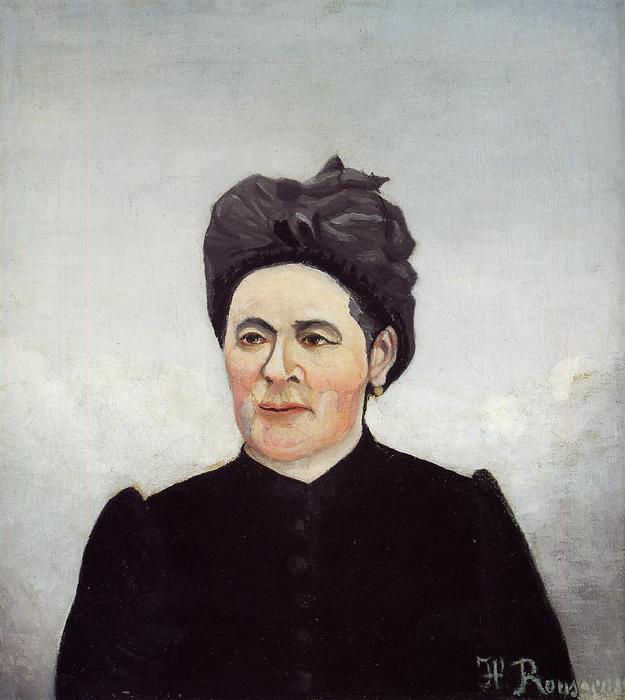
Henri Julien Félix Rousseau, known affectionately as “Le Douanier” – the customs officer – wasn't a name typically associated with the grand halls of Parisian art. Yet, within his humble studio, fueled by a lifetime spent collecting taxes and observing the world through a uniquely perceptive lens, he crafted images that continue to resonate with an almost unsettling beauty. ‘Portrait of a Woman,’ painted in 1895, is not merely a likeness; it’s a carefully constructed tableau of quiet dignity, veiled mystery, and a profound sense of timelessness – a testament to Rousseau's singular artistic vision.
The painting immediately draws the eye with its stark simplicity. A woman, rendered in the muted tones of charcoal, ivory, and subtle grey, dominates the composition. She occupies nearly all of the canvas’s space, her posture formal yet not rigid, suggesting a contained strength. Her gaze is direct, unwavering, and profoundly unsettling. It's a look that doesn’t invite conversation but rather demands attention, as if she holds a secret known only to herself. The background – a hazy wash of indeterminate blue-grey – serves primarily to isolate the subject, amplifying her presence and reinforcing the painting’s intimate scale.
The Naïve Aesthetic: A World Within
Rousseau's style is inextricably linked to the “naïve art” movement, a phenomenon that emerged in 19th-century France. Rejecting academic conventions of perspective and realism, these artists – often self-taught – created works characterized by flattened spaces, simplified forms, and vibrant, sometimes dreamlike imagery. ‘Portrait of a Woman’ exemplifies this approach perfectly. The lines are soft and blended, creating an almost velvety texture; there's no sharp definition, no attempt to mimic the precise details of reality. Instead, Rousseau prioritizes feeling and atmosphere, capturing a mood rather than a photographic likeness.
This deliberate lack of technical precision is crucial to understanding the painting’s power. It allows the viewer to project their own emotions and interpretations onto the subject. The absence of intricate detail forces us to focus on the woman's expression – her enigmatic gaze, the subtle curve of her lips, the hint of melancholy in her eyes. It’s a portrait that invites contemplation, prompting questions about her life, her thoughts, and her story.
Color, Texture, and Symbolism
The color palette is deliberately restrained, dominated by blacks, whites, and muted flesh tones. The use of black for the woman's dress and the shadows around her face creates a sense of formality and seriousness. White highlights on her skin suggest an underlying luminosity, hinting at a hidden vitality beneath the surface. The subtle variations in grey contribute to the painting’s overall atmosphere of quiet introspection.
Rousseau’s technique involved layering colors meticulously to create tonal nuances – a process that lends the painting a remarkable depth and richness despite its apparent simplicity. The brushstrokes are visible but not overtly emphasized, contributing to the work's tactile quality. Beyond the purely visual, one might interpret the portrait through the lens of symbolism. The woman’s stern expression could represent authority, resilience, or perhaps even a quiet sorrow. Her solitary presence speaks to themes of introspection and isolation – common threads in Rousseau’s oeuvre.
A Legacy of Wonder
'Portrait of a Woman' is more than just a painting; it’s a window into the mind of Henri Rousseau—a man who found beauty and meaning in the overlooked corners of the world. His work, initially dismissed as primitive, has since been recognized for its profound emotional resonance and its influence on subsequent generations of artists. Reproductions of this captivating portrait offer a chance to experience firsthand the magic and mystery that defined Rousseau’s unique artistic vision – a silent gaze that continues to hold us in thrall.
Related Artworks
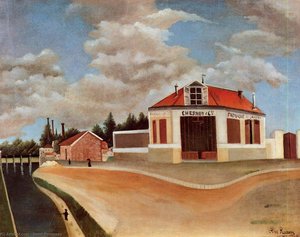
Artist Biography
Henri Julien Félix Rousseau: A Life in Art
Early Life and Background
- Born on May 21, 1844, in Laval, France, Henri Julien Félix Rousseau led an unconventional life before becoming a renowned artist.
- His early years were marked by modest circumstances; his father was a tinsmith, and Rousseau himself worked various jobs throughout his youth.
- He received some formal education, showing aptitude for drawing, but ultimately pursued a career as a toll collector – earning him the nickname “Le Douanier” (the customs officer).
- Rousseau served in the military for four years before settling into his role at the Paris octroi, collecting taxes on goods entering the city.
Artistic Development and Style
- Rousseau was largely self-taught as an artist, beginning to paint seriously in his early forties after receiving encouragement from a friend.
- His style is characterized by its naïve or primitive quality, marked by flat perspectives, simplified forms, and vibrant, often unrealistic colors.
- He drew inspiration from botanical gardens, illustrated magazines, and visits to the Jardin des Plantes in Paris, rather than direct observation of nature.
- Rousseau’s paintings often feature lush jungle scenes, exotic animals, portraits, and depictions of everyday life, all rendered with a unique sense of wonder and imagination.
Influences and Artistic Context
- While largely self-taught, Rousseau was aware of the artistic movements of his time – Impressionism and Post-Impressionism – but developed a distinctly personal style that set him apart.
- He admired artists like Eugène Delacroix and drew inspiration from their use of color and exotic subject matter.
- Rousseau’s work predates and anticipates aspects of Surrealism and other early 20th-century avant-garde movements.
Major Works and Achievements
- Some of Rousseau's most celebrated paintings include:
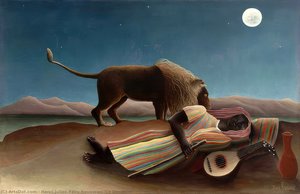
- The Sleeping Gypsy (1897) – a dreamlike depiction of a woman asleep in a jungle setting.
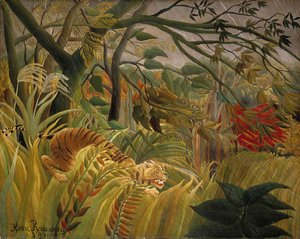
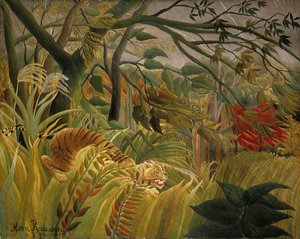
- Tiger in a Tropical Storm (Surprised!) (1891) – showcasing his dramatic use of color and composition.
- Self-Portrait (1890) - A formal portrait showing the artist with a palette and brushes.
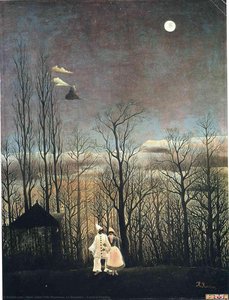
- The Carnival Evening (1886) – capturing a festive scene with intricate details.
- He exhibited regularly at the Salon des Indépendants, gaining recognition among fellow artists and gradually attracting critical attention.
Historical Significance and Legacy
- Initially ridiculed by many critics for his unconventional style, Rousseau’s work eventually gained appreciation as a unique expression of artistic vision.
- He became an inspiration to several prominent artists, including Pablo Picasso and other members of the avant-garde movement.
- In 1908, Picasso famously organized “Le Banquet Rousseau,” a celebratory event honoring the artist and acknowledging his influence.
- Rousseau’s paintings continue to captivate audiences today with their dreamlike quality, vibrant colors, and imaginative subject matter.
- His work remains a testament to the power of self-expression and the enduring appeal of naïve art.
Death and Posthumous Recognition
- Henri Rousseau died on September 2, 1910, in Paris.
- His legacy continued to grow after his death, solidifying his place as a significant figure in modern art history.
- Today, his works are displayed in major museums worldwide and continue to inspire artists and art lovers alike.
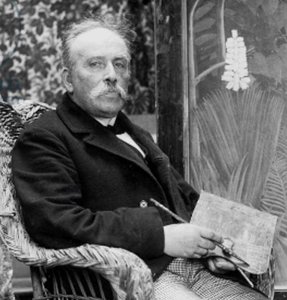
henri julien félix rousseau (le douanier)
1844 - 1910
Quick Facts
- Birth Date: April 17, 1844
- Birth Place: Laval, France
- Death Date: September 2, 1910
- Influenced:
- Vincent van Gogh
- Paul Gauguin
- Influenced By: Impressionist and Post-Impressionist contemporaries
- Movement: Post-Impressionism, Naive art
- Name: Henri Julien Félix Rousseau
- Nationality: French
- Notable Works:
- Sleeping Gypsy
- The Dream
- Carnival Evening
- Tiger in a Tropical Storm
- The Toll House
Related Articles
Henri Matisse's Masterpieces: Explore 25 Iconic Paintings & Art Decor Ideas
Journey through Henri Matisse's 25 most iconic paintings! Explore Fauvism, vibrant colors & the stories behind masterpieces like 'The Dance'. Find museum-quality art reproductions and curated decor ideas to elevate your space. Discover all masterpieces on ArtsDot.com.
Henri Rousseau: Primitivism, Paradox & Subversion of Academic Tradition
Explore the captivating world of Henri Rousseau, the celebrated Naïve artist who challenged academic traditions with his unique jungle scenes & dreamlike symbolism. Discover his lasting influence on modern art and collecting today.
The Untamed Vision: Exploring Naïve Art & Primitivism's Rejection of Convention
Explore the revolutionary world of Naïve Art & Primitivism! Discover how artists challenged academic traditions with raw emotion & unique styles. Learn about Picasso, Rousseau & more at ArtsDot.
The Unconventional Vision: Exploring the Characteristics, History & Enduring Appeal of Naïve Art
Explore the captivating world of naïve art! Discover its history, characteristics, key artists & collecting tips from ArtsDot's experts. Find your perfect piece today.
Fauvism's Boldest Visions: 10 Masterpieces That Revolutionized Modern Art | ArtsDot
Explore 10 Fauvist masterpieces by Matisse, Derain & Vlaminck that ignited Modern Art! Discover bold colors, expressionist landscapes & the history of this revolutionary movement. Find museum-quality prints at ArtsDot.com.