 Preview
 Send
Send Share
Share
 Details

 Download
 Similars
 X-Ray
X-Ray Diaporama
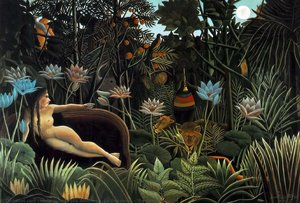
The Dream


 Read More
Giclée / Art Print
Museum-quality giclée or canvas print with fast production and flexible finish options. ( Buy Hand Made Painting Buy Image)




P118B $10

P118H $10

P118W $10

P438Z $10

P508JH $12

P508YH $12

P805H $10

P805Z $10

P919BZ $10

P919G $10

P919XJ $10

P959ZH $10

P968JZ $12

W106C $8

W218G $10

W218JH $8

W218Y $10

W307PJ $10

W316G $10

W316PJ $8

W316Y $10

W398PJ $8

W4111J $10

W500HY $15

W500JH $15

W692G $12

W849H $8

W940BG $15

W953PJ $8




Pick from our preset sizes that match the artwork's original proportions.

You may enter your own dimensions to fit a specific frame or space. If your selected size does not match the original image's proportions, we will either crop the artwork or extend the image with a mirrored or solid-fill edge. A digital mockup will be sent for your approval before production begins.
Please note that the on-screen preview does not reflect the actual cropping or extension. Only the mockup will accurately show the final composition.
While custom sizes are available, we recommend selecting a dimension from the predefined list to preserve the original proportions.
Worldwide Delivery () in 2 weeks instead of standard 4/5 weeks. (16 August)

Free Worldwide Express Shipping

High-Quality Linen Canvas

Full Shipping Insurance

Customs Tax Refund Guarantee

True Color Matching Guarantee

60-Day Return Policy (Defects Only)

100% Money-Back Guarantee

Bulk Discount Offer
 Glass option is only available in size under 110 CM

The Dream
Giclée / Art Print
Reproduction Size
-


Total Price
$ 63
Collectible Description
A Portal to the Subconscious: Exploring Henri Rousseau’s “The Dream”
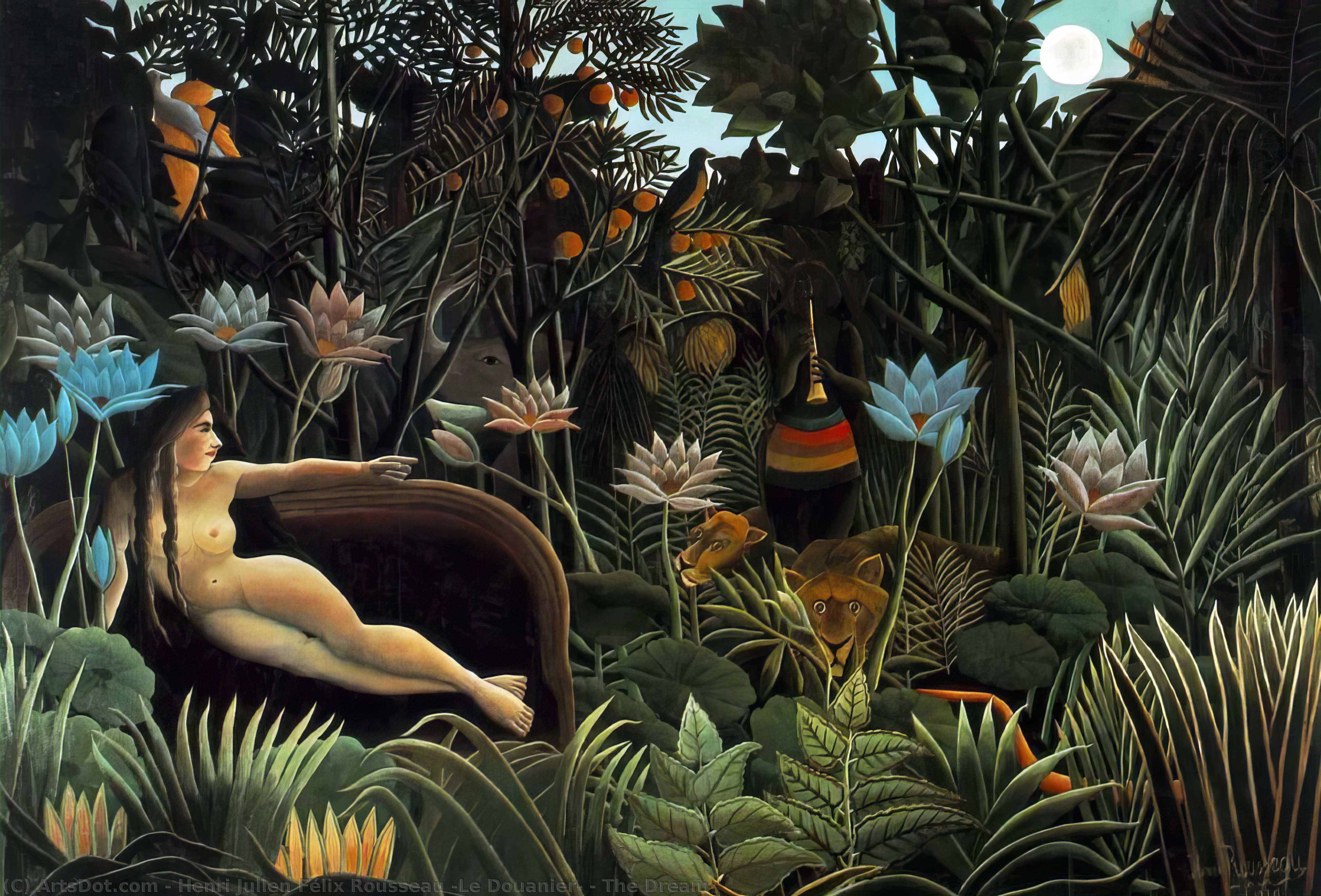
Henri Rousseau's 1910 masterpiece, “The Dream,” is more than a painting; it’s an invitation into a lush and enigmatic world born from imagination. This captivating work exemplifies Rousseau’s unique ability to blend reality and fantasy, creating a visual experience that continues to intrigue and inspire.
Subject Matter & Compositional Intrigue
At the heart of this jungle reverie lies a reclining nude woman, peacefully lost in contemplation. She is enveloped by an explosion of exotic flora and fauna – a carefully constructed ecosystem teeming with life. Rousseau masterfully balances density and open space, guiding the viewer’s eye through layers of vibrant color and texture. The composition isn't about strict realism; it’s a harmonious arrangement where the human form intimately interacts with the untamed wilderness. Overlapping planes create a sense of depth despite the painting’s overall flatness, drawing us deeper into this fantastical scene.
Artistic Style: Naive Art & Primitivism
“The Dream” is quintessential Rousseau – a striking example of his signature blend of Naive art and Primitivism. Characterized by simplified forms, flattened perspectives, bold, unmodulated colors, and a deliberate lack of traditional academic polish, his work stands apart. Self-taught and rejecting formal training, Rousseau developed a unique visual language inspired by folk art, children’s drawings, and the boundless realm of imagination – not direct observation. This intentional “naiveté” lends the artwork an enchanting quality, encouraging individual interpretation and fostering a sense of wonder.
Technique: Layered Colors & Bold Definition
Rousseau employed a meticulous technique involving smooth, even layers of paint with minimal blending or shading. Brushstrokes are visible but subtle, contributing to the clarity and precision of the image. He utilized bold outlines to define shapes, further emphasizing the flatness characteristic of his style. This approach creates a compelling visual representation of dense foliage and animal fur through implied texture rather than actual textural variation on the canvas surface – a testament to his skill in suggestion.
Historical Context: A Late-Blooming Genius
Henri Julien Félix Rousseau (1844-1910), affectionately known as Le Douanier (“the customs officer”) due to his profession, was a French post-impressionist painter who achieved recognition later in life. Initially ridiculed by critics, he gained posthumous acclaim and became a significant influence on avant-garde artists like Pablo Picasso. The famous “Le Banquet Rousseau” in 1908 celebrated him as a self-taught genius whose work foreshadowed many of the artistic movements to come. The painting reflects the early 20th century’s burgeoning fascination with exoticism, the subconscious mind, and non-Western art – themes that would be further explored by Surrealist and Expressionist artists.
Symbolism & Emotional Resonance
“The Dream” is rich in symbolism, inviting multiple interpretations. The nude woman may represent innocence, vulnerability, or a primal connection to nature; her relaxed pose suggests sensuality and reverie. The exotic animals could symbolize untamed desires, the power of instinct, or manifestations of the subconscious. The jungle setting itself evokes mystery, danger, allure, and the boundless potential of the imagination. The overall emotional impact is one of wonder, tranquility, and a gentle invitation to contemplate our own inner landscapes.
Interior Design & Display
“The Dream” makes a striking statement in various interior settings. Its vibrant colors and dreamlike imagery add a touch of exotic whimsy to living rooms, bedrooms, or studies. The painting’s unique style complements both modern and eclectic décor schemes.
- Pairing Suggestions: Consider pairing it with natural materials like wood, rattan, and lush plants for an organic feel, or contrasting it with bold geometric patterns for a more contemporary look.
- Display Recommendation: Frame this piece in a simple, natural wood frame to allow the artwork's vibrant colors and unique style to take center stage. Consider placement in a room with soft lighting to enhance its dreamlike quality.
A high-quality reproduction allows art lovers to bring the magic of Rousseau’s vision into their homes, creating a captivating focal point that sparks conversation and inspires contemplation.
Related Artworks
Artist Biography
Henri Julien Félix Rousseau: A Life in Art
Early Life and Background
- Born on May 21, 1844, in Laval, France, Henri Julien Félix Rousseau led an unconventional life before becoming a renowned artist.
- His early years were marked by modest circumstances; his father was a tinsmith, and Rousseau himself worked various jobs throughout his youth.
- He received some formal education, showing aptitude for drawing, but ultimately pursued a career as a toll collector – earning him the nickname “Le Douanier” (the customs officer).
- Rousseau served in the military for four years before settling into his role at the Paris octroi, collecting taxes on goods entering the city.
Artistic Development and Style
- Rousseau was largely self-taught as an artist, beginning to paint seriously in his early forties after receiving encouragement from a friend.
- His style is characterized by its naïve or primitive quality, marked by flat perspectives, simplified forms, and vibrant, often unrealistic colors.
- He drew inspiration from botanical gardens, illustrated magazines, and visits to the Jardin des Plantes in Paris, rather than direct observation of nature.
- Rousseau’s paintings often feature lush jungle scenes, exotic animals, portraits, and depictions of everyday life, all rendered with a unique sense of wonder and imagination.
Influences and Artistic Context
- While largely self-taught, Rousseau was aware of the artistic movements of his time – Impressionism and Post-Impressionism – but developed a distinctly personal style that set him apart.
- He admired artists like Eugène Delacroix and drew inspiration from their use of color and exotic subject matter.
- Rousseau’s work predates and anticipates aspects of Surrealism and other early 20th-century avant-garde movements.
Major Works and Achievements
- Some of Rousseau's most celebrated paintings include:
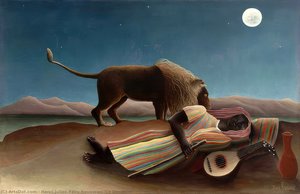
- The Sleeping Gypsy (1897) – a dreamlike depiction of a woman asleep in a jungle setting.
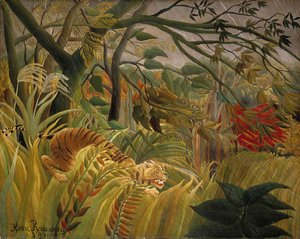
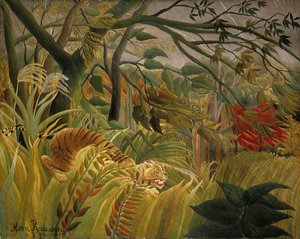
- Tiger in a Tropical Storm (Surprised!) (1891) – showcasing his dramatic use of color and composition.
- Self-Portrait (1890) - A formal portrait showing the artist with a palette and brushes.
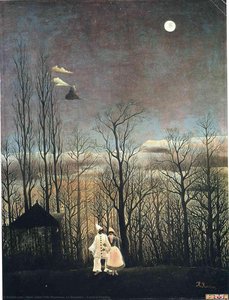
- The Carnival Evening (1886) – capturing a festive scene with intricate details.
- He exhibited regularly at the Salon des Indépendants, gaining recognition among fellow artists and gradually attracting critical attention.
Historical Significance and Legacy
- Initially ridiculed by many critics for his unconventional style, Rousseau’s work eventually gained appreciation as a unique expression of artistic vision.
- He became an inspiration to several prominent artists, including Pablo Picasso and other members of the avant-garde movement.
- In 1908, Picasso famously organized “Le Banquet Rousseau,” a celebratory event honoring the artist and acknowledging his influence.
- Rousseau’s paintings continue to captivate audiences today with their dreamlike quality, vibrant colors, and imaginative subject matter.
- His work remains a testament to the power of self-expression and the enduring appeal of naïve art.
Death and Posthumous Recognition
- Henri Rousseau died on September 2, 1910, in Paris.
- His legacy continued to grow after his death, solidifying his place as a significant figure in modern art history.
- Today, his works are displayed in major museums worldwide and continue to inspire artists and art lovers alike.
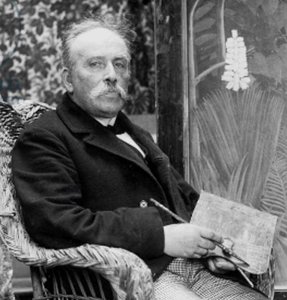
henri julien félix rousseau (le douanier)
1844 - 1910
Quick Facts
- Birth Date: April 17, 1844
- Birth Place: Laval, France
- Death Date: September 2, 1910
- Influenced:
- Vincent van Gogh
- Paul Gauguin
- Influenced By: Impressionist and Post-Impressionist contemporaries
- Movement: Post-Impressionism, Naive art
- Name: Henri Julien Félix Rousseau
- Nationality: French
- Notable Works:
- Sleeping Gypsy
- The Dream
- Carnival Evening
- Tiger in a Tropical Storm
- The Toll House
Related Articles
Henri Matisse's Masterpieces: Explore 25 Iconic Paintings & Art Decor Ideas
Journey through Henri Matisse's 25 most iconic paintings! Explore Fauvism, vibrant colors & the stories behind masterpieces like 'The Dance'. Find museum-quality art reproductions and curated decor ideas to elevate your space. Discover all masterpieces on ArtsDot.com.
Henri Rousseau: Primitivism, Paradox & Subversion of Academic Tradition
Explore the captivating world of Henri Rousseau, the celebrated Naïve artist who challenged academic traditions with his unique jungle scenes & dreamlike symbolism. Discover his lasting influence on modern art and collecting today.
The Unconventional Vision: Exploring the Characteristics, History & Enduring Appeal of Naïve Art
Explore the captivating world of naïve art! Discover its history, characteristics, key artists & collecting tips from ArtsDot's experts. Find your perfect piece today.
The Untamed Vision: Exploring Naïve Art & Primitivism's Rejection of Convention
Explore the revolutionary world of Naïve Art & Primitivism! Discover how artists challenged academic traditions with raw emotion & unique styles. Learn about Picasso, Rousseau & more at ArtsDot.
Fauvism's Boldest Visions: 10 Masterpieces That Revolutionized Modern Art | ArtsDot
Explore 10 Fauvist masterpieces by Matisse, Derain & Vlaminck that ignited Modern Art! Discover bold colors, expressionist landscapes & the history of this revolutionary movement. Find museum-quality prints at ArtsDot.com.