 Preview
 Send
Send Share
Share
 Details

 Download
 Similars
 X-Ray
X-Ray Diaporama
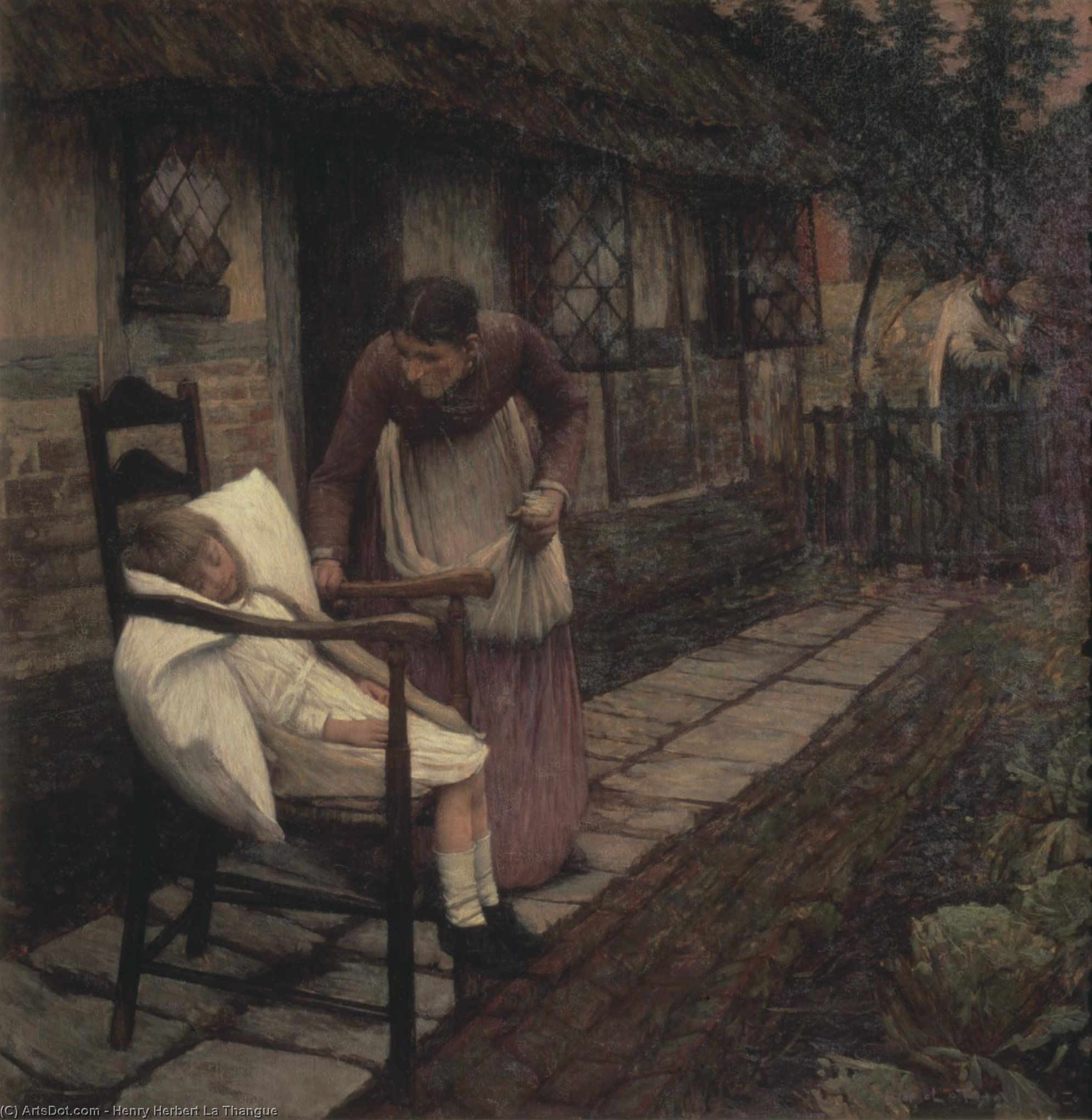
The Man with the Scythe


 Read More
Giclée / Art Print
Museum-quality giclée or canvas print with fast production and flexible finish options. ( Buy Hand Made Painting Buy Image)




P118B $10

P118H $10

P118W $10

P438Z $10

P508JH $12

P508YH $12

P805H $10

P805Z $10

P919BZ $10

P919G $10

P919XJ $10

P959ZH $10

P968JZ $12

W106C $8

W218G $10

W218JH $8

W218Y $10

W307PJ $10

W316G $10

W316PJ $8

W316Y $10

W398PJ $8

W4111J $10

W500HY $15

W500JH $15

W692G $12

W849H $8

W940BG $15

W953PJ $8




Pick from our preset sizes that match the artwork's original proportions.

You may enter your own dimensions to fit a specific frame or space. If your selected size does not match the original image's proportions, we will either crop the artwork or extend the image with a mirrored or solid-fill edge. A digital mockup will be sent for your approval before production begins.
Please note that the on-screen preview does not reflect the actual cropping or extension. Only the mockup will accurately show the final composition.
While custom sizes are available, we recommend selecting a dimension from the predefined list to preserve the original proportions.
Worldwide Delivery () in 2 weeks instead of standard 4/5 weeks. (21 August)

Free Worldwide Express Shipping

High-Quality Linen Canvas

Full Shipping Insurance

Customs Tax Refund Guarantee

True Color Matching Guarantee

60-Day Return Policy (Defects Only)

100% Money-Back Guarantee

Bulk Discount Offer
 Glass option is only available in size under 110 CM

The Man with the Scythe
Giclée / Art Print
Reproduction Size
-


Total Price
$ 63
Collectible Description
A Glimpse into Nostalgic Domesticity
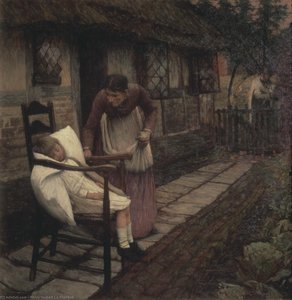
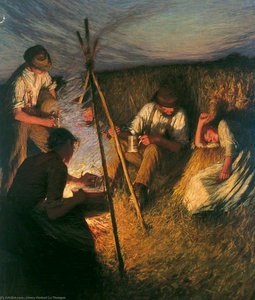
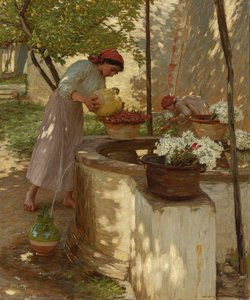
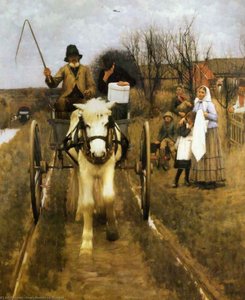
This evocative scene, captured by Henry Herbert La Thangue in 1896, transports the viewer directly into a moment suspended in time—a tableau vivant of late Victorian life. Though the title suggests a figure associated with harvest or fate, the visual evidence presents something far more intimate: a quiet gathering outside a humble dwelling. The composition centers on a woman cradling a child, their presence imbued with a profound sense of maternal tenderness. Surrounding them, other figures drift through the frame—a person visible to the left, and two others further back to the right—all contributing to an atmosphere thick with unspoken stories and shared history. The inclusion of a simple chair near the center grounds the scene in tangible reality, suggesting this was not merely a posed portrait, but a slice of life observed during a pause in daily routine.
The Artistry of Realism and Atmosphere
La Thangue’s mastery is evident in his commitment to British realism, echoing the spirit of the Newlyn School movement. His technique allows light to filter across the figures and the setting with remarkable subtlety. One can almost feel the quality of the late afternoon sun illuminating the scene. The artist possesses a gift for rendering not just objects, but atmospheres—the gentle weight of old-fashioned clothing, the soft curve of a child’s head against an adult shoulder. His training, which included exposure to the plein air traditions of Paris, is channeled here into capturing the immediacy and warmth of an outdoor domestic setting. The black and white nature of this depiction only heightens the focus on form, gesture, and the interplay between light and shadow.
Historical Resonance and Symbolism
Dating to 1896, the painting speaks volumes about a perceived bygone era—a yearning for simpler times. The clothing styles anchor us firmly in the late nineteenth century, evoking a romanticized view of rural English life. While the title might suggest themes of mortality or cyclical change through the scythe motif, the visual narrative leans heavily into themes of continuity: the passing down of life from one generation to the next. The grouping of figures suggests community and interdependence; they are bound together by the shared space and the quiet rhythm of their existence outside the threshold of home. It is a meditation on family structure and enduring human connection.
Bringing History Home
For collectors, art enthusiasts, or those seeking to infuse a room with soulful depth, this reproduction offers more than mere decoration; it offers narrative weight. The emotional impact of the piece is one of profound nostalgia—a gentle ache for moments that are irretrievable. Reproducing such a work allows modern interiors to absorb the quiet dignity and detailed observation of Victorian artistry. Imagine this scene rendered in your drawing-room, allowing the viewer to pause, breathe, and connect with the enduring human drama captured so beautifully by Henry Herbert La Thangue.
Related Artworks

Artist Biography
The Visionary Realism of Henry Herbert La Thangue
Henry Herbert La Thangue stands as a pivotal figure in the tapestry of British realist landscape painting, a master whose brush captured the quiet dignity of the English countryside and the fleeting light of the European continent. Born in Croydon, Surrey, in 1859, his artistic journey began amidst the intellectual ferment of Victorian London. Nurtured by connections to fellow luminaries such as Stanhope Forbes and Frederick Goodall during his time at Dulwich College, La Thangue developed an early, profound appreciation for meticulous observation. This formative period instilled in him a commitment to detail that would become the hallmark of his enduring legacy.
His formal education was marked by rigorous discipline, encompassing both the Lambeth School of Art and the prestigious Royal Academy in London. The year 1879 proved to be a watershed moment when he was awarded a coveted gold medal, an achievement that propelled him toward a transformative scholarship at Jean-Léon Gérôme's atelier in Paris. It was within this French setting that La Thangue encountered the ethos of the Barbizon School. While his instructors occasionally critiqued his inclination toward romanticism, La Thangue successfully synthesized the principles of plein air painting with an unwavering dedication to realism, learning to capture the immediate, atmospheric essence of natural light.
A Journey Through Light and Landscape
La Thangue’s creative spirit was never confined by borders. Between 1881 and 1882, his expeditions to Brittany and the Rhône Valley in Donzère allowed him to immerse himself in the diverse landscapes of France. These travels broadened his artistic horizons, introducing a palette of soft colors and tranquil beauty that would later manifest in works such as "A Provençal Stream." This piece serves as a serene testament to his Impressionist influences, where the movement of water and the warmth of the sun are rendered with a delicate, evocative touch.
Upon returning to England in 1886, La Thangue became an active participant in the shifting tides of the British art establishment. His membership in the Royal Institute of Oil Painters solidified his professional standing, yet he remained a reformer at heart. His involvement in the movement to challenge the traditionalist grip of the Royal Academy eventually contributed to the formation of the New English Art Club (NEAC). Through this new venue, he championed a more democratic approach to art, showcasing works that celebrated the honest, unadorned beauty of rural life and the labor of the working class.
Mastery of the Rural Narrative
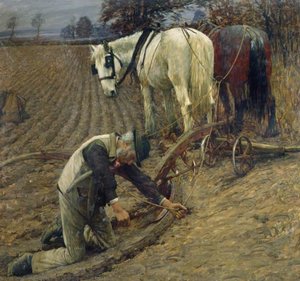
The true soul of La Thangue’s oeuvre lies in his ability to transform ordinary agricultural scenes into profound emotional experiences. His later years, particularly his time in South Walsham, Norfolk, saw a deepening of his focus on the rhythms of the land. In masterpieces such as "The Last Furrow" (1895), he captures the poignant beauty of the harvest, utilizing a realist technique that honors the grit and grace of rural existence. His work often employs a rich, impasto texture to lend physical weight to the earth and sky depicted on his canvas.
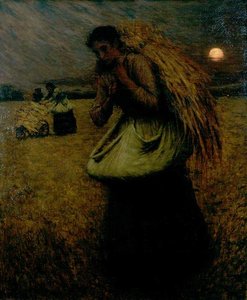
Perhaps no work encapsulates his ability to blend symbolism with naturalism better than "Nightfall," also known as "The Gleaners." In this poignant 1895 oil painting, La Thangue utilizes warm colors and a sense of encroaching shadow to evoke the solemnity of the harvest season. Through his eyes, the landscape is not merely a setting but a living character, imbued with the history of those who toil upon it. His legacy remains a vital part of the Newlyn School tradition, offering a window into a vanished era of British pastoral life through a lens of exquisite, light-filled realism.
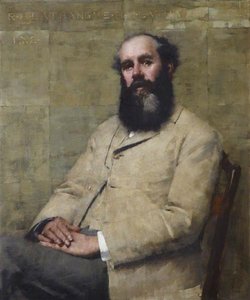
Henry Herbert La Thangue
1859 - 1929 , United Kingdom
Quick Facts
- Artistic Movement Or Style: Realist Landscape & Genre Painting
- Artists Or Movements Influenced By This Artist: ['Newlyn School']
- Artists Who Influenced This Artist:
- Jean-Léon Gérôme
- Bastien Lepage
- Dagnan Bouveret
- Date Of Birth: 1859
- Full Name: Henry Herbert La Thangue
- Nationality: English
- Notable Artworks:
- The Mulberry Tree
- Return of the Reapers
- The Man with the Scythe
- Place Of Birth: Croydon, United Kingdom
Related Articles

The Gaze of a Changing World: Victorian Realism & Modern Life
Explore the captivating world of Victorian Realism! Discover genre painting's rise, social commentary in art, & masters like Fedotov and Wilkie. Expert analysis & high-quality reproductions at ArtsDot.
Romantic Realism's Finest: 10 Masterpieces for Your Home | ArtsDot
Explore 10 defining masterpieces of Romantic Realism! Discover Courbet, Millet & Daumier's powerful paintings—capturing emotion and social realities. Find museum-quality reproductions for your home at ArtsDot.com.
19th Century Masterpieces: 10 Paintings That Defined an Era | ArtsDot
Journey through 19th century art with ArtsDot! Explore 10 iconic paintings – from Monet & Renoir to Courbet – and discover the stories behind Romanticism, Realism & Impressionism. Find museum-quality reproductions for your home decor. Explore the full collection online!
Benjamin Haughton: Victorian Genre Painting & Social Commentary
Explore the captivating world of Benjamin Haughton, Victorian genre painter. Discover his realistic depictions of daily life, social commentary, and enduring artistic legacy. Shop high-quality reproductions at ArtsDot.
Thomas George Webster: Navigating Genre Boundaries & American Identity in 19th-Century Landscape Painting
Explore the captivating genre scenes of Thomas George Webster, a Victorian painter bridging British traditions with American themes. Discover his style, influences & legacy in 19th-century art history.