 Preview
 Send
Send Share
Share
 Details

 Download
 Similars
 X-Ray
X-Ray Diaporama
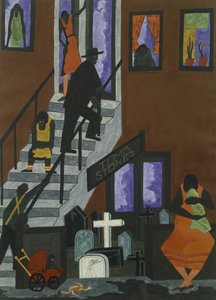
Tombstones


 Read More
Giclée / Art Print
Museum-quality giclée or canvas print with fast production and flexible finish options. ( Buy Hand Made Painting Buy Image)




P118B $10

P118H $10

P118W $10

P438Z $10

P508JH $12

P508YH $12

P805H $10

P805Z $10

P919BZ $10

P919G $10

P919XJ $10

P959ZH $10

P968JZ $12

W106C $8

W218G $10

W218JH $8

W218Y $10

W307PJ $10

W316G $10

W316PJ $8

W316Y $10

W398PJ $8

W4111J $10

W500HY $15

W500JH $15

W692G $12

W849H $8

W940BG $15

W953PJ $8




Pick from our preset sizes that match the artwork's original proportions.

You may enter your own dimensions to fit a specific frame or space. If your selected size does not match the original image's proportions, we will either crop the artwork or extend the image with a mirrored or solid-fill edge. A digital mockup will be sent for your approval before production begins.
Please note that the on-screen preview does not reflect the actual cropping or extension. Only the mockup will accurately show the final composition.
While custom sizes are available, we recommend selecting a dimension from the predefined list to preserve the original proportions.
Worldwide Delivery () in 2 weeks instead of standard 4/5 weeks. (18 August)

Free Worldwide Express Shipping

High-Quality Linen Canvas

Full Shipping Insurance

Customs Tax Refund Guarantee

True Color Matching Guarantee

60-Day Return Policy (Defects Only)

100% Money-Back Guarantee

Bulk Discount Offer
 Glass option is only available in size under 110 CM

Tombstones
Giclée / Art Print
Reproduction Size
-


Total Price
$ 63
Collectible Description
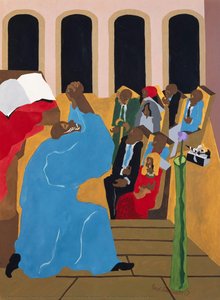
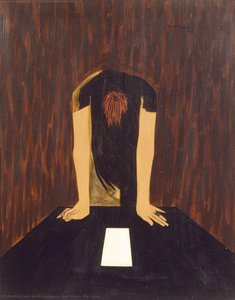
Tombstones by Jacob Lawrence: A Meditation on Mortality and Community
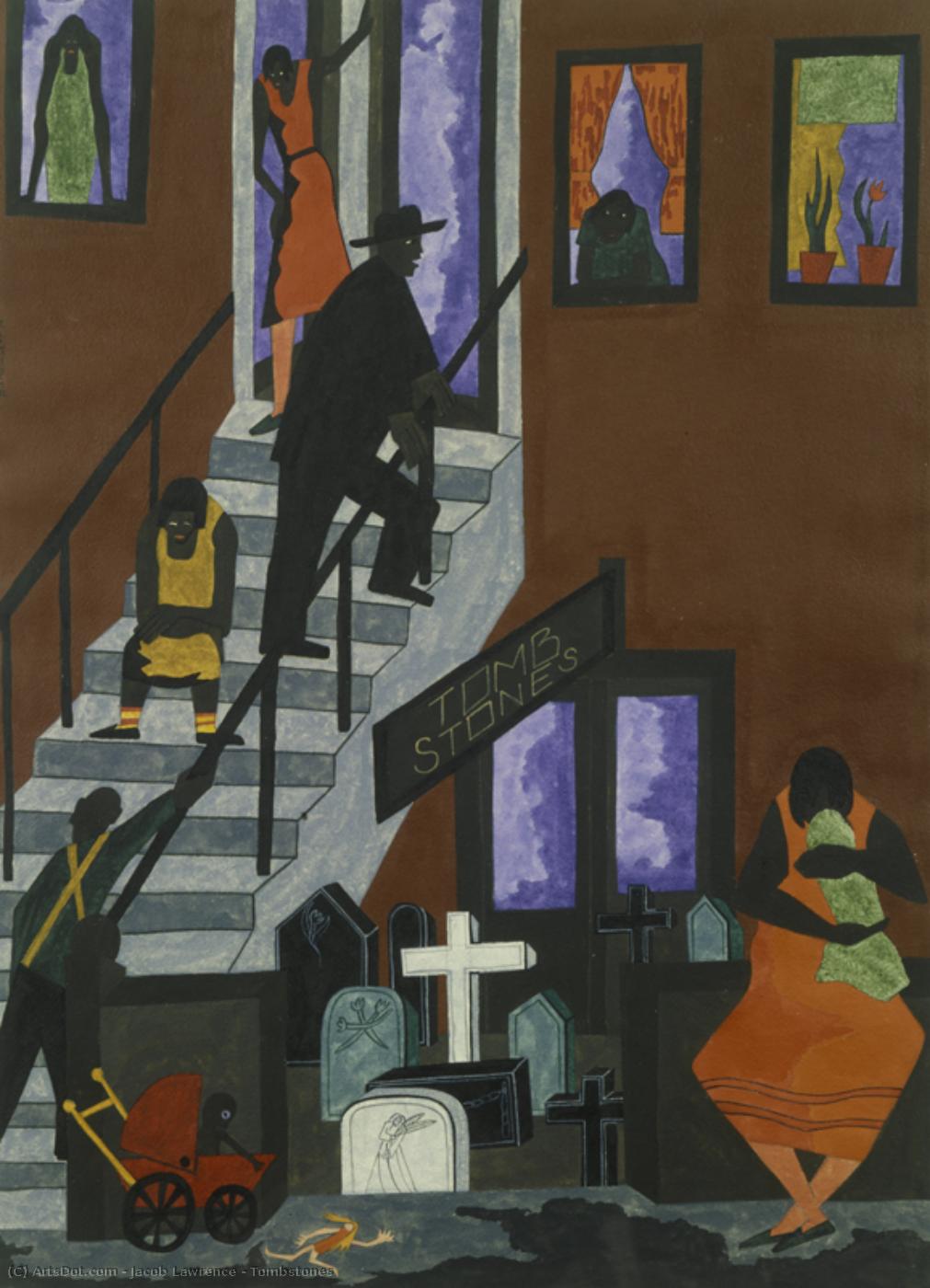
Jacob Lawrence’s “Tombstones,” painted in 1942 during the tumultuous years following Pearl Harbor, stands as a poignant testament to the realities faced by African Americans residing in Harlem. More than just a depiction of a graveyard setting—though undeniably evocative of remembrance—the artwork embodies Lawrence's signature style: dynamic cubism blended with Social Realism, resulting in a visual narrative brimming with symbolic depth and emotional resonance.
- Composition & Perspective: Lawrence employs a flattened perspective characteristic of his oeuvre, prioritizing storytelling over strict adherence to traditional linear perspective. The central staircase dominates the scene, guiding the viewer’s gaze upwards towards an architectural backdrop populated by figures engaged in quiet contemplation. This deliberate arrangement emphasizes the cyclical nature of life and death—the ascent representing aspiration, while the descent signifies inevitable decline.
- Color Palette & Texture: The painting utilizes a muted earthy palette dominated by browns, greens, yellows, and blues, reflecting the somber mood of the subject matter. Lawrence eschews detailed textural representation, opting instead for color blocking and line work to convey surfaces—creating an impression of stillness and solidity despite the dynamic composition.
- Line Work & Geometric Forms: Strong, defined lines are integral to Lawrence’s artistic vision. These lines delineate forms with precision, contributing to a geometric quality that underscores order amidst narrative complexity. The stair railings, building outlines, and tombstones themselves are rendered with unwavering clarity—a stylistic hallmark of Lawrence's oeuvre.
- Symbolism & Narrative Depth: “Tombstones” transcends mere visual representation; it delves into profound themes of mortality, remembrance, and the collective experience of Black Americans during a period marked by hardship and resilience. The presence of tombstones—a deliberate choice reflecting Lawrence’s own observations—serves as a focal point for contemplation on life's fragility.
- Historical Context & Artistic Movement: Lawrence’s work aligns seamlessly with the American Social Realism movement, which sought to portray everyday life and social issues in an honest and accessible manner. The painting reflects the anxieties of wartime America while simultaneously capturing the spirit of Harlem—a vibrant cultural hub grappling with challenges posed by racial discrimination and economic disparity.
The artwork’s enduring power lies not only in its meticulous depiction of a specific locale but also in Lawrence's masterful ability to distill complex emotions into simplified forms. “Tombstones” invites viewers to consider the significance of confronting mortality—to honor memory—and to recognize the importance of communal solidarity in navigating life’s inevitable hardships.
Executed in tempera paint on paper, "Tombstones" exemplifies Lawrence's commitment to conveying truthfulness and emotion through a distinctive artistic technique. The artist’s deliberate layering of color planes creates depth without relying on conventional shading—resulting in an image that is both visually striking and intellectually stimulating.
Further research into Jacob Lawrence’s life and artistic journey reveals his unwavering dedication to documenting the experiences of African Americans during the Great Migration era. His work serves as a powerful reminder of the importance of confronting difficult realities with compassion and understanding—a legacy that continues to inspire artists and audiences alike.
Related Artworks

Artist Biography
A Life Painted in Story: The World of Jacob Lawrence
Jacob Armstead Lawrence, born in Atlantic City, New Jersey, in 1917, emerged as one of the most significant American artists of the 20th century. His life story is intrinsically woven into his art—a powerful narrative shaped by the realities of being African-American during a period of profound social change. Following his parents’ divorce in 1924, Lawrence experienced a childhood marked by movement and adaptation, spending time in foster care in Philadelphia before ultimately finding a home with his mother in Harlem during the vibrant years of the Harlem Renaissance. This immersion into the cultural heart of Black America would become the wellspring of his artistic vision. It was within the bustling streets and communal spirit of Harlem that Lawrence first encountered art, attending classes at Utopia Children’s House and later studying under Charles Alston at the Harlem Art Workshop—a formative experience that set him on a path to becoming a visual storyteller of unparalleled depth.Dynamic Cubism: A Style Born of Experience
Lawrence didn't simply adopt artistic styles; he forged his own, famously describing it as “dynamic cubism.” This wasn’t an imitation of the European avant-garde but rather a unique synthesis of modernist principles and the lived experiences of his community. Influenced by the bold colors and flattened forms of African sculpture and Mexican muralists—artists who prioritized narrative and social commentary—Lawrence developed a visual language that was both strikingly modern and deeply rooted in Black culture. His paintings are characterized by strong, simplified shapes, vibrant color palettes, and a deliberate rejection of traditional perspective. This approach wasn’t merely aesthetic; it served to emphasize the emotional weight of his subjects and create a sense of immediacy and accessibility. He sought not to replicate reality but to distill its essence, capturing the spirit of a people and their history with unwavering honesty.Chronicling History & Everyday Life
Lawrence’s artistic output is remarkable for its breadth and thematic consistency. He didn't focus on isolated portraits or landscapes; instead, he created sweeping series that tackled monumental historical events and the nuances of everyday Black life. His breakthrough came with The Migration Series, a powerful sequence of sixty panels depicting the Great Migration—the mass movement of African Americans from the rural South to the industrial North in search of opportunity and escape from Jim Crow segregation. This work, begun in 1940-41, catapulted Lawrence to national recognition, earning him accolades and securing his place as a leading voice in American art. But The Migration Series was just the beginning. He went on to create equally compelling series dedicated to figures like Toussaint L’Ouverture, Frederick Douglass, and Harriet Tubman—transforming historical narratives into accessible visual stories. Beyond these grand historical cycles, Lawrence also found beauty and significance in the ordinary: scenes of barbershops, diners, and domestic life became canvases for exploring themes of community, resilience, and identity. His painting Bar and Grill, a stark depiction of segregation within a New Orleans café, exemplifies his ability to distill complex social realities into potent visual statements. Similarly, Victory and Defeat, with its imposing wall of cannonballs, commemorates the pivotal siege of Yorktown, Virginia, offering a nuanced reflection on American history.Legacy & Enduring Influence
Jacob Lawrence’s impact extends far beyond his impressive body of work. He was not only an artist but also a dedicated educator, teaching at institutions like Black Mountain College and the University of Washington for sixteen years. Through his teaching, he nurtured generations of artists, encouraging them to find their own voices and explore themes relevant to their experiences. Lawrence paved the way for countless African-American artists who followed, challenging prevailing norms and expanding the boundaries of American art. His work continues to resonate today, prompting critical conversations about race, history, and social justice. Featured in prominent museums such as the Smithsonian American Art Museum and the University of Washington’s collection, his paintings serve as enduring testaments to the power of art to illuminate the human condition and inspire change. He left behind a legacy not just of beautiful images but of courageous storytelling—a visual chronicle of a people's journey toward freedom and self-determination.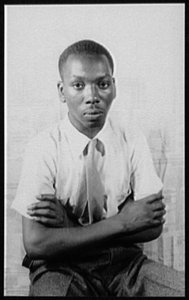
Jacob Lawrence
1917 - 2000 , United States of America
Quick Facts
- Artistic Movement Or Style: Dynamic Cubism
- Artists Or Movements Influenced By This Artist: African-American artists
- Date Of Birth: September 7, 1917
- Date Of Death: June 9, 2000
- Full Name: Jacob Lawrence
- Nationality: American
- Notable Artworks:
- Bar and Grill
- Victory and Defeat
- Captain Skinner
- Firewood 55
- Place Of Birth: Atlantic City, USA
Related Articles

Transforming Spaces: A Comprehensive Exploration of Wall Decor Through Art History & Contemporary Practice
Explore the art of transforming spaces with our comprehensive guide to wall decor. From historical movements to contemporary trends, discover how to curate impactful interiors and commission bespoke artwork for a truly personalized aesthetic.
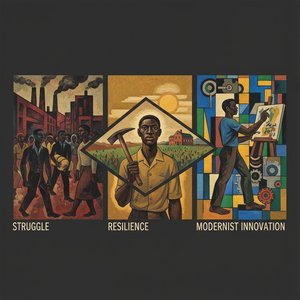
Jacob Lawrence: Narratives of Struggle, Resilience & Modernist Innovation
Explore the powerful narratives of Jacob Lawrence, a pivotal African American artist of the Harlem Renaissance. Discover his iconic 'Migration Series,' dynamic cubism style, and lasting impact on American art history.
The Return of the Fresco: Why Wall Murals Are the New Luxury Statement
Elevate your space with bespoke wall murals & frescoes. Explore the resurgence of this luxury art form. Expert design guidance & seamless installation – .
Top 10 Masterpieces for Your Living Room: Iconic Paintings & Art Decor Ideas |
Transform your living room with iconic art! Explore our guide to the Top 10 most famous paintings – from Van Gogh's Starry Night to Mona Lisa. Discover artist stories, techniques & find museum-quality reproductions for timeless decor. Explore the full collection on

Weddings & Wall Art: Transforming Memories into Masterpieces for Your Home
Transform your wedding memories into stunning wall art! Discover unique gifts & personalized portraits with 's expert consultation & museum-quality reproductions.