Preview
 Send
Send Share
Share
 Details

 Download
 Similars
 X-Ray
X-Ray Diaporama
 Stats
StatsLandscape with a Shepherd
 Oil On Canvas
- WallArt
- Dutch Golden Age
 1800
1800 69.0 x 91.0 cm
 Rijksmuseum
 Read More
Giclée / Art Print
Museum-quality giclée or canvas print with fast production and flexible finish options. ( Buy Hand Made Painting Switch to Digital Image)




P118B $10

P118H $10

P118W $10

P438Z $10

P508JH $12

P508YH $12

P805H $10

P805Z $10

P919BZ $10

P919G $10

P919XJ $10

P959ZH $10

P968JZ $12

W106C $8

W218G $10

W218JH $8

W218Y $10

W307PJ $10

W316G $10

W316PJ $8

W316Y $10

W398PJ $8

W4111J $10

W500HY $15

W500JH $15

W692G $12

W849H $8

W940BG $15

W953PJ $8
Pick from our preset sizes that match the artwork's original proportions.

You may enter your own dimensions to fit a specific frame or space. If your selected size does not match the original image's proportions, we will either crop the artwork or extend the image with a mirrored or solid-fill edge. A digital mockup will be sent for your approval before production begins.
Please note that the on-screen preview does not reflect the actual cropping or extension. Only the mockup will accurately show the final composition.
While custom sizes are available, we recommend selecting a dimension from the predefined list to preserve the original proportions.
Worldwide Delivery () in 2 weeks instead of standard 4/5 weeks. (14 September)

Free Worldwide Express Shipping

High-Quality Linen Canvas

Full Shipping Insurance

Customs Tax Refund Guarantee

True Color Matching Guarantee

100-Day Return Policy (Defects Only)

100% Money-Back Guarantee

Bulk Discount Offer
 Glass option is only available in size under 110 CM

Landscape with a Shepherd
Giclée / Art Print
Reproduction Size
-


Total Price
$ 63
A Moment Frozen in Time: Jacob van Strij’s ‘Landscape with a Shepherd’
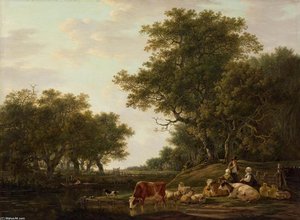
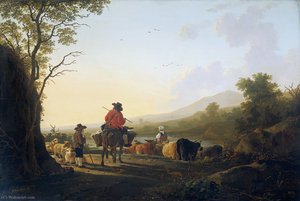
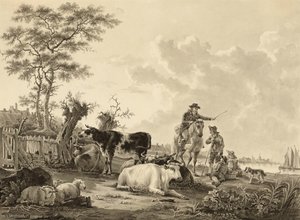
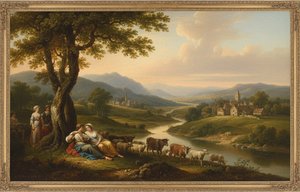
Jacob van Strij's “Landscape with a Shepherd,” painted around 1800, isn’t merely a depiction of a rural scene; it’s an invitation to step into the heart of 18th-century Dutch pastoralism. The painting captures a fleeting moment – a group of cows and sheep resting beneath the dappled shade of ancient trees, overseen by a solitary shepherd tending his flock. More than just a record of a landscape, it's a carefully constructed tableau designed to evoke a profound sense of tranquility, connection with nature, and the quiet dignity of rural life.
The scene unfolds with remarkable realism, yet infused with an almost dreamlike quality. Van Strij’s meticulous attention to detail—the individual blades of grass, the texture of the bark on the trees, the subtle shifts in light—grounds the image in tangible reality. However, he elevates this realism through a masterful use of color and composition. The palette is dominated by muted greens and blues, creating a sense of atmospheric depth and suggesting the cool embrace of an early autumn afternoon. The sky, rendered with delicate washes of blue and grey, hints at impending rain, adding a touch of melancholy to the otherwise serene setting.
Echoes of Cuyp and the Dutch Golden Age
Van Strij’s work is deeply rooted in the artistic traditions of the Dutch Golden Age, particularly the legacy of Aelbert Cuyp. Like Cuyp, Van Strij was captivated by the beauty of the natural world and sought to capture its essence on canvas. Cuyp's influence is evident in Van Strij’s use of light and shadow, his ability to render atmospheric effects with remarkable subtlety, and his preference for depicting scenes of rural life. However, while Cuyp often focused on dramatic lighting and fleeting moments, Van Strij imbues his landscapes with a greater sense of stillness and contemplation.
The painting’s composition is carefully balanced, drawing the eye through a series of receding planes. The foreground, dominated by the grazing animals, gradually fades into the middle ground, where the trees stand sentinel over the distant horizon. This layering creates a sense of depth and perspective, inviting the viewer to lose themselves in the vastness of the landscape. The shepherd himself is positioned slightly off-center, acting as a focal point within the composition—a silent observer of nature’s rhythms.
Symbolism and Emotional Resonance
Beyond its purely representational qualities, “Landscape with a Shepherd” carries significant symbolic weight. The scene evokes a sense of harmony between humanity and nature – a reminder of our dependence on the land and the importance of respecting its bounty. The shepherd represents a connection to tradition, a link to the past, and a quiet reverence for the natural world. The animals symbolize fertility, abundance, and the cyclical rhythms of life.
Furthermore, the painting’s mood is profoundly contemplative. There's no sense of urgency or drama; instead, we are invited to pause and appreciate the simple beauty of the scene. The muted colors, the soft light, and the stillness of the landscape create a feeling of peace and serenity—a welcome respite from the stresses of modern life. It’s a painting that speaks to our innate desire for connection with nature and our longing for moments of quiet contemplation.
Bringing the Pastoral Home
Reproductions of “Landscape with a Shepherd” offer a remarkable opportunity to bring this timeless masterpiece into your home or office. ArtsDot.com provides high-quality, hand-painted reproductions that faithfully capture the painting’s original beauty and detail. Whether you choose a standard size or commission a custom reproduction tailored to your specific needs, you can enjoy the enduring appeal of Van Strij's evocative landscape for years to come.
Related Artworks
Artist Biography
The Master of Winter’s Embrace: The Life and Legacy of Jacob van Strij
In the quiet, frost-touched landscapes of the late eighteenth century, few artists captured the ephemeral beauty of the Dutch seasonal cycle as poignantly as Jacob van Strij. Born in the historic city of Dordrecht on October 2, 1756, Van Strij was a painter whose soul seemed inextricably linked to the atmospheric shifts of the Netherlands. He emerged from a lineage of artistic devotion, the son of Leendert van Strij, a respected painter and draftsman who provided his early education. This familial foundation, combined with the presence of his brother Abraham—a founding member of the prestigious Pictura Dordrecht drawing society—ensured that Jacob’s upbringing was steeped in the rigorous traditions of Dutch visual artistry.
His journey toward artistic maturity took him beyond the borders of his homeland to the vibrant academic atmosphere of Antwerp. Between 1774 and 1776, Van Strij attended the classes of Andries Cornelis Lens at the Academy of Fine Arts. It was during this formative period that his technical prowess began to coalesce with a profound sensitivity to light. Under the guidance of such mentors, he mastered the classical principles of composition and the delicate interplay of shadow, skills that would later allow him to breathe life into the frozen rivers and misty pastures that became his hallmark.
A Vision Rooted in the Golden Age
While Van Strij lived and worked during the transition from the late Baroque to the early Rococo era, his artistic heart remained anchored in the reverence of the Dutch Golden Age. He looked backward to the masters of the seventeenth century to find a way forward, drawing immense inspiration from the atmospheric perspective of Aelbert Cuyp and the dramatic chiaroscibility of Rembrandt van Rijn. This connection to the past is evident in his ability to manipulate light, using it not merely as an illumination of form, but as a vessel for emotion and seasonal mood.
His oeuvre is characterized by a remarkable versatility in subject matter, though he is most celebrated for specific genres that evoke a sense of timeless tranquility:
- Winter Landscapes: Perhaps his most enduring contribution, these works capture the stillness of a world blanketed in snow, where the biting cold is softened by the warmth of subtle, glowing light.
- Marine Paintings: Demonstrating a keen eye for the maritime heritage of the Netherlands, he rendered the movement of water and the majesty of vessels with great precision.
- Pastoral Scenes: His depictions of cattle, shepherds, and rural life reflect a deep respect for the rhythms of nature and the quiet dignity of the countryside.
Artistic Achievement and Historical Significance
Beyond his technical skill as a painter, printmaker, and draftsman, Jacob van Strij was regarded by his contemporaries as a man of great intellect and culture. He was a well-read individual who contributed to the intellectual life of Dordrecht, delivering lectures at the Teekengenootschap Pictura on the complexities of mythology and the enduring brilliance of the Old Masters. This duality—the meticulous observer of nature and the scholarly custodian of art history—allowed him to create works that were both visually captivating and intellectually grounded.
Though his life ended in 1815, Van Strij’s influence persists through the many collections that house his treasures, from the Dordrechts Museum to the Smithsonian American Art Museum. His ability to transform a simple landscape into a profound meditation on light and season ensures his place in the canon of Dutch art. He did not merely paint what he saw; he painted the feeling of the wind, the weight of the snow, and the enduring peace of the Dutch landscape, leaving behind a legacy that continues to evoke a sense of wonder in all who behold it.
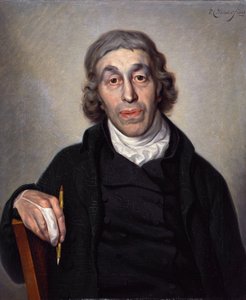
jacob van strij dordrecht
1756 - 1815 , Netherlands
Quick Facts
- Artistic Movement Or Style: Dutch Golden Age Landscape Painting
- Artists Or Movements Influenced By This Artist: ['17th-century landscape painters']
- Artists Who Influenced This Artist: ['Albert Cuyp']
- Date Of Birth: October 2, 1756
- Date Of Death: February 4, 1815
- Full Name: Jacob van Strij
- Nationality: Dutch
- Notable Artworks:
- Landscape with a Shepherd
- Figures in a forest landscape
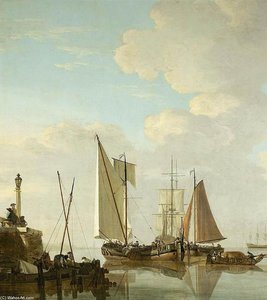
- Two Boeiers and a Cat under Sail
- Place Of Birth: Dordrecht, Netherlands
Related Articles
Nicolaes Berchem: Dutch Golden Age Pastoralism & the Evolution of Landscape Painting
Explore the captivating world of Nicolaes Berchem, a leading Dutch Golden Age painter. Discover his idyllic landscapes, masterful technique & lasting influence on art history. Learn more at ArtsDot.
Idyllic Visions: Exploring the Pastoral Scene in Art History – From Arcadia to Modern Interpretations
Explore the captivating history of pastoral art from classical Arcadia to modern masterpieces. Discover key artists like Millet & Cole at ArtsDot. Find serene landscape paintings for your home.
Jacob van Ruisdael: Master of Dutch Landscape & the Evocation of National Identity
Explore the life & work of Jacob van Ruisdael, the preeminent Dutch landscape painter. Discover his technical brilliance, symbolic depth, and lasting influence on art history. Learn about collecting Ruisdael's masterpieces.
Idyllic Visions: Exploring the Pastoral Tradition in Western Art – Themes, Techniques & Enduring Appeal
Explore the rich history of pastoral art from classical Arcadia to contemporary interpretations. Discover key artists, themes & collecting tips at ArtsDot.

John Constable's Masterpieces: Explore 25 Iconic Landscapes for Your Home
Journey through John Constable's 25 most celebrated landscapes. Explore Romanticism, Dedham Vale & his masterful use of light in iconic paintings like 'Hay Wain'. Find museum-quality art reproductions and elevate your home decor on ArtsDot.com.