Preview
 Send
Send Share
Share
 Details

 Download
 Similars
 X-Ray
X-Ray Diaporama
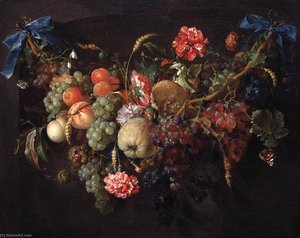
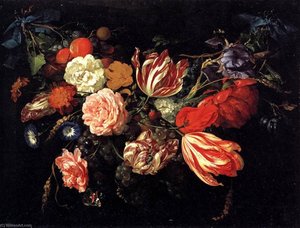
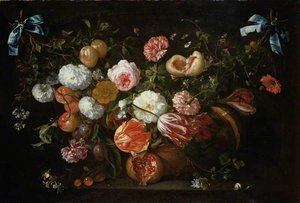
Garland with fruits


 Read More
Hand Made Oil Reproduction
Hand-painted oil on canvas in your size and frame, made to order by our artists. ( Buy Print Buy Image)




































Pick from our preset sizes that match the artwork's original proportions.

You may enter your own dimensions to fit a specific frame or space. If your selected size does not match the original image's proportions, we will either crop the artwork or extend the painting with additional hand-painted elements. A digital mockup will be sent for your approval before production begins.
Please note that the on-screen preview does not reflect the actual cropping or extension. Only the mockup will accurately show the final composition.
While custom sizes are available, we recommend selecting a dimension from the predefined list to preserve the original proportions.
After order, ArtsDot.com team will email client for instructions and provide a mockup preview
Worldwide Delivery () in 3/4 weeks instead of standard 5 weeks. (21 August). No compromise on quality.

Free Worldwide Express Shipping

High-Quality Linen Canvas

Full Shipping Insurance

Customs Tax Refund Guarantee

True Color Matching Guarantee

60-Day Return Policy (Defects Only)

100% Money-Back Guarantee

Bulk Discount Offer
 Glass option is only available in size under 110 CM

Garland with fruits
Reproduction Medium
Reproduction Size
-


Total Price
$ 263
Artwork Description
The Painting's Composition and Style
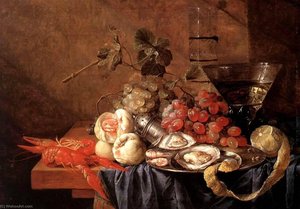
The Garland with Fruits features an intricate arrangement of various fruits, including grapes, apples, oranges, plums, peaches, and cherries. The painting's composition is quite complex, showcasing De Heem's exceptional skill in capturing the details of each fruit. The colors used in the painting create a vibrant and lively atmosphere, making it an appealing piece of artwork. As seen in other works by De Heem, such as Still-Life with Flowers by his son Cornelis De Heem, the use of light and shadow adds depth and dimension to the painting.Influence and Legacy
De Heem's work had a significant influence on the development of still-life painting in the Netherlands during the 17th century. His innovative style and techniques inspired many other artists, including Abraham Mignon (Minjon) and Hans Bollongier (Jan Bollongier). The Flemish Baroque Art Movement, which De Heem was a part of, is characterized by its dramatic and emotional style, rich colors, and intense light and dark shadows. For more information on this art movement, visit /art/list/?Filter=A@D3CQN7-Flemish-Baroque-Art-Movement.- View the Garland with Fruits painting by Jan Davidszoon De Heem at /art/list/?Filter=AQTQFK-Jan-Davidszoon-De-Heem-Garland-with-fruits.
- Learn more about the artist's life and work on Wikipedia: https://en.wikipedia.org/wiki/Jan_Davidsz._de_Heem.
The Garland with Fruits is a testament to De Heem's skill and artistry, and its beauty continues to inspire and captivate audiences today.
Related Artworks
Artist Biography
Jan Davidszoon de Heem: The Quintessential Dutch Still Life Master
Jan Davidszoon de Heem (c. 1606 – before April 26, 1684) stands as one of the most celebrated figures in Dutch Baroque painting, achieving renown primarily for his breathtakingly realistic depictions of still lifes—a genre he elevated to unparalleled heights of artistic sophistication. Born Johannes van Antwerpen in Utrecht, de Heem’s early life remains somewhat shrouded in mystery, though he apprenticed under his father, David de Heem the Elder, a respected artist himself who instilled in him a foundational understanding of perspective and meticulous observation. This formative influence extended beyond familial ties; he honed his skills further under the tutelage of Balthasar van der Ast, arguably Utrecht’s most prominent painter during that era, absorbing the stylistic precepts of Antwerp Mannerism alongside classical principles. His artistic journey took him to Leiden around 1625 where he studied diligently with David Bailly, a fellow artist known for his innovative use of chiaroscuro—the dramatic interplay of light and shadow—a technique de Heem would master with exceptional precision. Leiden provided fertile ground for experimentation and intellectual discourse, shaping the young de Heem’s artistic sensibilities. Recognizing his burgeoning talent, he swiftly moved to Antwerp in 1635 or 1636, joining the Guild of Saint Luke and securing a berth as a citizen—a significant step toward establishing himself as a professional artist within the bustling Flemish art world. Despite frequent absences due to guild obligations and administrative duties, de Heem’s reputation grew exponentially, attracting commissions from wealthy patrons eager to adorn their homes with his masterful creations. De Heem's artistic style is characterized by an obsessive attention to detail—a hallmark of Dutch Baroque painting—and a profound understanding of naturalism. Unlike many contemporaries who favored idealized landscapes or mythological subjects, de Heem focused exclusively on inanimate objects arranged in elaborate compositions. His still lifes are renowned for their luminous colors achieved through glazing techniques and masterful rendering of textures – from velvety petals to glistening fruit skins. Recurring motifs include exotic fruits—particularly peaches and pears—flowers (roses, lilies, tulips), insects (bees, butterflies), and occasionally skulls or vanitas symbols representing mortality—a deliberate reminder of the transience of earthly existence. These elements are interwoven with meticulous geometric precision, reflecting the influence of Renaissance perspective and demonstrating de Heem’s mastery of artistic conventions. His sons played an integral role in his workshop, assisting him in preparing for commissions and ensuring the quality control of finished paintings. Notably, Jan Davidszoon de Heem collaborated closely with his eldest son Cornelis, who continued to practice as a still life painter, upholding the family’s legacy of artistic excellence. The artist's success was undeniable; he commanded considerable fees and achieved fame beyond Utrecht and Antwerp. A portrait of William III surrounded by flowers fetched an astounding 2000 guilders—the highest price ever paid for a painting during the Dutch Golden Age—a testament to his artistic prestige and the admiration of his patrons. Throughout his career, de Heem produced an astonishing output of approximately 350 paintings, cementing his place as one of the foremost artists of his time. His work is housed in museums across Europe, including the Mauritshuis in The Hague and the Rijksmuseum in Amsterdam, where visitors can marvel at the enduring beauty and technical brilliance of his masterpieces. Jan Davidszoon de Heem’s legacy extends beyond mere artistic achievement; he embodies the spirit of Dutch Baroque—a celebration of observation, meticulous craftsmanship, and a contemplative engagement with themes of life and death—leaving an indelible mark on art history as a true visionary of his era.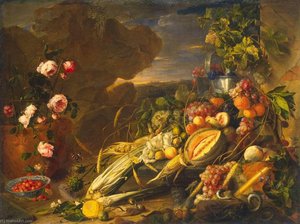
jan davidszoon de heem
1606 - 1684
Quick Facts
- Artistic Movement Or Style: Dutch Baroque
- Artists Or Movements Influenced By This Artist: ['Jacob Marrel']
- Artists Who Influenced This Artist:
- David de Heem (father)
- Balthasar van der Ast
- Date Of Birth: 1606
- Date Of Death: 1684
- Full Name: Jan Davidszoon de Heem
- Nationality: Dutch
- Notable Artworks:
- Still Life: A Banqueting Scene
- Festoon of Fruit and Flowers
- Garland with fruits
- Place Of Birth: Utrecht, Netherlands
Related Articles

Dutch Baroque Masters: 10 Paintings That Shaped an Era | ArtsDot
Journey through the Golden Age with our guide to the Top 10 Dutch Baroque masterpieces! Explore iconic paintings by Rembrandt, Vermeer & Frans Hals. Find museum-quality art reproductions and elevate your home decor at ArtsDot.com.

Golden Age Reflections: Dutch Baroque Painting & Cultural Innovation
Explore the Dutch Golden Age of painting! Discover key artists like Vermeer & ter Borch, their innovative techniques, and the rich cultural context behind these Baroque masterpieces. Learn about collecting & appreciating this iconic art period.
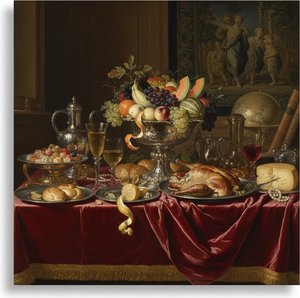
Abraham Hendricksz van Beyeren: Pioneering Dutch Still Life & the Banquet Tradition
Explore the captivating world of Dutch Golden Age still life with Abraham van Beyeren. Discover his innovative techniques, symbolic banquet scenes & lasting influence on art history. Learn about collecting these masterpieces.
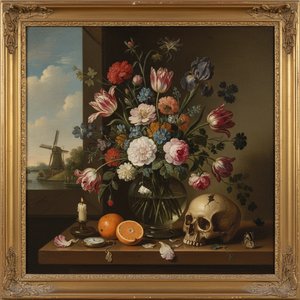
Jan Jansz Wijnants: A Study in Dutch Golden Age Still Life & Floral Transience
Explore the captivating world of Jan Wijnants and Dutch Golden Age still life painting. Discover symbolism, masterful techniques & lasting influence on floral art history. Learn more!
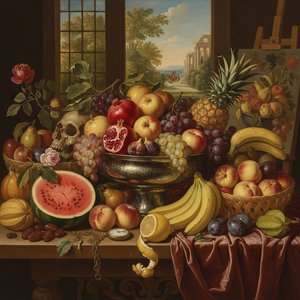
The Bountiful Still Life: Symbolism & Artistic Representation of Fruit Across Art History
Explore the rich history of still life painting & the symbolism of fruit across art movements. Discover masterpieces from Caravaggio to Cézanne with ArtsDot – expert guidance & museum-quality reproductions.