 Preview
 Send
Send Share
Share
 Details

 Download
 Similars
 X-Ray
X-Ray Diaporama
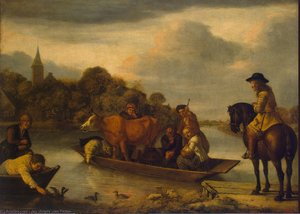
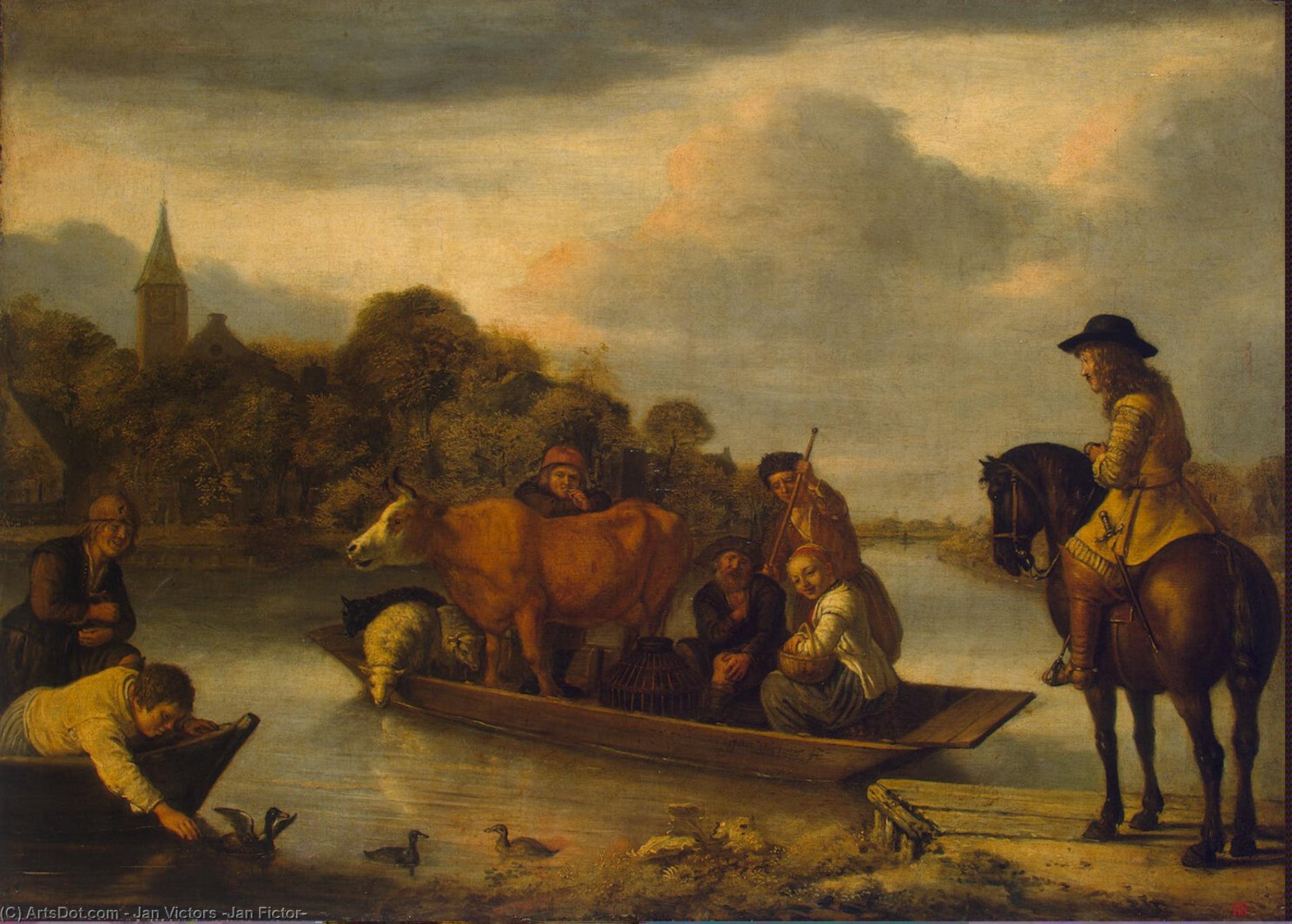
Ferryboat
 Oil On Canvas
- WallArt
- Baroque
 1660
1660- Early Modern
 85.0 x 118.0 cm
 Hermitage Museum
 Read More
Hand Made Oil Reproduction
Hand-painted oil on canvas in your size and frame, made to order by our artists. ( Buy Print Buy Image)




P118B $10

P118H $10

P118W $10

P438Z $10

P508JH $12

P508YH $12

P805H $10

P805Z $10

P919BZ $10

P919G $10

P919XJ $10

P959ZH $10

P968JZ $12

W106C $8

W218G $10

W218JH $8

W218Y $10

W307PJ $10

W316G $10

W316PJ $8

W316Y $10

W398PJ $8

W4111J $10

W500HY $15

W500JH $15

W692G $12

W849H $8

W940BG $15

W953PJ $8




Pick from our preset sizes that match the artwork's original proportions.

You may enter your own dimensions to fit a specific frame or space. If your selected size does not match the original image's proportions, we will either crop the artwork or extend the painting with additional hand-painted elements. A digital mockup will be sent for your approval before production begins.
Please note that the on-screen preview does not reflect the actual cropping or extension. Only the mockup will accurately show the final composition.
While custom sizes are available, we recommend selecting a dimension from the predefined list to preserve the original proportions.
After order, ArtsDot.com team will email client for instructions and provide a mockup preview
Worldwide Delivery () in 3/4 weeks instead of standard 5 weeks. (16 August). No compromise on quality.

Free Worldwide Express Shipping

High-Quality Linen Canvas

Full Shipping Insurance

Customs Tax Refund Guarantee

True Color Matching Guarantee

60-Day Return Policy (Defects Only)

100% Money-Back Guarantee

Bulk Discount Offer
 Glass option is only available in size under 110 CM

Ferryboat
Reproduction Medium
Reproduction Size
-


Total Price
$ 263
Artwork Description
A Journey Across the Water: The Narrative Power of Jan Victors' Ferryboat
To gaze upon this depiction of a ferry crossing is to be instantly transported to the bustling, vital arteries of 17th-century Dutch life. Jan Victors, master chronicler of human endeavor and dramatic moments, captures here not merely a passage from one bank to another, but a rich tableau vivant brimming with activity and quiet coexistence. The scene unfolds upon the water, a liquid mirror reflecting both the sky and the weighty cargo—a confluence of humanity, domesticated beasts, and the sheer necessity of travel. One can almost hear the creak of the boat timbers and the lowing of the cattle as this vital crossing takes place.
Mastery in Genre and Narrative Detail
Victors’s technique here is a testament to the meticulous observation characteristic of the Dutch Golden Age. The composition is wonderfully dense, yet never feels cluttered; every figure and animal occupies its space with purpose. Observe the men—some standing with an air of watchful guardianship, others seated in postures suggesting momentary rest amidst the journey's rhythm. They interact with their surroundings, their presence anchoring the scene. But it is the integration of life itself that elevates this piece beyond simple genre painting. The inclusion of the livestock—the sturdy cows and the noble horse—speaks to the economic backbone of the era. These animals are not mere props; they are participants in a shared moment of transit, bound by the immediate needs of passage.
Symbolism of Passage and Community
Art historically, water has always been a potent symbol—a threshold between worlds, representing change, journey, and the unknown. In this context, the ferryboat becomes a microcosm of community itself. The people, animals, and even the solitary bird flitting above are all reliant on this shared means of passage. This suggests themes of interdependence; no single element can navigate this crossing alone. For the modern collector or designer, this painting offers more than just decoration; it offers contemplation—a visual meditation on journeys taken, connections maintained, and the enduring rhythm of daily life against the backdrop of a vast, flowing world.
Technique and Emotional Resonance for Your Space
The rich tonality and palpable texture evident in Victors’s brushwork invite close inspection. While the subject matter is grounded in everyday reality—the mundane act of ferrying goods—the execution imbues it with a profound sense of drama, aligning perfectly with his reputation as a master of dramatic storytelling. Reproducing this work allows one to bring that specific 17th-century Dutch atmosphere into contemporary interiors. Imagine this piece anchoring a drawing-room or study; its narrative depth provides conversation, while its masterful composition offers an immediate focal point of quiet grandeur. It is a piece that whispers stories of resilience and human connection across the ages.
Related Artworks
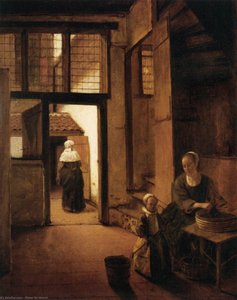
Artist Biography
Jan Victors (1619 – 1679): A Master of Dramatic Biblical Storytelling
Born in Amsterdam during the height of the Dutch Golden Age, Jan Victors, also known as Jan Fictor, was a painter whose career unfolded within a complex interplay of artistic influences and religious convictions. His life, though relatively obscure compared to contemporaries like Rembrandt or Vermeer, reveals a significant contribution to the rich tapestry of 17th-century Dutch art – specifically in his masterful depictions of biblical narratives and poignant genre scenes. While biographical details remain somewhat fragmented, piecing together information from tax records, artistic analysis, and historical context paints a portrait of an artist deeply committed to his faith, yet undeniably skilled in capturing human emotion and dramatic tension.
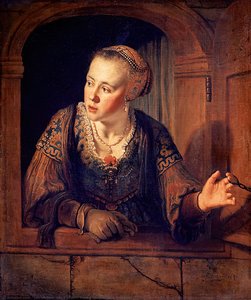
Early accounts suggest that Victors’s artistic journey began under the tutelage of Rembrandt van Rijn. Though the precise nature of their relationship remains debated – some scholars believe he was merely a student, while others posit a more substantial mentorship – the influence of Rembrandt is undeniable in Victors's early work, particularly evident in his study of character and composition. The “Young girl at a window” (circa 1640), now housed in the Louvre, stands as a testament to this formative period, showcasing a remarkable ability to convey youthful expectation and vulnerability – qualities that would become hallmarks of Victors’s oeuvre.
A Calvinist Painter: Restraint and Narrative
What distinguishes Jan Victors from many of his contemporaries is his deliberate avoidance of certain subjects deemed unsuitable for a devout Calvinist. He steadfastly resisted painting scenes depicting Christ, angels, or nudity – a conscious decision rooted in his religious beliefs. This constraint, however, did not stifle his creativity; rather, it channeled him towards exploring the vast and emotionally resonant world of biblical history and human drama. Victors’s paintings are replete with powerful narratives drawn from the Old Testament, often focusing on moments of moral struggle, familial conflict, and profound faith – themes that resonated deeply within the Calvinist community.
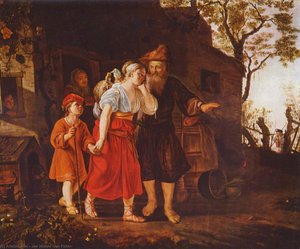
His approach to storytelling is characterized by a dramatic use of light and shadow, a technique known as chiaroscuro. Influenced heavily by Caravaggio, Victors masterfully employed contrasting tones to heighten emotional impact and create a sense of theatricality. This stylistic choice is particularly evident in “Abraham’s Parting from the Family of Lot” (1655), where the stark contrast between light and darkness underscores the gravity of Abraham's decision and the poignant farewells exchanged.
Key Works and Artistic Development
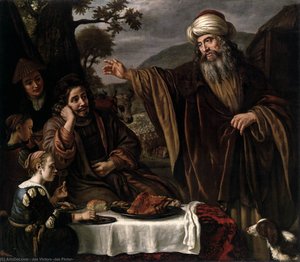
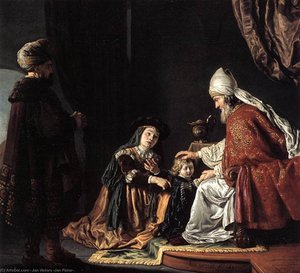
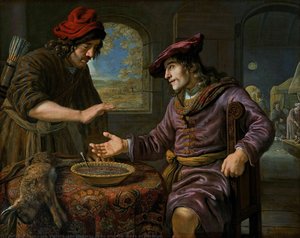
Among Victors’s most celebrated works are "Hannah Giving Her Son Samuel to the Priest" (1645) and “Esau and the Mess of Pottage” (1653). The latter, depicting a seemingly trivial moment – Esau's impulsive reaction to his brother Jacob’s trickery – is imbued with profound psychological insight. Victors doesn’t simply illustrate the event; he captures the raw emotions of regret, jealousy, and reconciliation. “Abraham’s Parting” similarly demonstrates his ability to convey complex human relationships within a biblical context, while “Hannah Giving Her Son Samuel” showcases his skill in portraying religious devotion and familial love.
Victors's style evolved over time, reflecting both the influence of Rembrandt and his own developing artistic vision. His earlier works are characterized by a more formal, almost academic approach, reminiscent of Pieter Lastman. However, as he matured, his paintings became increasingly dynamic and emotionally charged, demonstrating a greater sense of immediacy and dramatic intensity.
Later Life and Legacy
In the later years of his life, Jan Victors abandoned painting for a more practical role as a ‘ziekentrooster’ – a professional nurse and cleric serving the Dutch East India Company. He traveled to Indonesia (then the Dutch East Indies) in 1676, where he tragically died shortly after arrival. Despite this relatively brief period of activity, Victors left behind a significant body of work that continues to captivate viewers with its dramatic intensity, skillful use of chiaroscuro, and profound exploration of human emotion within the framework of biblical narratives.
His paintings are now housed in prominent museums worldwide, including the Getty Museum, the Tel Aviv Museum of Art, and the Städel Museum. Jan Victors’s legacy as a skilled and emotionally resonant painter remains firmly established – a testament to his artistic talent and unwavering commitment to portraying the complexities of faith and human experience.
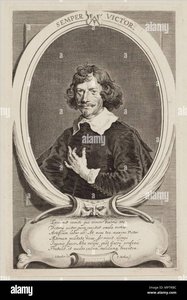
jan victors (jan fictor)
1619 - 1679 , Netherlands
Quick Facts
- Artistic Movement Or Style: Baroque painting, Chiaroscuro
- Artists Or Movements Influenced By This Artist: ['Caravaggism']
- Artists Who Influenced This Artist: ['Rembrandt']
- Date Of Birth: June 13, 1619
- Date Of Death: December 1679
- Full Name: Jan Victors (Jan Fictor)
- Nationality: Dutch
- Notable Artworks:
- Abraham's Parting
- Hannah Giving Samuel
- Place Of Birth: Amsterdam, Netherlands
Related Articles
Jan Steen: A Master of Dutch Genre Painting & the Golden Age
Explore the life & art of Jan Steen, a leading Dutch Golden Age painter renowned for his humorous genre scenes & insightful social commentary. Discover his techniques, legacy, and collecting tips.

Dutch Masters: 10 Golden Age Paintings That Still Inspire |
Journey into the Dutch Golden Age! Explore 10 iconic paintings by Rembrandt, Vermeer & Hals. Discover the stories behind these Baroque masterpieces and find museum-quality art reproductions to elevate your home decor on .

Golden Age Reflections: Dutch Baroque Painting & Cultural Innovation
Explore the Dutch Golden Age of painting! Discover key artists like Vermeer & ter Borch, their innovative techniques, and the rich cultural context behind these Baroque masterpieces. Learn about collecting & appreciating this iconic art period.

Illuminating Innovation: Exploring the Dutch Golden Age of Painting
Explore the Dutch Golden Age of painting with ArtsDot. Discover Rembrandt, Vermeer & other Masters. Learn about key characteristics, iconic artworks, and lasting influence. Expert insights for collectors & enthusiasts.
Genre Painting: A Window into Daily Life & Societal Values of the Dutch Golden Age
Explore the captivating world of Dutch Golden Age genre painting! Discover realistic depictions of daily life, masterful artists like Ostade & Metsu, and hidden symbolism. Learn about this influential art movement with ArtsDot.