 Preview
 Send
Send Share
Share
 Details

 Download
 Similars
 X-Ray
X-Ray Diaporama
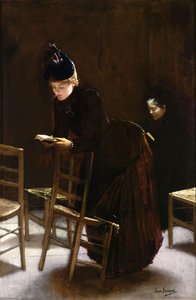
Femme en Priere


 Read More
Hand Made Oil Reproduction
Hand-painted oil on canvas in your size and frame, made to order by our artists. ( Buy Print Buy Image)




P118B $10

P118H $10

P118W $10

P438Z $10

P508JH $12

P508YH $12

P805H $10

P805Z $10

P919BZ $10

P919G $10

P919XJ $10

P959ZH $10

P968JZ $12

W106C $8

W218G $10

W218JH $8

W218Y $10

W307PJ $10

W316G $10

W316PJ $8

W316Y $10

W398PJ $8

W4111J $10

W500HY $15

W500JH $15

W692G $12

W849H $8

W940BG $15

W953PJ $8




Pick from our preset sizes that match the artwork's original proportions.

You may enter your own dimensions to fit a specific frame or space. If your selected size does not match the original image's proportions, we will either crop the artwork or extend the painting with additional hand-painted elements. A digital mockup will be sent for your approval before production begins.
Please note that the on-screen preview does not reflect the actual cropping or extension. Only the mockup will accurately show the final composition.
While custom sizes are available, we recommend selecting a dimension from the predefined list to preserve the original proportions.
After order, ArtsDot.com team will email client for instructions and provide a mockup preview
Worldwide Delivery () in 3/4 weeks instead of standard 5 weeks. (16 August). No compromise on quality.

Free Worldwide Express Shipping

High-Quality Linen Canvas

Full Shipping Insurance

Customs Tax Refund Guarantee

True Color Matching Guarantee

60-Day Return Policy (Defects Only)

100% Money-Back Guarantee

Bulk Discount Offer
 Glass option is only available in size under 110 CM

Femme en Priere
Reproduction Medium
Reproduction Size
-


Total Price
$ 263
Artwork Description
A Moment Suspended in Time
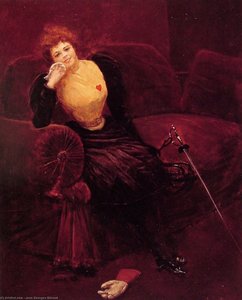
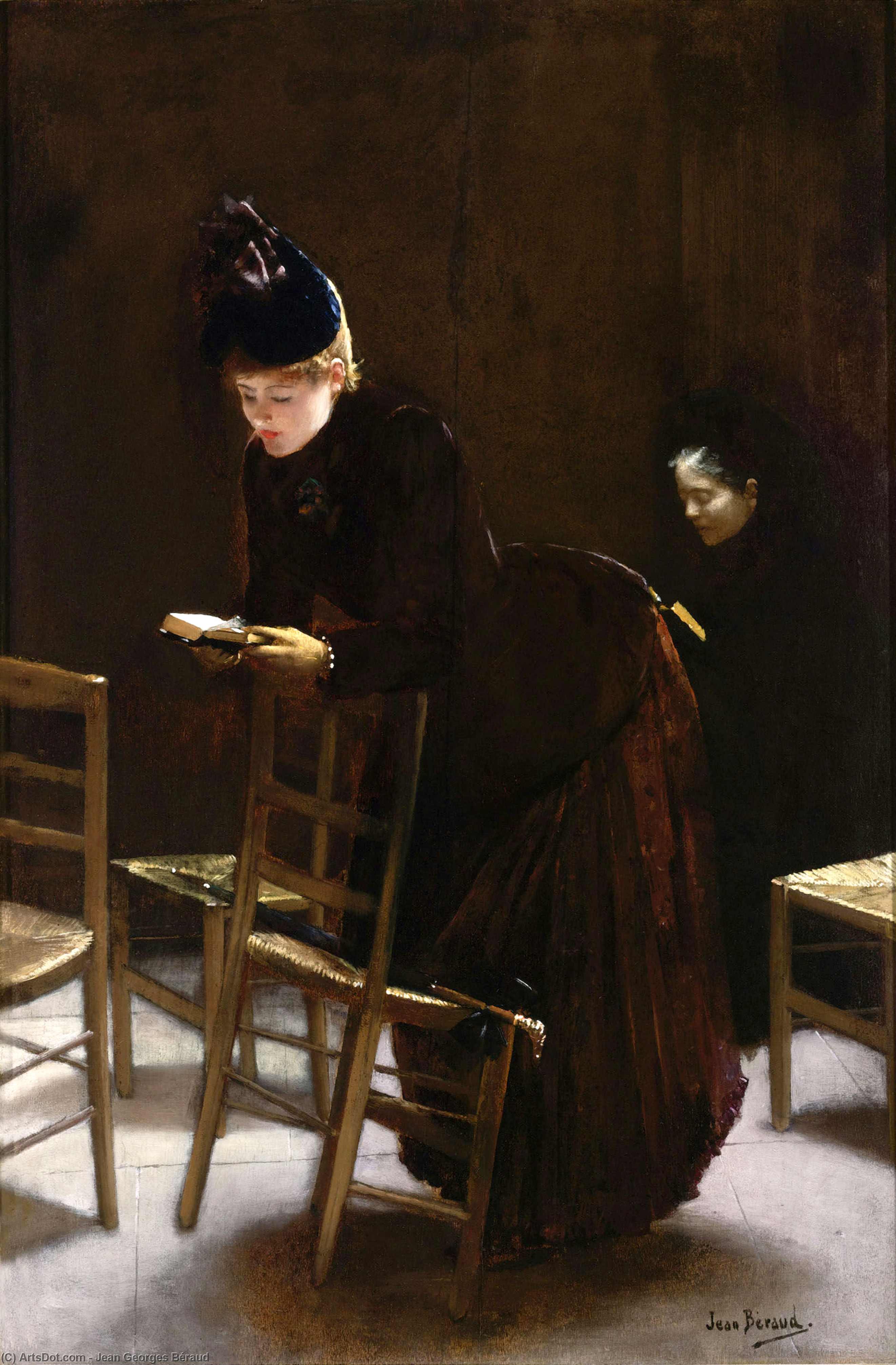
In the quietude of 1877, Jean Georges Béraud captured a scene that transcends the mere depiction of figures, offering instead a profound window into the soul of the Belle Époque. Femme en Priere is not simply a portrait of two women; it is an evocative study of intimacy, devotion, and the sacredness of shared silence. As one woman stands near the center of the room, her fingers tracing the pages of a book, while her companion rests in a seated position, the painting invites the viewer into a sanctuary of reflection. The atmosphere is thick with a gentle, contemplative energy, where the act of reading becomes a form of prayer, and the soft, dim lighting wraps the subjects in a cocoon of privacy that feels both timeless and deeply personal.
The composition masterfully utilizes light and shadow to direct the emotional narrative. Béraud, a student of the legendary Gustave Courbet, employs a technique that balances academic precision with an almost Impressionistic sensitivity to atmosphere. The room is bathed in a muted, soft glow that catches the delicate textures of fabric and the subtle contours of the women's faces. This careful manipulation of light creates a sense of depth, making the space feel tangible yet ethereal. By keeping the eyes of both subjects closed or cast downward, Béraud removes the direct gaze of the subjects from the viewer, instead forcing us to focus on their internal worlds. This choice fosters a powerful emotional resonance, as we become silent witnesses to a moment of pure, unadulterated peace.
The Elegance of Parisian Intimacy
To understand Femme en Priere is to understand the artistic heartbeat of late 19th-century Paris. Béraud was a master at capturing the elegance of urban life, yet in this particular work, he retreats from the bustling boulevards and vibrant cafes to explore the quiet corners of domestic existence. The painting serves as a poignant reminder of the beauty found in stillness. The subtle interplay of colors—soft tones that blend seamlessly into the shadows—complements the theme of spiritual or mental retreat. For the discerning collector or interior designer, this piece offers more than just aesthetic beauty; it provides a focal point of serenity that can transform a room into a place of calm and sophistication.
Integrating a high-quality oil reproduction of this masterpiece into a contemporary space allows for a sophisticated dialogue between history and modern luxury. The painting's ability to evoke tenderness and shared connection makes it an ideal selection for those looking to add a layer of emotional depth to their decor. Whether placed in a sunlit study or a dimly lit library, the work retains its ability to command attention through its quiet strength. It stands as a testament to Béraud’s enduring legacy, proving that even a century after its creation, the essence of a tender, shared moment remains an infinitely captivating subject for the human spirit.
Related Artworks

Artist Biography
The Gilded Lens of the Belle Époque
To step into a canvas by Jean-Georges Béraud is to be transported to the heart of a Paris that breathed with an incomparable elegance and restless energy. Born in 1849, the artist—originally known as Séverin Louis Stein—was a child of transition, coming of age during a period when the city was being physically and culturally reimagined. While some historical accounts trace his earliest beginnings to Saint Petersburg, where his father worked as a sculptor, it was the vibrant, cobblestone streets of Paris that ultimately shaped his soul and his brush. His early life was marked by the profound shifts of the late 19th century, including the interruption of his legal studies by the Franco-Prussian War, an event that likely sharpened his eye for the fleeting, precious moments of stability found within urban splendor.
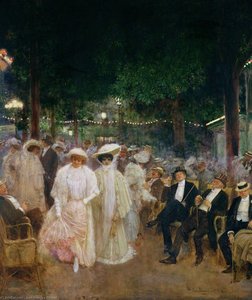
Béraud’s artistic lineage is a fascinating study in duality. Under the mentorship of masters like Gustave Courbet and Léon Bonnat, he mastered the rigorous discipline of academic precision, yet he could not resist the luminous, atmospheric pull of the Impressionist movement. This tension between meticulous detail and the ephemeral play of light became his signature. He did not merely paint scenes; he captured the very pulse of the Belle Époque. Whether it was the shimmering reflections on the banks of the Seine or the sophisticated bustle of the Champs-Élysées, Béraud possessed a rare ability to render the textures of modern life—the silk of a gown, the steam from a café, and the golden glow of gaslight—with an almost cinematic clarity.
A Chronicler of Parisian Splendor
The true genius of Béraud lies in his role as a visual historian of the Parisian night and day. His oeuvre serves as a window into the social hierarchies and leisure activities of a bygone era. He found profound inspiration in the city's most iconic landmarks, turning the Champs-Élysées, the Montmartre district, and the opulent Paris Opera into stages for his dramatic compositions. In works such as An Elegant Couple Entering a Box at the Paris Opera, one can sense the hushed anticipation and the weight of social ritual, rendered with an exquisite attention to the opulence of the setting.
Beyond the grand boulevards, Béraud possessed a deep affection for the intimate corners of urban existence. He was a master of the "genre" scene, finding beauty in the mundane yet elevated:
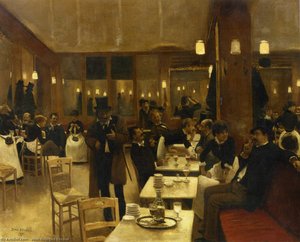
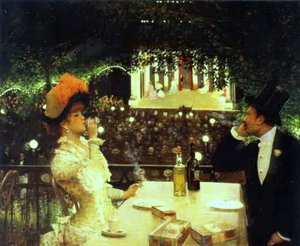
- The Café Culture: In masterpieces like La brasserie, he captures the convivial spirit and the sensory richness of Parisian social hubs.
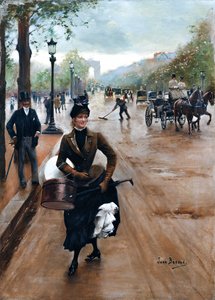
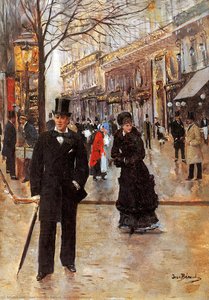
- Urban Motion: His paintings such as On the boulevard evoke the rhythmic movement of crowds and carriages, bathed in the soft, transformative light of the afternoon sun.
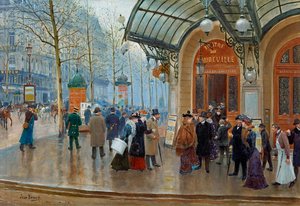
- Theatrical Grandeur: Through depictions like Outside the Vaudeville Theatre, he highlights the intersection of public life and the allure of performance.
Legacy and Artistic Significance
As the 19th century gave way to the 20th, Béraud’s work remained a steadfast anchor for the aesthetic values of his time. While newer, more radical movements began to deconstruct form entirely, Béraud continued to refine his ability to convey psychological depth through gesture and gaze. His portraits were never mere likenesses; they were studies in character, capturing the subtle nuances of the intellectuals, artists, and socialites who defined the French cultural landscape. He sought to capture not just what Paris looked like, but how it felt—the dynamism, the sophistication, and the underlying complexities of a society at its zenith.
Today, the works of Jean-Georges Béraud stand as essential artifacts of art history. They offer more than just aesthetic pleasure; they provide a nostalgic, yet technically masterful, window into the soul of France. His legacy is found in every brushstroke that celebrates the light of the Belle Époque, reminding us of a time when art and urban life were inextricably linked in a dance of elegance and light. Through his eyes, we continue to witness the eternal, shimmering magic of Paris.
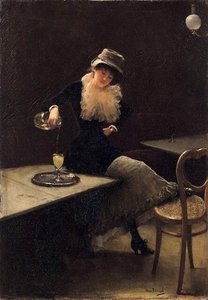
jean georges béraud
1849 - 1936 , France
Quick Facts
- Artistic Movement Or Style: Impressionism
- Artists Or Movements Influenced By This Artist: ['Charles François Jalabert']
- Artists Who Influenced This Artist: ['Georges Stein']
- Date Of Birth: 1849
- Date Of Death: 1936
- Full Name: Jean Georges Béraud
- Nationality: French
- Notable Artworks:
- An Elegant Couple
- La brasserie
- On the boulevard
- Place Of Birth: Paris, France
Related Articles

Cézanne's Masterpieces: 25 Iconic Artworks to Transform Your Space
Journey through 25 iconic artworks by Paul Cézanne – a master of Impressionism and Post-Impressionism. Explore his landscapes, still lifes, and the stories behind these timeless masterpieces. Discover museum-quality reproductions & curated decor at ArtsDot.com.

Impressionism's Masterpieces: 10 Paintings That Defined a Movement | ArtsDot
Journey through Impressionism's heart with 10 iconic paintings by Monet, Renoir & Degas. Explore light, color & the stories behind these masterpieces. Find museum-quality art reproductions and elevate your home decor on ArtsDot.com.
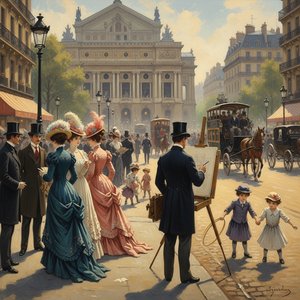
Jean-Georges Béraud: Capturing Parisian Life in the Belle Époque
Explore the captivating world of Jean-Georges Béraud, master painter of Belle Époque Paris. Discover his iconic scenes, artistic evolution, and social commentary. A deep dive into 19th-century French art.
Fleeting Moments & Radiant Light: Exploring the Enduring Legacy of Impressionism
Explore the captivating world of Impressionism! Discover its history, key artists like Monet & Renoir, defining techniques, and lasting impact on modern art. Expert insights for collectors.
The Enduring Legacy of French Art: Movements, Masters & Cultural Impact
Explore the rich history of French art, from the Salon to Impressionism & beyond. Discover iconic masters, key movements, and expert guidance for collecting timeless masterpieces. ArtsDot.