![Greek Interior [sketch] — Jean-léon Gérôme](/media/artworks/images/full/4a/2b/4a2b8b92a562425483349bd6edd77037.Jpg)
 Preview
 Send
Send Share
Share
 Details

 Download
 Similars
 X-Ray
X-Ray Diaporama
Greek Interior [sketch]


 Read More
Hand Made Oil Reproduction
Hand-painted oil on canvas in your size and frame, made to order by our artists. ( Buy Print Buy Image)




P118B $10

P118H $10

P118W $10

P438Z $10

P508JH $12

P508YH $12

P805H $10

P805Z $10

P919BZ $10

P919G $10

P919XJ $10

P959ZH $10

P968JZ $12

W106C $8

W218G $10

W218JH $8

W218Y $10

W307PJ $10

W316G $10

W316PJ $8

W316Y $10

W398PJ $8

W4111J $10

W500HY $15

W500JH $15

W692G $12

W849H $8

W940BG $15

W953PJ $8




Pick from our preset sizes that match the artwork's original proportions.

You may enter your own dimensions to fit a specific frame or space. If your selected size does not match the original image's proportions, we will either crop the artwork or extend the painting with additional hand-painted elements. A digital mockup will be sent for your approval before production begins.
Please note that the on-screen preview does not reflect the actual cropping or extension. Only the mockup will accurately show the final composition.
While custom sizes are available, we recommend selecting a dimension from the predefined list to preserve the original proportions.
After order, ArtsDot.com team will email client for instructions and provide a mockup preview
Worldwide Delivery () in 3/4 weeks instead of standard 5 weeks. (16 August). No compromise on quality.

Free Worldwide Express Shipping

High-Quality Linen Canvas

Full Shipping Insurance

Customs Tax Refund Guarantee

True Color Matching Guarantee

60-Day Return Policy (Defects Only)

100% Money-Back Guarantee

Bulk Discount Offer
 Glass option is only available in size under 110 CM

Greek Interior [sketch]
Reproduction Medium
Reproduction Size
-


Total Price
$ 263
Artwork Description
A Glimpse into Antiquity: The Intimacy of Gérôme’s Sketch
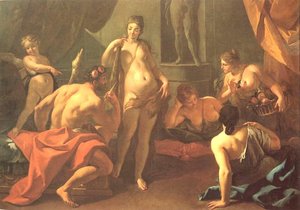
In the delicate, preparatory strokes of Greek Interior [sketch], we are invited to step through a veil of time into a world of quiet, classical repose. Jean-Léon Gérôme, a titan of 19th-century French academic art, possessed an unparalleled ability to breathe life into the ancient past, and even in this more spontaneous sketch format, his mastery of narrative is palpable. The scene unfolds within a private chamber, where a group of women rests amidst the soft textures of pillows and bedding. There is a profound sense of stillness here; the figures are not posed for a grand historical epic, but are captured in a moment of unscripted relaxation. A loyal dog lingers near the reclining figures, adding a touch of domestic warmth to an otherwise classical setting, grounding the ethereal beauty of the scene in a recognizable, lived-in reality.
The composition breathes with an atmosphere of comfort and communal ease. As eyes wander through the room, one notices the interplay between those standing in quiet observation and those nestled deeply into the cushions. This arrangement creates a rhythmic flow that guides the viewer’s gaze across the canvas, mimicking the wandering eye of a guest entering a private sanctuary. For the collector or interior designer, this piece offers more than just visual interest; it provides a window into the Orientalist and Academic traditions, where the pursuit of "exotic" or "classical" beauty was used to evoke a sense of wonder and escapism.
Technique and the Art of the Preliminary Vision
While Gérôme is often celebrated for his hyper-realistic, polished oil paintings that leave no brushstroke visible, this sketch reveals the raw, intellectual engine behind his finished masterpieces. In this work, we see the artist’s ability to map out light, shadow, and human form with incredible economy of line. The technique relies on a sophisticated understanding of anatomy and spatial depth, using subtle tonal shifts to suggest the weight of limbs against soft fabrics and the way light filters into a shaded interior. It is an intimate look at the process of creation—the moment where an idea begins to take physical shape.
For those looking to adorn a sophisticated space, such a piece serves as a brilliant focal point that balances strength with subtlety. The sketch format allows for a certain lightness of touch that prevents the artwork from overwhelming a room, making it an ideal choice for a curated gallery wall or a quiet corner in a study. It carries an air of intellectual prestige, signaling an appreciation for the foundational stages of classical art history. To possess such a reproduction is to hold a fragment of the artist's original thought process, capturing the very essence of Gérôme’s legendary precision before it was even layered with final glazes.
A Timeless Addition to the Modern Interior
Beyond its historical significance, Greek Interior [sketch] resonates with a modern sensibility regarding the importance of rest and sanctuary. In an era of constant digital noise, the imagery of figures finding peace in a shared, quiet space feels deeply relevant. The artwork does not demand attention through loud colors or jarring movements; instead, it seduces the viewer through its soft textures and tranquil subject matter. It is a piece designed for contemplation, making it a perfect companion for spaces dedicated to relaxation, such as bedrooms, libraries, or elegant lounge areas.
Integrating a high-quality reproduction of this work into an interior design scheme allows for a seamless blend of classical elegance and contemporary comfort. Whether paired with minimalist modern furniture to highlight its historical contrast, or nestled within a more traditional, opulent setting to enhance a sense of grandeur, the sketch acts as a bridge between eras. It offers a sophisticated way to introduce narrative depth and emotional warmth into any home, providing a lasting sense of grace that only the masters of the 19th century could evoke.
Related Artworks
Artist Biography
A Master of Narrative Detail: The Life and Art of Jean-Léon Gérôme
Jean-Léon Gérôme, a name synonymous with the academic painting of 19th-century France, was more than just a skilled technician; he was a storyteller who captivated audiences with meticulously rendered scenes brimming with drama and exotic allure. Born in Vesoul in 1824, his artistic journey began under the guidance of local artist Claude-Basile Cariage, laying the foundation for a career that would see him become arguably the most celebrated painter of his time. Moving to Paris at sixteen, he initially studied under Paul Delaroche, a master of historical painting, and later attended the École des Beaux-Arts, absorbing the principles of classical training. However, Gérôme quickly distinguished himself not through slavish imitation but through an innovative blend of meticulous realism and dramatic narrative—a combination that would define his unique style. His early success with *The Cock Fight* in 1847 catapulted him to fame, establishing him as a leading figure within the Neo-Grec movement, which sought to revive classical themes with a newfound attention to archaeological detail.From Historical Grandeur to Orientalist Visions
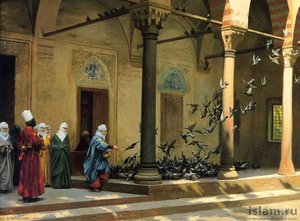
Gérôme’s artistic range was remarkably broad. He tackled historical subjects with an almost cinematic flair, imbuing them with a sense of immediacy and psychological depth. His large-scale mural commission, *The Age of Augustus, the Birth of Christ*, intended as a flattering allegory for Napoleon III, showcased his ability to handle complex compositions and grand narratives. Yet, it was perhaps in his Orientalist paintings that Gérôme truly captured the public imagination. Inspired by travels to Turkey, Egypt, and North Africa, he depicted scenes of harems, bustling marketplaces, and desert landscapes with an exoticism that both fascinated and, viewed through a modern lens, sometimes perpetuated problematic stereotypes. Paintings like *Harem Women Feeding Pigeons in a Courtyard* became immensely popular, offering European audiences a glimpse into a world perceived as mysterious and sensual. These works weren’t simply copies of what he saw; they were carefully constructed fantasies, blending observation with imagination to create compelling visual narratives. He wasn't merely documenting the Orient; he was *creating* it for Western consumption, a practice that would later draw criticism but undeniably contributed to his widespread appeal.A Pedagogue and Influential Teacher
Beyond his own artistic output, Gérôme exerted considerable influence as a teacher at the École des Beaux-Arts. His atelier became a breeding ground for future generations of artists, attracting students from across Europe and America. Among his most notable pupils were Thomas Eakins, John Singer Sargent, and Mary Cassatt—artists who would go on to forge their own distinct paths but whose foundations were undoubtedly shaped by Gérôme’s rigorous training and emphasis on technical skill. He instilled in them a dedication to draftsmanship, composition, and the importance of studying from life. While his conservative artistic views sometimes clashed with the emerging avant-garde movements, his impact on the development of American art, in particular, was profound. His students carried his principles back across the Atlantic, establishing their own ateliers and perpetuating the academic tradition.Legacy and Controversy: A Complex Artistic Inheritance
Jean-Léon Gérôme died in Paris in 1904, leaving behind a vast body of work that continues to provoke discussion and debate. While his technical mastery is undeniable, his artistic legacy remains complex. His meticulous realism, once celebrated as the pinnacle of academic achievement, came to be seen by some as stifling and overly concerned with surface appearances. The Orientalist paintings, while visually stunning, have been criticized for their exoticizing gaze and perpetuation of colonial stereotypes. However, it is crucial to understand Gérôme within his historical context. He was a product of his time, reflecting the prevailing attitudes and interests of 19th-century European society. His work offers valuable insights into the cultural anxieties and fantasies of that era, even as it challenges us to critically examine its underlying assumptions. Today, Gérôme’s paintings are admired not only for their technical brilliance but also for their ability to transport viewers to another time and place, inviting them to contemplate the complexities of history, culture, and representation.Key Moments in a Remarkable Career
- 1824: Born in Vesoul, France.
- 1840: Moves to Paris to study under Paul Delaroche.
- 1847: Achieves early recognition with *The Cock Fight* at the Paris Salon.
- 1852-1854: Receives commission for *The Age of Augustus, the Birth of Christ* and travels to Constantinople, Greece, and Turkey.
- Late Career: Transitions to sculpture, creating polychrome works inspired by classical antiquity.
- 1904: Dies in Paris, leaving behind a significant artistic legacy.
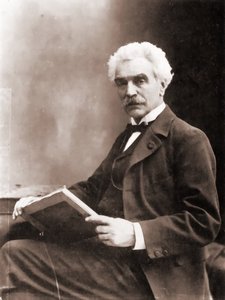
Jean-Léon Gérôme
1824 - 1904 , France
Quick Facts
- Artistic Movement Or Style: Academicism, Orientalism
- Artists Or Movements Influenced By This Artist:
- Thomas Eakins
- John Singer Sargent
- Mary Cassatt
- Artists Who Influenced This Artist: ['Paul Delaroche']
- Date Of Birth: May 11, 1824
- Date Of Death: January 10, 1904
- Full Name: Jean-Léon Gérôme
- Nationality: French
- Notable Artworks:
- The Cock Fight
- Pollice Verso
- Snake Charmer
- Place Of Birth: Vesoul, France
Related Articles
Academic Realism's Finest: 10 Masterpieces for Art Lovers & Home Decor
Explore 10 defining Academic Realism masterpieces by Bouguereau, Gérôme & Cabanel. Discover the stories behind these iconic paintings and bring timeless art into your home with museum-quality reproductions from ArtsDot.com. Explore the full collection online!
Academic Realism: Technique, History & Enduring Influence on Art
Explore the captivating world of Academic Realism! Discover key artists, techniques & its lasting impact on art history. Expert insights & high-quality reproductions at ArtsDot.
Romantic Realism's Finest: 10 Masterpieces for Your Home | ArtsDot
Explore 10 defining masterpieces of Romantic Realism! Discover Courbet, Millet & Daumier's powerful paintings—capturing emotion and social realities. Find museum-quality reproductions for your home at ArtsDot.com.
The Enduring Allure of the Nude: A Historical & Artistic Exploration of the Human Form
Explore the captivating history of nude art! Discover iconic paintings & artists from classical to modern eras. Uncover symbolism, techniques & find museum-quality reproductions at ArtsDot.

The Eloquent Line: Exploring the Artistic Significance of Sketches Across Movements and Media
Explore the profound artistic significance of sketches throughout history. From Renaissance masters to modern innovators like Van Gogh & Guston, discover how these foundational works reveal technique, emotion, and vision. Learn more at ArtsDot.