 Preview
 Send
Send Share
Share
 Details

 Download
 Similars
 X-Ray
X-Ray Diaporama
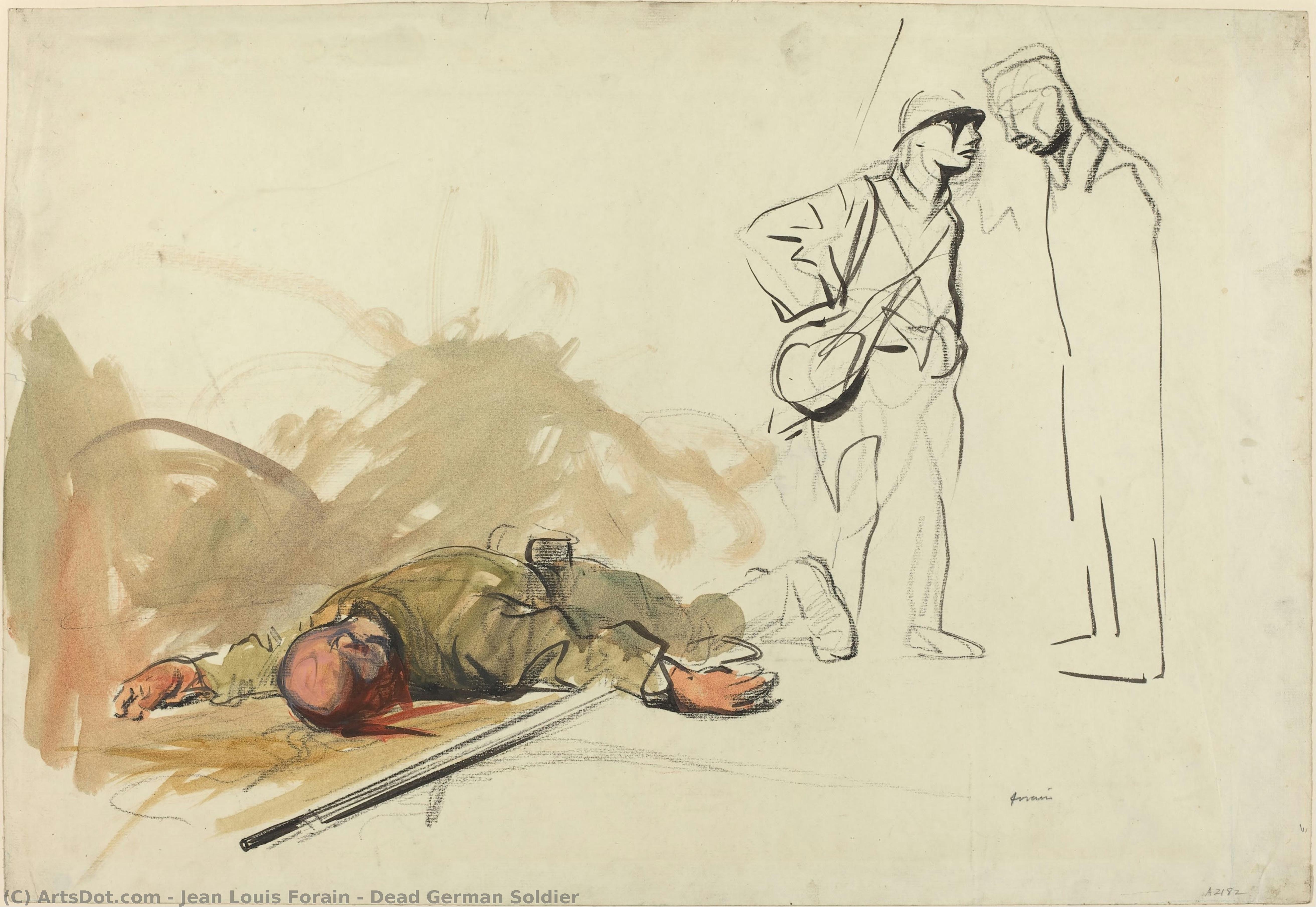
Dead German Soldier
 Drawing
- WallArt
- Impressionism
 1919
1919- 19th Century
 37.0 x 54.0 cm
 Read More
Hand Made Oil Reproduction
Hand-painted oil on canvas in your size and frame, made to order by our artists. ( Buy Print Buy Image)




P118B $10

P118H $10

P118W $10

P438Z $10

P508JH $12

P508YH $12

P805H $10

P805Z $10

P919BZ $10

P919G $10

P919XJ $10

P959ZH $10

P968JZ $12

W106C $8

W218G $10

W218JH $8

W218Y $10

W307PJ $10

W316G $10

W316PJ $8

W316Y $10

W398PJ $8

W4111J $10

W500HY $15

W500JH $15

W692G $12

W849H $8

W940BG $15

W953PJ $8




Pick from our preset sizes that match the artwork's original proportions.

You may enter your own dimensions to fit a specific frame or space. If your selected size does not match the original image's proportions, we will either crop the artwork or extend the painting with additional hand-painted elements. A digital mockup will be sent for your approval before production begins.
Please note that the on-screen preview does not reflect the actual cropping or extension. Only the mockup will accurately show the final composition.
While custom sizes are available, we recommend selecting a dimension from the predefined list to preserve the original proportions.
After order, ArtsDot.com team will email client for instructions and provide a mockup preview
Worldwide Delivery () in 3/4 weeks instead of standard 5 weeks. (16 August). No compromise on quality.

Free Worldwide Express Shipping

High-Quality Linen Canvas

Full Shipping Insurance

Customs Tax Refund Guarantee

True Color Matching Guarantee

60-Day Return Policy (Defects Only)

100% Money-Back Guarantee

Bulk Discount Offer
 Glass option is only available in size under 110 CM

Dead German Soldier
Reproduction Medium
Reproduction Size
-


Total Price
$ 263
Artwork Description
A Somber Echo of Conflict
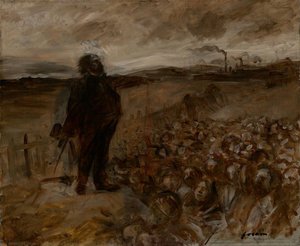
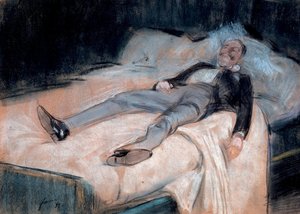
In the hauntingly stark lines of Jean Louis Forain’s 1919 work, Dead German Soldier, we are confronted with the raw, unvarnished aftermath of violence. This black and white drawing serves as a visceral window into a moment of profound tragedy, capturing a scene that transcends mere documentation to become a poignant meditation on mortality. The composition centers on a fallen figure, whose stillness is punctuated by the grim reality of blood seeping from a head wound. Through Forain’s masterful use of contrast, the viewer is drawn into a landscape of grief, where the presence of distant, watching figures adds a layer of psychological tension, suggesting the heavy, lingering shadows cast by the Great War.
The technique employed here speaks to Forain’s roots as a celebrated caricaturist and Impressionist. Eschewing the lush colors often associated with his contemporaries, he utilizes a monochromatic palette to strip the scene of any decorative distraction, forcing an intimate encounter with the subject's suffering. The linework is deliberate and evocative, creating a sense of depth and atmosphere that makes the coldness of the ground almost palpable. There is a striking, surreal quality to the composition—notably the presence of an object resembling a guitar at the top center—which introduces a jarring, symbolic dissonance. This unexpected element disrupts the grim realism, perhaps acting as a metaphor for the interrupted melodies of life or the shattered culture left in the wake of conflict.
Historical Resonance and Artistic Legacy
To understand the emotional weight of this piece, one must consider the era of its creation. Produced in 1919, the work emerges from the immediate, bleeding wounds of World War I. Forain, a man deeply embedded in the social fabric of Paris, possessed a unique ability to capture both the wit of Parisian life and the profound darkness of human struggle. This drawing is not merely an illustration of death; it is a historical artifact that captures the collective trauma of a generation. The starkness of the medium reflects the austerity of a post-war world, where the grandeur of the Belle Époque had been replaced by a sobering realization of human fragility.
For collectors and connoisseurs of fine art reproductions, Dead German Soldier offers more than just a visual centerpiece; it offers a profound narrative depth. For interior designers seeking to curate spaces with intellectual and emotional gravity, this piece provides a sophisticated focal point that invites contemplation. It is an ideal acquisition for those who appreciate the intersection of historical significance and technical mastery. Owning a reproduction of such a powerful work allows one to preserve a fragment of history, bringing the evocative power of Forain’s somber vision into a modern setting, where it can continue to provoke thought, empathy, and a deep appreciation for the enduring strength of the human spirit amidst devastation.
Related Artworks
Artist Biography
Early Life and Artistic Beginnings
- Born: Reims, France (1852)
- Died: 1931
- Jean Louis Forain's artistic journey began in Reims, France, on October 23, 1852. His family relocated to Paris when he was eight years old, a pivotal move that shaped his future career.
- His father, an ornamental sign painter, provided initial support and exposure to art.
- Forain started as a caricaturist, contributing satirical drawings to Parisian journals like Le Monde Parisien and Le Rire Satirique. This honed his observational skills and wit.
- Formal training followed at the École des Beaux Arts under Jean-Léon Gérôme and Jean-Baptiste Carpeaux.
Impressionist Influences and Artistic Development
- Forain became involved with the Impressionist movement, participating in several exhibitions between 1879 and 1884.
- He was influenced by core Impressionist principles: capturing fleeting moments, light effects, and scenes from everyday life.
- Unlike some contemporaries focused on landscapes, Forain centered his work on Parisian popular entertainments – bustling cafés, racetracks, ballet.
- His style developed with loose brushwork, bold colors, and a keen eye for urban atmosphere.
Notable Works and Artistic Style
- Forain worked in oils, watercolors, pastels, etchings, and lithographs.
- "On the Verses of Verlaine, A Rogue Takes a Stroll in the Country," exemplifies his ability to capture French life with detail.
- His watercolors are celebrated for vibrant colors and atmosphere.
- Forain’s style blended caricature and Impressionism, creating humorous and insightful works.
- He was skilled at portraying human figures, often exaggerating features for memorable characters.
- His depictions of Parisian nightlife, opera audiences, and racegoers offer a window into late 19th-century French society.
Later Life and Legacy
- During World War I, Forain contributed patriotic illustrations. He even enlisted in the camouflage section.
- In his later years, he depicted scenes of law courts and Parisian institutions.
- He was elected a member of the Royal Academy of Arts in London.
- Jean-Louis Forain passed away on July 11, 1931, leaving behind a significant body of work admired for its wit, observation, and portrayal of Parisian life.
Collections and Further Exploration
- Musée Maurice Denis (France)
- Musée National Jean-Jacques Henner (Paris, France)
- Explore more artworks: Jean Louis Forain | 121 Artworks
- Order paintings reproductions: Order Paintings Reproductions of Jean Louis Forain
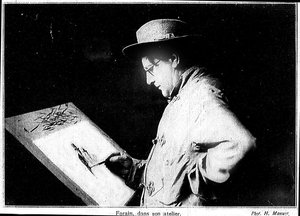
Jean Louis Forain
1852 - 1931 , France
Quick Facts
- Artistic Movement Or Style: Impressionism
- Artists Or Movements Influenced By This Artist: ['Henri de Toulouse-Lautrec']
- Artists Who Influenced This Artist:
- Jean-Léon Gérôme
- Jean-Baptiste Carpeaux
- Edgar Degas
- Honoré Daumier
- Date Of Birth: October 23, 1852
- Date Of Death: July 11, 1931
- Full Name: Jean-Louis Forain
- Nationality: French
- Notable Artworks:
- On the Verses of Verlaine
- La République sur le banc
- Place Of Birth: Reims, France
Related Articles

White on Canvas: 10 Masterpieces & Timeless Elegance for Your Home Decor
Explore 10 iconic white paintings by Monet, Whistler & Rothko! Discover the stories behind these serene masterpieces and their impact on art history. Find museum-quality reproductions for your home decor at .
The Eloquent Line: Exploring the Artistic Significance of Sketches Across Movements and Media
Explore the profound artistic significance of sketches throughout history. From Renaissance masters to modern innovators like Van Gogh & Guston, discover how these foundational works reveal technique, emotion, and vision. Learn more at ArtsDot.

Dark Masterpieces: 10 Iconic Paintings Dominated by Black Tones |
Explore 10 iconic paintings dominated by black tones, from Rembrandt’s chiaroscuro to Goya's dark expressions. Discover the stories behind these masterpieces & find museum-quality art reproductions for your home at .

Monochrome Visions: Exploring the Aesthetic & Historical Significance of Black & White Photography
Explore the rich history & artistic power of black and white photography. From early techniques to iconic masters like Ansel Adams, discover why monochrome continues to captivate art lovers today. Expert insights for collectors.
The Nuances of Graphite: Exploring Emotional Depth & Technical Mastery in Pencil Drawing
Explore the captivating world of graphite drawing! Discover its rich history, master essential techniques like chiaroscuro, and learn how artists evoke emotion through this timeless medium. Expert insights for art enthusiasts.