 Preview
 Send
Send Share
Share
 Details

 Download
 Similars
 X-Ray
X-Ray Diaporama
Altarpiece of Saint Miquel de Castelló d
 Tempera On Panel
- International Gothic
 Late Medieval
 240.0 x 180.0 cm
 Girona Art Museum
 Read More
Giclée / Art Print
Museum-quality giclée or canvas print with fast production and flexible finish options. ( Buy Hand Made Painting Buy Image)




P118B $10

P118H $10

P118W $10

P438Z $10

P508JH $12

P508YH $12

P805H $10

P805Z $10

P919BZ $10

P919G $10

P919XJ $10

P959ZH $10

P968JZ $12

W106C $8

W218G $10

W218JH $8

W218Y $10

W307PJ $10

W316G $10

W316PJ $8

W316Y $10

W398PJ $8

W4111J $10

W500HY $15

W500JH $15

W692G $12

W849H $8

W940BG $15

W953PJ $8




Pick from our preset sizes that match the artwork's original proportions.

You may enter your own dimensions to fit a specific frame or space. If your selected size does not match the original image's proportions, we will either crop the artwork or extend the image with a mirrored or solid-fill edge. A digital mockup will be sent for your approval before production begins.
Please note that the on-screen preview does not reflect the actual cropping or extension. Only the mockup will accurately show the final composition.
While custom sizes are available, we recommend selecting a dimension from the predefined list to preserve the original proportions.
Worldwide Delivery () in 2 weeks instead of standard 4/5 weeks. (4 September)

Free Worldwide Express Shipping

High-Quality Linen Canvas

Full Shipping Insurance

Customs Tax Refund Guarantee

True Color Matching Guarantee

60-Day Return Policy (Defects Only)

100% Money-Back Guarantee

Bulk Discount Offer
 Glass option is only available in size under 110 CM

Altarpiece of Saint Miquel de Castelló d
Giclée / Art Print
Reproduction Size
-


Total Price
$ 63
A Vision of Devotion: The Altarpiece of Saint Miquel de Castelló
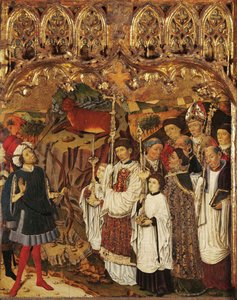
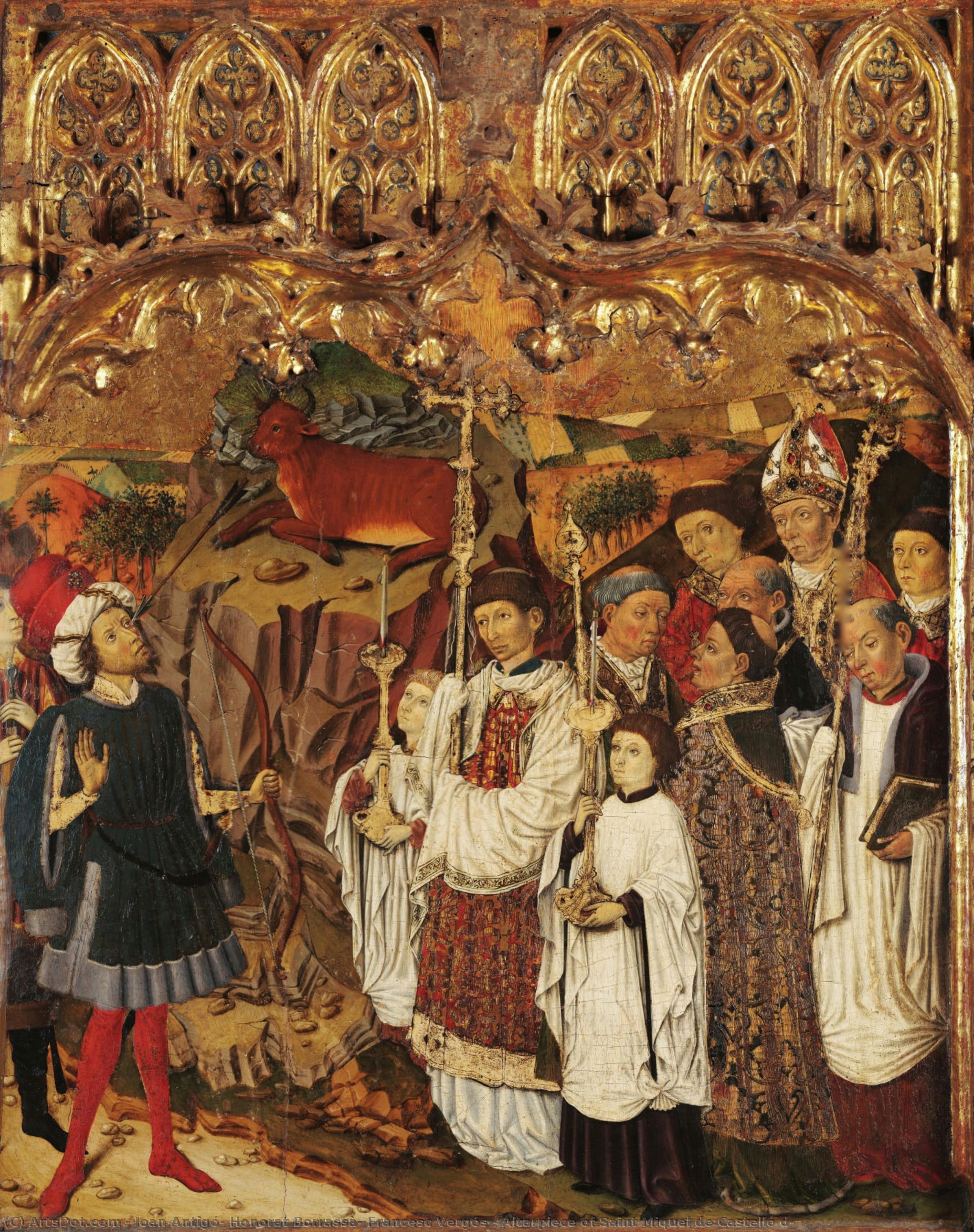
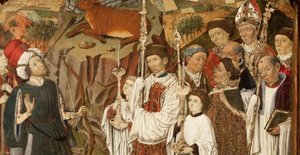
In the quiet corridors of art history, certain works possess the power to transport the viewer across centuries, bridging the gap between the medieval soul and the modern eye. The Altarpiece of Saint Miquel de Castelló is such a masterpiece, a sprawling and intricate tapestry of human devotion and narrative complexity. Spanning an impressive 240 x 180 cm, this monumental work serves as a window into a bygone era, where every figure and gesture was imbued with profound spiritual significance. The composition draws the eye through a labyrinth of characters, most notably a central figure holding a cross, standing in solemn proximity to a person bearing a cow upon their shoulders—a striking image that suggests both the weight of earthly burdens and the triumph of faith.
The painting is set against the architectural grandeur of a building featuring a massive archway, an element that provides not only structural depth but also a sense of sacred enclosure. This setting, combined with the meticulously rendered medieval attire of the subjects, creates a stage for a historical or hagiographic drama. For the collector or interior designer, this piece offers more than mere decoration; it provides a focal point of immense character, capable of anchoring a room with its rich, saturated colors and the profound gravity of its subject matter.
The Mastery of the Vergós Group
To understand the technical brilliance of this altarpiece, one must look to the collaborative genius of the Vergós Group. Comprising the skilled hands of Joan Antigó, Honorat Borrassà, and Francesc Vergós, this collective of Catalan painters operated during a transformative period in the late 15th and early 16th centuries. Their work is a quintessential expression of the International Gothic style, a movement characterized by its elegance, fine detail, and a certain lyrical grace that sought to harmonize naturalism with stylized beauty.
The technique employed here is a testament to their shared mastery. The artists utilized layers of pigment to achieve a vibrant luminosity, ensuring that the light seems to emanate from within the figures themselves. The interplay of light and shadow across the folds of medieval garments and the textured surfaces of the architectural backdrop demonstrates a sophisticated command of depth. This level of detail is what makes a high-quality reproduction of this work so captivating; when captured with precision, the subtle transitions in color and the intricate linework allow the viewer to rediscover the painstaking labor of these Catalan masters.
Symbolism and Emotional Resonance
Beyond its aesthetic splendor, the Altarpiece of Saint Miquel de Castelló functions as a complex symbolic language. In the tradition of retables, every element was designed to instruct and inspire the faithful. The presence of the cross serves as an unmistakable emblem of sacrifice and redemption, while the unusual imagery of the figure with the animal on their shoulders may allude to specific local legends or biblical allegories regarding stewardship and the sanctity of life. These symbols work in harmony to create an atmosphere of contemplative reverence.
For those seeking to incorporate art into a curated space, this piece offers an unparalleled emotional impact. It evokes a sense of timelessness and stability, making it an ideal selection for environments that value heritage, storytelling, and intellectual depth. Whether placed in a grand library, a formal dining hall, or a sophisticated gallery setting, the altarpiece invites continuous re-examination, offering new layers of meaning with every glance. It is not merely a depiction of a historical scene, but a profound meditation on the human condition, rendered in the exquisite language of the Gothic tradition.
Related Artworks


Artist Biography
Bernardo Rossellino: The Architect of Renaissance Florence
Born in the unassuming mountain village of Settignano, near Florence, in 1409, Bernardo di Matteo del Borra Gamberelli – known to posterity as Bernardo Rossellino – was a sculptor and architect whose influence quietly reshaped the artistic landscape of his era. While not always heralded with the same fervent acclaim as contemporaries like Donatello or Brunelleschi, Rossellino’s contribution lies in his masterful synthesis of classical ideals and innovative techniques, establishing him as a pivotal figure in the transition from Gothic to Renaissance art. His legacy is particularly evident in his work for Pope Nicholas V and Pope Pius II at Pienza, where he helped to redefine civic space and elevate the aesthetic standards of the burgeoning humanist city.
Rossellino’s early life was steeped in the practical realities of quarrying stone – a family trade. His uncle, Jacopo di Domenico di Luca del Borra Gamberelli, likely imparted his initial skills, grounding him in the fundamentals of working with marble and other building materials. However, it was Florence itself that proved to be his true apprenticeship. By 1420, he had established himself as a sculptor’s assistant, most likely under Nanni di Bartolo “il Rosso,” a master known for his expressive figures and innovative use of color. This association exposed Rossellino to the burgeoning experimental atmosphere of Florence – a city brimming with artists eager to break from traditional conventions and embrace the rediscovered beauty of antiquity.
Rossellino’s artistic development was profoundly shaped by this environment. He absorbed the revolutionary approaches championed by Brunelleschi, Donatello, Ghiberti, and Masaccio, embracing their commitment to humanism, naturalism, and a renewed interest in classical forms. Unlike some of his peers who sought to replicate existing styles, Rossellino demonstrated a remarkable ability to integrate these influences into his own distinct artistic voice. His sculptures, characterized by their refined elegance, balanced proportions, and subtle emotional depth, reflect this careful assimilation of diverse traditions.
The Architect of Pienza: A City Transformed
Rossellino’s most enduring legacy resides in his architectural work at Pienza, a small town commissioned by Pope Pius II as a “New Florence.” Between 1459 and 1463, Rossellino served as the chief architect of this ambitious project, transforming a modest settlement into a meticulously planned Renaissance city. His designs were informed by a deep understanding of classical urban planning principles, incorporating elements such as harmonious street layouts, symmetrical building facades, and strategically placed public spaces.
The centerpiece of Rossellino’s architectural achievements in Pienza is undoubtedly the Duomo (Cathedral), with its elegant façade and soaring campanile. However, his influence extended far beyond this single structure. He designed numerous palaces, churches, and civic buildings, creating a cohesive urban environment that exemplified the ideals of Renaissance humanism. Notably, he oversaw the construction of the Palazzo Comunale, the town hall, which served as a model for future civic architecture throughout Italy. His meticulous attention to detail, combined with his innovative use of materials and techniques, resulted in a city that is widely regarded as one of the most beautiful examples of Renaissance urban planning.
Sculptural Innovations and Artistic Style
While Rossellino’s architectural achievements are often highlighted, his sculptural work deserves equal recognition. His sculptures demonstrate a remarkable mastery of technique and a profound understanding of human anatomy and expression. The Leonardo Bruni Tomb, created in Florence around 1438-1440, showcases his ability to capture the solemn dignity and intellectual gravitas of the humanist scholar. Similarly, the Empoli Annunciation Group, also from this period, exemplifies his refined modeling skills and his skillful use of drapery to create a sense of movement and volume.
Rossellino’s sculptural style is characterized by its elegance, restraint, and subtle emotionality. Unlike the more flamboyant figures produced by some of his contemporaries, Rossellino's sculptures possess a quiet dignity and a profound sense of humanity. His figures are often depicted in moments of contemplation or action, conveying a range of emotions with remarkable subtlety. He skillfully employed classical proportions and idealized forms, while simultaneously imbuing his work with a distinctly Renaissance sensibility.
Legacy and Historical Significance
Bernardo Rossellino died in 1464, leaving behind a body of work that profoundly influenced the course of Italian art and architecture. While he may not have achieved the same level of fame as some of his more celebrated contemporaries, his contributions to the development of Renaissance aesthetics are undeniable. His architectural designs at Pienza established new standards for urban planning, while his sculptures demonstrated a remarkable mastery of technique and a profound understanding of humanism.
Rossellino’s legacy extends beyond his individual works; he played a crucial role in shaping the artistic culture of Florence and Italy as a whole. His workshop, which included his brothers Antonio and Domenico, became one of the most important centers of stoneworking in Florence during the 1450s and 1460s, contributing significantly to the city’s economic prosperity and its reputation as a hub of artistic innovation. Bernardo Rossellino's quiet influence continues to resonate today, reminding us of the enduring power of classical ideals and the transformative potential of Renaissance art.
joan antigó, honorat borrassà, francesc vergós
1409 - 1452 , Spain
Quick Facts
- Artistic Movement Or Style: Renaissance
- Artists Or Movements Influenced By This Artist:
- Brunelleschi
- Donatello
- Masaccio
- Artists Who Influenced This Artist: ['Nanni di Bartolo']
- Date Of Birth: 1409
- Date Of Death: 1464
- Full Name: Bernardo di Matteo del Borra Gamberelli
- Nationality: Italian
- Notable Artworks:
- Leonardo Bruni Tomb
- Empoli Annunciation
- Place Of Birth: Settignano, Italy
Related Articles
Beyond Borders: The Spiritual & Stylistic Innovations of International Gothic Art
Explore the exquisite beauty & spiritual depth of International Gothic art. Discover key artists like Simone Martini & Pol de Limbourg, its origins, symbolism, and lasting influence on European painting. Expert insights at ArtsDot.
The Radiant Dusk of Medieval Vision: Exploring Late Gothic Art's Synthesis of Faith, Form & Emotionality (c. 1300-1500)
Explore the exquisite beauty & spiritual depth of Late Gothic art (c. 1300-1500). Discover key artists, symbolism, and its lasting influence on the Renaissance. Expert insights at ArtsDot.
High Medieval Art: 10 Masterpieces That Shaped an Era | ArtsDot
Journey through High Medieval Art! Explore 10 iconic masterpieces – from Giotto's frescoes to stunning Gothic cathedrals. Discover the stories behind these timeless paintings, sculptures & illuminated manuscripts. Find museum-quality art reproductions at ArtsDot.com.

Late Medieval Masterpieces: 10 Artworks That Defined an Era | ArtsDot
Journey through 10 defining Late Medieval masterpieces – from Giotto's frescoes to Jan van Eyck’s realism. Explore the stories, techniques & vibrant colors of Gothic art. Find museum-quality reproductions and elevate your home decor with ArtsDot.com! Discover all masterpieces on ArtsDot.com
The Shadow of Faith: Exploring Gothic Art's Spiritual Intensity & Architectural Innovation
Explore the spiritual intensity & architectural innovation of Gothic art! Discover the symbolism behind cathedrals, stained glass & master artists like Giotto and Monet. A deep dive into medieval history & artistic expression.