 Preview
 Send
Send Share
Share
 Details

 Download
 Similars
 X-Ray
X-Ray Diaporama
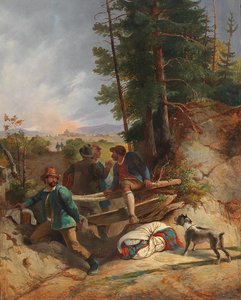
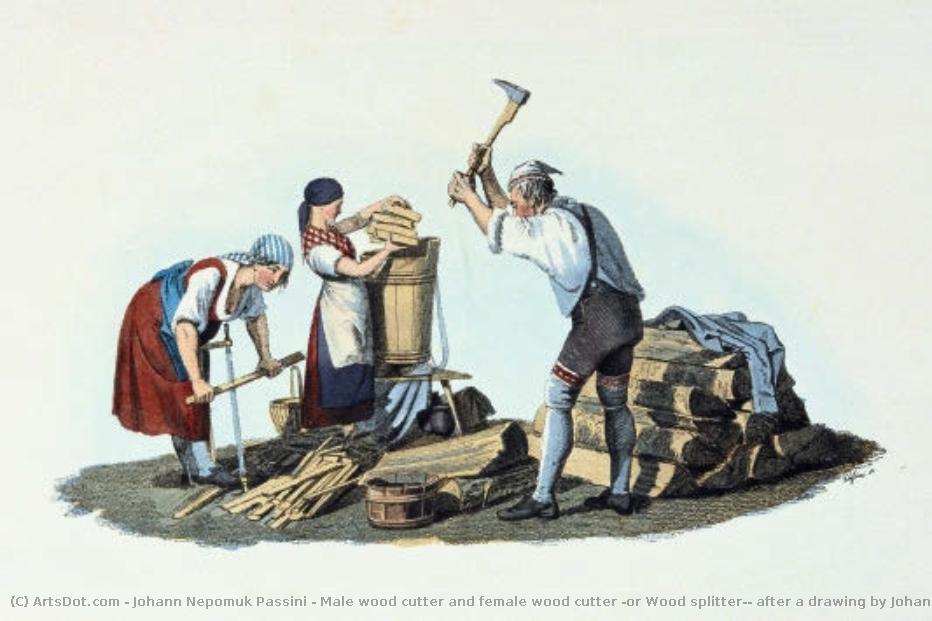
Male wood cutter and female wood cutter (or Wood splitter), after a drawing by Johann Josef Schindler


 Read More
Hand Made Oil Reproduction
Hand-painted oil on canvas in your size and frame, made to order by our artists. ( Buy Print Buy Image)




P118B $10

P118H $10

P118W $10

P438Z $10

P508JH $12

P508YH $12

P805H $10

P805Z $10

P919BZ $10

P919G $10

P919XJ $10

P959ZH $10

P968JZ $12

W106C $8

W218G $10

W218JH $8

W218Y $10

W307PJ $10

W316G $10

W316PJ $8

W316Y $10

W398PJ $8

W4111J $10

W500HY $15

W500JH $15

W692G $12

W849H $8

W940BG $15

W953PJ $8




Pick from our preset sizes that match the artwork's original proportions.

You may enter your own dimensions to fit a specific frame or space. If your selected size does not match the original image's proportions, we will either crop the artwork or extend the painting with additional hand-painted elements. A digital mockup will be sent for your approval before production begins.
Please note that the on-screen preview does not reflect the actual cropping or extension. Only the mockup will accurately show the final composition.
While custom sizes are available, we recommend selecting a dimension from the predefined list to preserve the original proportions.
After order, ArtsDot.com team will email client for instructions and provide a mockup preview
Worldwide Delivery () in 3/4 weeks instead of standard 5 weeks. (16 August). No compromise on quality.

Free Worldwide Express Shipping

High-Quality Linen Canvas

Full Shipping Insurance

Customs Tax Refund Guarantee

True Color Matching Guarantee

60-Day Return Policy (Defects Only)

100% Money-Back Guarantee

Bulk Discount Offer
 Glass option is only available in size under 110 CM

Male wood cutter and female wood cutter (or Wood splitter), after a drawing by Johann Josef Schindler
Reproduction Medium
Reproduction Size
-


Total Price
$ 288
Related Artworks
Artist Biography
A Chronicler of Austrian Life: The World of Johann Nepomuk Passini
Johann Nepomuk Passini, born in Vienna in 1798 and passing away in Graz in 1874, occupies a fascinating, yet often understated, position within the landscape of 19th-century Austrian art. He wasn’t a revolutionary innovator like some of his contemporaries; rather, he was a meticulous observer, a skilled craftsman who dedicated his life to capturing the essence of everyday existence and the burgeoning Romantic appreciation for natural beauty. Passini's artistic journey unfolded during a period of significant societal change – the decline of the Habsburg Empire, the rise of nationalism, and an increasing fascination with the picturesque. He responded to these currents not through overt political statements, but by focusing on the lives of ordinary people and the tranquil scenes that surrounded them. His work provides a valuable window into the Austria of his time, offering glimpses of rural life, burgeoning urban centers, and the quiet dignity of its inhabitants.Early Life and Artistic Training
Details surrounding Passini’s early training remain somewhat elusive, a common characteristic for artists working outside the immediate orbit of court patronage. However, it is clear he possessed a natural aptitude for draftsmanship and an eye for detail. Vienna in the late 18th and early 19th centuries was a vibrant artistic hub, steeped in the traditions of classicism but increasingly influenced by Romantic ideals emanating from Northern Europe. Passini’s initial work suggests a grounding in traditional techniques – precise rendering of form, careful attention to light and shadow – yet he quickly moved beyond mere imitation. He embraced the burgeoning medium of lithography, recognizing its potential for wider dissemination of his images. This early foray into printmaking proved crucial, establishing him as an artist capable of reaching a broader audience than was possible with traditional painting alone. His father, Ludwig Passini, also contributed to the artistic landscape, further shaping Johann’s development within a creative family environment.A Master of Multiple Mediums
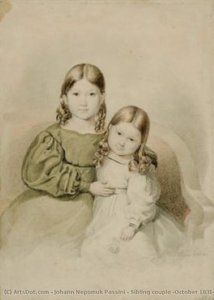
Passini distinguished himself through his versatility. While perhaps best known today for his copperplate engravings and lithographs, he was equally adept as a watercolorist and genre painter. His engravings, often based on his own drawings or those of contemporaries like Johann Josef Schindler, demonstrate remarkable technical skill – the delicate lines conveying texture, depth, and atmosphere with impressive precision. These prints weren’t simply reproductions; they were carefully considered works in their own right, often enhancing the original image through subtle adjustments and artistic interpretation. His watercolors, on the other hand, reveal a more intimate connection to his subjects. Works like “Sibling Couple (October 1831)” showcase a tender sensitivity, capturing fleeting moments of childhood innocence with delicate brushstrokes and muted tones. His genre scenes, depicting rural life – woodcutters at work, families engaged in daily routines – offer poignant snapshots of Austrian society. He wasn’t interested in grand historical narratives or mythological allegories; his focus was on the beauty and dignity of ordinary lives.Romantic Sensibilities and Artistic Legacy
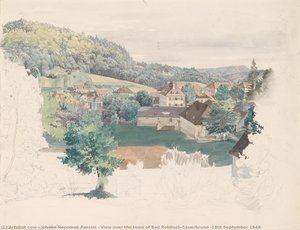
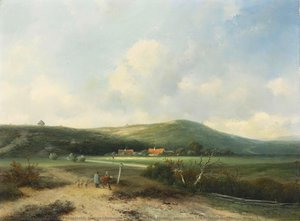
Passini's art is firmly rooted in the Romantic tradition, though he avoids the dramatic intensity often associated with the movement. His landscapes are characterized by a sense of tranquility, a quiet appreciation for the natural world. He wasn’t interested in portraying nature as a sublime force to be feared or conquered; rather, he sought to capture its beauty and harmony. This sensibility is evident in works like “View over the town of Bad Rohitsch-Sauerbrunn,” where the serene landscape evokes a sense of peace and contemplation. His paintings often feature figures integrated seamlessly into the environment, emphasizing the interconnectedness between humanity and nature. While Passini may not have achieved widespread international fame during his lifetime, his work remains significant for its meticulous craftsmanship, its sensitive portrayal of Austrian life, and its embodiment of Romantic ideals. He left behind a substantial body of work – engravings, lithographs, watercolors, and paintings – that continues to offer valuable insights into the art and culture of 19th-century Austria. His influence can be seen in the works of later artists who sought to capture the beauty of everyday life and the tranquility of the natural world.Rediscovering Passini Today
In recent years, there has been a growing appreciation for artists like Johann Nepomuk Passini – those whose work fell outside the mainstream narratives of art history but nonetheless offer valuable insights into their time. His paintings and prints are increasingly sought after by collectors and scholars alike, drawn to his meticulous craftsmanship, sensitive portrayal of Austrian life, and embodiment of Romantic sensibilities. The availability of reproductions, thanks to platforms like ArtsDot, allows a wider audience to experience the beauty and tranquility of his work. Passini’s legacy lies not in grand pronouncements or revolutionary innovations, but in his quiet dedication to capturing the essence of everyday existence – a chronicler of Austrian life whose art continues to resonate with viewers today.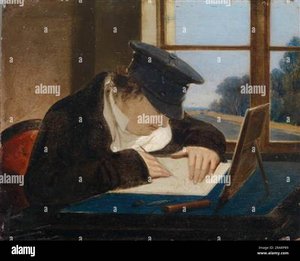
johann nepomuk passini
1798 - 1874 , Austria
Quick Facts
- Artistic Movement Or Style: Romanticism
- Date Of Birth: 1798
- Date Of Death: 1874
- Full Name: Johann Nepomuk Passini
- Nationality: Austrian
- Notable Artworks:
- Male Wood Cutter & Female Wood Cutter
- Sibling Couple (October 1831)
- View over Bad Rohitsch-Sauerbrunn
- Place Of Birth: Vienna, Austria
Related Articles
Romantic Realism's Finest: 10 Masterpieces for Your Home | ArtsDot
Explore 10 defining masterpieces of Romantic Realism! Discover Courbet, Millet & Daumier's powerful paintings—capturing emotion and social realities. Find museum-quality reproductions for your home at ArtsDot.com.
19th Century Masterpieces: 10 Paintings That Defined an Era | ArtsDot
Journey through 19th century art with ArtsDot! Explore 10 iconic paintings – from Monet & Renoir to Courbet – and discover the stories behind Romanticism, Realism & Impressionism. Find museum-quality reproductions for your home decor. Explore the full collection online!
The Evocative Embrace of Reality: Exploring Romantic Realism in 19th-Century Painting
Explore the captivating world of Romantic Realism! Discover key artists like Courbet & Millet, masterpieces, and the social context behind this influential art movement. Expert insights for collectors at ArtsDot.

Romantic Landscapes: 10 Masterpieces for Your Home | ArtsDot
Journey through 10 Romantic landscape masterpieces by Friedrich, Turner & Cole. Explore emotional art, sublime nature scenes & iconic 19th-century paintings. Find museum-quality reproductions for your home at ArtsDot.com – discover the full collection online!
Cultivating Visions: Rural Life & Social Commentary in Art History
Explore the rich history of rural life in art! Discover masterpieces from Dutch Masters to Van Gogh & Courbet. Uncover artistic movements, social significance & expert collecting insights at ArtsDot.