 Send
Send Share
Share
 Details

 Download
 Similars
 Diaporama
Haida Basketry Hat
 Wood
Wood- Sculpture
- Northwest Coast Indigenous Art
 1900
1900- 19th Century
 U.S. Department of the Interior Museum
 Read More
Hand Made Oil Reproduction
Hand-painted oil on canvas in your size and frame, made to order by our artists. ( Buy Print Buy Image)




































Pick from our preset sizes that match the artwork's original proportions.

You may enter your own dimensions to fit a specific frame or space. If your selected size does not match the original image's proportions, we will either crop the artwork or extend the painting with additional hand-painted elements. A digital mockup will be sent for your approval before production begins.
Please note that the on-screen preview does not reflect the actual cropping or extension. Only the mockup will accurately show the final composition.
While custom sizes are available, we recommend selecting a dimension from the predefined list to preserve the original proportions.
After order, ArtsDot.com team will email client for instructions and provide a mockup preview
Worldwide Delivery () in 3/4 weeks instead of standard 5 weeks. (21 August). No compromise on quality.

Free Worldwide Express Shipping

High-Quality Linen Canvas

Full Shipping Insurance

Customs Tax Refund Guarantee

True Color Matching Guarantee

60-Day Return Policy (Defects Only)

100% Money-Back Guarantee

Bulk Discount Offer
 Glass option is only available in size under 110 CM

Haida Basketry Hat
Reproduction Medium
Reproduction Size
-


Total Price
$ 288
Artwork Description
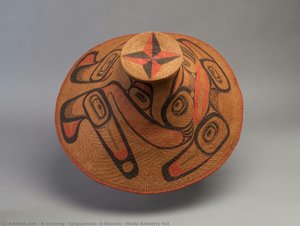
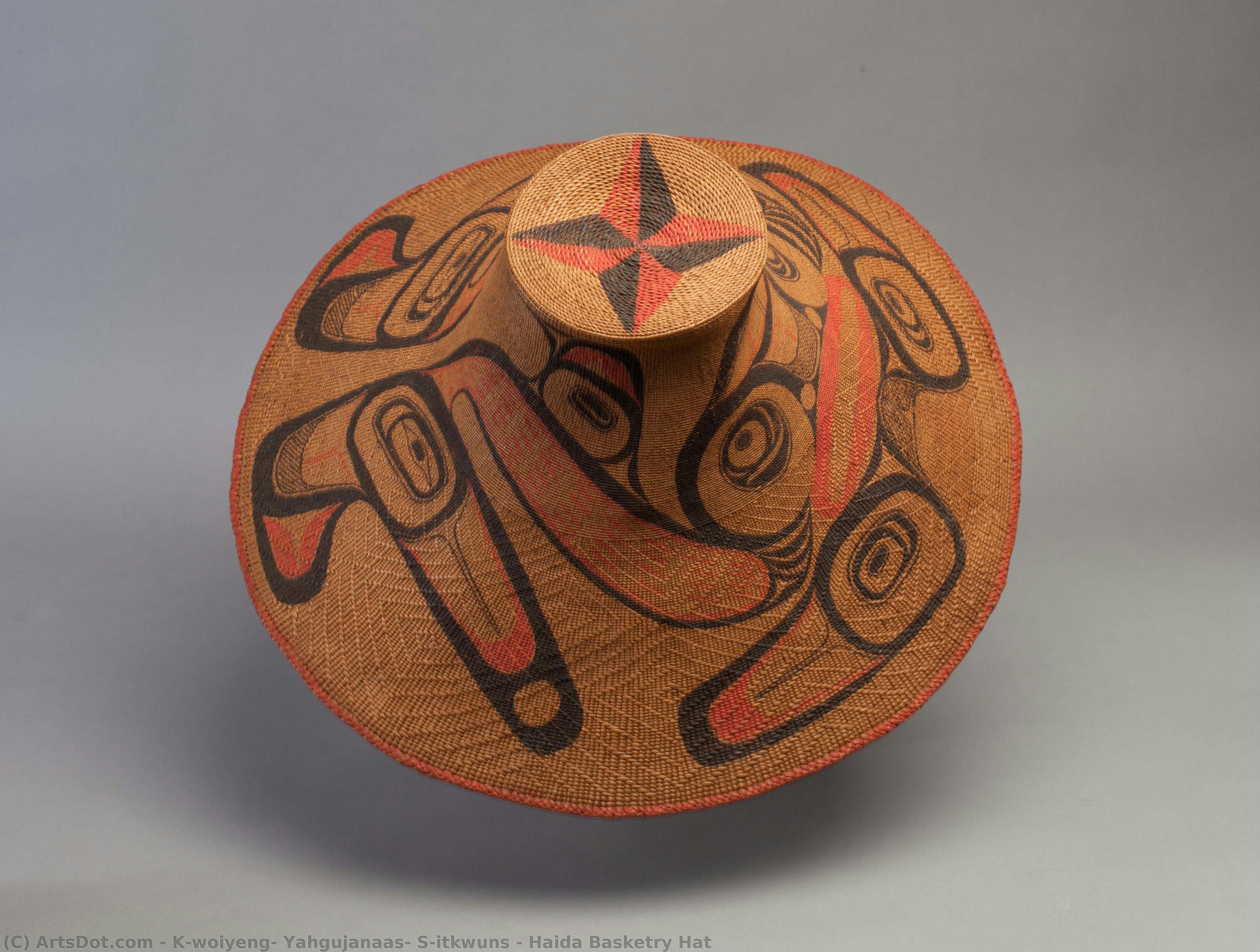
A Window into Haida Spirit: The Basketry Hat of k'woiyeng, yahgujanaas, s’itkwuns
This extraordinary basketry hat, crafted by the renowned Haida artists k’woiyeng, yahgujanaas, and s’itkwuns in the early 20th century, offers a profound glimpse into the heart of Indigenous Northwest Coast art. Executed around 1900, this piece transcends mere craftsmanship; it is a potent expression of cultural belief, ancestral connection, and masterful artistic technique. The hat's circular form immediately draws the eye, emphasizing its inherent significance as a container – not just for the head, but perhaps for spirit or memory.
- Materiality: Constructed primarily from meticulously woven wood, the foundation of the hat speaks to the Haida’s deep understanding and reverence for natural resources. The use of pigments—bold black and vibrant red—adds layers of symbolic meaning and visual impact.
- Technique: The artist's skill is evident in the precise carving of geometric patterns and stylized human figures, a hallmark of Northwest Coast art. This combination of weaving and carving represents a sophisticated synthesis of traditional skills.
The hat’s design is rich with symbolism. The central starburst pattern, a recurring motif in Haida cosmology, likely represents the radiating energy of the Creator or ancestral spirits. The anthropomorphic faces – rendered with remarkable detail – are almost certainly representations of ancestors, revered figures who held power and influence within the community. These stylized depictions aren’t simply portraits; they're conduits to the spiritual realm, embodying the Haida belief in a continuous connection between the living and the dead.
The Legacy of Northwest Coast Art
This piece belongs to a vibrant artistic tradition that flourished for centuries among the Indigenous peoples of the Pacific Northwest. Northwest Coast art is characterized by its geometric abstraction, its reliance on symbolic representation, and its profound connection to spiritual beliefs. The Haida, in particular, developed a highly sophisticated system of iconography, using forms like spirals, waves, and human figures to convey complex ideas about cosmology, social structure, and personal identity.
The style employed here reflects the broader artistic trends of the period, influenced by European contact while firmly rooted in Haida cultural practices. The sharp lines and defined shapes are reminiscent of both traditional carving techniques and emerging modern aesthetics, demonstrating a dynamic interplay between cultures.
A Study in Form and Symbol
The artist’s careful attention to detail is immediately apparent. The diffused lighting enhances the texture of the woven basketry and the smooth finish of the carved elements, creating a tactile quality that invites close observation. The relatively flat perspective focuses on the object's three-dimensional form, allowing us to appreciate the intricate layering of patterns and the subtle variations in wood grain.
Beyond its aesthetic qualities, this hat serves as a powerful reminder of the Haida people’s rich cultural heritage and their enduring artistic legacy. It is a testament to the power of art to connect us to our ancestors, to express profound spiritual beliefs, and to celebrate the beauty of the natural world.
Collecting a Piece of History
This hand-painted reproduction captures not only the visual essence of k’woiyeng, yahgujanaas, s’itkwuns’s remarkable work but also its historical significance. It offers an opportunity to bring a piece of Haida culture into your home or office, sparking conversation and inspiring contemplation about Indigenous art and spirituality. A stunning addition to any collection, this reproduction is more than just artwork; it's a window into another world.
Related Artworks
Artist Biography
Élisabeth Vigée Le Brun: A Portraitist of the Ancien Régime
Élisabeth Louise Vigée Le Brun, born in Paris in 1755 and passing away in 1842, stands as a pivotal figure in the history of French art. More than simply a painter, she was a shrewd observer of her time, a master of portraiture, and a woman who navigated the complex social landscape of the late 18th and early 19th centuries with remarkable skill and ambition. Her life story is intertwined with the dramatic shifts occurring in European society – from the opulence of the Ancien Régime to the revolutionary fervor that ultimately swept away the monarchy. Vigée Le Brun’s legacy rests primarily on her captivating portraits, which offer intimate glimpses into the lives of royalty, aristocracy, and prominent figures of the era, revealing not just their outward appearances but also a nuanced understanding of their personalities and social standing.
Early Life and Artistic Training
Vigée Le Brun’s early life was marked by a somewhat unconventional path to artistic recognition. Born into a family of modest means, she received her initial education in Paris, immersing herself in the art world through visits to museums and studying the works of masters like Jean-Baptiste-Camille Corot. Crucially, she found mentorship with her cousin, Louis Vigée, a painter who provided her with invaluable instruction and access to artistic circles. This early training laid the foundation for her later success, particularly in capturing the likenesses and expressions of her subjects. Unlike many artists of her time, Vigée Le Brun did not pursue formal academic training at the prestigious Académie Royale de Peinture et Sculpture, instead relying on self-directed study and the guidance of influential figures.
Service to the Royal Court: Marie Antoinette and Beyond
Vigée Le Brun’s career truly took flight with her appointment as the official portrait painter to Marie Antoinette in 1778. This patronage proved transformative, providing her with unprecedented access to the royal court and establishing her reputation as one of the most sought-after artists in France. Her portraits of the Queen were renowned for their elegance, grace, and psychological depth – capturing not just Marie Antoinette’s beauty but also her intelligence, wit, and vulnerability. Following the French Revolution, Vigée Le Brun continued to serve as a portraitist, adapting to the changing political climate and securing commissions from prominent figures across Europe, including Catherine the Great of Russia, Napoleon Bonaparte, and numerous members of the aristocracy.
Style and Technique: Rococo Refinements and Neoclassical Influences
Vigée Le Brun’s artistic style is often described as a synthesis of Rococo elegance and emerging Neoclassical principles. Initially, her portraits were characterized by the lush colors, delicate brushwork, and elaborate costumes typical of the Rococo period. However, as she matured as an artist, she began to incorporate elements of restraint, clarity, and anatomical accuracy that aligned with the growing influence of Neoclassicism. Her use of light and shadow was particularly masterful, creating a sense of depth and volume in her portraits and highlighting the subjects’ features with subtle precision. She paid meticulous attention to detail, capturing not only the physical appearance but also the expressions and gestures that revealed the inner lives of her sitters.
Legacy and Historical Significance
Élisabeth Vigée Le Brun's impact on the history of art is profound. She was one of the few female artists to achieve widespread recognition and success during a period when women faced significant barriers in the artistic world. Her portraits offer invaluable insights into the lives, customs, and social dynamics of the Ancien Régime and beyond. Her ability to capture both the outward appearance and inner character of her subjects cemented her place as a master portraitist, influencing generations of artists who followed. Today, her works are celebrated in major museums around the world, serving as enduring testaments to her artistic skill, keen observation, and remarkable life story. Her memoirs, published late in life, provide a fascinating firsthand account of her experiences navigating the turbulent political landscape of revolutionary France.

k'woiyeng, yahgujanaas, s'itkwuns
1842 - 1926 , United States of America
Quick Facts
- Artistic Movement Or Style: Portrait painting
- Artists Or Movements Influenced By This Artist:
- Rococo
- Neoclassicism
- Artists Who Influenced This Artist:
- Daubigny
- Reynolds
- Date Of Birth: 16 April 1755
- Date Of Death: 30 March 1842
- Full Name: Élisabeth Vigée Le Brun
- Nationality: French
- Notable Artworks:
- Marie Antoinette
- Self-portrait Straw Hat
- Lady Hamilton
- Place Of Birth: Paris, France
Related Articles

Geometric Abstraction's 10 Defining Masterpieces | Art for Your Home - ArtsDot
Explore 10 defining masterpieces of Geometric Abstraction! Discover Kandinsky, Mondrian & Malevich’s iconic works. Find museum-quality art reproductions and curated decor ideas to elevate your home at ArtsDot.com.
Geometric Design in Art: A Historical Survey & Contemporary Appeal for Collectors
Explore the enduring legacy of geometric abstraction! Discover key artists, historical movements & investment insights for discerning art collectors. Expert guidance from ArtsDot.

Beyond Form & Color: Geometric Abstraction's Evolution in 20th/21st Century Art
Explore the evolution of geometric abstraction from Cubism to contemporary art. Discover key artists like Malevich & Mondrian, investment insights, and expert collecting advice at ArtsDot.
Beyond Form & Color: Geometric Abstraction's Enduring Legacy in Art History
Explore the captivating world of geometric abstraction! Discover its origins, key artists like Malevich & Mondrian, and why this movement remains highly valued by art collectors today. Expert insights at ArtsDot.
The Enduring Appeal of Geometric Patterns in Art: A Historical & Contemporary Exploration
Explore the captivating history of geometric abstraction in art, from ancient roots to contemporary masters. Expert insights for collectors & enthusiasts. Discover key artists, movements & investment potential.