 Preview
 Send
Send Share
Share
 Details

 Download
 Similars
 X-Ray
X-Ray Diaporama
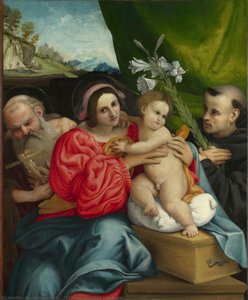
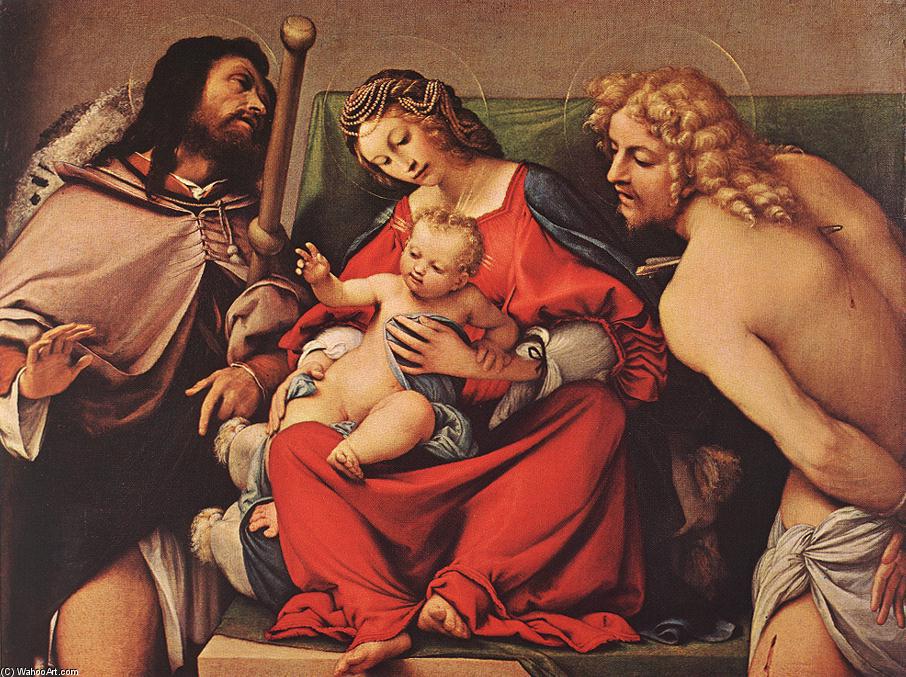
Madonna with the Child and Sts Rock and Sebastian
 Acrylic On Canvas
- WallArt
- High Renaissance Mannerist
 1522
1522 80.0 x 70.0 cm
 Contini Bonacossi Collection
 Read More
Giclée / Art Print
Museum-quality giclée or canvas print with fast production and flexible finish options. ( Buy Hand Made Painting Buy Image)




P118B $10

P118H $10

P118W $10

P438Z $10

P508JH $12

P508YH $12

P805H $10

P805Z $10

P919BZ $10

P919G $10

P919XJ $10

P959ZH $10

P968JZ $12

W106C $8

W218G $10

W218JH $8

W218Y $10

W307PJ $10

W316G $10

W316PJ $8

W316Y $10

W398PJ $8

W4111J $10

W500HY $15

W500JH $15

W692G $12

W849H $8

W940BG $15

W953PJ $8




Pick from our preset sizes that match the artwork's original proportions.

You may enter your own dimensions to fit a specific frame or space. If your selected size does not match the original image's proportions, we will either crop the artwork or extend the image with a mirrored or solid-fill edge. A digital mockup will be sent for your approval before production begins.
Please note that the on-screen preview does not reflect the actual cropping or extension. Only the mockup will accurately show the final composition.
While custom sizes are available, we recommend selecting a dimension from the predefined list to preserve the original proportions.
Worldwide Delivery () in 2 weeks instead of standard 4/5 weeks. (5 September)

Free Worldwide Express Shipping

High-Quality Linen Canvas

Full Shipping Insurance

Customs Tax Refund Guarantee

True Color Matching Guarantee

60-Day Return Policy (Defects Only)

100% Money-Back Guarantee

Bulk Discount Offer
 Glass option is only available in size under 110 CM

Madonna with the Child and Sts Rock and Sebastian
Giclée / Art Print
Reproduction Size
-


Total Price
$ 63
Madonna and Child with Saint Roch and Saint Sebastian (Lotto)
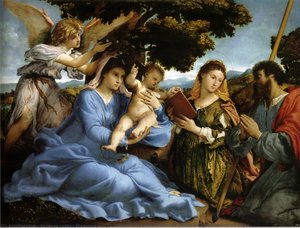
The painting “Madonna and Child with Saint Roch and Saint Sebastian” by Lorenzo Lotto stands as a testament to Venetian Renaissance artistry, capturing not merely religious piety but also an unsettling exploration of human vulnerability. Created around 1518, it resides within the National Gallery of Canada in Ottawa—a fortunate circumstance that allows for close examination of Lotto’s masterful technique and profound artistic vision. This devotional masterpiece exemplifies the burgeoning Mannerist style, subtly diverging from the idealized forms championed by its predecessors while retaining a core humanist sensibility.- Subject Matter: The composition depicts Mary cradling Jesus Christ alongside Saint Roch—a protector against plague—and Saint Sebastian—martyred for his unwavering faith—creating a poignant tableau of divine grace and earthly suffering. Lotto’s deliberate choice to portray these figures in close proximity underscores the interconnectedness between spiritual devotion and human experience.
- Style & Technique: Lotto's approach distinguishes itself from the prevailing stylistic trends of his time. While maintaining a recognizable High Renaissance framework—particularly evident in the pyramidal structure—he introduces unsettling distortions and asymmetries that foreshadow the Mannerist preoccupation with psychological realism. The artist’s nervous poses and subtle shifts in perspective contribute to an atmosphere of unease, reflecting Lotto's own eccentric personality and signaling a pivotal moment in artistic history.
- Historical Context: Lotto’s work emerged during a period marked by intellectual ferment and artistic experimentation—the High Renaissance transitioning into the Mannerist movement. Venetian art was undergoing significant transformation, grappling with questions of beauty, emotion, and representation. Lotto's patronage came from Battista Cucchi, a surgeon known for his meticulous anatomical studies, reflecting the humanist emphasis on observation and understanding the human body as central to spiritual contemplation.
- Symbolism: The painting is replete with symbolic gestures designed to convey deeper meanings beyond the surface narrative. Saint Roch’s healed thigh symbolizes divine compassion and resilience—a visual reminder of God's healing power amidst suffering. Sebastian’s twisted posture embodies martyrdom and unwavering faith, highlighting the sacrifices demanded by devotion. Furthermore, Lotto’s use of muted colors and diffused light contributes to an emotional resonance that transcends mere depiction, inviting viewers to contemplate themes of mortality and redemption.
- Emotional Impact: “Madonna and Child with Saint Roch and Saint Sebastian” possesses a remarkable ability to evoke contemplation and empathy. Lotto's masterful rendering of human emotion—particularly Sebastian’s anguish—captures the essence of spiritual torment without resorting to melodrama. The painting compels viewers to confront questions about faith, suffering, and compassion—themes that continue to resonate powerfully across centuries.
The artwork’s journey through history – from its initial placement in a Venetian convent facing dissolution to its eventual acquisition by Alessandro Contini Bonacossi and subsequent inclusion in the Uffizi collection – underscores its enduring significance as an exemplar of Renaissance artistic achievement.
Further research into Lotto's life and work reveals a prolific artist who traveled extensively throughout Italy, adapting his style to diverse contexts while maintaining a distinctive visual language. His unwavering commitment to anatomical accuracy—evident in the meticulous depiction of Saint Roch’s wound—demonstrates Lotto’s dedication to humanist ideals.
Related Artworks
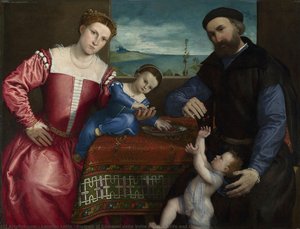
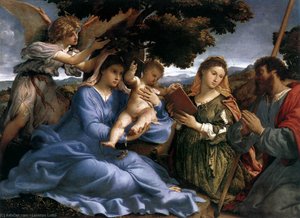
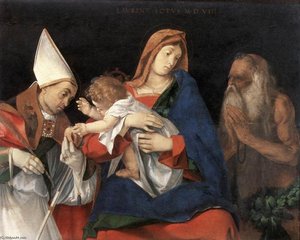
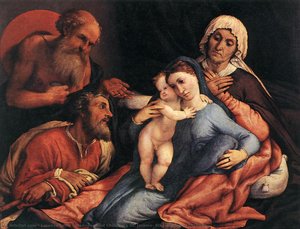
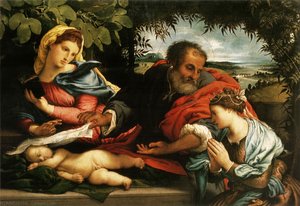
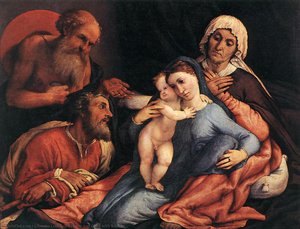
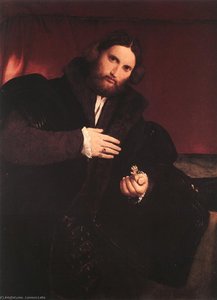
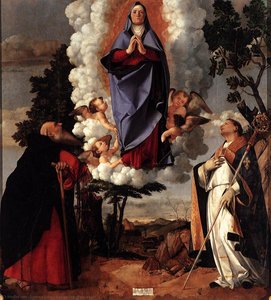

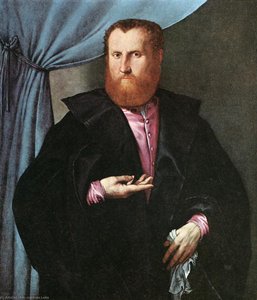
Artist Biography
A Venetian Wanderer: The Life and Art of Lorenzo Lotto
Born in the vibrant heart of Venice around 1480, Lorenzo Lotto emerged as a distinctive voice within the Italian Renaissance, though his artistic journey would lead him far beyond the lagoon city’s celebrated studios. Unlike many of his contemporaries who firmly established themselves within specific schools or courts, Lotto embarked on a peripatetic career, traversing cities like Treviso, Rome, Bergamo, and Ancona before ultimately finding solace as a lay brother in Loreto. This itinerant existence profoundly shaped his artistic vision, exposing him to diverse influences while fostering an independent spirit that set him apart. While early training remains somewhat shrouded in mystery, it’s believed he absorbed the lessons of Giovanni Bellini, a leading figure of the Venetian school, yet Lotto quickly transcended simple imitation, forging a style uniquely his own—a blend of High Renaissance grace and nascent Mannerist sensibilities.Blending Traditions: Style and Influences
Lotto’s artistic signature lies in his remarkable ability to synthesize diverse influences into a cohesive and deeply personal aesthetic. His early works reveal the impact of Giorgione's poetic naturalism, particularly evident in the subtle atmospheric effects and lyrical compositions. However, a sojourn in Rome brought him into contact with the art of Raphael, imbuing his work with a newfound clarity of form and compositional balance. Later, during his extended stay in Bergamo, he absorbed elements of Lombard realism, adding a grounded physicality to his figures. This eclectic approach is not merely additive; Lotto masterfully integrated these influences, creating paintings that are both technically refined and emotionally resonant. He wasn’t afraid to experiment with perspective, often employing unusual vantage points to heighten the sense of drama or intimacy. His palette, while rooted in Venetian colorism, evolved over time, becoming increasingly vibrant and expressive. Susanna and the Elders, painted during his Bergamo period, exemplifies this maturity—a captivating narrative rendered with luminous colors and a keen psychological insight into the characters’ emotions.Portraits of the Soul: Lotto's Masterpieces
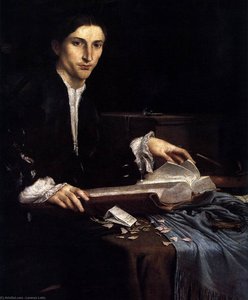
While Lotto excelled in religious painting, it is perhaps through his portraits that he truly distinguished himself. He possessed an extraordinary gift for capturing not just the physical likeness but also the inner life of his sitters. His portraits are rarely idealized; instead, they present individuals with all their complexities and vulnerabilities. Man with a Golden Paw, painted in 1527, is a prime example—a captivating study of a gentleman holding a small golden statuette, its symbolism open to interpretation but undeniably intriguing. The sitter’s gaze is direct and engaging, conveying a sense of intelligence and quiet contemplation. Similarly, Portrait of a 37-year-old Man, showcases Lotto's ability to convey personality through subtle details—the man’s clothing, his posture, the expression in his eyes all contribute to a compelling psychological portrait. These are not merely representations of individuals; they are windows into their souls.A Rediscovered Legacy: Historical Significance
Despite achieving considerable recognition during his lifetime, Lotto's reputation waned after his death in 1556 or 1557. His works, often dispersed throughout provincial churches and private collections, were largely overlooked for centuries. It wasn’t until the late 19th century, with Bernard Berenson’s groundbreaking scholarship, that Lotto experienced a significant revival of interest. Today, he is recognized as one of the most original and compelling artists of the Italian Renaissance. His unique blend of stylistic influences, his psychological depth, and his technical mastery continue to captivate audiences and inspire art historians. He stands as a testament to the power of artistic independence—a wanderer who forged his own path and left an indelible mark on the world of art. The rediscovery of Lotto’s oeuvre has enriched our understanding of the Renaissance, revealing a complex and multifaceted artist whose work deserves continued exploration and appreciation.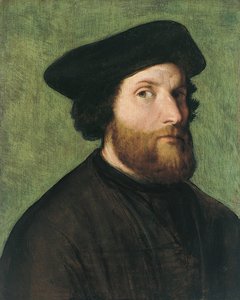
Lorenzo Lotto
1480 - 1556 , Italy
Quick Facts
- Artistic Movement Or Style: Renaissance, Mannerism
- Artists Who Influenced This Artist:
- Giovanni Bellini
- Giorgione
- Correggio
- Palma the Elder
- Date Of Birth: c. 1480
- Date Of Death: 1556/57
- Full Name: Lorenzo Lotto
- Nationality: Italian
- Notable Artworks:
- Virgin and Child with St. Jerome
- Allegory of Virtue and Vice
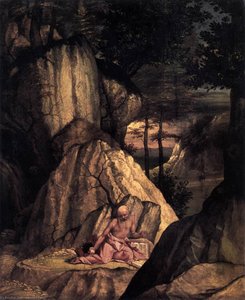
- St. Jerome in the desert
- Man with a Golden Paw
- Place Of Birth: Venice, Italy
Related Articles
Lorenzo Lotto: Unveiling the Enigma of a Venetian Master's Portraits
Explore the captivating world of Lorenzo Lotto, a Venetian Renaissance master renowned for his psychologically insightful portraits & enigmatic symbolism. Discover his life, style, and rediscovered legacy with ArtsDot.

Jacopo Tintoretto's Masterpieces: 25 Paintings That Define Venetian Drama | ArtsDot
Explore 25 breathtaking masterpieces by Jacopo Tintoretto, the Venetian master of drama and light. Discover the stories behind iconic Renaissance paintings & find museum-quality art reproductions to elevate your home decor on ArtsDot.com.

Raphael's Masterpieces: 25 Iconic Paintings & Renaissance Art for Your Home
Explore 25 breathtaking Raphael paintings! Journey through the Italian Renaissance with masterpieces like 'School of Athens' & iconic Madonnas. Find museum-quality art reproductions and elevate your home decor on ArtsDot.com.
The Golden Light of Innovation: Exploring the Venetian Renaissance Art Movement (1430–1580)
Explore the Golden Age of Venetian art (1430–1580). Discover Giorgione, Titian & Tintoretto's techniques, the 'colorito' revolution, and lasting influence. Expert insights for collectors & enthusiasts.
Pietro Longhi's Venetian Scenes: A Study of Rococo Society & Domestic Life
Explore the captivating world of Pietro Longhi's Venetian scenes! Discover insightful analysis of his Rococo masterpieces & social commentary on 18th-century life. Learn about this 'Venetian Hogarth' and his lasting artistic legacy.