 Preview
 Send
Send Share
Share
 Details

 Download
 Similars
 X-Ray
X-Ray Diaporama
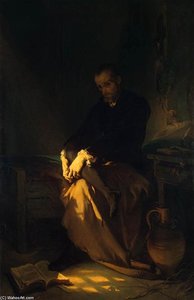
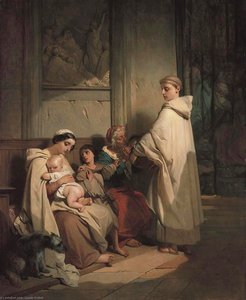
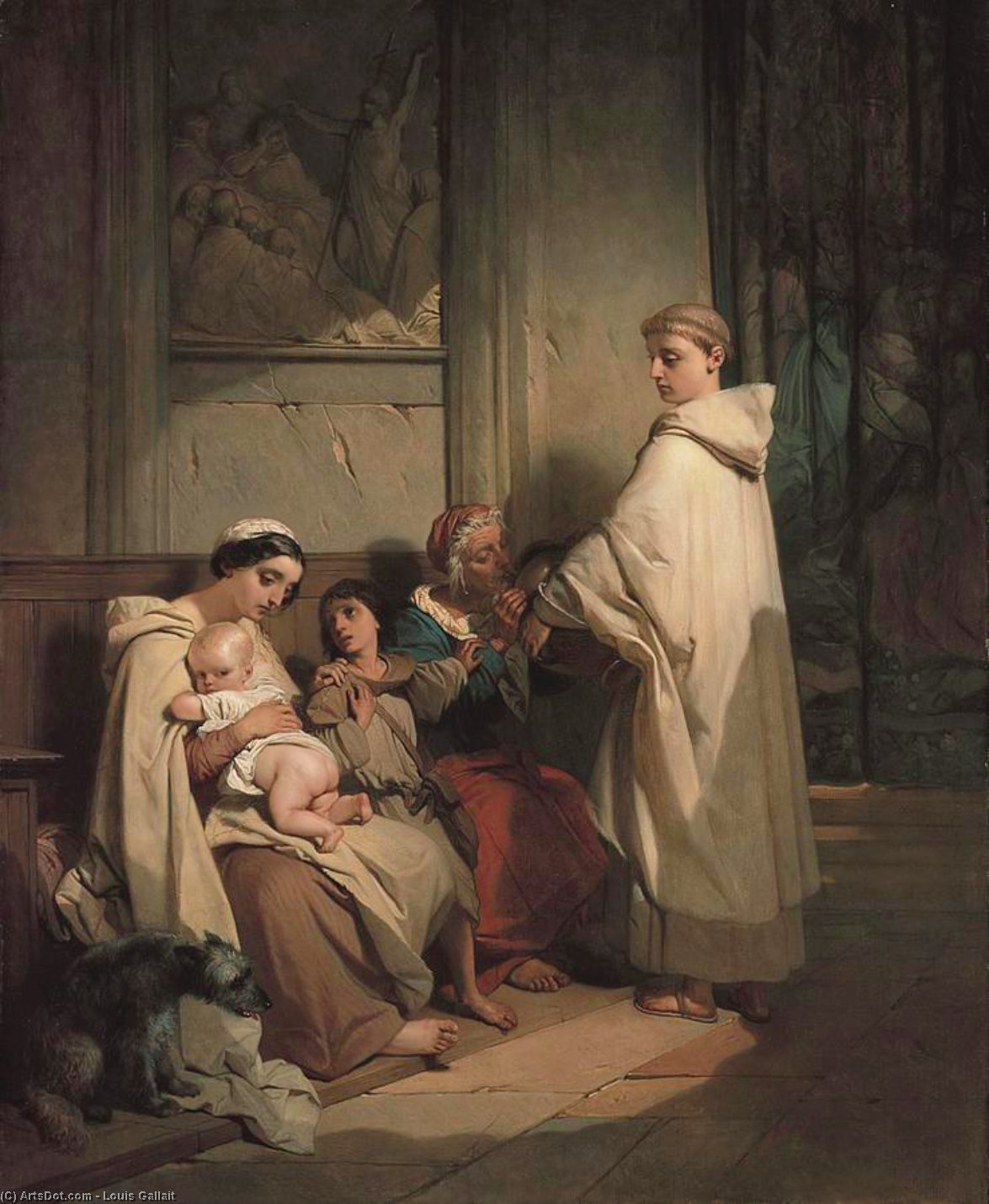
Monk Feeding the Poor
 Oil On Canvas
- WallArt
- Romanticism
 1845
1845- 19th Century
 100.0 x 82.0 cm
 Neue Pinakothek
 Read More
Hand Made Oil Reproduction
Hand-painted oil on canvas in your size and frame, made to order by our artists. ( Buy Print Buy Image)




P118B $10

P118H $10

P118W $10

P438Z $10

P508JH $12

P508YH $12

P805H $10

P805Z $10

P919BZ $10

P919G $10

P919XJ $10

P959ZH $10

P968JZ $12

W106C $8

W218G $10

W218JH $8

W218Y $10

W307PJ $10

W316G $10

W316PJ $8

W316Y $10

W398PJ $8

W4111J $10

W500HY $15

W500JH $15

W692G $12

W849H $8

W940BG $15

W953PJ $8




Pick from our preset sizes that match the artwork's original proportions.

You may enter your own dimensions to fit a specific frame or space. If your selected size does not match the original image's proportions, we will either crop the artwork or extend the painting with additional hand-painted elements. A digital mockup will be sent for your approval before production begins.
Please note that the on-screen preview does not reflect the actual cropping or extension. Only the mockup will accurately show the final composition.
While custom sizes are available, we recommend selecting a dimension from the predefined list to preserve the original proportions.
After order, ArtsDot.com team will email client for instructions and provide a mockup preview
Worldwide Delivery () in 3/4 weeks instead of standard 5 weeks. (16 August). No compromise on quality.

Free Worldwide Express Shipping

High-Quality Linen Canvas

Full Shipping Insurance

Customs Tax Refund Guarantee

True Color Matching Guarantee

60-Day Return Policy (Defects Only)

100% Money-Back Guarantee

Bulk Discount Offer
 Glass option is only available in size under 110 CM

Monk Feeding the Poor
Reproduction Medium
Reproduction Size
-


Total Price
$ 263
Artwork Description
A Testament to Compassion: Exploring Louis Gallait’s “Monk Feeding the Poor”
The Belgian Romantic painter Louis Gallait (1810 – 1887) achieved renown not merely for his artistic talent but for revitalizing a genre that had languished in the wake of Neoclassical dominance—historical painting. His masterpiece, “Monk Feeding the Poor,” completed in 1845, stands as a powerful emblem of Victorian moral idealism and exemplifies Gallait’s meticulous approach to capturing dramatic narratives with profound emotional resonance.Subject Matter and Narrative Depth
The painting depicts a scene brimming with humanist concern: a monk diligently distributing food to a group of impoverished individuals. This wasn't simply a depiction of charity; it was an assertion of Christian virtue against the backdrop of societal hardship. Gallait skillfully portrays the vulnerability of those receiving aid – faces etched with sorrow and desperation – juxtaposed against the solemn dignity of the monastic figure, conveying a palpable sense of compassion and responsibility. The inclusion of a dog adds another layer to the composition, symbolizing loyalty and faithfulness amidst adversity—a common motif in Romantic art reflecting anxieties about social decay and the importance of moral fortitude.Style and Technique: Embracing Dramatic Realism
Gallait’s style aligns squarely with the tenets of Romantic painting, prioritizing expressive emotion over strict adherence to classical conventions. He eschewed idealized forms for a robust realism that aimed to convey the textures and nuances of human experience. The monochrome palette—primarily shades of grey—intensifies the dramatic impact of the scene, focusing attention on form and gesture rather than coloristic embellishments. Gallait employed meticulous brushwork, layering pigments with painstaking detail to achieve a palpable sense of depth and atmosphere. Light plays a crucial role in illuminating faces and highlighting the monk’s posture, emphasizing his unwavering dedication to alleviating suffering.Historical Context: Victorian Morality and Artistic Revival
“Monk Feeding the Poor” emerged during a period marked by significant social reform movements within Britain and Belgium—a time when artists wrestled with questions of moral responsibility and sought to engage viewers emotionally. The painting reflects the broader Romantic preoccupation with portraying human struggles against oppressive forces, mirroring themes prevalent in literature and opera of the era. Gallait’s revival of historical painting coincided with a renewed interest in narrative storytelling and psychological exploration within the artistic community, signaling a decisive break from the stylistic rigidity of the preceding century.Symbolism: Faith, Charity, and Societal Responsibility
Beyond its immediate depiction of generosity, “Monk Feeding the Poor” resonates with deeper symbolic meanings. The monk embodies Christian compassion—a cornerstone of Victorian morality—representing selfless devotion to alleviating human suffering. The impoverished individuals symbolize vulnerability and injustice, prompting contemplation on societal obligations to care for those less fortunate. Furthermore, the dog serves as a reminder that loyalty and faithfulness endure even amidst hardship, reinforcing the painting’s overarching message about moral fortitude and spiritual integrity.Emotional Impact: A Window into Victorian Sentiment
Gallait's masterful execution transcends mere visual representation; it evokes profound emotional responses in the viewer. The solemn lighting, combined with expressive brushwork, captures the gravity of the situation while simultaneously conveying a sense of hope—the promise that compassion can triumph over despair. “Monk Feeding the Poor” remains an enduring testament to Romantic idealism and continues to inspire admiration for its artistic merit and its poignant portrayal of human empathy. It serves as a beautiful reminder of the importance of social responsibility and the transformative power of faith in confronting adversity.Related Artworks

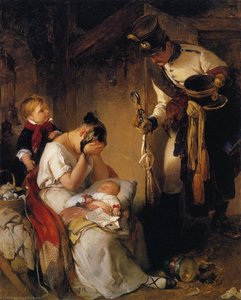
Artist Biography
The Architect of Belgian History Painting
Louis Gallait stands as a monumental figure in the annals of nineteenth-century art, a painter whose brush breathed new life into the grand tradition of history painting within Belgium. Born in 1810 in the historic city of Tournai, Gallait’s early years were shaped by a profound connection to his Belgian roots, a foundation that would later allow him to translate national identity into sweeping, dramatic canvases. His artistic journey began under the watchful eyes of masters like Cornelis Cels and Philippe Auguste Henlam at the Académie Royale de Tournai, where he first learned to marry technical precision with emotional depth. This early training provided the essential scaffolding for a career that would eventually bridge the gap between the romanticism of the past and the burgeoning realism of his era.
As his talent matured, Gallait sought the vibrant artistic currents of Antwerp, studying under Mathieu Ignace van Brée to refine his command over light and composition. His ascent was marked by a series of triumphs that captured the imagination of the Belgian public. The 1832 presentation of Tribute to Caesar at Ghent’s Salon served as a definitive breakthrough, earning him prestigious accolades and signaling the arrival of a master. By the time he debuted at the Brussels Salon in 1833 with Christ Healing the Blind, Gallait had already begun to establish his signature style: a poignant, deeply humanistic approach to sacred and historical narratives that resonated with the spiritual and cultural sensibilities of his contemporaries.
A Vision of Grandeur and Realism
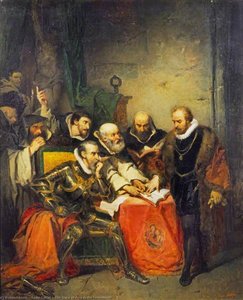
The true zenith of Gallait’s career arrived when he turned his gaze toward the epic scale of European history. Moving to Paris in 1841, he immersed himself in the intellectual heart of the art world, yet his heart remained tethered to the grand narratives of his homeland and the broader continent. It was during this period that he produced his most celebrated masterpiece, The Abdication of Charles V. This monumental work, commissioned by the Belgian government, remains a testament to his ability to weave meticulous historical accuracy with theatrical grandeur. Through the use of breathtakingly detailed costumes and a masterful, rich color palette, Gallait did more than merely record an event; he resurrected a moment of profound political and personal gravity, captivating audiences across Europe.
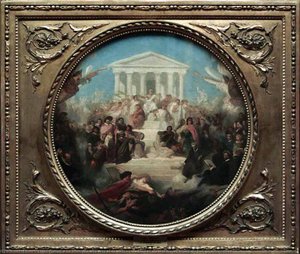
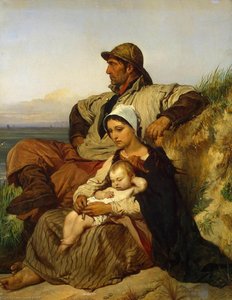
Gallait’s technical prowess was characterized by a unique blend of Romantic drama and a burgeoning sense of Realism. While his themes often leaned toward the epic, his execution possessed a grounded, tactile quality that prevented his work from drifting into mere abstraction. This is evident in works such as Le Triomphe des Arts, where he explores the triumph of good governance through classical allegory, and in more intimate, human-centric pieces like Fisherman's Family. In these later works, one can observe a shift toward a more tender observation of daily life, yet the underlying strength of his composition and his dedication to narrative clarity remain ever-present.
Legacy and Artistic Significance
Beyond the grand historical canvases, Gallait’s repertoire included deeply moving depictions of compassion and social reality. In Monk Feeding the Poor, he utilized a dramatic, almost chiaroscuro-driven technique to highlight the profound dignity found in acts of charity, inviting viewers into a space of intense empathy. His ability to navigate between the monumental and the intimate allowed him to become not just a painter of kings and emperors, but a chronicler of the human condition.
The historical significance of Louis Gallait cannot be overstated. He was the primary catalyst for the revival of history painting in Belgium, providing a visual language for a nation finding its footing in a modern era. His influence can be summarized through several key contributions:
- Revival of National Narrative: He utilized historical themes to foster a sense of Belgian identity and pride during a period of significant political evolution.
- Mastery of Composition: His ability to organize complex, multi-figure scenes with clarity and dramatic tension set a standard for academic painting in the mid-19th century.
- Synthesis of Styles: He successfully bridged the gap between the emotional intensity of Romanticism and the meticulous detail of Realism.
- Cultural Impact: Through his international exhibitions, he brought Belgian artistic excellence to the forefront of the European stage, ensuring that the nation's visual culture was recognized far beyond its borders.
Though the era of grand history painting would eventually give way to new movements, the legacy of Louis Gallait persists in the enduring power of his imagery. He remains a painter of profound substance, whose works continue to invite us into the dramatic, the sacred, and the deeply human.
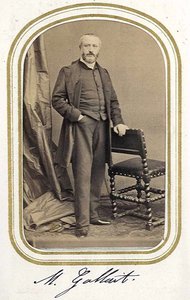
Louis Gallait
1810 - 1887 , Belgium
Quick Facts
- Artistic Movement Or Style: Romanticism
- Artists Who Influenced This Artist:
- Philippe Auguste Hennequin
- Mathieu Ignace Van Brée
- Date Of Birth: June 9, 1810
- Date Of Death: November 20, 1887
- Full Name: Louis Gallait
- Nationality: Belgian
- Notable Artworks:
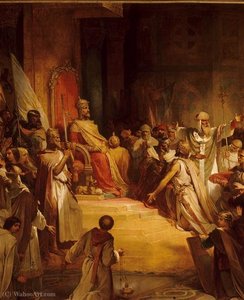
- Abdication Details: Charles Quint Married
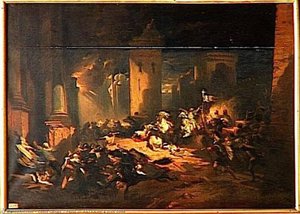
- Prize d’Antioque.3 Juin 1098
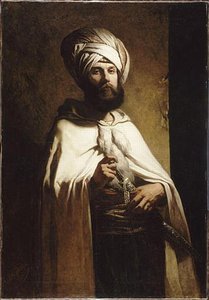
- Portrait Du Peintre Et Graveur Charles Cousin En Costume Arabe
- Place Of Birth: Tournai, Belgium
Related Articles
Anne-Louis Girodet: Bridging Neoclassicism & Romanticism with Emotional Truth
Explore the captivating world of Anne-Louis Girodet, a pivotal figure bridging Neoclassicism & Romanticism. Discover his masterpieces and unique artistic vision with ArtsDot.

Morris Louis: Pioneering Color Field Painting & Abstract Expressionism's Legacy
Explore the groundbreaking abstract expressionism of Morris Louis, a pioneer of Color Field painting. Discover his innovative techniques, influential series & lasting legacy in post-war American art. Learn more at ArtsDot.
The Evocative Brushstroke: Exploring Emotion, Individuality & the Sublime in Romanticism's Artistic Landscape
Explore the passionate world of Romanticism! Discover masterpieces by Friedrich & Goya, delve into the sublime, and understand the movement's lasting impact on art history. Expert analysis & insights at ArtsDot.
Romanticism's Greatest Artworks: 10 Masterpieces for Your Home |
Journey through Romanticism's soul with 10 iconic artworks by Delacroix, Goya & Turner. Explore emotional landscapes and historical drama. Find museum-quality art reproductions to elevate your home at – Discover all masterpieces online!
The Sublime and the Sensual: Exploring Emotion & Individuality in Romanticism's Artistic Revolution
Explore the passionate world of Romanticism! Discover masterpieces by Friedrich & Goya, delve into the sublime, and understand the movement's lasting impact on art history. Expert analysis & insights.