

 Preview
 Send
Send Share
Share
 Details

 Download
 Similars
 X-Ray
X-Ray Diaporama
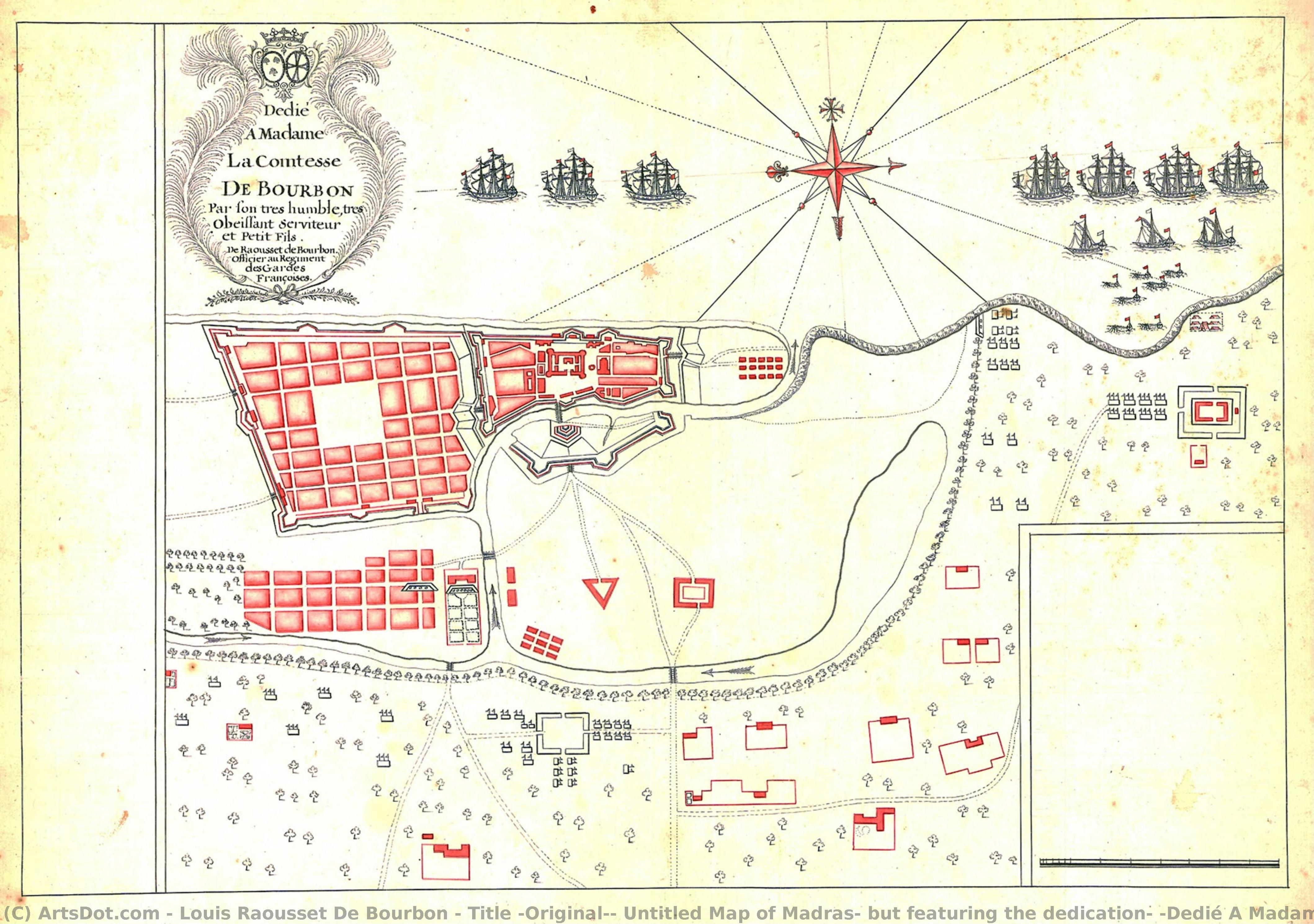
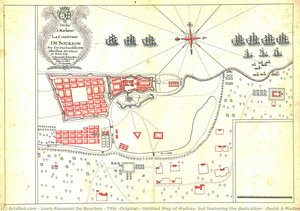
Title (Original): Untitled Map of Madras, but featuring the dedication: “Dedié A Madame La Comtesee de Bourbon Par son tres humble, tres Obessant Serviteur et Petit Fils. De Raousset de Bourbon Officier au Regiment des Guardes Françoises.”
 Historical Cartography
 46.0 x 61.0 cm
 Kalakriti Archives
 Read More
Hand Made Oil Reproduction
Hand-painted oil on canvas in your size and frame, made to order by our artists. ( Buy Print Buy Image)




































Pick from our preset sizes that match the artwork's original proportions.

You may enter your own dimensions to fit a specific frame or space. If your selected size does not match the original image's proportions, we will either crop the artwork or extend the painting with additional hand-painted elements. A digital mockup will be sent for your approval before production begins.
Please note that the on-screen preview does not reflect the actual cropping or extension. Only the mockup will accurately show the final composition.
While custom sizes are available, we recommend selecting a dimension from the predefined list to preserve the original proportions.
After order, ArtsDot.com team will email client for instructions and provide a mockup preview
Worldwide Delivery () in 3/4 weeks instead of standard 5 weeks. (25 August). No compromise on quality.

Free Worldwide Express Shipping

High-Quality Linen Canvas

Full Shipping Insurance

Customs Tax Refund Guarantee

True Color Matching Guarantee

60-Day Return Policy (Defects Only)

100% Money-Back Guarantee

Bulk Discount Offer
 Glass option is only available in size under 110 CM

Title (Original): Untitled Map of Madras, but featuring the dedication: “Dedié A Madame La Comtesee de Bourbon Par son tres humble, tres Obessant Serviteur et Petit Fils. De Raousset de Bourbon Officier au Regiment des Guardes Françoises.”
Reproduction Medium
Reproduction Size
-


Total Price
$ 263
Artwork Description
Related Artworks
Artist Biography
The Noble Cartographer: The Life and Legacy of Louis Raousset de Bourbon
In the grand tapestry of nineteenth-century French history, few figures capture the imagination quite like Louis Raousset de Bourbon. Born in 1817 into the prestigious and storied Bourbon lineage, his life was a delicate intersection of aristocratic duty and artistic obsession. As an officer within the Régiment des Gardes Françaises, Bourbon was shaped by the discipline of military service and the meticulous rigor of classical education. Yet, beneath the uniform of a nobleman lay the soul of a chronicler, a man driven to translate the chaotic movements of war into the precise, elegant language of cartography. His life, though tragically shortened by his death in 1854, remains an evocative study of how personal heritage and historical passion can converge to create a lasting, albeit unfinished, visual legacy.
The centerpiece of Bourbon’s artistic contribution is not a canvas of sweeping landscapes or emotive portraits, but rather a monumental, unfinished manuscript map of Madras. This work was born from a profound sense of familial devotion, commissioned by Madame Comtesse de Bourbon. The project sought to immortalize the dramatic Fall of Madras in 1746—a pivotal moment during the First Carnatic War when French forces achieved a stunning victory over the British East India Company. Through his work, Bourbon attempted to bridge the gap between historical record and artistic interpretation, transforming a strategic military event into a detailed topographical narrative that captured the very essence of colonial struggle.
A Masterpiece of Precision and Unfinished Ambition
To examine Bourbon’s approach to cartography is to witness a masterful command of engraving. Eschewing the expressive flourishes common in much of the era's romantic art, he embraced the academic tradition of realism and meticulous observation. His technique relied on intricate linework to define the rugged contours of the Madras coastline and the strategic fortifications of Fort St. George. By utilizing subtle shading, he breathed a sense of three-dimensional depth into his manuscript, allowing the viewer to perceive the terrain not merely as a flat diagram, but as a living battlefield. This precision was likely informed by the reconnaissance surveys of skilled engineers like Louis Paradis de la Roche, whose technical expertise provided the foundation upon which Bourbon built his visual epic.
However, there is a profound poignancy in the incompleteness of his greatest work. The map remains an unfinished vision, a testament to a life interrupted by illness and premature death. While the topographical details are rendered with astonishing fidelity, the intended key—the element that would have provided the final layer of strategic clarity—was never completed. This absence creates a unique historical tension; the viewer is left to navigate the contours of the siege through the lens of what remains, much like piecing together the fragmented history of the Bourbon era itself. It is this very quality of being an unfinished vision that lends his work such an enigmatic and haunting allure.
Historical Significance and Artistic Resonance
The significance of Louis Raousset de Bourbon extends far beyond the borders of France or the specificities of the Madras campaign. His work serves as a vital window into the era of imperial expansion and the intense colonial rivalry between France and Britain. Through his eyes, we see the strategic importance of Indian territories and the high stakes of the 18th-century global conflicts. His ability to synthesize military intelligence with artistic craftsmanship makes him a unique figure in the history of both art and cartography.
Ultimately, Bourbon’s legacy is defined by several key elements:
- The Intersection of Class and Craft: He utilized his aristocratic position and military training to pursue a highly specialized form of historical documentation.
- Technical Excellence: His mastery of engraving and topographical accuracy set a standard for contemporary manuscript mapping.
- Historical Preservation: His dedication to documenting the Siege of Madras provides modern historians with a visually stunning perspective on the First Carnatic War.
- The Beauty of the Incomplete: His unfinished map stands as a romantic symbol of lost potential and the ephemeral nature of human endeavor.
louis raousset de bourbon
1817 - 1854 , France
Quick Facts
- Artistic Movement Or Style: Military Art
- Date Of Birth: 1817
- Full Name: Louis Raousset de Bourbon
- Nationality: French
- Notable Artworks: ['Untitled Map of Madras']
- Place Of Birth: Avignon, France
Related Articles

Goya's Masterpieces: Explore 25 Iconic Paintings & Art Prints | ArtsDot
Delve into the world of Francisco Goya with ArtsDot. Explore 25 iconic paintings – from 'The Third of May' to his haunting Black Paintings. Discover the stories, techniques & emotions behind these Spanish masterpieces. Find museum-quality art reproductions for your home at ArtsDot.com!

About Us
Discover our story! We bring world-class art into your life through expert curation, personalized creations, and free previews. Trusted by individuals and businesses since 2000.
Maurice Quentin de La Tour: Light, Shadow & the Rococo Portrait
Explore the captivating world of Maurice Quentin de La Tour, a master of Rococo portraiture. Discover his innovative pastel techniques, intimate depictions of French aristocracy, and lasting artistic legacy. Learn more at ArtsDot.
18th Century Masters: 10 Artworks That Define an Era | ArtsDot
Journey through 18th century art! Explore 10 iconic paintings – from Rococo elegance to Neoclassical grandeur. Discover Fragonard, David & more. Find museum-quality reproductions and elevate your home decor on ArtsDot.com.
Pierre Puvis de Chavannes: Symbolism, Mural Painting, and the Pursuit of Ideal Beauty
Explore the life & work of Pierre Puvis de Chavannes, a pivotal Symbolist painter renowned for his monumental murals. Discover his aesthetic principles, key artworks like 'Hope,' and lasting influence on modern art. A deep dive into 19th-century French painting.

