 Preview
 Send
Send Share
Share
 Details

 Download
 Similars
 X-Ray
X-Ray Diaporama
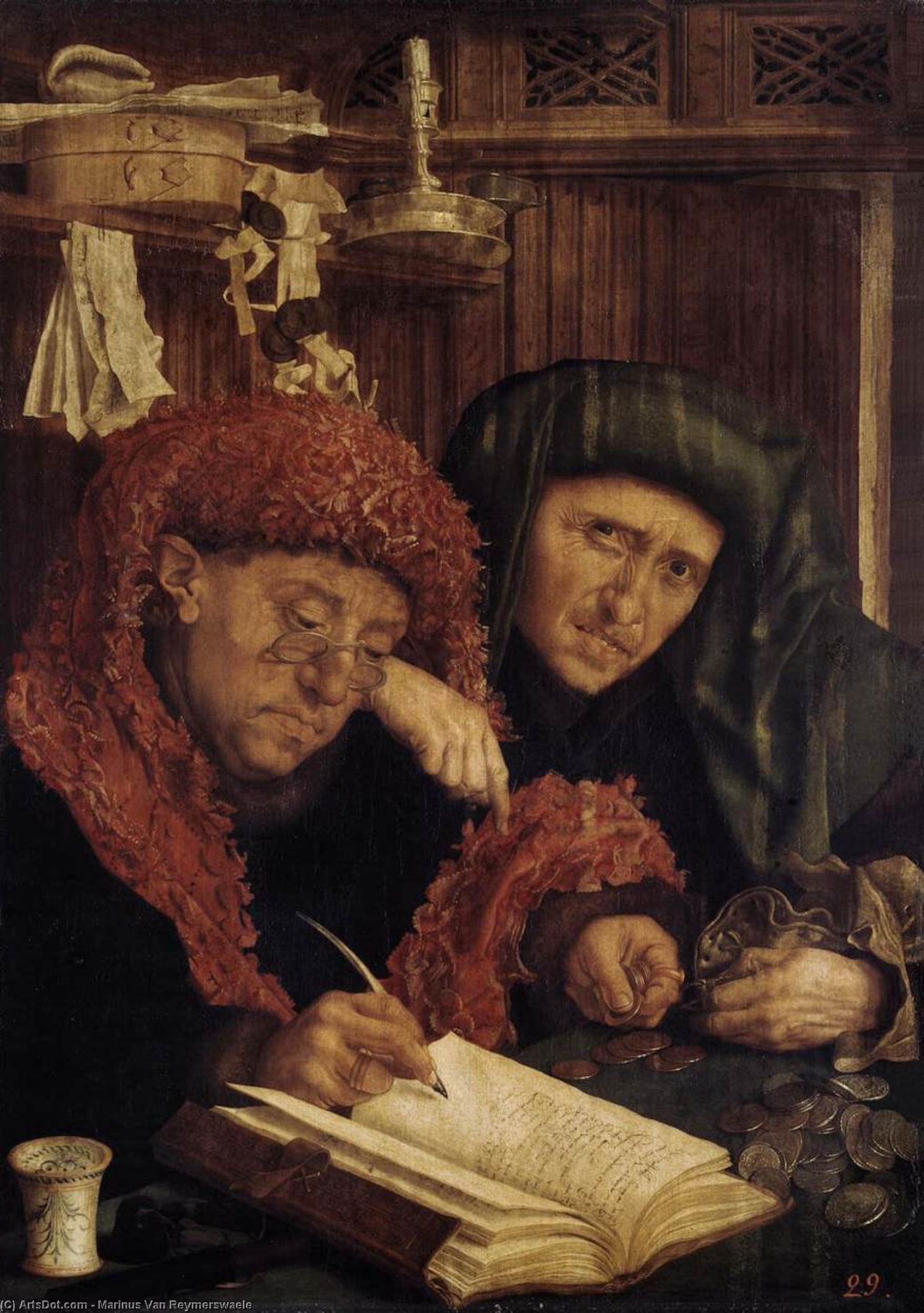
The Tax Collectors
 Oil On Panel
- WallArt
- Renaissance Realism
 Renaissance
 84.0 x 60.0 cm
 Hermitage Museum
 Read More
Hand Made Oil Reproduction
Hand-painted oil on canvas in your size and frame, made to order by our artists. ( Buy Print Buy Image)




P118B $10

P118H $10

P118W $10

P438Z $10

P508JH $12

P508YH $12

P805H $10

P805Z $10

P919BZ $10

P919G $10

P919XJ $10

P959ZH $10

P968JZ $12

W106C $8

W218G $10

W218JH $8

W218Y $10

W307PJ $10

W316G $10

W316PJ $8

W316Y $10

W398PJ $8

W4111J $10

W500HY $15

W500JH $15

W692G $12

W849H $8

W940BG $15

W953PJ $8




Pick from our preset sizes that match the artwork's original proportions.

You may enter your own dimensions to fit a specific frame or space. If your selected size does not match the original image's proportions, we will either crop the artwork or extend the painting with additional hand-painted elements. A digital mockup will be sent for your approval before production begins.
Please note that the on-screen preview does not reflect the actual cropping or extension. Only the mockup will accurately show the final composition.
While custom sizes are available, we recommend selecting a dimension from the predefined list to preserve the original proportions.
After order, ArtsDot.com team will email client for instructions and provide a mockup preview
Worldwide Delivery () in 3/4 weeks instead of standard 5 weeks. (20 August). No compromise on quality.

Free Worldwide Express Shipping

High-Quality Linen Canvas

Full Shipping Insurance

Customs Tax Refund Guarantee

True Color Matching Guarantee

60-Day Return Policy (Defects Only)

100% Money-Back Guarantee

Bulk Discount Offer
 Glass option is only available in size under 110 CM

The Tax Collectors
Reproduction Medium
Reproduction Size
-


Total Price
$ 263
Artwork Description
A Glimpse into the Soul of the Northern Renaissance
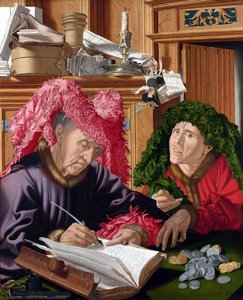
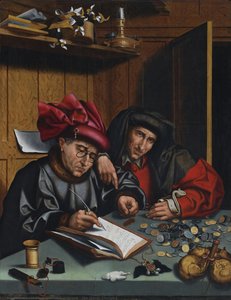
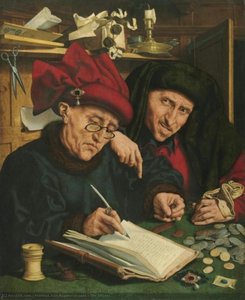
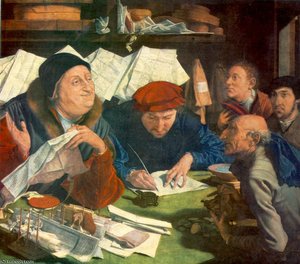
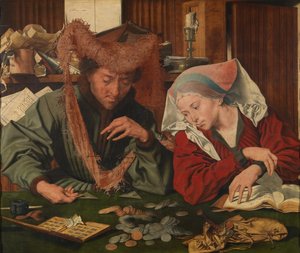
In the quiet, focused atmosphere of a sixteenth-century study, Marinus van Reymerswaele captures a moment that feels both intensely private and profoundly social. The Tax Collectors is not merely a depiction of administrative duty; it is a masterful window into the shifting economic tides of the Northern Renaissance. As two figures lean over their ledgers, lost in the meticulous task of assessment, the viewer is invited to witness the intersection of burgeoning commerce and civic governance. The painting breathes with the weight of responsibility, where every stroke of the pen and every turn of a page carries the gravity of law and the heavy scent of old parchment.
The scene is anchored by an extraordinary level of detail that defines the Flemish tradition. One can almost hear the scratch of the quill against paper and the rustle of heavy, textured fabrics. Reymerswa waele employs a technique characterized by a sharp, almost tactile realism, ensuring that the sheen on a metal scale or the intricate folds of a scholar's sleeve are rendered with breathtaking clarity. This meticulousness does more than showcase technical prowess; it grounds the intellectual labor of the subjects in a tangible, physical reality, making the historical distance between the viewer and the canvas feel remarkably thin.
Symbolism and the Weight of Authority
Beyond the surface level of a mundane transaction, the artwork is rich with symbolic resonance. The presence of the scale and the scissors serves as a silent language of justice and precision. These instruments represent the weighing of evidence and the decisive cutting of accounts—metaphors for the meticulous nature of truth and the finality of legal judgment. The figures themselves, draped in attire that suggests official status, embody the era's growing reliance on documented bureaucracy and the intellectualization of power. There is a profound sense of gravitas in their posture; they are not merely men at work, but guardians of the social contract.
The muted, earthy palette further enhances this atmosphere of somber contemplation. By utilizing deep browns, ochres, and subdued tones, the artist directs the eye away from superficial brilliance and toward the structural integrity of the composition. This color theory creates a sense of timelessness, evoking a world where stability was sought through order and record-keeping. For the discerning collector, this piece offers more than visual beauty; it provides a narrative depth that rewards prolonged observation, revealing layers of meaning regarding greed, duty, and the meticulous administration of wealth.
An Enduring Legacy for Modern Spaces
For interior designers and art enthusiasts alike, The Tax Collectors serves as a sophisticated anchor for a curated space. Its historical weight and classical composition make it an ideal centerpiece for libraries, studies, or formal living areas where one wishes to evoke a sense of heritage and intellectual rigor. The painting’s ability to command attention through texture and shadow rather than loud color allows it to integrate seamlessly into both traditional and contemporary settings, providing a touch of Old World elegance that transcends fleeting trends.
Owning a high-quality reproduction of this masterpiece is an opportunity to bring the quiet intensity of the Renaissance into the modern home. It is a piece that invites conversation, prompting guests to linger over the details of the figures' expressions and the intricate objects scattered across the desk. In an age of digital fleetingness, the enduring presence of Reymerswaele’s work offers a grounding connection to the craftsmanship and the profound human stories of our shared artistic history.
Related Artworks





Artist Biography
Titian: The Sun of Venice
The decade of the 1490s witnessed a burgeoning Renaissance across Europe, and within that vibrant landscape, Titian – born Tiziano Vecellio around 1488/90 in the small Alpine town of Pieve di Cadore – emerged as one of its most dazzling stars. His life, spanning nearly eight decades, coincided with a period of immense artistic transformation, marked by shifts from the more rigid formality of early Renaissance Florence to the richer, more sensual palettes and dynamic compositions that would define Venetian painting for generations. His story is not simply one of technical mastery; it’s a reflection of the evolving cultural currents of his time – a testament to ambition, patronage, and the enduring power of color.
Titian's early training was conventional for an aspiring artist of his era. He began as a pupil in the workshop of Sebastiano Zuccato, a renowned mosaicist in Venice, before briefly joining the studio of Gentile Bellini, one of the city’s most established masters. However, it was through his association with Giorgione – a figure whose influence would ripple throughout Titian's career – that he truly began to forge his own distinctive style. Giorgione’s innovative use of color and atmospheric perspective, coupled with a focus on capturing fleeting moments of beauty, provided a crucial foundation for Titian’s later development. The pair collaborated on the magnificent frescoes adorning the ‘Scuola del Santo’ in Padua, a project that cemented their bond and established Titian as a rising talent.
The Rise to Prominence
Following Giorgione's untimely death in 1510, Titian seized his opportunity. He quickly established himself as an independent artist, attracting the attention of wealthy patrons throughout Italy – from the powerful Medici family in Florence to the dukes and princes of Ferrara, Mantua, and Urbino. His versatility was remarkable; he excelled at a wide range of subjects, including portraits, mythological scenes, religious altarpieces, and landscapes. He wasn’t simply a painter; he was a courtier, a diplomat, and a master of presentation, understanding the importance of cultivating relationships with his clients.
Titian's early works are characterized by a delicate lyricism and a fondness for pastoral settings – scenes of shepherds, nymphs, and idyllic landscapes bathed in soft light. However, as he matured, his style underwent a dramatic transformation. He embraced bolder colors, looser brushwork, and a more dynamic approach to composition. His later paintings are infused with a sensual energy and a profound understanding of human emotion. The ‘Assumption of the Virgin’ (1516-18) for Santa Maria Gloriosa dei Frari in Venice is a prime example of this evolution – a monumental altarpiece that redefined Venetian painting and set a new standard for grandeur and emotional intensity.
Technique and Innovation
Titian's mastery of color was unparalleled. He developed a unique technique known as “color glazing,” applying thin, translucent layers of paint to build up rich, luminous surfaces. This method allowed him to achieve an astonishing range of hues and tones – from the deepest ultramarine blues to the most vibrant reds and yellows. He also experimented extensively with different pigments, constantly seeking new ways to capture the nuances of light and shadow. His use of *chiaroscuro*—the dramatic contrast between light and dark—became a hallmark of his style, adding depth and drama to his compositions.
Beyond color, Titian’s innovations extended to composition and brushwork. He moved away from the rigid formality of earlier Renaissance painting, embracing a more fluid and expressive approach. His brushstrokes were often loose and gestural, conveying a sense of movement and spontaneity. He also pioneered new techniques for depicting drapery and texture, creating fabrics that seemed to shimmer and flow with life.
Legacy and Influence
Titian’s influence on subsequent generations of artists is immeasurable. He was followed by a succession of Venetian painters – including Tintoretto, Veronese, and Bassano – who built upon his innovations and established the Venetian school as one of the most important artistic centers in Europe. His techniques were studied and imitated throughout the 17th century and beyond, shaping the course of Western art history.
Titian’s legacy extends far beyond the canvas. He was a shrewd businessman, a charismatic personality, and a keen observer of human nature. His life embodies the spirit of the Renaissance – a period of unprecedented creativity, innovation, and cultural exchange. He remains one of the most beloved and admired artists in history, celebrated for his dazzling colors, dramatic compositions, and profound understanding of beauty.
marinus van reymerswaele
1490 - 1546 , Netherlands
Quick Facts
- Artistic Movement Or Style: Renaissance painting”
- Artists Or Movements Influenced By This Artist: ['Venetian School”,\n “European painting”']
- Artists Who Influenced This Artist:
- Giorgione
- Giovanni Bellini
- Date Of Birth: c. 1490
- Date Of Death: 1576
- Full Name: Tiziano Vecellio”
- Nationality: Venetian
- Notable Artworks:
- Assumption of the Virgin
- Venus of Urbino
- Bacchus and Ariadne
- Place Of Birth: Pieve di Cadore, Italy
Related Articles
Hermitage Masterpieces: 25 Art Treasures to Inspire Your Home Decor
Journey through the Hermitage Museum's 25 greatest artworks! Explore masterpieces by Rembrandt, Leonardo da Vinci & Vermeer. Find museum-quality art reproductions and curated decor ideas to bring timeless beauty home. Discover all masterpieces on ArtsDot.com.

Oil on Canvas: A Historical & Technical Exploration of a Timeless Artistic Medium
Explore the rich history & enduring techniques of oil painting on canvas. Discover the science behind its longevity, conservation practices, and contemporary relevance. Expert insights for art enthusiasts.

The Enduring Legacy of Oil on Canvas: Technique, History & Aesthetic Impact
Explore the rich history & techniques of oil painting – from Renaissance masters to Impressionism. Discover pigments, layering methods, and why this timeless medium endures. Expert insights for artists & art enthusiasts.

The Enduring Legacy of Oil on Canvas: Technique, History & Contemporary Practice
Explore the rich history & enduring techniques of oil painting on canvas. Discover the science behind its longevity, conservation practices, and contemporary relevance. Expert insights for art enthusiasts.
Titian: Innovation, Technique & the Venetian Renaissance Portrait Tradition
Explore the revolutionary techniques & enduring legacy of Titian, the master of Venetian Renaissance portraiture. Discover insights for collectors & appreciate his impact on art history.