 Preview
 Send
Send Share
Share
 Details

 Download
 Similars
 X-Ray
X-Ray Diaporama
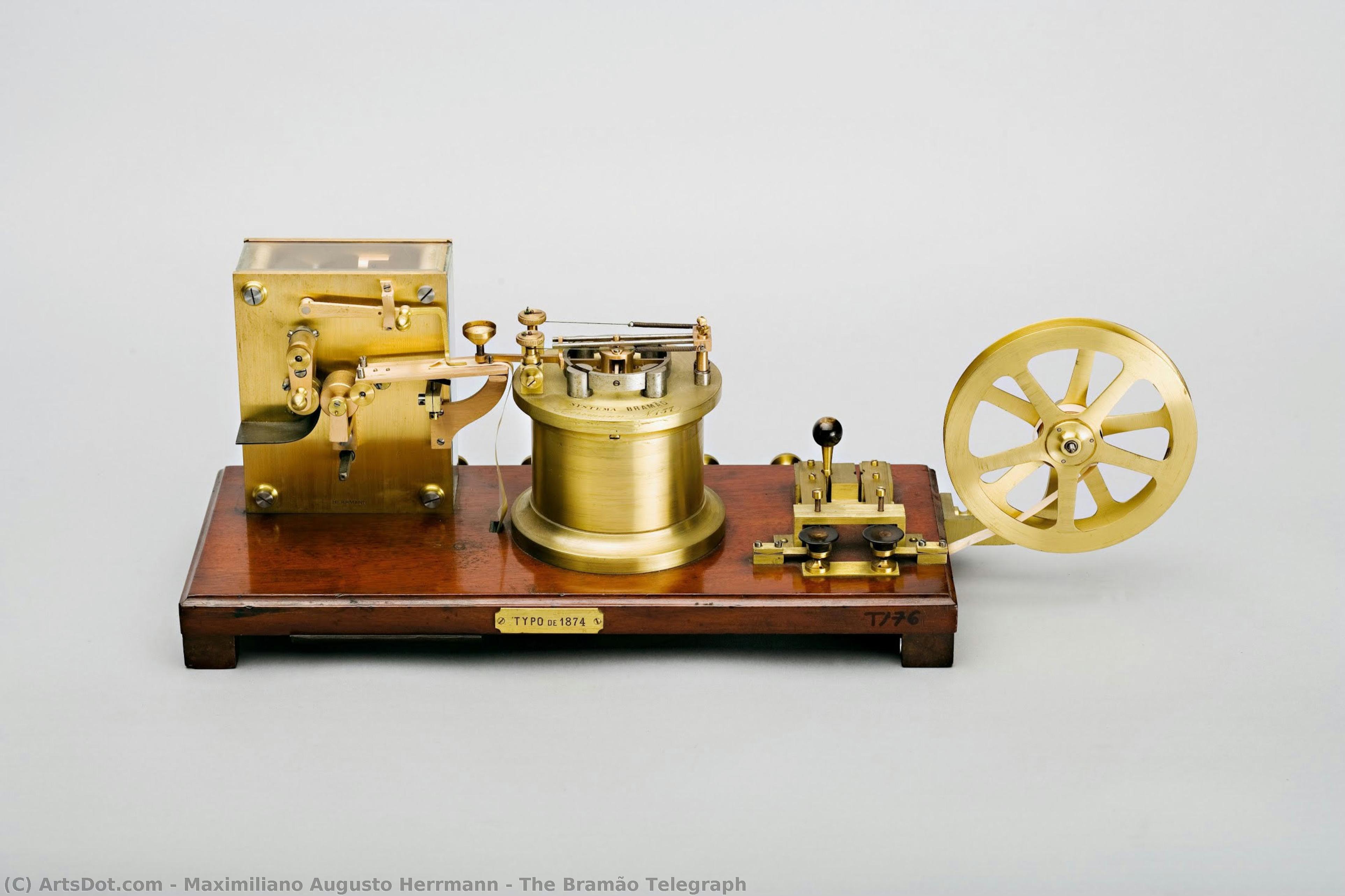
The Bramão Telegraph


 Read More
Hand Made Oil Reproduction
Hand-painted oil on canvas in your size and frame, made to order by our artists. ( Buy Print Buy Image)




































Pick from our preset sizes that match the artwork's original proportions.

You may enter your own dimensions to fit a specific frame or space. If your selected size does not match the original image's proportions, we will either crop the artwork or extend the painting with additional hand-painted elements. A digital mockup will be sent for your approval before production begins.
Please note that the on-screen preview does not reflect the actual cropping or extension. Only the mockup will accurately show the final composition.
While custom sizes are available, we recommend selecting a dimension from the predefined list to preserve the original proportions.
After order, ArtsDot.com team will email client for instructions and provide a mockup preview
Worldwide Delivery () in 3/4 weeks instead of standard 5 weeks. (23 August). No compromise on quality.

Free Worldwide Express Shipping

High-Quality Linen Canvas

Full Shipping Insurance

Customs Tax Refund Guarantee

True Color Matching Guarantee

60-Day Return Policy (Defects Only)

100% Money-Back Guarantee

Bulk Discount Offer
 Glass option is only available in size under 110 CM

The Bramão Telegraph
Reproduction Medium
Reproduction Size
-


Total Price
$ 263
Artwork Description
Related Artworks






Artist Biography
The Architect of Connection: The Life and Legacy of Maximiliano Augusto Herrmann
In the grand tapestry of nineteenth-century innovation, where the gears of the Industrial Revolution hummed with the promise of a shrinking world, few figures embodied the spirit of connectivity as profoundly as Maximiliano Augusto Herrmann. Born in the vibrant streets of Lisbon on April 17, 1838, Herrmann was not merely an engineer; he was a visionary who sought to bridge distances through the delicate dance of electricity and mechanics. His journey began with a rigorous academic foundation at the Industrial Institute of Lisbon, where between 1857 and 1862, he mastered the intricate language of instrumentation and mechanics. This period of intense study nurtured an inquisitive mind, one that would eventually look at the silence between two points and see the potential for a voice to travel through it.
Herrmann’s early professional years were defined by his role as a telegraph lines inspector for the North and East Portuguese Railway Company. This position placed him at the very pulse of the era's communication networks, allowing him to witness firsthand the limitations of existing technology. It was this intimate contact with the friction of communication—the difficulty of reading fading Morse signals or the cumbersome nature of early telegraphic devices—that ignited his inventive fire. He did not merely observe the flaws in the system; he felt a calling to refine them, leading him to establish a specialized workshop in Lisbon dedicated to the creation of precision instruments that would change the course of Portuguese telecommunications.
A Symphony of Wire and Signal
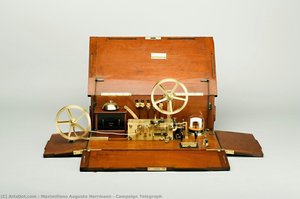
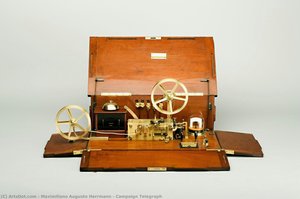
The true brilliance of Herrmann lay in his ability to simplify complexity, turning arduous technical processes into seamless human experiences. One of his most celebrated triumphs was the Campaign Telegraph, a device that showcased his mastery of adaptation and refinement. While utilizing components like a receiver from Paris, Herrmann meticulously re-engineered the transmitter, compass, and lightning rods to create a portable, efficient tool for field use. This innovation was not just about hardware; it was about the democratization of information, making telegraphy more accessible in rugged environments. His technical prowess reached a crescendo at the International Telegraphic Conference in 1865, where his improvements to Morse receivers—specifically designed to solve the frustrating illegibility of ink-heavy or faint dry-tip signals—earned him international acclaim.
Perhaps his most enduring and romantic contribution to history is the Herrmann wall telephone, introduced in 1880. Often referred to as the "privileged phone," this device was a marvel of ergonomic design for its time. By incorporating buttons to activate the instrument, Herrmann removed the mechanical barriers that had previously made telephony a cumbersome task. The aesthetic and functional elegance of the telephone—featuring double earpieces connected by flexible tubes and a fixed transmitter—represented a monumental leap forward. This invention did more than just transmit sound; it facilitated the expansion of public telephone lines across Portugal's major urban centers, weaving a web of audible connection through the heart of the nation.
The Enduring Resonance of Innovation
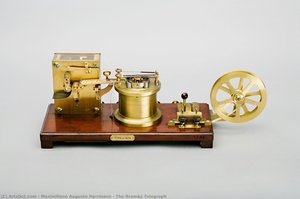
Beyond the physical machines, Herrmann’s work represents a pivotal moment in the evolution of human interaction. His development of the Bramão Telegraph, which utilized a double chain operation to optimize ticker tape consumption and speed, further illustrates his commitment to efficiency and economic sustainability in communication. He approached every technical hurdle—whether it was the precision of a stylus or the regulation of a Morse signal—with a meticulous attention to detail that reflected a deep respect for the sanctity of the message being sent.
Though his name may not be as widely recognized in modern pop culture as those of other industrial titans, the historical significance of Maximiliano Augusto Herrmann is undeniable. He was a pioneer who understood that progress is measured by how effectively we can reach one another. His life, spanning from the mid-nineteenth century to 1930, serves as a testament to the power of engineering to serve humanity. Through his hands, the cold metal of telegraph keys and the flexible tubes of telephones became the very nerves of a modernizing society, ensuring that even in the most remote corners, the pulse of progress could be felt and heard.
Maximiliano Augusto Herrmann
1838 - 1930 , Portugal
Quick Facts
- Date Of Birth: April 17, 1838
- Full Name: Maximiliano Augusto Herrmann
- Nationality: Portuguese
- Notable Artworks:
- The Bramão Telegraph
- Campaign Telegraph
- Place Of Birth: Lisbon, Portugal