 Preview
 Send
Send Share
Share
 Details

 Download
 Similars
 X-Ray
X-Ray Diaporama
Game Piece
 Oil On Canvas
- WallArt
- Baroque
 1667
1667- Early Modern
 126.0 x 173.0 cm
 Akademie Der Bildenden Künste Wien
 Read More
Hand Made Oil Reproduction
Hand-painted oil on canvas in your size and frame, made to order by our artists. ( Buy Print Buy Image)




P118B $10

P118H $10

P118W $10

P438Z $10

P508JH $12

P508YH $12

P805H $10

P805Z $10

P919BZ $10

P919G $10

P919XJ $10

P959ZH $10

P968JZ $12

W106C $8

W218G $10

W218JH $8

W218Y $10

W307PJ $10

W316G $10

W316PJ $8

W316Y $10

W398PJ $8

W4111J $10

W500HY $15

W500JH $15

W692G $12

W849H $8

W940BG $15

W953PJ $8




Pick from our preset sizes that match the artwork's original proportions.

You may enter your own dimensions to fit a specific frame or space. If your selected size does not match the original image's proportions, we will either crop the artwork or extend the painting with additional hand-painted elements. A digital mockup will be sent for your approval before production begins.
Please note that the on-screen preview does not reflect the actual cropping or extension. Only the mockup will accurately show the final composition.
While custom sizes are available, we recommend selecting a dimension from the predefined list to preserve the original proportions.
After order, ArtsDot.com team will email client for instructions and provide a mockup preview
Worldwide Delivery () in 3/4 weeks instead of standard 5 weeks. (17 August). No compromise on quality.

Free Worldwide Express Shipping

High-Quality Linen Canvas

Full Shipping Insurance

Customs Tax Refund Guarantee

True Color Matching Guarantee

60-Day Return Policy (Defects Only)

100% Money-Back Guarantee

Bulk Discount Offer
 Glass option is only available in size under 110 CM

Game Piece
Reproduction Medium
Reproduction Size
-


Total Price
$ 263
Artwork Description
A Dramatic Encounter in the Dutch Golden Age
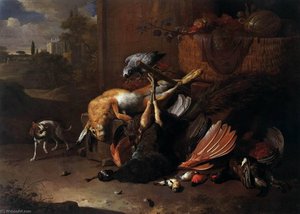
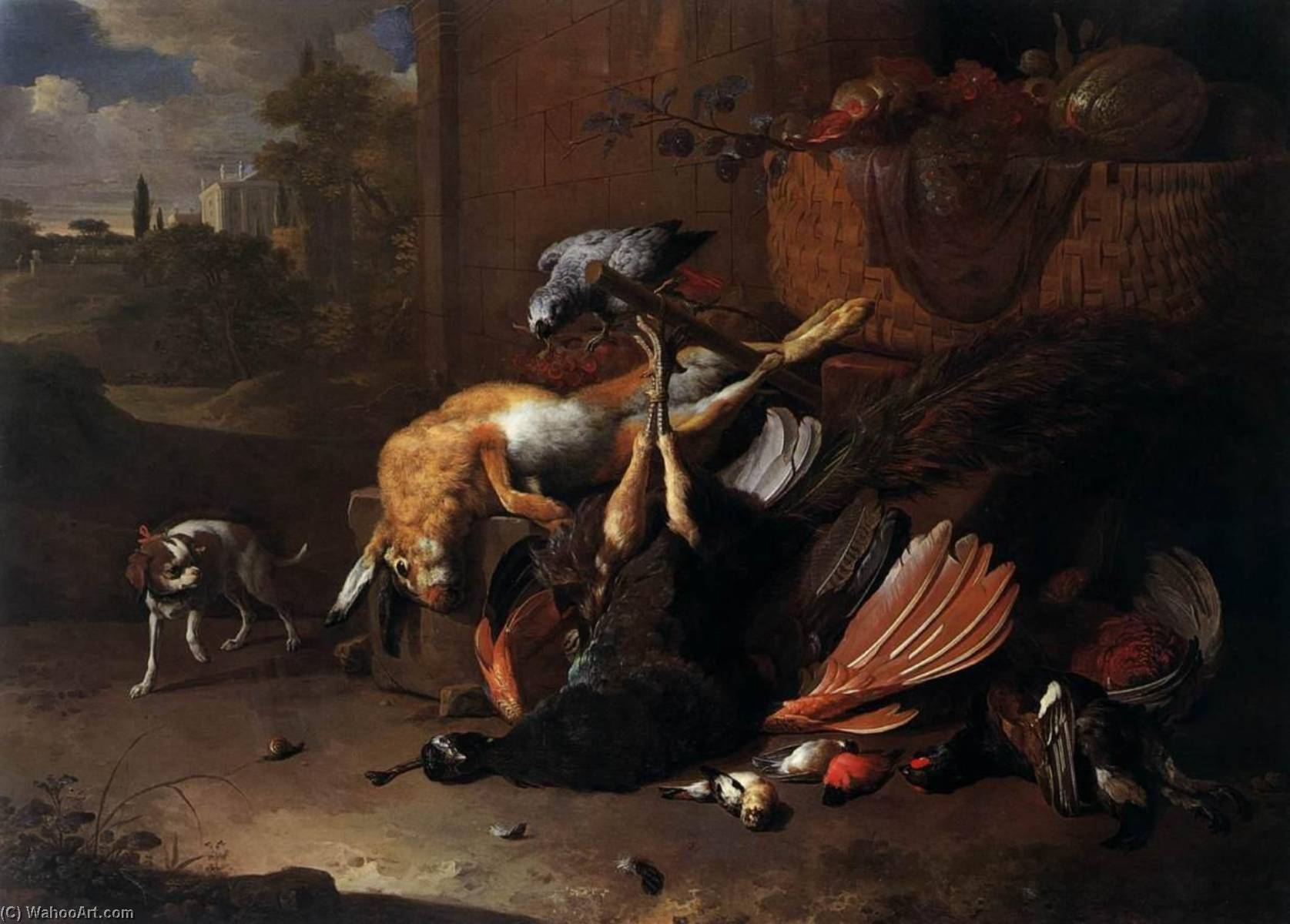
In the heart of the seventeenth century, the Dutch Golden Age reached a pinnacle of expressive vitality, and few artists captured this era's kinetic energy as masterfully as Melchior De Hondecoeter. His 1667 masterpiece, Game Piece, serves as a breathtaking window into a world where nature and human struggle intersect with theatrical intensity. The canvas unfolds within the confines of a rustic courtyard, yet it feels infinitely expansive due to the artist's command over movement. At the center of this unfolding drama, a man is locked in a visceral struggle with two birds; one bird clings to his grasp while another descends from above in a sudden, feathered assault. This central conflict is not merely a depiction of a moment in time, but an exploration of the raw, unbridled forces of life and instinct.
The composition is far from a solitary struggle. De Hondecoeter breathes life into the entire environment, populating the scene with a diverse cast of creatures that heighten the sense of organized chaos. Dogs weave through the foreground, their watchful eyes adding layers of tension to the courtyard setting, while in the distant background, the presence of a horse lends a sense of scale and pastoral depth. The inclusion of domestic elements—a simple bench and a solitary chair—anchors the wildness of the avian battle within a recognizable, human space, creating a poignant contrast between the tranquility of home and the sudden eruption of natural ferocity.
Mastery of Light and Baroque Technique
To behold Game Piece is to witness the profound technical prowess of a true animalier. De Hondecoeter employs the dramatic techniques of chiaroscuro and tenebrism to sculpt his subjects out of the shadows. By manipulating extreme contrasts between light and dark, he directs the viewer's gaze with surgical precision, ensuring that the frantic motion of the birds and the strained muscles of the man are illuminated against a more somber, atmospheric backdrop. This play of light does more than provide visibility; it imbues the scene with a psychological weight, turning a courtyard skirmish into a high-stakes theatrical performance.
The artist's brushwork is equally evocative, utilizing warm color palettes and soft, textured strokes to create a palpable sense of depth. One can almost feel the flutter of wings and the coarse texture of the animals' coats. This meticulous attention to detail allows for a sensory experience that transcends the visual, inviting collectors and art enthusiasts to lose themselves in the tactile reality of the painting. For those seeking to bring this level of sophistication into a curated space, the painting offers a rich tapestry of textures that complement both classical and contemporary interior designs.
A Timeless Legacy for the Discerning Collector
Beyond its technical brilliance, Game Piece resonates with an emotional complexity that remains timeless. It captures the duality of existence: the coexistence of domestic peace and wild unpredictability. For the art lover, it is a study in the beauty of motion; for the interior designer, it is a commanding focal point capable of anchoring a room with its historical gravity and vibrant energy. As a significant work housed in the Akademie Der Bildenden Künste Wien, this painting represents the zenith of Dutch animal portraiture.
Owning a high-quality reproduction of such a monumental work allows one to invite the spirit of the Baroque era into a modern home. It is an opportunity to celebrate the legacy of Melchior De Hondecoeter and to surround oneself with the enduring power of the Dutch masters—a piece that does not merely decorate a wall, but tells a story of survival, struggle, and the magnificent, chaotic beauty of the natural world.
Related Artworks


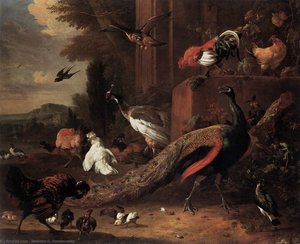
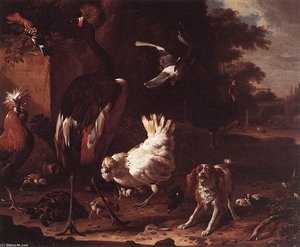
Artist Biography
The Avian Majesty of Melchior de Hondecoeter
In the golden twilight of the Dutch Golden Age, few artists captured the vibrant pulse of the natural world as vividly as Melchior de Hondecoeter. A master of the Baroque era, his brush possessed a rare alchemy, capable of transforming mere pigment into the iridescent sheen of a peacock’s plume or the delicate, translucent down of a songbird. Born in Utrecht around 1636, Hondecoetter emerged not merely as a painter of animals, but as a storyteller of the exotic and the magnificent. His work serves as a window into a century defined by global exploration, where the arrival of rare species from distant lands ignited a profound fascination with the wonders of the natural order.
The foundation of his extraordinary talent was laid through rigorous discipline and an unwavering commitment to anatomical truth. Apprenticeship under the esteemed Willem van Royen provided him with the technical scaffolding necessary to master the complexities of light and shadow. Yet, Hondecoetter’s genius lay in his ability to transcend mere scientific documentation. While he approached his subjects with the precision of a naturalist—studying musculature and skeletal structure with almost clinical devotion—he infused every composition with a theatrical energy characteristic of the Baroque movement. His canvases are never static; they are stages where birds interact, preen, and take flight amidst lush, atmospheric landscapes.
A Symphony of Color and Motion
To gaze upon a Hondecoeter masterpiece is to experience a sensory deluge. He rejected the muted, somber palettes that often characterized much of Dutch genre painting, opting instead for a bold, expressive use of color that commands the viewer's attention. His technique was a sophisticated balance of precise observation and expressive bravura. Through masterful rendering of texture, he could differentiate between the heavy, waxy surface of a waterfowl’s wing and the soft, airy lightness of a forest dweller. This tactile quality creates an immersive experience, pulling the observer into a world where the rustle of feathers feels almost audible.
The development of his style saw him move toward increasingly complex and dynamic compositions. He became renowned for his ability to arrange multiple subjects within a single frame, creating a sense of organized chaos that mirrors the untamed beauty of nature. These works often featured:
- Exoticism: The inclusion of rare, brightly colored birds that symbolized wealth, discovery, and the expanding horizons of the Dutch Republic.
- Dramatic Lighting: A use of chiaroscuro that highlighted the intricate details of plumage while casting deep, mysterious shadows in the surrounding foliage.
- Narrative Depth: Scenes that suggested a larger story, whether it be a moment of predatory tension or a peaceful interlude in a sun-drenched garden.
Legacy and Historical Significance
Melchior de Hondecoeter’s influence extended far beyond the borders of the Netherlands. As an animalier, he helped establish a specialized genre that would captivate collectors across Europe, from the courts of kings to the homes of wealthy merchants. His ability to marry scientific accuracy with high art ensured that his work was valued both for its aesthetic splendor and its contribution to the era's burgeoning interest in natural history.
Though his life ended in 1695, his artistic footprint remains indelible. He did not simply paint birds; he elevated them to subjects of profound dignity and drama. In an age of discovery, Hondecoeter acted as a visual chronicler of the earth's splendor, leaving behind a legacy of canvases that continue to breathe with life, color, and an eternal sense of wonder. His work remains a testament to the power of art to bridge the gap between the observed world and the human imagination.
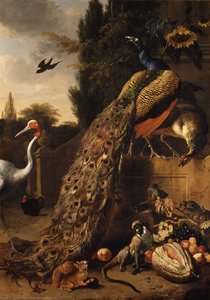
melchior de hondecoetter
1636 - 1695
Quick Facts
- Artistic Movement Or Style: Baroque
- Artists Or Movements Influenced By This Artist: ['William Hendrik Wilhemus van Royen']
- Artists Who Influenced This Artist: ['None Known']
- Date Of Death: 1695
- Full Name: Melchior de Hondecoetter
- Nationality: Dutch
- Notable Artworks:
- A Cock
- The Menagerie
- Birds, Butterflies and a Frog Among Plants and Fungi
- Place Of Birth: Utrecht, Netherlands
Related Articles

Dutch Baroque Masters: 10 Paintings That Shaped an Era | ArtsDot
Journey through the Golden Age with our guide to the Top 10 Dutch Baroque masterpieces! Explore iconic paintings by Rembrandt, Vermeer & Frans Hals. Find museum-quality art reproductions and elevate your home decor at ArtsDot.com.

Golden Age Reflections: Dutch Baroque Painting & Cultural Innovation
Explore the Dutch Golden Age of painting! Discover key artists like Vermeer & ter Borch, their innovative techniques, and the rich cultural context behind these Baroque masterpieces. Learn about collecting & appreciating this iconic art period.

Baroque Masterpieces: 10 Paintings That Defined an Era |
Journey through the drama & grandeur of Baroque art! Explore 10 masterpieces by Caravaggio, Rembrandt, Rubens & more. Discover stunning oil paintings, rich colors & timeless stories. Find museum-quality reproductions at .
Decoding Baroque Grandeur: A Guide to the Drama and Emotion of 17th-Century Art
Explore the breathtaking drama of 17th-century Baroque art. Our expert guide decodes the use of chiaroscuro, emotional intensity, and historical grandeur to help you appreciate and curate timeless masterpieces for your collection.

The Visceral Stage: Exploring Dramatic Narratives & Emotional Intensity in Baroque Art
Explore the dramatic world of Baroque art! Discover iconic masters like Caravaggio & Rembrandt, their techniques, and the movement's lasting impact. Expert insights for collectors & enthusiasts at ArtsDot.