 Preview
 Send
Send Share
Share
 Details

 Download
 Similars
 X-Ray
X-Ray Diaporama
Adoration of the Magi
 Tempera On Panel
- Renaissance
 1470
1470- Renaissance
 54.0 x 39.0 cm
 Lindenau-Museum
 Read More
Hand Made Oil Reproduction
Hand-painted oil on canvas in your size and frame, made to order by our artists. ( Buy Print Buy Image)




P118B $10

P118H $10

P118W $10

P438Z $10

P508JH $12

P508YH $12

P805H $10

P805Z $10

P919BZ $10

P919G $10

P919XJ $10

P959ZH $10

P968JZ $12

W106C $8

W218G $10

W218JH $8

W218Y $10

W307PJ $10

W316G $10

W316PJ $8

W316Y $10

W398PJ $8

W4111J $10

W500HY $15

W500JH $15

W692G $12

W849H $8

W940BG $15

W953PJ $8




Pick from our preset sizes that match the artwork's original proportions.

You may enter your own dimensions to fit a specific frame or space. If your selected size does not match the original image's proportions, we will either crop the artwork or extend the painting with additional hand-painted elements. A digital mockup will be sent for your approval before production begins.
Please note that the on-screen preview does not reflect the actual cropping or extension. Only the mockup will accurately show the final composition.
While custom sizes are available, we recommend selecting a dimension from the predefined list to preserve the original proportions.
After order, ArtsDot.com team will email client for instructions and provide a mockup preview
Worldwide Delivery () in 3/4 weeks instead of standard 5 weeks. (1 September). No compromise on quality.

Free Worldwide Express Shipping

High-Quality Linen Canvas

Full Shipping Insurance

Customs Tax Refund Guarantee

True Color Matching Guarantee

60-Day Return Policy (Defects Only)

100% Money-Back Guarantee

Bulk Discount Offer
 Glass option is only available in size under 110 CM

Adoration of the Magi
Reproduction Medium
Reproduction Size
-


Total Price
$ 263
A Divine Encounter in Tempera: The Majesty of Ciampanti
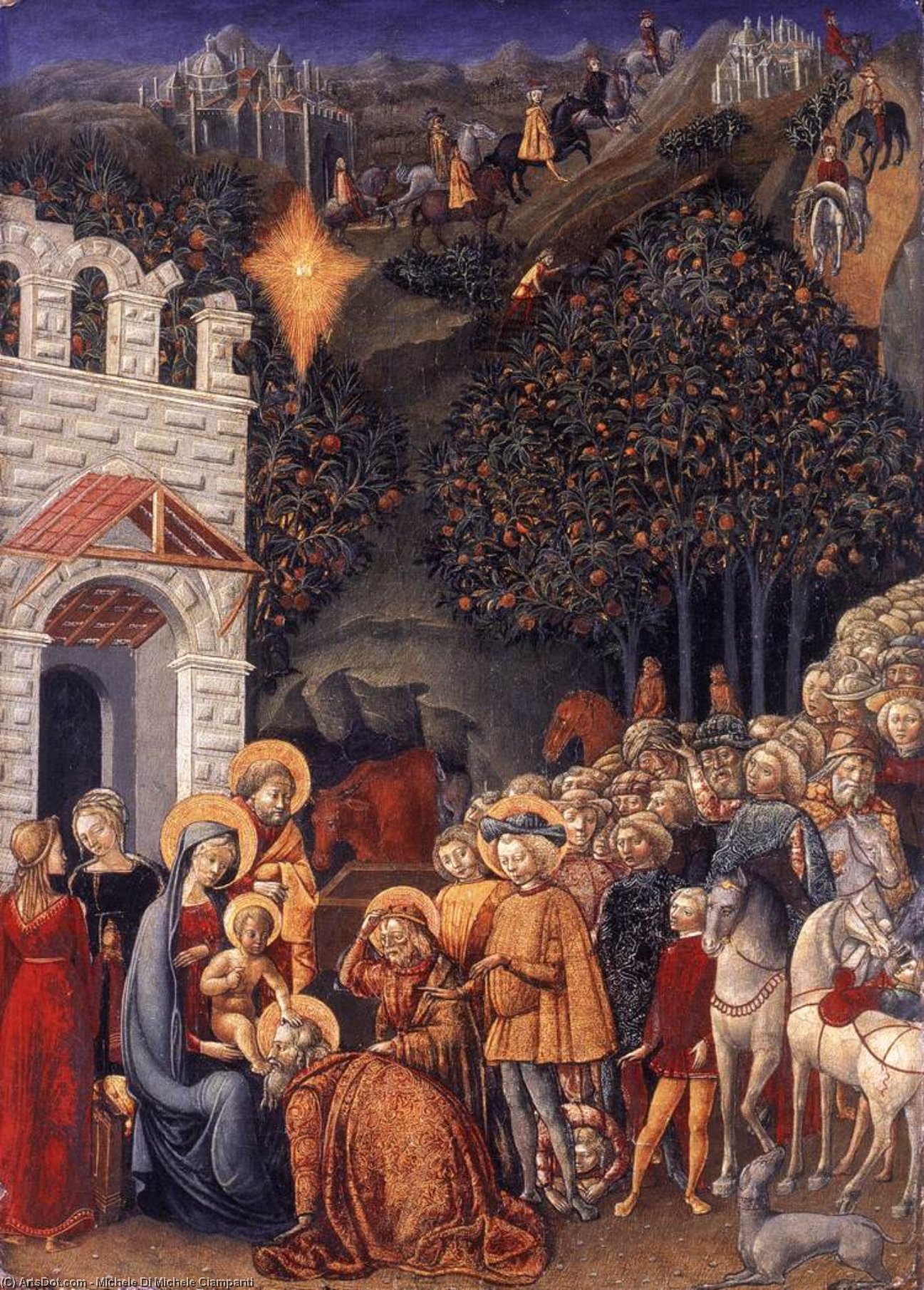
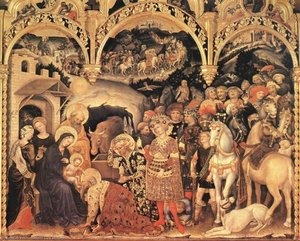
In the quiet, hallowed halls of the Lindenau-Museum, there exists a window into the spiritual fervor of the Quattrocento. Michele di Michele Ciampanti’s Adoration of the Magi, executed around 1470, is not merely a painting but a profound theological narrative captured through the delicate medium of tempera on wood. The scene unfolds with a breathtaking intimacy, drawing the viewer into a sacred moment where the earthly and the divine intersect. As the eye wanders across the 54 x 39 cm panel, one is immediately struck by the luminous quality of the light, a hallmark of the Renaissance masters, which seems to emanate from the Christ child himself, casting a soft, celestial glow upon the gathered figures.
The composition is a masterclass in Renaissance storytelling, centering on the profound reverence of the three Magi. These kings, representing the far reaches of the known world—Europe, Africa, and Asia—kneel in humble submission before the infant Jesus. Each figure is draped in opulent, heavy fabrics, where Ciamp Ciampanti has meticulously rendered intricate patterns and rich pigments that speak to their royal lineage. The act of presenting gold, frankincense, and myrrh serves as a powerful symbolic triad: representing wealth, divinity, and mortality. This ritualistic exchange is framed by the tender presence of the Virgin Mary holding the child, while Joseph stands as a silent, protective sentinel, grounding the divine event in human familial warmth.
Symbolism and the Renaissance Landscape
Beyond the central figures, the painting breathes with a life of its own through its detailed environmental storytelling. The background is far from a mere backdrop; it is a living landscape of rolling hills and verdant trees that suggests the eternal nature of the Nativity. High above, angels drift through the heavens, their ethereal forms adding a sense of weightless grace to the composition, reminding the observer that this event is witnessed by all of creation. The inclusion of animals—horses and dogs—adds a layer of terrestrial realism, symbolizing loyalty and the quiet service of the natural world to the divine plan.
A distant castle rises against the horizon, providing a sense of architectural permanence and historical context, perhaps hinting at the European setting familiar to Ciampanti’s contemporary audience. The artist utilizes light and shadow with remarkable precision to create a three-dimensional depth, pulling the viewer into the very folds of the Magi's robes and the soft contours of the landscape. This interplay of vibrant reds, deep blues, and sun-drenched yellows creates a visual rhythm that is both stimulating and meditative.
An Eternal Legacy for the Discerning Collector
For the art lover or the interior designer, owning a reproduction of this masterpiece offers more than just decoration; it provides an infusion of historical soul into a modern space. The Adoration of the Magi carries an emotional weight that transcends centuries, evoking feelings of peace, reverence, and wonder. Whether placed in a grand gallery or a quiet study, the painting serves as a focal point of contemplation, inviting guests to pause and reflect on the artistry and devotion of the Renaissance era.
A high-quality, hand-painted oil reproduction allows the textures of Ciampanti’s original vision—the fine detail of the tempera technique and the richness of the period colors—to be experienced in a contemporary setting. It is an investment in heritage, bringing the profound beauty of 15th-century Italian mastery into the heart of the home, ensuring that the light of this divine encounter continues to shine for generations to come.
Related Artworks


![Adoration Of The Magi — The Younger Zurich Carnation Master [nelkenmeister], Early Renaissance](/media/artworks/images-thumb/2f/6d/2f6d73ec5fc9c27e013112f02083ff54.jpg)
Artist Biography
The Luminous Legacy of Michele di Michele Ciampanti
In the hallowed corridors of the Italian Renaissance, few names evoke the delicate intersection of spiritual devotion and technical mastery quite like Michele di Michele Ciampanti. Active during a transformative era that bridged the late Quattrocento and the burgeoning Mannerist movement, Ciampanti emerged as a painter of profound emotional depth and luminous clarity. Whether working in the vibrant atmosphere of Bergamo or the storied landscapes of Lucca, his hand left an indelible mark on the religious iconography of the period. His artistry was not merely about the depiction of sacred figures, but about capturing the very essence of the divine through a sophisticated command of light, color, and narrative tension.
The life of Ciampanti remains partially shrouded in the mists of history, as archival records from the fifteenth and sixteenth centuries often leave gaps in the biographical tapestry. However, what is known suggests an artist deeply connected to the shifting artistic currents of Northern and Central Italy. Some scholars identify him with the Master of Stratonice, a figure whose work displays a remarkable sensitivity to the burgeoning Renaissance style. His early training likely exposed him to the rigorous principles of Venetian painting—specifically the use of atmospheric perspective and rich glazing techniques—which allowed him to imbain his canvases with a sense of breathing, living space. This technical foundation enabled him to move beyond simple representation, creating works where the air itself seems heavy with sanctity.
A Mastery of Symbolism and Technique
To gaze upon a Ciampanti masterpiece is to enter a world where every brushstroke serves a theological purpose. His approach to the medium, particularly in his use of tempera on wood, demonstrates an exquisite control over texture and luminosity. In works such as the Adoration of the Magi, the artist employs a breathtaking intimacy to draw the viewer into the sacred encounter. The way light emanates from the Christ child, casting a celestial glow upon the heavy, opulent fabrics of the Three Kings, serves as a powerful metaphor for the divine entering the earthly realm. Through his meticulous rendering of gold, frankincense, and myrrh, he transforms material wealth into symbols of mortality and eternal devotion.
Beyond the central figures, Ciampanti’s landscapes act as living participants in the religious drama. His backgrounds are rarely mere scenery; they are lush, verdant environments that suggest the eternal nature of the biblical narratives he portrays. This ability to blend illusionistic painting with profound spiritual emotion is perhaps his greatest achievement. Whether through the monumental scale of his frescoes or the delicate precision of his panel paintings, he mastered the art of directing the viewer's eye toward the heart of the mystery, using shadow and perspective to ground the miraculous in a tangible, human reality.
Historical Significance and Artistic Impact
The enduring significance of Michele di Michele Ciampanti lies in his role as a bridge between eras. His work embodies the transition from the structured, often symbolic language of the early Renaissance to the more expressive and dynamic energy of Mannerism. By integrating the influences of Tuscan masters like Sandro Botticelli and Filippino Lippi with the atmospheric innovations of the Venetian school, he helped cultivate a unique Lombard style that resonated throughout the Italian peninsula.
His contributions to the artistic heritage of Bergamo and Lucca remain vital components of the regional identity. The frescoes that adorn their churches continue to serve as windows into a period of intense religious fervor and aesthetic discovery. As we reflect on his body of work, we see more than just historical artifacts; we encounter a master who used the tools of his craft—light, pigment, and perspective—to articulate the deepest aspirations of the human spirit, ensuring that his vision remains as radiant today as it was centuries ago.

Quick Facts
- Artistic Movement Or Style: Italian Renaissance
- Full Name: Michele di Michele Ciampanti
- Nationality: Italian
- Notable Artworks:
- Adoration of the Magi
- San Giovannino Dei Cavalieri, Maestro Di Stratonice, Annunciazione
- Bandinella Centinata Con Crocifisso Tra Penitenti Bianchi
- Place Of Birth: Bergamo, Italy
Related Articles

Illuminating Surfaces: A Comprehensive Exploration of Tempera on Panel Painting Techniques & Historical Significance
Explore the rich history & techniques of tempera painting! Discover Renaissance masters like Botticelli & Fra Angelico, conservation insights, and the enduring legacy of this captivating art form. Learn more now!
Illuminating History: A Comprehensive Exploration of Tempera Painting Techniques & Artistic Legacy
Explore the rich history & techniques of tempera painting! Discover Renaissance masters like Botticelli & Fra Angelico, conservation insights, and the enduring legacy of this captivating art form.
Tempera's Timeless Legacy: 10 Masterpieces That Revolutionized Art | ArtsDot
Journey through 10 legendary tempera on panel masterpieces by Giotto, Duccio & Botticelli. Explore the history, symbolism & enduring beauty of these iconic artworks. Find museum-quality reproductions for your home at ArtsDot.com.
Sacred Narratives Embodied: A Comprehensive Exploration of Religious Iconography in Art History
Explore the rich history of religious iconography in art! Discover symbolism, movements & masterpieces from Byzantine to Renaissance periods. Expert insights for collectors and enthusiasts at ArtsDot.

Charles Bird King: Capturing Native American Dignity Through Portraiture & Cultural Exchange
Explore the captivating portraits of Charles Bird King, renowned for his depictions of Native American leaders. Discover the historical context, artistic techniques, and collecting value of these significant 19th-century artworks.