 Preview
 Send
Send Share
Share
 Details

 Download
 Similars
 X-Ray
X-Ray Diaporama
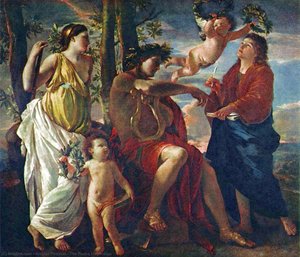
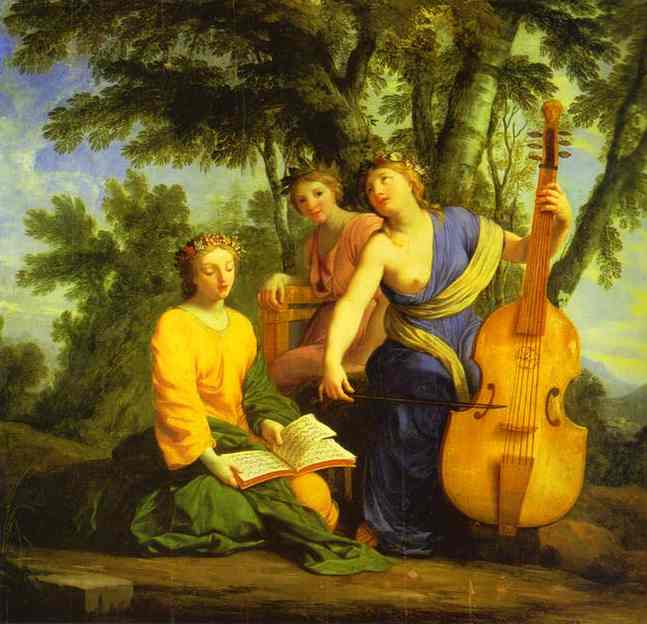
Melpomene, Erato, and Polymnia


 Read More
Hand Made Oil Reproduction
Hand-painted oil on canvas in your size and frame, made to order by our artists. ( Buy Print Buy Image)




P118B $10

P118H $10

P118W $10

P438Z $10

P508JH $12

P508YH $12

P805H $10

P805Z $10

P919BZ $10

P919G $10

P919XJ $10

P959ZH $10

P968JZ $12

W106C $8

W218G $10

W218JH $8

W218Y $10

W307PJ $10

W316G $10

W316PJ $8

W316Y $10

W398PJ $8

W4111J $10

W500HY $15

W500JH $15

W692G $12

W849H $8

W940BG $15

W953PJ $8




Pick from our preset sizes that match the artwork's original proportions.

You may enter your own dimensions to fit a specific frame or space. If your selected size does not match the original image's proportions, we will either crop the artwork or extend the painting with additional hand-painted elements. A digital mockup will be sent for your approval before production begins.
Please note that the on-screen preview does not reflect the actual cropping or extension. Only the mockup will accurately show the final composition.
While custom sizes are available, we recommend selecting a dimension from the predefined list to preserve the original proportions.
After order, ArtsDot.com team will email client for instructions and provide a mockup preview
Worldwide Delivery () in 3/4 weeks instead of standard 5 weeks. (16 August). No compromise on quality.

Free Worldwide Express Shipping

High-Quality Linen Canvas

Full Shipping Insurance

Customs Tax Refund Guarantee

True Color Matching Guarantee

60-Day Return Policy (Defects Only)

100% Money-Back Guarantee

Bulk Discount Offer
 Glass option is only available in size under 110 CM

Melpomene, Erato, and Polymnia
Reproduction Medium
Reproduction Size
-


Total Price
$ 263
Artwork Description
A Gathering of the Muses: Poussin’s Evocation of Classical Harmony
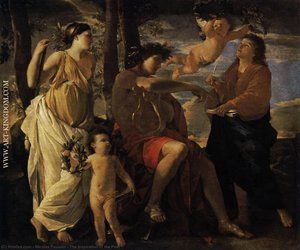
Nicolas Poussin's “Melpomene, Erato, and Polymnia” is not merely a portrait; it’s a carefully constructed tableau vivant, a glimpse into the world of classical inspiration. The painting depicts three of the nine Muses – goddesses who presided over the arts and sciences in Greek mythology – engaged in quiet contemplation beneath the sheltering branches of a tree. Melpomene, the Muse of tragedy, Erato, embodying lyric poetry, and Polymnia, representing sacred hymn and eloquence, are rendered with a serene dignity that speaks to Poussin’s deep reverence for antiquity. The composition is remarkably balanced; each figure occupies her space with a graceful composure, their postures suggesting both individual character and harmonious connection. The subtle interplay of light and shadow across their faces and drapery adds depth and realism, while the inclusion of two violins hints at the musicality inherent in their divine roles.
Poussin’s Classical Vision: A French Master in Rome
To understand “Melpomene, Erato, and Polymnia,” one must consider Nicolas Poussin's unique artistic journey. Born in France but spending the majority of his career in Rome, he became a pivotal figure in establishing a distinctly *classical* French Baroque style. Unlike many of his contemporaries who embraced the dramatic flourishes and emotional intensity characteristic of Italian Baroque painting, Poussin sought order, clarity, and intellectual rigor. He meticulously studied ancient Roman art and literature, striving to emulate their principles of balance, proportion, and narrative restraint. This dedication is evident in the carefully arranged composition, the idealized forms of the Muses, and the overall sense of calm contemplation that pervades the scene. Poussin wasn’t simply *depicting* mythological figures; he was attempting to embody the spirit of classical ideals themselves.
Symbolism and Interpretation: The Power of Artistic Inspiration
The choice of these three particular Muses is significant. Melpomene, often depicted with a tragic mask, represents the profound emotional depth of dramatic art. Erato, associated with love poetry, embodies beauty and passion. Polymnia, representing sacred hymn, suggests the elevating power of eloquence and intellectual pursuit. Their gathering under the tree – a traditional symbol of knowledge and life – can be interpreted as an allegory for the interconnectedness of these artistic disciplines. The violins present are not merely decorative elements; they symbolize the harmonious blending of music, poetry, and drama—the very essence of the Muses’ influence. Poussin invites us to reflect on the source of creative inspiration itself, suggesting that true artistry arises from a synthesis of intellect, emotion, and spiritual insight.
A Timeless Resonance: Bringing Classical Beauty into Your Space
Owning a reproduction of “Melpomene, Erato, and Polymnia” is an invitation to cultivate a sense of serenity and intellectual refinement within your home. The painting’s muted palette and balanced composition make it remarkably versatile, complementing a wide range of interior styles. Whether displayed in a library, study, or living room, this artwork will serve as a constant reminder of the enduring power of classical ideals. The subtle emotional depth of the piece encourages quiet contemplation, while its elegant aesthetic adds a touch of timeless sophistication to any space. It’s more than just a decorative element; it's a window into a world where beauty, intellect, and artistic inspiration converge.
Related Artworks
Artist Biography
A Life Steeped in Classical Reverie
Nicolas Poussin, a name synonymous with the grandeur of French Baroque painting, was nonetheless a soul deeply rooted in Italian soil for much of his artistic life. Born in Le Havre, Normandy, in June 1594, his early years remain somewhat veiled in mystery, yet they undoubtedly laid the foundation for a career that would become pivotal in shaping the classical tradition within French art. Though he briefly studied in Paris during the early 1610s, absorbing influences from lesser-known artists of the time, it was his journey to Rome in 1624 that truly ignited his artistic destiny. This wasn’t merely a geographical relocation; it was an immersion into the heart of antiquity, a pilgrimage to the very source of inspiration that would define his aesthetic vision. Poussin's initial forays into painting were marked by a sensuous quality reminiscent of Venetian masters like Titian, yet even in these early works, a nascent sense of order and intellectual rigor began to emerge—a foreshadowing of the style he would so masterfully refine.
The Roman Years: Forging a Classical Ideal
Rome proved to be more than just a studio for Poussin; it became his intellectual crucible. He found himself amidst a vibrant circle of scholars, archaeologists, and fellow artists, notably Cassiano dal Pozzo, whose profound understanding of classical antiquity profoundly influenced the artist’s approach. Dal Pozzo's dedication to meticulously documenting ancient remains instilled in Poussin a deep respect for historical accuracy and a desire to imbue his paintings with a sense of timelessness. This period saw Poussin move away from the flamboyant exuberance of some of his contemporaries, instead embracing a style characterized by clarity, balance, and a deliberate emphasis on linear composition. He meticulously studied Raphael’s works, absorbing their harmonious arrangements and graceful forms, while simultaneously drawing inspiration from ancient sculptures and literary sources like Ovid's *Metamorphoses*. His paintings began to populate with figures drawn from classical history and mythology, rendered not as mere decorative elements but as embodiments of moral virtues and philosophical ideals.
Themes of History, Myth, and the Sacred
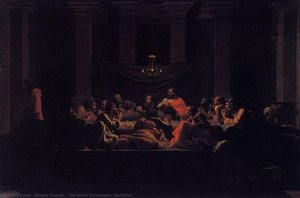
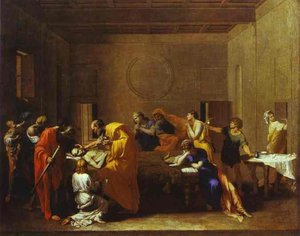
Poussin’s artistic output was remarkably diverse, yet consistently unified by his commitment to these core principles. He frequently depicted scenes from ancient history—the tragic fate of Germanicus, for example—imbued with a sense of stoic dignity and moral weight. His mythological paintings weren't simply retellings of familiar tales; they were explorations of human nature, often laden with allegorical meaning. The *Arcadia* series, particularly the iconic *Et in Arcadia ego*, became emblematic of his philosophical depth, prompting contemplation on mortality and the enduring power of memory. Beyond history and myth, Poussin also turned to religious subjects, most notably in *The Seven Sacraments*—a monumental undertaking that showcased both his theological understanding and compositional prowess. Even within these sacred scenes, however, he maintained a classical restraint, avoiding excessive emotionalism in favor of a serene and dignified presentation. Later in his career, expansive landscapes became increasingly prominent, blending realism with idealized forms to create vistas that evoked a sense of harmony and tranquility.
A Lasting Legacy: Shaping French Art
Despite spending the majority of his career abroad, Nicolas Poussin’s influence on French art was immense. He briefly returned to Paris in 1640 at the behest of Cardinal Richelieu, appointed as First Painter to the King, but found himself stifled by the demands and intrigues of court life. He soon returned to Rome, where he continued to paint until his death in 1665. His dedication to classical principles helped establish a standard for artistic training and practice within France, influencing generations of artists who followed. He became a leading figure in the Académie Royale de Peinture et de Sculpture, solidifying his position as a cornerstone of French Classicism. Artists like Jacques-Louis David and Paul Cézanne openly acknowledged their debt to Poussin’s rigorous approach and intellectual depth. His legacy extends far beyond mere stylistic imitation; it represents a commitment to order, clarity, and the enduring power of classical ideals—a testament to an artist who sought not simply to depict the world but to elevate it through the lens of reason and beauty.
- Notable Works: *The Death of Germanicus*, *The Seven Sacraments Series*, *A Roman Road*, *Orion Blinded Searching for the Sun*, *The Seasons*.
- Key Characteristics: Classical Composition, Linearity, Historical and Mythological Themes, Serene Landscapes.
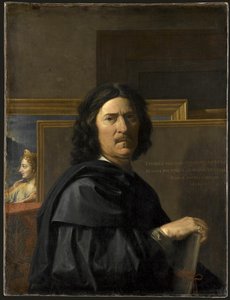
Nicolas Poussin
1594 - 1665 , France
Quick Facts
- Artistic Movement Or Style: Baroque, Classicism
- Artists Or Movements Influenced By This Artist:
- Jacques-Louis David
- Paul Cézanne
- Artists Who Influenced This Artist:
- Raphael
- Titian
- Date Of Birth: 1594
- Date Of Death: 1665
- Full Name: Nicolas Poussin
- Nationality: French
- Notable Artworks:
- The Death of Germanicus
- Seven Sacraments Series
- A Roman Road
- Orion Blinded
- The Seasons
- Place Of Birth: Le Havre, France
Related Articles
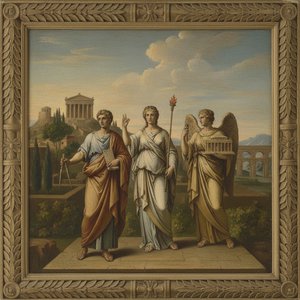
Nicolas Poussin: Classicism, Allegory & Order in 17th-Century French Painting
Explore the life & work of Nicolas Poussin, a master of French Classicism. Discover his allegorical paintings, Roman influences, and enduring impact on art history. Expert analysis & insights.
Charles Le Brun: Master of French Baroque Classicism & His Enduring Legacy
Explore the life & art of Charles Le Brun, master of French Baroque Classicism. Discover his royal commissions, influence on Versailles, and enduring legacy through detailed analysis & stunning artworks.
Simon Vouet: A Baroque Master's Journey from Italian Influence to French Classicism
Explore the life & art of Simon Vouet, a pivotal French Baroque painter who introduced Italian styles to France. Discover his masterpieces and lasting influence on 17th-century art.
Baroque Classicism: Reconciling Drama & Order in 17th-Century Art
Explore the captivating world of Baroque Classicism! Discover its history, key artists like Caravaggio & Rubens, and defining characteristics. Expert insights & high-quality reproductions at ArtsDot.
The Enduring Legacy of Classicism: Principles, Evolution & Influence in Western Art
Explore the enduring legacy of Classicism in Western art! Discover its historical context, key principles, iconic masterpieces & lasting influence. Learn about Renaissance and Neoclassical movements with ArtsDot.