 Preview
 Send
Send Share
Share
 Details

 Download
 Similars
 X-Ray
X-Ray Diaporama
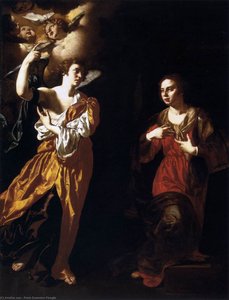
Annunciation
 Oil On Canvas
- WallArt
- Baroque
 1630
1630- Early Modern
 216.0 x 154.0 cm
 Szépmûvészeti Múzeum
 Read More
Hand Made Oil Reproduction
Hand-painted oil on canvas in your size and frame, made to order by our artists. ( Buy Print Buy Image)




P118B $10

P118H $10

P118W $10

P438Z $10

P508JH $12

P508YH $12

P805H $10

P805Z $10

P919BZ $10

P919G $10

P919XJ $10

P959ZH $10

P968JZ $12

W106C $8

W218G $10

W218JH $8

W218Y $10

W307PJ $10

W316G $10

W316PJ $8

W316Y $10

W398PJ $8

W4111J $10

W500HY $15

W500JH $15

W692G $12

W849H $8

W940BG $15

W953PJ $8




Pick from our preset sizes that match the artwork's original proportions.

You may enter your own dimensions to fit a specific frame or space. If your selected size does not match the original image's proportions, we will either crop the artwork or extend the painting with additional hand-painted elements. A digital mockup will be sent for your approval before production begins.
Please note that the on-screen preview does not reflect the actual cropping or extension. Only the mockup will accurately show the final composition.
While custom sizes are available, we recommend selecting a dimension from the predefined list to preserve the original proportions.
After order, ArtsDot.com team will email client for instructions and provide a mockup preview
Worldwide Delivery () in 3/4 weeks instead of standard 5 weeks. (17 August). No compromise on quality.

Free Worldwide Express Shipping

High-Quality Linen Canvas

Full Shipping Insurance

Customs Tax Refund Guarantee

True Color Matching Guarantee

60-Day Return Policy (Defects Only)

100% Money-Back Guarantee

Bulk Discount Offer
 Glass option is only available in size under 110 CM

Annunciation
Reproduction Medium
Reproduction Size
-


Total Price
$ 263
Artwork Description
The Divine Encounter: An Exploration of Finoglia's Annunciation
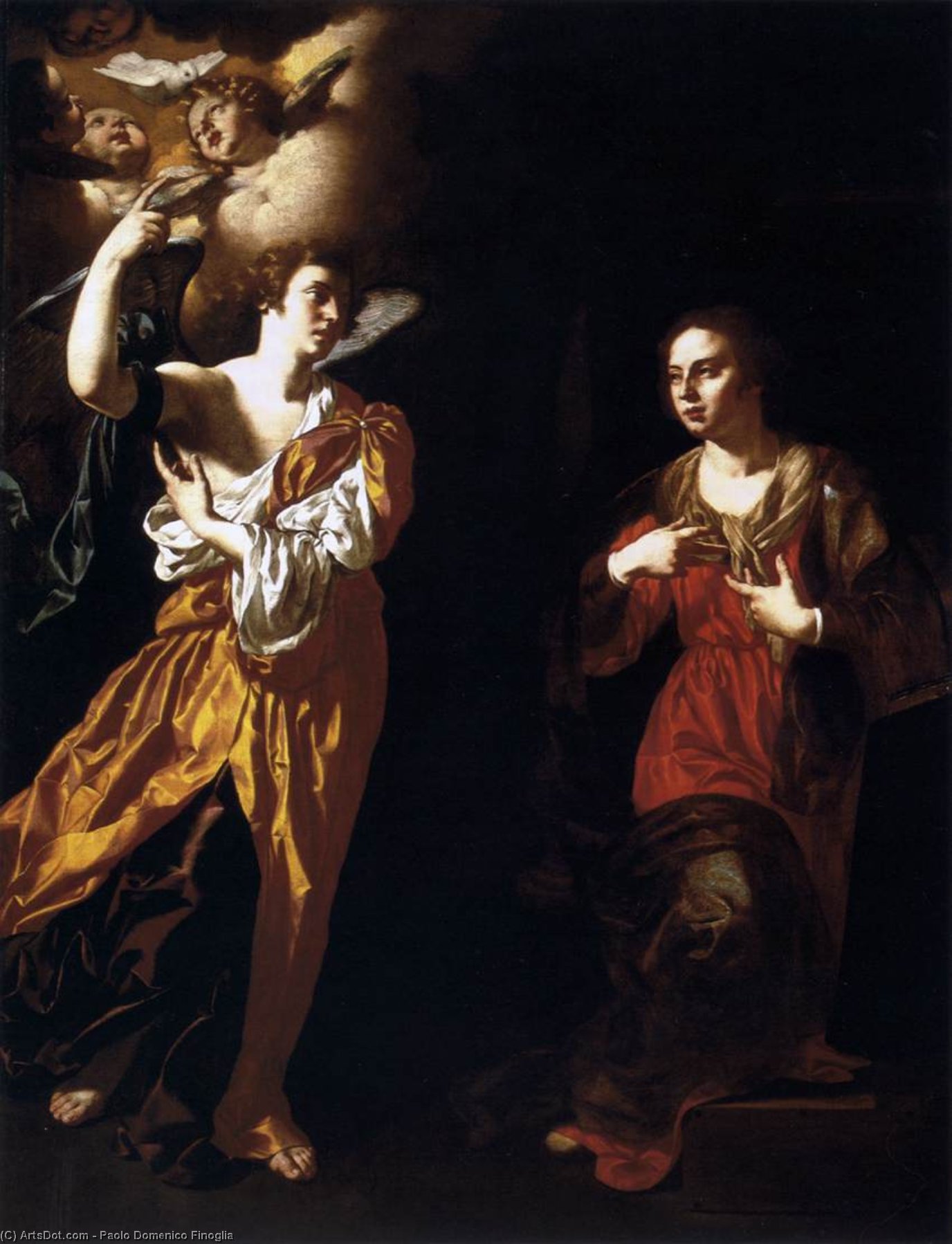
To stand before Paolo Domenico Finoglia’s Annunciation is to step directly into the luminous, dramatic heart of the Baroque era. This painting captures one of Christianity’s most pivotal moments—the announcement to Mary that she will conceive the Son of God. The composition itself is a masterful orchestration of divine intervention meeting human grace. Observe the figures: on the left, Mary stands enveloped in contemplation, her posture suggesting both piety and profound reception. Opposite her, Gabriel, the celestial messenger, radiates an ethereal energy as he delivers the momentous news. Finoglia does not merely depict a scene; he captures a palpable moment of divine breath passing through sacred space.
Baroque Drama and Compositional Depth
Finoglia’s style is deeply rooted in the fervor of early Baroque art, characterized by its dramatic intensity and rich emotional resonance. The composition is anything but static; it pulses with implied narrative energy. Beyond the central pair, the inclusion of secondary figures—those gathered near the edges or positioned around the architectural elements like the visible staircase on the right—adds layers of witness to this sacred event. These peripheral characters serve not only as compositional anchors but also as visual echoes of the devotion surrounding such a monumental theological occurrence. The entire arrangement speaks to the Counter-Reformation's desire to make religious narratives immediate, emotionally gripping, and overwhelmingly beautiful for the viewer.
Symbolism Woven in Light and Drapery
The symbolism within this Annunciation is as rich as Finoglia’s palette suggests. The elaborate costumes worn by all figures are more than mere decoration; they speak to status, role, and spiritual elevation. Mary's book often symbolizes her learned piety or her acceptance of divine will. Gabriel’s presence embodies the intersection of the heavenly and earthly realms. Furthermore, the handling of light—even in a black and white representation, one can sense the intended luminosity—is crucial. Light itself functions as a divine emanation, illuminating the truth being spoken between the angel and the Virgin.
A Touch of Neapolitan Baroque Mastery
Created around 1630, this work places Finoglia at the zenith of his career in Naples. His biography notes his immersion in the artistic currents that favored dramatic flair alongside humanist ideals. This painting perfectly encapsulates that balance: it is deeply spiritual and devotional, yet executed with a sophisticated understanding of human form and theatrical staging. For those who appreciate art that demands emotional engagement—art that feels both historically significant and intimately personal—this piece offers an unparalleled window into 17th-century Italian religious artistry. Owning a reproduction allows one to bring this vibrant narrative drama into a modern setting, transforming any space into a sanctuary of contemplation.
Related Artworks
Artist Biography
The Luminous Vision of Paolo Domenico Finoglia
To step into the world of Paolo Domenico Finoglia is to enter a realm where the celestial and the earthly collide in a breathtaking display of Baroque splendor. Known affectionately by his contemporaries as Finoglio, this master of the early seventeenth century breathed life into the sacred narratives of Southern Italy. Born around 1590 in Orta de Atella, near the vibrant heart of Naples, Finoglia emerged from a landscape steeped in both Mannerist elegance and the burgeoning dramatic intensity of the Baroque era. His artistry was not merely a matter of pigment on canvas; it was a profound spiritual undertaking, designed to transport the faithful into the very presence of the divine through a masterful orchestration of light, color, and emotion.
The foundations of Finoglia’s technique were laid in the rich artistic traditions of Campania. While historical records suggest he likely honed his early skills under the tutelage of the Mannerist painter Ippolito Borghese, his stylistic evolution reveals a much more complex dialogue with the masters of his age. He possessed a remarkable ability to synthesize the refined, sometimes elongated grace of Mannerism with the raw, tenebrist power emerging from the influence of Battistello Caracciolo and the revolutionary Caravaggio. This unique blend allowed him to create works that were simultaneously sophisticated in their composition and visceral in their emotional impact, utilizing deep shadows and brilliant highlights to sculpt figures out of the darkness.
A Legacy Written in Light and Devotion
Finoglia’s career was defined by monumental commissions that left an indelible mark on the churches and cathedrals of Naples and Apulia. His reputation as a premier decorator was cemented through his profound involvement with the Pozzuoli Cathedral, where his hand guided the spiritual atmosphere of the sacred space. His oeuvre is perhaps most celebrated for its devotion to religious iconography, particularly his numerous depictions of the Immaculate Conception and various saints. In these works, one finds a signature use of vibrant, luminous palettes—specifically deep, regal blues and passionate reds—that serve to heighten the theological significance of each scene.
Beyond individual altarpieces, Finoglia’s ambition reached its zenith in his large-scale narrative projects. One of his most staggering achievements was the decoration of scenes from Torquato Tasso’s epic poem, Gerusalemme Liberata. Commissioned by Count Giangirolamo II Acquaviva d’Aragona, these ten massive canvases represented a pinnacle of narrative painting, where he utilized illusionistic perspective to create immersive environments that seemed to extend the very walls of the viewer's reality. His ability to weave complex literary themes into visual masterpieces demonstrated a humanist intellect that was as sharp as his brushwork was delicate.
The enduring significance of Finoglia lies in his role as a bridge between eras and styles. His work embodies the spirit of the Counter-Reformation, an era that demanded art which was both instructional and emotionally gripping. Through his mastery of chiaroscuro and his ability to imbue even the most static religious figures with a sense of divine breath, he helped define the visual language of the Neapolitan Baroque. Even today, when viewing his Annunciation or his episodes from the Life of Abraham, one is struck by a sense of profound movement—a feeling that the sacred moment is not a memory of the past, but a living, breathing event unfolding before our very eyes.
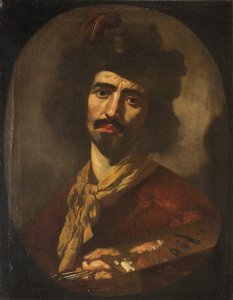
Paolo Domenico Finoglia
1590 - 1645 , Italy
Quick Facts
- Artistic Movement Or Style: Baroque
- Artists Or Movements Influenced By This Artist: ['']
- Artists Who Influenced This Artist: ['Ippolito Borghese']
- Date Of Birth: ca. 1590
- Date Of Death: 1645
- Full Name: Paolo Domenico Finoglia
- Nationality: Italian
- Notable Artworks:
- Immaculate Conception
- Tassos Gerusalemme Liberata
- Place Of Birth: Napoli, Italy
Related Articles

Baroque Masterpieces: 10 Paintings That Defined an Era |
Journey through the drama & grandeur of Baroque art! Explore 10 masterpieces by Caravaggio, Rembrandt, Rubens & more. Discover stunning oil paintings, rich colors & timeless stories. Find museum-quality reproductions at .

Fra Angelico's Masterpieces: 25 Renaissance Paintings for Your Home | ArtsDot
Explore 25 breathtaking masterpieces by Fra Angelico, a Renaissance master. Discover the stories behind his iconic frescoes, Annunciations & religious art. Find museum-quality reproductions and elevate your home decor with ArtsDot.com.

Giclée Prints: Archival Quality & Aesthetic Nuances for the Discerning Collector
Explore the world of giclée prints with ArtsDot. Learn about archival quality, aesthetic nuances & investment potential. Expert guidance for discerning art collectors seeking museum-quality reproductions and lasting value.
Baroque Painting's Greatest Hits: 10 Masterpieces for Your Home | ArtsDot
Journey through Baroque painting's glory! Explore 10 masterpieces by Caravaggio, Rembrandt & Vermeer. Discover dramatic lighting, rich colors & timeless stories. Find museum-quality art reproductions for your home at ArtsDot.com.

The Visceral Stage: Exploring Dramatic Narratives & Emotional Intensity in Baroque Art
Explore the dramatic world of Baroque art! Discover iconic masters like Caravaggio & Rembrandt, their techniques, and the movement's lasting impact. Expert insights for collectors & enthusiasts at ArtsDot.