 Preview
 Send
Send Share
Share
 Details

 Download
 Similars
 X-Ray
X-Ray Diaporama
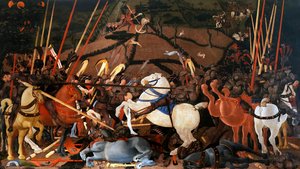
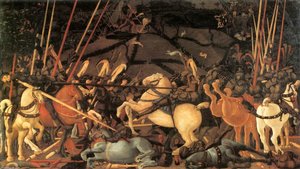
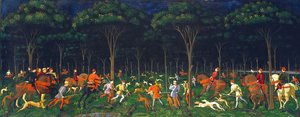
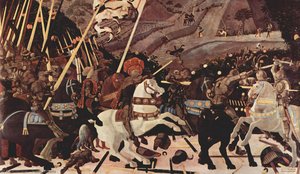
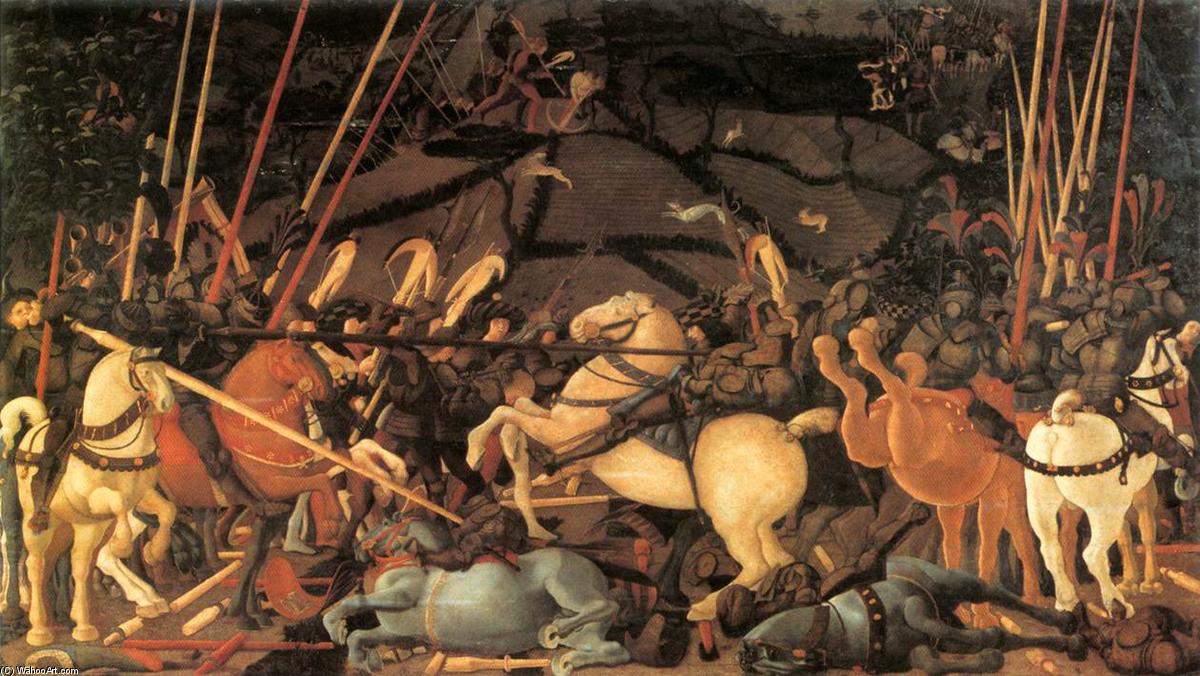
Bernardino della Ciarda Thrown Off His Horse
 Acrylic On Canvas
- WallArt
- Renaissance Perspective Innovation
 1450
1450 182.0 x 220.0 cm
 Galleria degli Uffizi
 Read More
Hand Made Oil Reproduction
Hand-painted oil on canvas in your size and frame, made to order by our artists. ( Buy Print Buy Image)




P118B $10

P118H $10

P118W $10

P438Z $10

P508JH $12

P508YH $12

P805H $10

P805Z $10

P919BZ $10

P919G $10

P919XJ $10

P959ZH $10

P968JZ $12

W106C $8

W218G $10

W218JH $8

W218Y $10

W307PJ $10

W316G $10

W316PJ $8

W316Y $10

W398PJ $8

W4111J $10

W500HY $15

W500JH $15

W692G $12

W849H $8

W940BG $15

W953PJ $8




Pick from our preset sizes that match the artwork's original proportions.

You may enter your own dimensions to fit a specific frame or space. If your selected size does not match the original image's proportions, we will either crop the artwork or extend the painting with additional hand-painted elements. A digital mockup will be sent for your approval before production begins.
Please note that the on-screen preview does not reflect the actual cropping or extension. Only the mockup will accurately show the final composition.
While custom sizes are available, we recommend selecting a dimension from the predefined list to preserve the original proportions.
After order, ArtsDot.com team will email client for instructions and provide a mockup preview
Worldwide Delivery () in 3/4 weeks instead of standard 5 weeks. (16 August). No compromise on quality.

Free Worldwide Express Shipping

High-Quality Linen Canvas

Full Shipping Insurance

Customs Tax Refund Guarantee

True Color Matching Guarantee

60-Day Return Policy (Defects Only)

100% Money-Back Guarantee

Bulk Discount Offer
 Glass option is only available in size under 110 CM

Bernardino della Ciarda Thrown Off His Horse
Reproduction Medium
Reproduction Size
-


Total Price
$ 263
Artwork Description
Bernardino della Ciarda Thrown Off His Horse by Paolo Uccello: A Triumph of Perspective and Florentine Pride
Paolo Uccello’s “Bernardino della Ciarda Thrown Off His Horse” stands as a monumental achievement in Renaissance art, transcending mere depiction to embody the spirit of innovation and ambition that defined Florence during its golden age. Completed around 1450, this tempera painting residing within the hallowed halls of the Galleria degli Uffizi isn’t simply a battlefield scene; it's a meticulously crafted demonstration of linear perspective—a breakthrough technique championed by Uccello himself and his workshop – that irrevocably altered the course of artistic representation.A Revolutionary Vision of Space
The painting captures a pivotal moment in Florentine history: the decisive victory against Siena during the War of Siena, a conflict fueled by papal ambition and simmering tensions between rival republics. However, Uccello’s genius lies not merely in documenting this event but in conveying its dynamism with unparalleled accuracy. He achieved this feat through painstaking observation and mathematical calculation—a characteristic that cemented his reputation as “Uccello,” the Bird, referencing his fascination with avian anatomy and flight, mirroring the precision he brought to capturing movement on canvas. The artist’s obsessive pursuit of perspective resulted in a scene rendered with astonishing depth, creating an illusion of three dimensions that was unheard of at the time. This wasn't merely about making things look bigger; it was about recreating reality itself.Detailed Composition and Symbolism
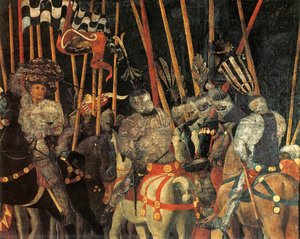
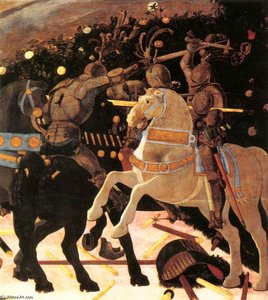
The composition is dominated by three horses—a central stallion and two flanking mounts—each positioned strategically to guide the viewer’s eye across the battlefield. Scattered amongst them are soldiers engaged in combat, their postures conveying urgency and determination. Swords glint menacingly under the Tuscan sun, emphasizing the violence of the confrontation. Beyond the immediate action, Uccello incorporates subtle symbolic elements reflecting Florentine ideals – courage, resilience, and unwavering faith in divine providence. The careful arrangement of figures contributes to a palpable sense of tension and drama, mirroring the anxieties surrounding political instability.The Workshop of Innovation
Paolo Uccello’s influence extended far beyond this single masterpiece. He spearheaded “The Workshop of Paolo Uccello,” fostering an environment where experimentation flourished and groundbreaking discoveries were celebrated. His dedication to mastering linear perspective wasn't confined to artistic pursuits; it permeated his scientific investigations into optics, demonstrating the breadth of his intellectual curiosity. The Galleria degli Uffizi houses not only this iconic painting but also numerous preparatory sketches and studies—providing invaluable insight into Uccello’s creative process and highlighting the collaborative spirit that characterized his workshop.An Enduring Legacy
“Bernardino della Ciarda Thrown Off His Horse” continues to inspire awe and admiration centuries after its creation. Its masterful execution, combined with its profound symbolic significance, secures its place as one of the most important artworks of the Early Renaissance. Reproductions crafted by ArtsDot offer a chance to experience this breathtaking vision firsthand, allowing collectors and interior designers alike to bring a piece of Florentine history into their homes—a testament to Uccello’s enduring legacy as a pioneer of artistic innovation and a champion of humanist ideals.Related Artworks
Artist Biography
A Florentine Visionary: The Life and Art of Paolo Uccello
Paolo Uccello, born Paolo di Dono in 1397 amidst the rolling hills near Florence, remains one of the most captivatingly enigmatic figures of the Early Renaissance. His very nickname, “Uccello” – little bird – hints at a whimsical nature and an artistic inclination towards depicting the avian world, yet it belies a mind deeply engaged with the burgeoning intellectual currents of his time. He wasn’t merely a painter; he was a pioneer, a mathematician of the canvas, striving to unlock the secrets of visual space and translate them into breathtaking works of art. His father, Dono di Paolo, practiced the dual profession of barber-surgeon, while his mother, Antonia, hailed from a Florentine noble family – a lineage that perhaps instilled in young Paolo both a practical sensibility and an appreciation for refined aesthetics. From 1412 to 1416, Uccello’s formative years were spent under the tutelage of Lorenzo Ghiberti, whose workshop was a crucible of artistic innovation, focused on the creation of the magnificent bronze doors for Florence's Baptistery. This early exposure steeped him in the prevailing Gothic style, with its emphasis on decorative elegance and narrative clarity, yet also ignited within him a desire to push beyond established boundaries.The Pursuit of Perspective: A Mathematical Mind at Play
Uccello’s artistic development wasn't simply about mastering technique; it was driven by an insatiable curiosity regarding the underlying principles governing perception. He became consumed with mathematics, particularly geometry and perspective, not as abstract disciplines but as tools to unlock a more truthful representation of reality. While Filippo Brunelleschi is often credited with discovering linear perspective, Uccello was among the first to systematically apply it to painting, meticulously calculating vanishing points and orthogonal lines to create an illusion of depth that had previously been largely absent from art. This wasn’t merely about technical accuracy; for Uccello, perspective became a means of structuring narrative, enhancing drama, and imbuing his compositions with a sense of order and intellectual rigor. His fascination bordered on obsession, as recounted by Giorgio Vasari, who described Uccello staying up late into the night, lost in contemplation of vanishing points and spatial relationships. This dedication, while sometimes perceived as eccentric, ultimately revolutionized painting and paved the way for future generations of artists.Masterpieces of Illusion: Key Works and Stylistic Traits
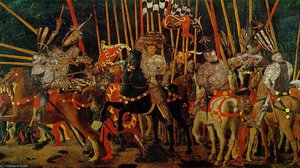
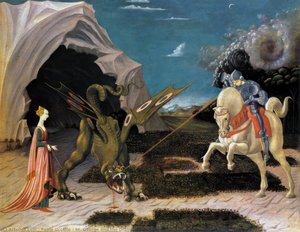
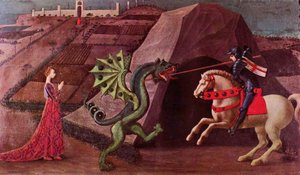
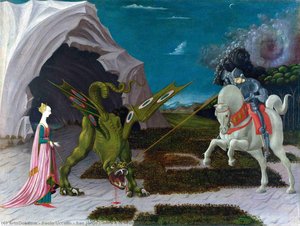
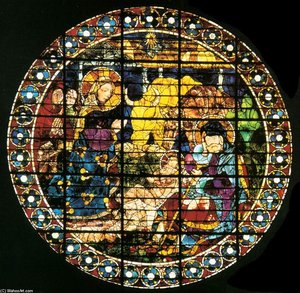
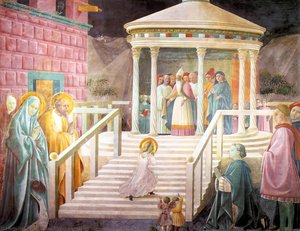
Uccello’s oeuvre, though relatively small, is marked by a distinctive style that blends Gothic elegance with Renaissance innovation. The Battle of San Romano, a series of three panels commissioned to commemorate a Florentine victory, stands as perhaps his most celebrated achievement. These paintings are not simply depictions of warfare; they are dynamic compositions filled with swirling figures, fragmented armor, and dramatically foreshortened lances – all rendered in vibrant colors and arranged according to meticulously calculated perspective. The Birth of the Virgin, showcases Uccello’s mastery of linear perspective, creating a convincing illusion of depth within a shallow space, while his St George and the Dragon presents a striking depiction of the legendary saint, characterized by bold colors and stylized forms. Even in works like The Flood and the Ark, part of the San Miniato al Monte frescoes, Uccello’s fascination with architectural detail and complex compositions is readily apparent. His style consistently reveals:Legacy and Influence: A Lasting Impact on Art History
Paolo Uccello’s contribution to the Renaissance extends far beyond his individual paintings. His pioneering exploration of perspective fundamentally altered the course of art history, influencing countless artists who followed in his wake. Albrecht Dürer, the renowned German printmaker and painter, was deeply inspired by Uccello's work, dedicating himself to the study of perspective and incorporating its principles into his own artistic practice. While Uccello’s style remained somewhat idiosyncratic throughout his career – a unique blend of Gothic refinement and Renaissance innovation – his groundbreaking approach to space and form secured his place as a pivotal figure in the development of Western art. He died in Florence in 1475, leaving behind a legacy not only of beautiful paintings but also of intellectual curiosity and artistic daring. His work continues to inspire awe and admiration, reminding us that true artistry lies not just in what is seen, but in the understanding of how we see it.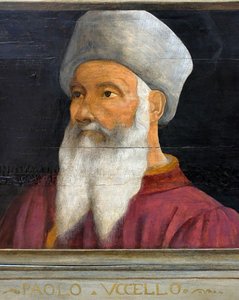
Paolo Uccello
1397 - 1475 , Italy
Quick Facts
- Artistic Movement Or Style: Early Renaissance
- Artists Or Movements Influenced By This Artist: ['Albrecht Dürer']
- Artists Who Influenced This Artist:
- Lorenzo Ghiberti
- Donatello
- Date Of Birth: 1397
- Date Of Death: 1475
- Full Name: Paolo Uccello
- Nationality: Italian
- Notable Artworks:
- Battle of San Romano
- Birth of the Virgin
- St George & Dragon
- The Flood and Ark
- Place Of Birth: Pratovecchio, Italy
Related Articles
Paolo Uccello: Pioneering Perspective & the Renaissance Pursuit of Visual Truth
Explore the revolutionary art of Paolo Uccello, a Florentine Renaissance master who pioneered perspective. Discover his iconic paintings like 'St. George & The Dragon' and learn about his lasting influence on art history.
High Medieval Art: 10 Masterpieces That Shaped an Era | ArtsDot
Journey through High Medieval Art! Explore 10 iconic masterpieces – from Giotto's frescoes to stunning Gothic cathedrals. Discover the stories behind these timeless paintings, sculptures & illuminated manuscripts. Find museum-quality art reproductions at ArtsDot.com.
The Noble Steed on Canvas: A Historical & Artistic Exploration of Horse Painting Across Cultures
Explore the rich history of horse painting! Discover masterpieces from Stubbs to Munnings & learn about symbolism, techniques & artists. Find museum-quality reproductions at ArtsDot.
The Equine Muse: A Historical & Artistic Exploration of Horses in Painting
Explore the captivating history of horses in painting! Discover Renaissance masterpieces, Baroque grandeur & expert insights for collecting equestrian art. Learn about symbolism, techniques & lasting value with ArtsDot.
The Noble Steed: A Historical and Artistic Exploration of Horses in Fine Art
Explore the rich history of horses in fine art! From ancient depictions to Renaissance masterpieces & beyond, discover iconic artworks and artists. Learn about symbolism, techniques, and find museum-quality reproductions at ArtsDot.