 Preview
 Send
Send Share
Share
 Details

 Download
 Similars
 X-Ray
X-Ray Diaporama
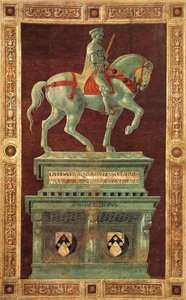
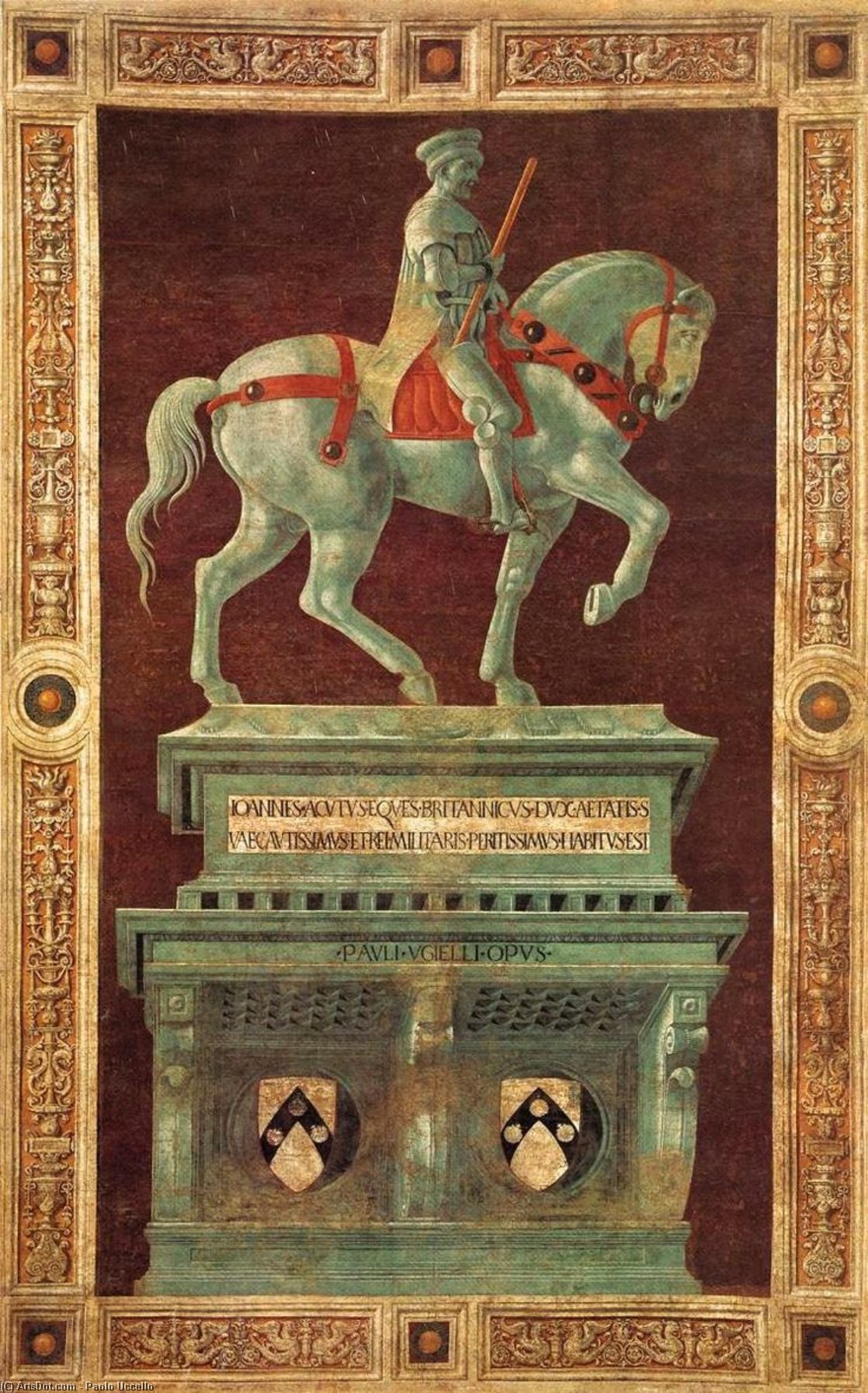
Funerary Monument to Sir John Hawkwood
 Acrylic On Canvas
- WallArt
- Renaissance
 1436
1436- Renaissance
 820.0 x 515.0 cm
 Duomo
Duomo
 Read More
Hand Made Oil Reproduction
Hand-painted oil on canvas in your size and frame, made to order by our artists. ( Buy Print Buy Image)




P118B $10

P118H $10

P118W $10

P438Z $10

P508JH $12

P508YH $12

P805H $10

P805Z $10

P919BZ $10

P919G $10

P919XJ $10

P959ZH $10

P968JZ $12

W106C $8

W218G $10

W218JH $8

W218Y $10

W307PJ $10

W316G $10

W316PJ $8

W316Y $10

W398PJ $8

W4111J $10

W500HY $15

W500JH $15

W692G $12

W849H $8

W940BG $15

W953PJ $8




Pick from our preset sizes that match the artwork's original proportions.

You may enter your own dimensions to fit a specific frame or space. If your selected size does not match the original image's proportions, we will either crop the artwork or extend the painting with additional hand-painted elements. A digital mockup will be sent for your approval before production begins.
Please note that the on-screen preview does not reflect the actual cropping or extension. Only the mockup will accurately show the final composition.
While custom sizes are available, we recommend selecting a dimension from the predefined list to preserve the original proportions.
After order, ArtsDot.com team will email client for instructions and provide a mockup preview
Worldwide Delivery () in 3/4 weeks instead of standard 5 weeks. (16 August). No compromise on quality.

Free Worldwide Express Shipping

High-Quality Linen Canvas

Full Shipping Insurance

Customs Tax Refund Guarantee

True Color Matching Guarantee

60-Day Return Policy (Defects Only)

100% Money-Back Guarantee

Bulk Discount Offer
 Glass option is only available in size under 110 CM

Funerary Monument to Sir John Hawkwood
Reproduction Medium
Reproduction Size
-


Total Price
$ 263
Artwork Description
The Echoes of War and Vision: Paolo Uccello’s Funerary Monument to Sir John Hawkwood
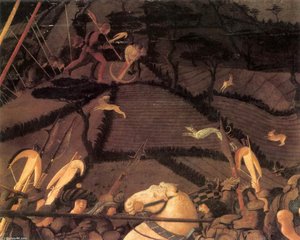
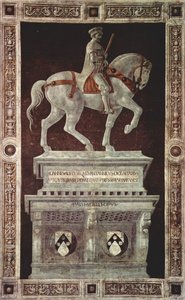
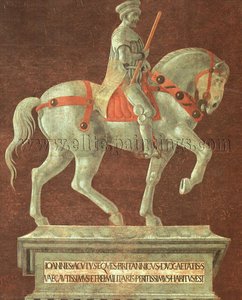
Paolo Uccello's *Funerary Monument to Sir John Hawkwood*, a fresco dominating the north wall of Florence Cathedral, isn’t merely a depiction of a soldier; it’s a meticulously constructed tableau of ambition, political maneuvering, and the burgeoning spirit of Renaissance perspective. Completed in 1436, this monumental work transcends its initial purpose as a commemorative piece for the celebrated English condottiero – a mercenary commander – to become a profound meditation on Florentine identity, artistic innovation, and the very nature of seeing. The fresco immediately commands attention with its scale—a vast expanse of painted plaster that draws the viewer into a meticulously rendered world, yet it’s the subtle details, the calculated distortions, and the underlying tension that truly captivate. It's a testament to Uccello’s singular vision, a blend of military grandeur and intellectual experimentation that continues to fascinate centuries later.- A Commission Forged in Politics: The genesis of this monumental work is inextricably linked to the volatile political landscape of 15th-century Florence. Sir John Hawkwood, a veteran of numerous Italian wars, had served Florence with considerable success, bolstering its defenses and securing vital alliances. However, his methods were often ruthless, and his loyalty was perpetually in question. Commissioning this fresco wasn’t simply an act of honoring a soldier; it was a strategic move by the Florentine Republic to solidify its position, projecting an image of strength and stability through the glorification of a foreign hero. The very choice of Hawkwood – a pragmatic warrior rather than a noble lineage – underscored Florence's pragmatic approach to diplomacy and military prowess.
- The Pioneering Use of Perspective: Uccello’s genius lies not just in his subject matter but in his revolutionary approach to visual representation. He wrestled with the challenge of depicting three-dimensional space on a two-dimensional surface, employing techniques that were groundbreaking for his time. Notice how he manipulates the vanishing point—not a single, fixed location as later artists would achieve—but rather utilizes *two* distinct points, creating an illusion of depth and drawing the eye towards the central figure of Hawkwood. This deliberate distortion, this conscious departure from traditional realism, is what makes the fresco so utterly compelling. It’s a visual puzzle, inviting the viewer to actively engage with the artwork and decipher its complex spatial relationships.
- Symbolism Woven into the Fabric: Beyond the immediate depiction of Hawkwood on horseback, the fresco is laden with symbolic meaning. The meticulously arranged shields – bearing the emblems of Florence and Hawkwood’s former employers – speak volumes about the shifting alliances and political machinations of the era. The carefully positioned horses, rendered with an almost obsessive attention to detail, represent both power and movement, mirroring Hawkwood's military career. Even the muted color palette—primarily verdant greens and earthy reds—contributes to the overall atmosphere of solemn grandeur.
The Artist’s Obsession: Uccello’s Mathematical Approach
Paolo Uccello wasn’t simply a painter; he was, by all accounts, a mathematician obsessed with the principles of perspective. Giorgio Vasari, in his *Lives of the Most Excellent Painters*, described Uccello as “a man who had made it his business to study perspective.” This dedication is evident throughout the *Funerary Monument*. He meticulously calculated angles and distances, creating a system for representing space that was far more complex and sophisticated than anything seen before. The fresco isn’t just aesthetically pleasing; it's a demonstration of Uccello’s intellectual rigor—a testament to his belief that art could be both beautiful *and* rational.- A Quest for the Vanishing Point: Uccello’s relentless pursuit of the vanishing point is perhaps the most striking aspect of his work. He experimented with different methods, often pushing the boundaries of what was considered acceptable in Renaissance art. The two distinct vanishing points—one for the sarcophagus and one for Hawkwood himself—create a sense of disorientation that forces the viewer to actively engage with the artwork’s spatial construction.
- The Influence of Geometry: Uccello's understanding of geometry played a crucial role in his artistic process. He employed geometric principles to create a sense of order and harmony within the composition, ensuring that all elements were aligned according to precise mathematical ratios. This meticulous attention to detail is evident in the perfectly proportioned horses, the carefully arranged shields, and the overall balance of the scene.
- A Departure from Tradition: Uccello’s approach to perspective was a radical departure from the conventions of his time. While other artists were focusing on creating realistic depictions of space, Uccello was experimenting with illusionistic techniques—creating the *impression* of depth rather than simply representing it accurately. This willingness to challenge established norms ultimately paved the way for future generations of Renaissance painters.
Restoration and Legacy: A Fresco Reborn
Over the centuries, the *Funerary Monument* has undergone several restorations, each adding a layer to its complex history. Initially, Lorenzo di Credi added a decorative frame in 1524, attempting to “correct” some of Uccello’s perceived imperfections. However, in 1842, the fresco was detached from the wall and repositioned twice for preservation purposes, a process that inevitably altered its original appearance. Today, it resides on the north wall of the nave, alongside another equestrian monument by Andrea del Castagno, offering a fascinating juxtaposition of artistic styles.- A Testament to Preservation: Despite the numerous interventions, the *Funerary Monument* remains remarkably well-preserved, providing invaluable insights into the techniques and aesthetics of Renaissance art. The careful conservation efforts undertaken over the past century have ensured that this masterpiece will continue to inspire and captivate audiences for generations to come.
- Influence on Later Artists: Uccello’s pioneering work in perspective had a profound influence on subsequent artists, including Leonardo da Vinci and Raphael. His experiments with spatial illusionism helped to shape the development of Renaissance art as a whole, demonstrating the power of visual representation to create convincing illusions of reality.
- A Continuing Source of Debate: The *Funerary Monument* continues to be a subject of scholarly debate, with historians and art critics offering diverse interpretations of its meaning and significance. Its complex symbolism, innovative perspective, and turbulent historical context ensure that it will remain a source of fascination for years to come.
Bringing Uccello’s Vision Home: Reproductions and Inspiration
The *Funerary Monument to Sir John Hawkwood* is more than just an artwork; it's a window into the mind of a visionary artist. ArtsDot offers meticulously crafted, hand-painted reproductions that capture the essence of this iconic fresco, allowing you to bring its grandeur and complexity into your own space. These reproductions are not mere copies—they are artistic interpretations, imbued with the spirit of Uccello’s original vision. Whether you're an art collector, a design enthusiast, or simply someone seeking inspiration, ArtsDot’s reproduction of this remarkable fresco offers a unique opportunity to connect with one of the most important works in Renaissance history. Explore our collection today and discover the enduring legacy of Paolo Uccello.Related Artworks
Artist Biography
A Florentine Visionary: The Life and Art of Paolo Uccello
Paolo Uccello, born Paolo di Dono in 1397 amidst the rolling hills near Florence, remains one of the most captivatingly enigmatic figures of the Early Renaissance. His very nickname, “Uccello” – little bird – hints at a whimsical nature and an artistic inclination towards depicting the avian world, yet it belies a mind deeply engaged with the burgeoning intellectual currents of his time. He wasn’t merely a painter; he was a pioneer, a mathematician of the canvas, striving to unlock the secrets of visual space and translate them into breathtaking works of art. His father, Dono di Paolo, practiced the dual profession of barber-surgeon, while his mother, Antonia, hailed from a Florentine noble family – a lineage that perhaps instilled in young Paolo both a practical sensibility and an appreciation for refined aesthetics. From 1412 to 1416, Uccello’s formative years were spent under the tutelage of Lorenzo Ghiberti, whose workshop was a crucible of artistic innovation, focused on the creation of the magnificent bronze doors for Florence's Baptistery. This early exposure steeped him in the prevailing Gothic style, with its emphasis on decorative elegance and narrative clarity, yet also ignited within him a desire to push beyond established boundaries.The Pursuit of Perspective: A Mathematical Mind at Play
Uccello’s artistic development wasn't simply about mastering technique; it was driven by an insatiable curiosity regarding the underlying principles governing perception. He became consumed with mathematics, particularly geometry and perspective, not as abstract disciplines but as tools to unlock a more truthful representation of reality. While Filippo Brunelleschi is often credited with discovering linear perspective, Uccello was among the first to systematically apply it to painting, meticulously calculating vanishing points and orthogonal lines to create an illusion of depth that had previously been largely absent from art. This wasn’t merely about technical accuracy; for Uccello, perspective became a means of structuring narrative, enhancing drama, and imbuing his compositions with a sense of order and intellectual rigor. His fascination bordered on obsession, as recounted by Giorgio Vasari, who described Uccello staying up late into the night, lost in contemplation of vanishing points and spatial relationships. This dedication, while sometimes perceived as eccentric, ultimately revolutionized painting and paved the way for future generations of artists.Masterpieces of Illusion: Key Works and Stylistic Traits
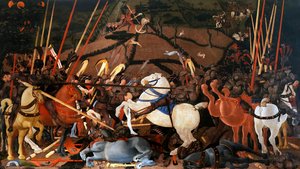
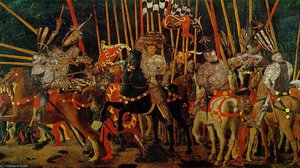
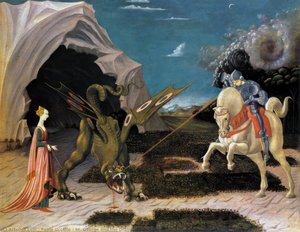
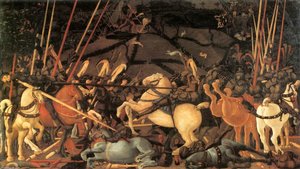
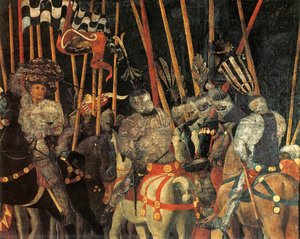
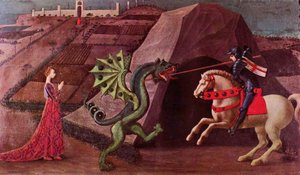
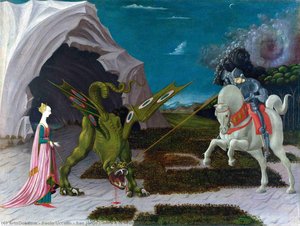
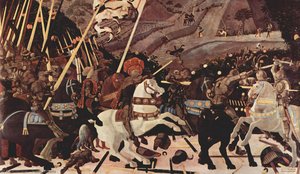
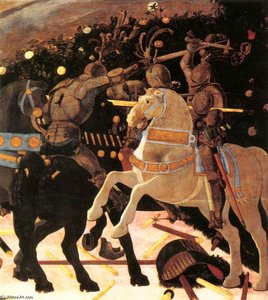
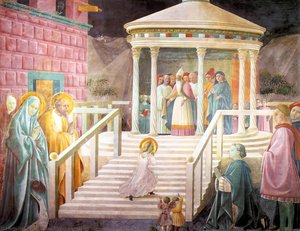
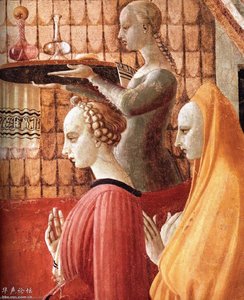
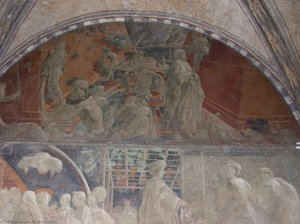
Uccello’s oeuvre, though relatively small, is marked by a distinctive style that blends Gothic elegance with Renaissance innovation. The Battle of San Romano, a series of three panels commissioned to commemorate a Florentine victory, stands as perhaps his most celebrated achievement. These paintings are not simply depictions of warfare; they are dynamic compositions filled with swirling figures, fragmented armor, and dramatically foreshortened lances – all rendered in vibrant colors and arranged according to meticulously calculated perspective. The Birth of the Virgin, showcases Uccello’s mastery of linear perspective, creating a convincing illusion of depth within a shallow space, while his St George and the Dragon presents a striking depiction of the legendary saint, characterized by bold colors and stylized forms. Even in works like The Flood and the Ark, part of the San Miniato al Monte frescoes, Uccello’s fascination with architectural detail and complex compositions is readily apparent. His style consistently reveals:Legacy and Influence: A Lasting Impact on Art History
Paolo Uccello’s contribution to the Renaissance extends far beyond his individual paintings. His pioneering exploration of perspective fundamentally altered the course of art history, influencing countless artists who followed in his wake. Albrecht Dürer, the renowned German printmaker and painter, was deeply inspired by Uccello's work, dedicating himself to the study of perspective and incorporating its principles into his own artistic practice. While Uccello’s style remained somewhat idiosyncratic throughout his career – a unique blend of Gothic refinement and Renaissance innovation – his groundbreaking approach to space and form secured his place as a pivotal figure in the development of Western art. He died in Florence in 1475, leaving behind a legacy not only of beautiful paintings but also of intellectual curiosity and artistic daring. His work continues to inspire awe and admiration, reminding us that true artistry lies not just in what is seen, but in the understanding of how we see it.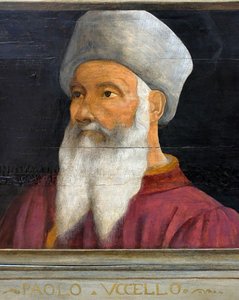
Paolo Uccello
1397 - 1475 , Italy
Quick Facts
- Artistic Movement Or Style: Early Renaissance
- Artists Or Movements Influenced By This Artist: ['Albrecht Dürer']
- Artists Who Influenced This Artist:
- Lorenzo Ghiberti
- Donatello
- Date Of Birth: 1397
- Date Of Death: 1475
- Full Name: Paolo Uccello
- Nationality: Italian
- Notable Artworks:
- Battle of San Romano
- Birth of the Virgin
- St George & Dragon
- The Flood and Ark
- Place Of Birth: Pratovecchio, Italy
Related Articles

The Fresco as Family Legacy: Preserving Heritage Through Wall Art
Explore the rich history & enduring legacy of fresco painting. Discover how to preserve family heritage through stunning wall art. Expert insights & restoration guidance.

John Singer Sargent's 25 Masterpieces: Portraits & Beyond | ArtsDot
Explore 25 iconic John Singer Sargent paintings – from dazzling portraits to Impressionist landscapes. Discover the stories behind Madame X, El Jaleo & more! Find museum-quality art reproductions and elevate your home decor with ArtsDot.com.

John Constable's Masterpieces: Explore 25 Iconic Landscapes for Your Home
Journey through John Constable's 25 most celebrated landscapes. Explore Romanticism, Dedham Vale & his masterful use of light in iconic paintings like 'Hay Wain'. Find museum-quality art reproductions and elevate your home decor on ArtsDot.com.

The Enduring Legacy of Fresco Painting: Techniques, History & Contemporary Relevance
Explore the rich history & enduring artistry of fresco painting – from Giotto to Michelangelo! Discover techniques, conservation efforts, & modern applications. Learn how ArtsDot brings this timeless art form to your home.

The Enduring Legacy of Fresco: Technique, History & Artistic Expression Across Cultures
Explore the rich history & enduring legacy of fresco painting! Discover ancient techniques, Giotto's masterpieces, and modern applications. Expert insights for art lovers & professionals.