 Preview
 Send
Send Share
Share
 Details

 Download
 Similars
 X-Ray
X-Ray Diaporama
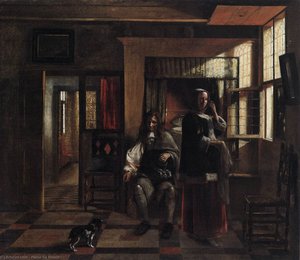
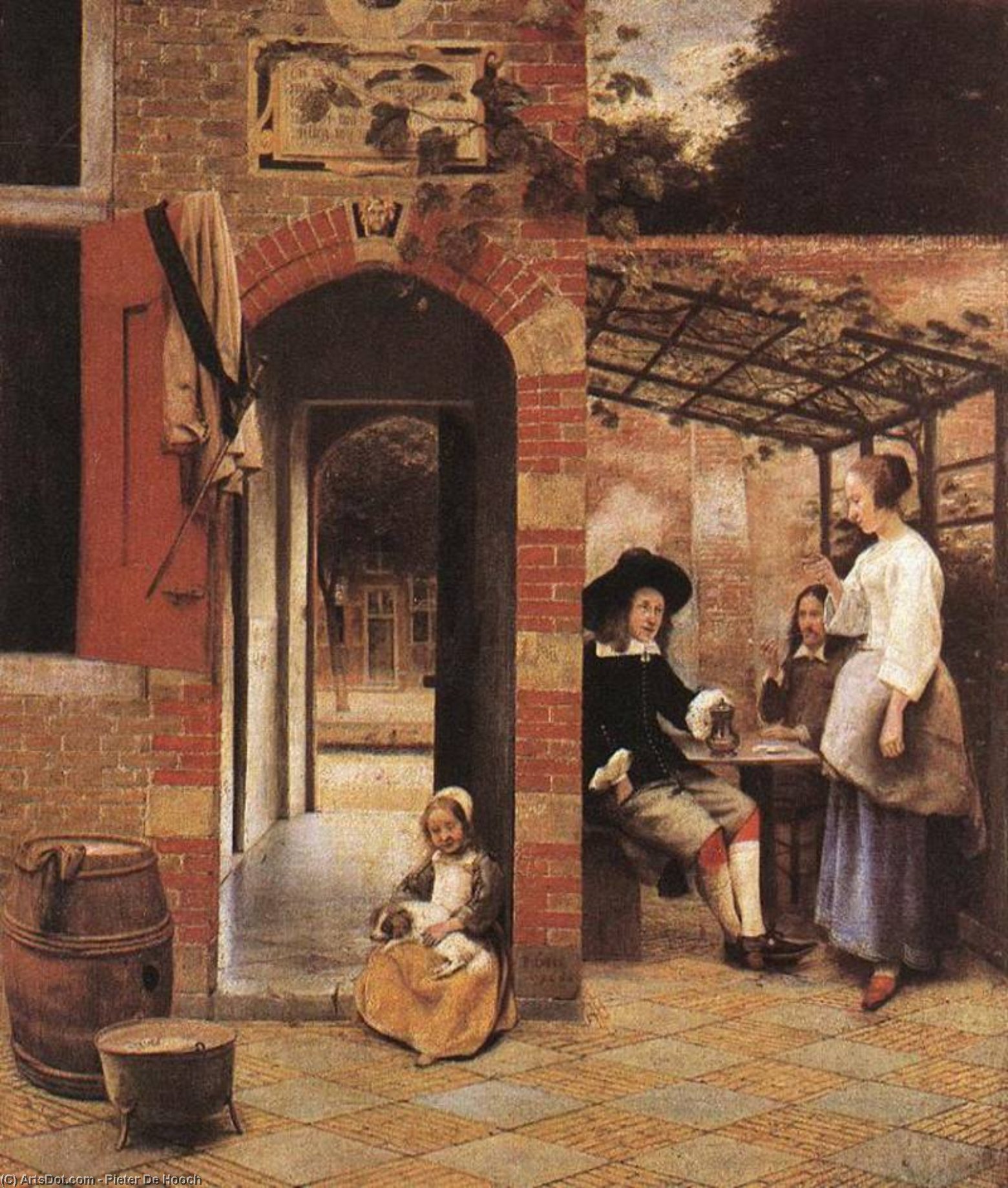
Drinkers in the Bower
 Acrylic
- WallArt
- Dutch Golden Age
 1658
1658 67.0 x 57.0 cm
 National Gallery of Scotland
 Read More
Giclée / Art Print
Museum-quality giclée or canvas print with fast production and flexible finish options. ( Buy Hand Made Painting Buy Image)




P118B $10

P118H $10

P118W $10

P438Z $10

P508JH $12

P508YH $12

P805H $10

P805Z $10

P919BZ $10

P919G $10

P919XJ $10

P959ZH $10

P968JZ $12

W106C $8

W218G $10

W218JH $8

W218Y $10

W307PJ $10

W316G $10

W316PJ $8

W316Y $10

W398PJ $8

W4111J $10

W500HY $15

W500JH $15

W692G $12

W849H $8

W940BG $15

W953PJ $8




Pick from our preset sizes that match the artwork's original proportions.

You may enter your own dimensions to fit a specific frame or space. If your selected size does not match the original image's proportions, we will either crop the artwork or extend the image with a mirrored or solid-fill edge. A digital mockup will be sent for your approval before production begins.
Please note that the on-screen preview does not reflect the actual cropping or extension. Only the mockup will accurately show the final composition.
While custom sizes are available, we recommend selecting a dimension from the predefined list to preserve the original proportions.
Worldwide Delivery () in 2 weeks instead of standard 4/5 weeks. (16 August)

Free Worldwide Express Shipping

High-Quality Linen Canvas

Full Shipping Insurance

Customs Tax Refund Guarantee

True Color Matching Guarantee

60-Day Return Policy (Defects Only)

100% Money-Back Guarantee

Bulk Discount Offer
 Glass option is only available in size under 110 CM

Drinkers in the Bower
Giclée / Art Print
Reproduction Size
-


Total Price
$ 63
Collectible Description
Pieter de Hooch’s “Drinkers in the Bower”: A Window Into Dutch Domestic Tranquility
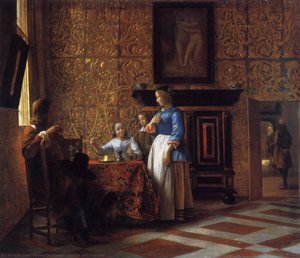
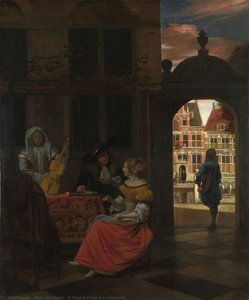
The painting "Drinkers in the Bower," executed by Pieter de Hooch in 1658, stands as a quintessential example of Dutch Golden Age art—a testament to meticulous observation and an understated elegance that continues to resonate with audiences today. More than just a depiction of figures seated outdoors, it’s a carefully crafted tableau capturing a fleeting moment of domestic serenity amidst the burgeoning complexities of seventeenth-century Amsterdam society.Subject Matter and Composition
At first glance, the scene presents itself as remarkably simple: several individuals occupy a courtyard garden setting. A woman cradles her infant child, while another man sits beside her on a bench—a commonplace tableau reflecting the daily life of affluent families during this period. However, De Hooch’s genius lies in his ability to imbue this seemingly unremarkable subject with profound psychological depth. The inclusion of a dog adds an element of domesticity and companionship, subtly reinforcing the theme of familial warmth. Two potted plants strategically positioned within the courtyard frame contribute to the overall composition, guiding the viewer's eye and enhancing the sense of tranquility.Style and Technique: Mastering Light and Atmosphere
De Hooch’s artistic style is characterized by its masterful manipulation of light—a technique central to his oeuvre and emblematic of the Dutch Baroque tradition. He employs chiaroscuro, utilizing dramatic contrasts between light and shadow to sculpt forms and create a palpable atmosphere. The diffused daylight filtering through the foliage casts soft shadows across the courtyard, illuminating faces and drapery with an ethereal glow. This subtle illumination isn’t merely decorative; it serves to convey emotion—a quiet contemplation of life's pleasures and connections. De Hooch’s meticulous brushwork contributes to the painting’s realism, capturing textures and nuances that would have captivated discerning viewers of his time.Historical Context: Reflecting Amsterdam’s Ascendancy
“Drinkers in the Bower” emerged during a period of unprecedented economic prosperity and cultural flourishing for Amsterdam—the apex of the Dutch Golden Age. The city had become a global center for trade, attracting merchants from across Europe and fostering an environment of intellectual curiosity and artistic innovation. Paintings like this reflected the values of the emerging middle class—a focus on family life, refined sensibilities, and appreciation for beauty. De Hooch’s work aligns with broader trends in Dutch art during this era, prioritizing psychological realism over grand mythological narratives or historical grandeur.Symbolism: Beyond Surface Appearances
The courtyard garden itself holds symbolic significance. Traditionally associated with privacy and contemplation, it represents a refuge from the pressures of urban life—a space for quiet reflection and familial connection. The woman holding her child embodies maternal tenderness and nurturing care—values deeply ingrained in Dutch culture during the seventeenth century. Furthermore, the presence of the dog symbolizes loyalty and companionship, reinforcing the painting’s overarching message of domestic harmony.Emotional Impact: Capturing a Moment of Quiet Beauty
Ultimately, “Drinkers in the Bower” succeeds in conveying an extraordinary emotional resonance—a feeling of serene contentment and understated grace. De Hooch's ability to capture the subtle nuances of human emotion is remarkable, inviting viewers to immerse themselves in this tranquil scene and contemplate the beauty of everyday life. It remains a captivating piece of art that speaks volumes about the spirit of its time and continues to inspire admiration for its masterful execution and profound psychological insight.Related Artworks
Artist Biography
early life and training
pieter de hooch, a prominent figure in the dutch golden age, was born on december 20, 1629, in rotterdam, netherlands. he was the eldest of five children to hendrick hendricksz de hooch, a bricklayer, and annetge pieters, a midwife. little is known about his early life, but it is believed that he worked in rotterdam, delft, and amsterdam. de hooch's artistic training took place in haarlem under the landscape painter nicolaes berchem, alongside jacob ochtervelt. this period laid the foundation for his future success as a painter of quiet domestic scenes with an open doorway.artistic style and themes
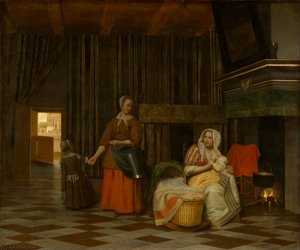
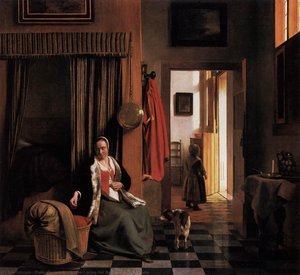
de hooch's work is characterized by its attention to detail, naturalism, and use of light. his paintings often featured everyday life, reflecting the values and aspirations of the emerging middle class. a notable example of this style is "the courtyard of a house in delft" (1658), which showcases his ability to capture the mundane details of everyday life. de hooch's work also shares themes and compositions with emanuel de witte, but his focus on people and their relationships sets him apart. this is evident in "woman nursing" (1658) and "woman with a baby on her lap" (1658), which demonstrate his interest in domestic scenes.notable works and legacy
some of de hooch's most notable works include:- "the merry drinker" (c. 1650)
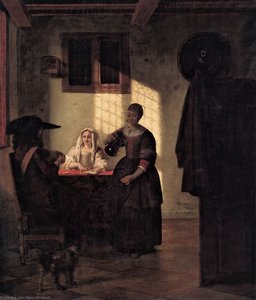
- "cardplayers in a sunlit room" (1658)
- "a woman preparing bread and butter for a boy" (1661)
museums and collections
de hooch's work can be found in various museums, including the koninklijk museum voor schone kunsten in antwerp, belgium, which features a vast collection of european art from the 15th to the 20th centuries. discover more about pieter de hooch and his works on ArtsDot: [https://ArtsDot.com/@/pieter-de-hooch](https://ArtsDot.com/@/pieter-de-hooch) /en/art/show/art-d3b4kt-en/ (discover the masterpieces of koninklijk museum voor schone kunsten, belgium) note: the provided links are from ArtsDot and are relevant to the topic. no external links were added as per the instructions.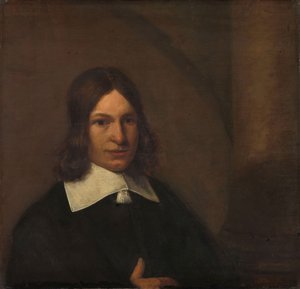
Pieter de Hooch
1629 - 1694 , Netherlands
Quick Facts
- Artistic Movement Or Style: Delft School, Dutch Golden Age
- Artists Or Movements Influenced By This Artist: ['Jan Vermeer']
- Artists Who Influenced This Artist: ['Nicolaes Berchem']
- Date Of Birth: December 20, 1629
- Full Name: Pieter Hendricksz de Hooch
- Nationality: Dutch
- Notable Artworks:
- The Empty Glass
- Woman Reading a Letter
- Cardplayers in a sunlit room
- A woman preparing bread and butter
- Place Of Birth: Rotterdam, Netherlands
Related Articles
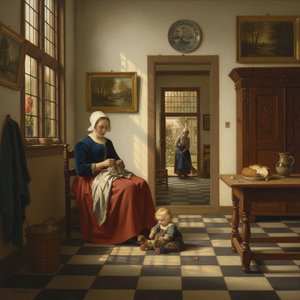
Pieter de Hooch: Illuminating Dutch Domestic Life & Golden Age Charm
Explore the captivating world of Pieter de Hooch, a master of Dutch Golden Age painting. Discover his innovative use of light, intimate domestic scenes, and lasting influence on art history. Learn more at ArtsDot.

Demandes Commerciales
APS ofrece reproducciones de bellas artes y encargos personalizados desde 2004. Confían en nosotros corporaciones, hoteles y coleccionistas selectos para obras de arte de calidad museística, servicio discreto y soluciones artísticas completas. ¡Póngase en contacto con nosotros para obtener un presupuesto personalizado!

Dutch Baroque Masters: 10 Paintings That Shaped an Era | ArtsDot
Journey through the Golden Age with our guide to the Top 10 Dutch Baroque masterpieces! Explore iconic paintings by Rembrandt, Vermeer & Frans Hals. Find museum-quality art reproductions and elevate your home decor at ArtsDot.com.

Goya's Masterpieces: Explore 25 Iconic Paintings & Art Prints | ArtsDot
Delve into the world of Francisco Goya with ArtsDot. Explore 25 iconic paintings – from 'The Third of May' to his haunting Black Paintings. Discover the stories, techniques & emotions behind these Spanish masterpieces. Find museum-quality art reproductions for your home at ArtsDot.com!

Golden Age Reflections: Dutch Baroque Painting & Cultural Innovation
Explore the Dutch Golden Age of painting! Discover key artists like Vermeer & ter Borch, their innovative techniques, and the rich cultural context behind these Baroque masterpieces. Learn about collecting & appreciating this iconic art period.