 Preview
 Send
Send Share
Share
 Details

 Download
 Similars
 X-Ray
X-Ray Diaporama
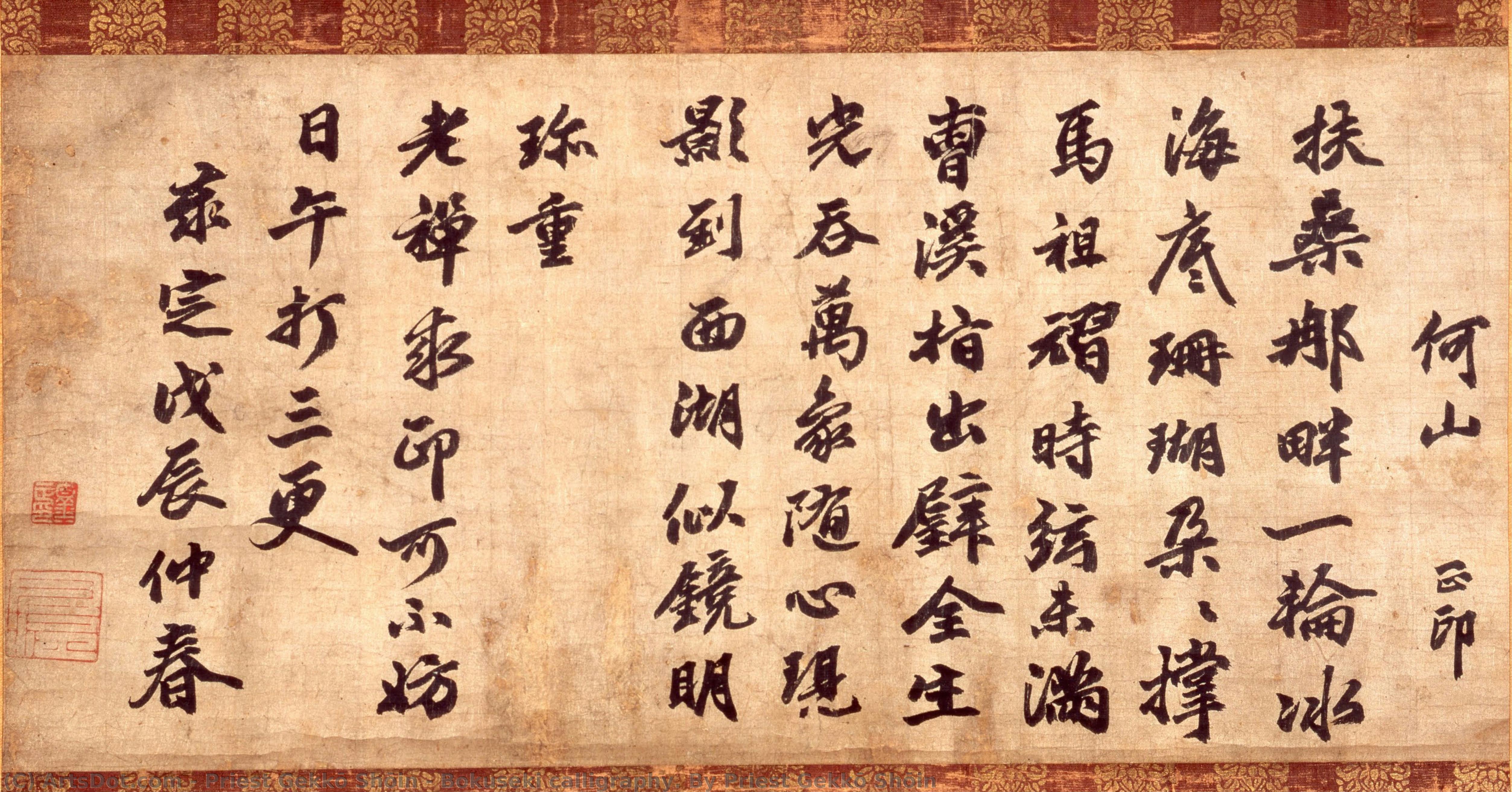
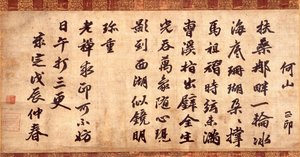
Bokuseki calligraphy. By Priest Gekkō Shōin

 Read More
Hand Made Oil Reproduction
Hand-painted oil on canvas in your size and frame, made to order by our artists. ( Buy Print Buy Image)




































Pick from our preset sizes that match the artwork's original proportions.

You may enter your own dimensions to fit a specific frame or space. If your selected size does not match the original image's proportions, we will either crop the artwork or extend the painting with additional hand-painted elements. A digital mockup will be sent for your approval before production begins.
Please note that the on-screen preview does not reflect the actual cropping or extension. Only the mockup will accurately show the final composition.
While custom sizes are available, we recommend selecting a dimension from the predefined list to preserve the original proportions.
After order, ArtsDot.com team will email client for instructions and provide a mockup preview
Worldwide Delivery () in 3/4 weeks instead of standard 5 weeks. (28 August). No compromise on quality.

Free Worldwide Express Shipping

High-Quality Linen Canvas

Full Shipping Insurance

Customs Tax Refund Guarantee

True Color Matching Guarantee

60-Day Return Policy (Defects Only)

100% Money-Back Guarantee

Bulk Discount Offer
 Glass option is only available in size under 110 CM

Bokuseki calligraphy. By Priest Gekkō Shōin
Reproduction Medium
Reproduction Size
-


Total Price
$ 263
Related Artworks
Artist Biography
The Silent Master of Mount Minobu
In the misty, high altitudes of Japan’s spiritual landscape, the name Priest Gekkō Shōin resonates with the profound stillness of a mountain morning. Known to history as Ogata Gekko, this monumental figure of the late thirteenth and early fourteenth centuries was far more than a mere monk; he was a bridge between the earthly realm and the transcendent. Born in 1246 into a noble family in Fujikawa, Iwabuchi Province, Gekko’s early life was steeped in the rigorous intellectual traditions of his father, Oi-no Kitsuroku. A renowned scholar and diplomat, Kitsuroku provided his son with a foundation in classical literature and Confucian ethics, yet it was a different, more visceral calling that would eventually define Gekko’s soul. The spiritual fire ignited by the teachings of Nichiren Daimyō—specifically the unwavering devotion to the Lotus Sutra—transformed a scholarly youth into a seeker of ultimate truth.
Gekko’s journey toward enlightenment was not one of easy contemplation but of disciplined, rigorous struggle. Seeking to embody the prophetic vision of the Third Age, where the mantra “Namu Myōhō Renge Kyō” could unlock the gates of wisdom for all, he underwent intense Zen training at Shijuku-in Temple. It was during this period of asceticism that his artistic sensibilities began to merge with his spiritual practice. He learned to cultivate an inner stillness so profound that it could be projected onto a canvas. This mastery reached its zenith in 1290 when he established the Taisekiji Temple atop Mount Minobu. This sacred peak became not only his lifelong sanctuary but also a beacon for Nichiren Buddhism, a place where the boundaries between the breath of the monk and the mist of the mountains began to dissolve.
The Aesthetic of Emptiness
The artistic legacy of Priest Gekkō Shōin is most vibrantly felt in his Kōkan Sansui, or "empty mountain scenery." To the untrained eye, these landscape paintings might appear as simple depictions of nature, but to the practitioner of Zen, they are windows into the void. Gekko’s work eschews the cluttered ornamentation of more decorative styles, opting instead for a profound minimalism that mirrors the meditative state. His canvases do not strive to capture the mere external beauty of a forest or a peak; rather, they aim to evoke the sense of transcendence and inner harmony found in the absence of ego. Through his brush, the landscape becomes a psychological space where the viewer is invited to lose themselves in the vastness of the infinite.
Technically, Gekko was a master of the subtle and the atmospheric. He possessed an unparalleled ability to manipulate ink tones, utilizing delicate gradations to suggest depth, moisture, and light. One of his most striking signatures was the use of subtle Prussian blue tones, which allowed him to create vistas that felt perpetually shrouded in the cool, damp air of a high-altitude monastery. His brushwork was both precise and fluid, capable of rendering the rugged texture of stone or the ephemeral quality of a passing cloud with equal grace. This technique served his higher purpose: to use the physical medium of ink and paper to represent the intangible essence of the spirit.
A Lasting Spiritual Impression
The historical significance of Priest Gekkō Shōin extends far beyond the borders of Japanese Zen Buddhism. He stands as a pivotal figure who helped codify the visual language of spiritual devotion through his Bokuseki calligraphy and landscape mastery. His life work represents a rare moment in art history where the creator, the subject, and the medium are entirely unified. When one contemplates his works today, one is not merely looking at historical artifacts; one is participating in a centuries-old ritual of contemplation. He remains a testament to the power of art to serve as a vessel for the divine, proving that through the disciplined application of beauty, the human spirit can touch the eternal.
priest gekkō shōin
China
Quick Facts
- Artistic Movement Or Style: Bokuseki calligraphy
- Artists Or Movements Influenced By This Artist: ['Japanese Zen Buddhism']
- Artists Who Influenced This Artist: ['Muqi']
- Date Of Death: February 7, 1333
- Full Name: Ogata Gekko
- Nationality: Japanese
- Notable Artworks: ['The Zen Priest Chōka']
- Place Of Birth: Fujikawa, Iwabuchi Ichirizuka