 Preview
 Send
Send Share
Share
 Details

 Download
 Similars
 X-Ray
X-Ray Diaporama
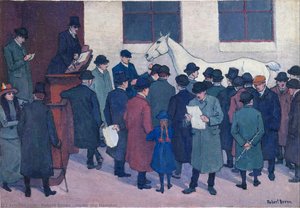
Sale at Tattersall's
 Oil On Canvas
- WallArt
- British Modernism
 1911
1911- Modern
 51.0 x 61.0 cm
 Read More
Hand Made Oil Reproduction
Hand-painted oil on canvas in your size and frame, made to order by our artists. ( Buy Print Buy Image)




P118B $10

P118H $10

P118W $10

P438Z $10

P508JH $12

P508YH $12

P805H $10

P805Z $10

P919BZ $10

P919G $10

P919XJ $10

P959ZH $10

P968JZ $12

W106C $8

W218G $10

W218JH $8

W218Y $10

W307PJ $10

W316G $10

W316PJ $8

W316Y $10

W398PJ $8

W4111J $10

W500HY $15

W500JH $15

W692G $12

W849H $8

W940BG $15

W953PJ $8




Pick from our preset sizes that match the artwork's original proportions.

You may enter your own dimensions to fit a specific frame or space. If your selected size does not match the original image's proportions, we will either crop the artwork or extend the painting with additional hand-painted elements. A digital mockup will be sent for your approval before production begins.
Please note that the on-screen preview does not reflect the actual cropping or extension. Only the mockup will accurately show the final composition.
While custom sizes are available, we recommend selecting a dimension from the predefined list to preserve the original proportions.
After order, ArtsDot.com team will email client for instructions and provide a mockup preview
Worldwide Delivery () in 3/4 weeks instead of standard 5 weeks. (16 August). No compromise on quality.

Free Worldwide Express Shipping

High-Quality Linen Canvas

Full Shipping Insurance

Customs Tax Refund Guarantee

True Color Matching Guarantee

60-Day Return Policy (Defects Only)

100% Money-Back Guarantee

Bulk Discount Offer
 Glass option is only available in size under 110 CM

Sale at Tattersall's
Reproduction Medium
Reproduction Size
-


Total Price
$ 263
Artwork Description
A Vibrant Pulse of Edwardian Life
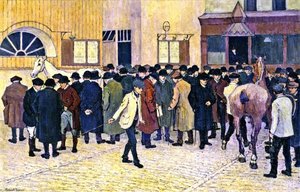
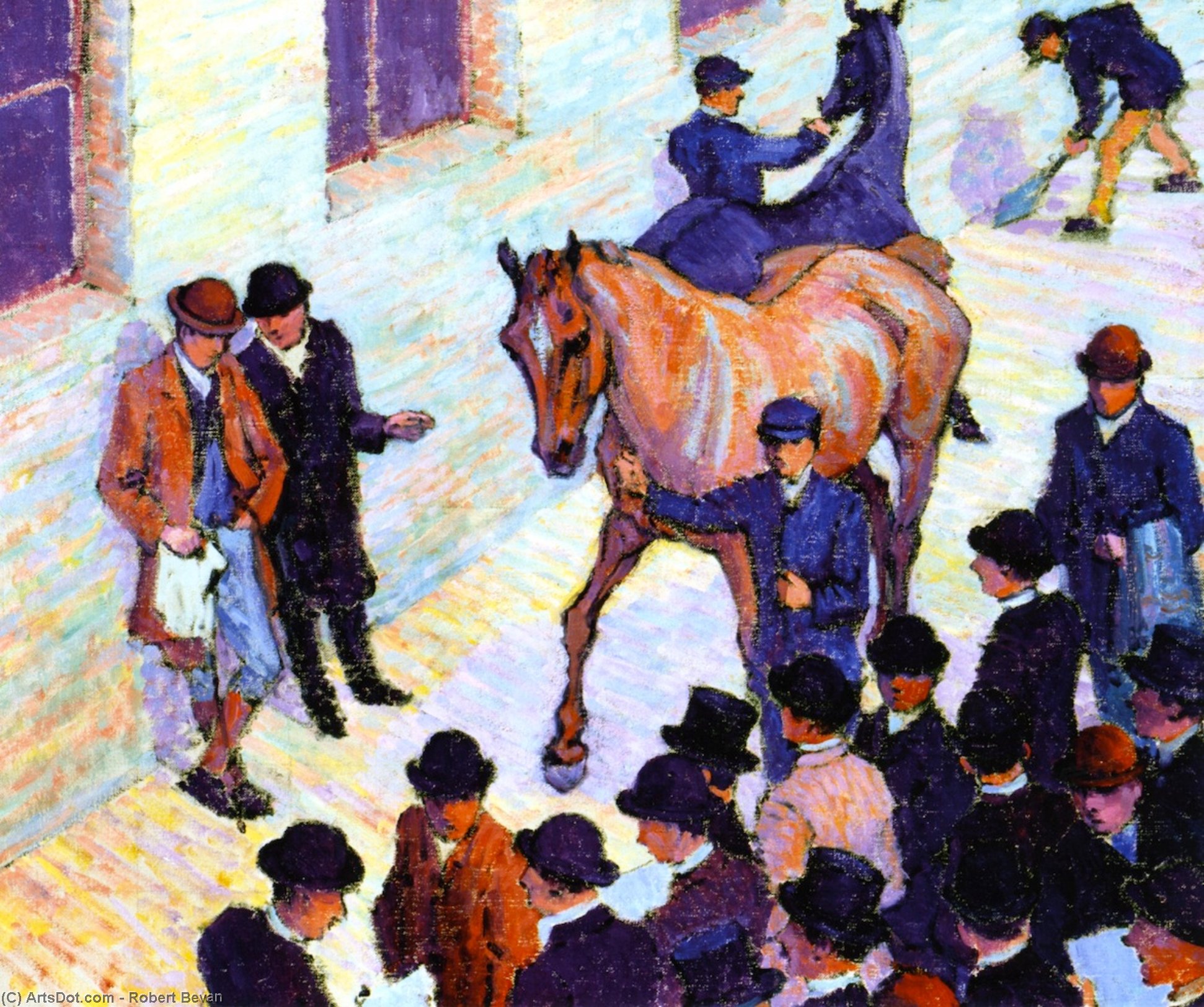
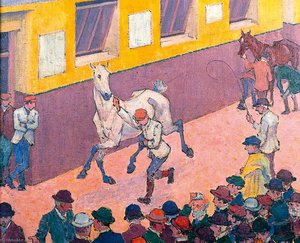
In the bustling heart of early twentieth-century London, few scenes capture the kinetic energy of urban commerce quite like Robert Polhill Bevan’s "Sale at Tattersall's." Painted in 1911, this masterful oil on canvas serves as a window into a bygone era, transporting the viewer to the legendary horse auction rooms where the air was thick with anticipation and the rhythmic cadence of bidding. Bevan, a pioneer of British Modernism and a founding member of the Camden Town Group, moves beyond mere documentation to capture the very soul of the marketplace. The composition is anchored by a central horse, its presence commanding and majestic, yet it is the surrounding human drama that breathes life into the frame. Figures are scattered throughout the scene, some leaning in with intense focus, others observing from the periphery, creating a layered tapestry of social interaction that feels both spontaneous and meticulously orchestrated.
The painting’s atmosphere is one of delightful chaos, a controlled whirlwind of movement and light. As one gazes upon the canvas, the eye is drawn through a crowd of spectators, past the subtle details of everyday life—such as a solitary handbag resting near the foreground—and toward the secondary horses that frame the central action. This arrangement creates a profound sense of depth, pulling the observer into the thick of the auction. For the collector or interior designer, this piece offers more than just a historical snapshot; it provides a focal point of immense character, capable of injecting a sense of narrative richness and sophisticated vitality into any curated space.
The Mastery of Color and Modernist Form
Technically, "Sale at Tattersall's" is a triumph of Bevan’s unique stylistic evolution. Moving away from the soft, atmospheric qualities of Impressionism, Bevan embraced a more robust and structured approach influenced by his encounters with Fauvism in France. His use of bold brushstrokes and a vivid, saturated palette allows the colors to vibrate against one another, mirroring the excitement of the auction itself. The textures achieved through the oil medium are rich and tactile, lending a physical weight to the horses and a palpable warmth to the skin tones of the crowd.
The artist’s ability to balance color and form is what makes this work so enduringly captivating. He utilizes light not merely to illuminate, but to sculpt the figures within the space, using patches of brightness to guide the viewer's journey across the canvas. This technique creates a rhythmic quality, where the eye dances from the muscularity of the equine subjects to the expressive gestures of the bidders. It is this marriage of structural integrity and chromatic brilliance that defines Bevan’s contribution to British art, making his works highly sought after by those who appreciate the intersection of tradition and modern innovation.
An Invitation to Timeless Elegance
Beyond its technical prowess, "Sale at Tattersall's" resonates on an emotional level, evoking a nostalgic longing for the structured yet vibrant social rituals of the Edwardian period. There is a certain dignity in the way Bevan depicts the intersection of animal and human, commerce and community. The painting celebrates the beauty found in the mundane, elevating a routine commercial event to the status of high art through sheer observational genius.
For those looking to adorn their homes or galleries with a piece that speaks of history, movement, and light, a high-quality reproduction of this work offers an unparalleled opportunity. Owning such a piece means bringing a fragment of London’s artistic heritage into one's personal environment. Whether placed in a sunlit study or a grand salon, the painting acts as a conversation starter, inviting guests to linger over its details and lose themselves in the lively, bustling world that Robert Bevan so brilliantly immortalized over a century ago.
Related Artworks
Artist Biography
A Pioneer of British Modernism: The Life and Art of Robert Polhill Bevan
Robert Polhill Bevan, born in Hove in 1865, occupies a pivotal yet often understated position within the narrative of early 20th-century British art. Emerging from a Quaker background steeped in banking connections – his parents were Richard Alexander Bevan and Laura Maria Polhill – he defied conventional expectations to become a daring innovator, a key figure in the transition from Impressionism towards more radical explorations of color and form. His journey was one of constant experimentation, absorbing influences from across Europe while forging a distinctly personal artistic vision that would profoundly impact the development of modern art in Britain. Bevan’s early education at Westminster School of Art under Fred Brown provided a solid foundation, but it was his subsequent studies at the Académie Julian in Paris that truly ignited his creative spark. There, he encountered a constellation of rising stars – Paul Sérusier, Pierre Bonnard, Édouard Vuillard, and Maurice Denis – artists who were challenging academic conventions and embracing new approaches to painting. These encounters proved formative, exposing Bevan to the principles of synthetism and laying the groundwork for his future explorations.Brittany, Fauvism, and the Search for Pure Color
The impact of Brittany on Bevan’s artistic development cannot be overstated. Two significant journeys in 1890 and 1891 immersed him in the atmosphere of Pont-Aven, a small coastal town that had become a magnet for artists seeking an alternative to Parisian salon culture. The bold colors and simplified forms championed by artists like Gauguin resonated deeply with Bevan, influencing his early drawings and prints. However, it was around 1904 that Bevan truly began to distinguish himself, embarking on a path of experimentation with pure color that anticipated the emergence of Fauvism on the continent. His painting “Courtyard” stands as a remarkable example of this proto-Fauvist approach, demonstrating a willingness to abandon naturalistic representation in favor of expressive chromatic intensity – a boldness that set him apart from many of his British contemporaries. This exploration didn’t remain static; Bevan subsequently adopted a divisionist or pointillist technique, evident in works like “Ploughing on the Downs” and “The Turn-Rice Plough,” showcasing his commitment to exploring different methods of applying color and capturing light. Throughout this period, the influence of masters such as Velázquez and Goya remained palpable, alongside more immediate guidance from Renoir regarding the depiction of horses – a testament to Bevan’s broad artistic curiosity and willingness to learn from diverse sources.Collective Visions: The Camden Town Group and Beyond
Bevan was not an artist who worked in isolation. He actively sought connection with like-minded individuals, playing a crucial role in the formation of several influential art groups. As a founding member of the Camden Town Group, he joined forces with artists determined to depict modern urban life and challenge established artistic norms. This collective spirit extended to his involvement with the London Group and the Cumberland Market Group, further demonstrating his commitment to progressive artistic movements. A particularly significant relationship was forged in 1908 when Bevan joined Walter Sickert’s Fitzroy Street group. Sickert's encouragement to focus on everyday subjects proved invaluable, steering Bevan towards a more grounded and socially engaged approach to art. The first Allied Artists’ Association exhibition in 1908 provided another important platform for Bevan, introducing him to the burgeoning world of international modernism – most notably, through his encounter with Wassily Kandinsky. These affiliations were not merely social; they fostered a dynamic exchange of ideas that shaped Bevan's artistic trajectory and contributed to the broader evolution of British art.Landscapes, Urban Scenes, and Lasting Legacy
While Bevan’s subject matter was diverse, encompassing portraits – including notable depictions of his wife, Stanislawa de Karłowska – and urban scenes documenting the decline of the horse cab trade (“The Cab Horse”), he is perhaps best known for his landscapes. His paintings of Sussex and Brittany are imbued with a vibrant energy, capturing the essence of rural life through expressive brushwork and bold color palettes. Works like “In the Downs near Lewes,” “The Chestnut Tree,” and “Landscape in the Blackdown Hills, Devon” exemplify this mastery, showcasing his ability to convey both the physical beauty and emotional resonance of the natural world. Robert Polhill Bevan’s legacy extends far beyond his individual paintings. He is rightfully recognized as a pioneer of modern British art, particularly for his early adoption of Fauvist principles and his fearless experimentation with color. His influence on subsequent generations of painters is undeniable, and his contribution to the Camden Town Group was instrumental in shaping the development of modern art in Britain. A retrospective exhibition at Colnaghi’s in 1961 served as a crucial moment of recognition, solidifying his place in art history and ensuring that his innovative spirit continues to inspire artists today. He remains a vital figure for understanding the complex evolution of British painting in the early twentieth century.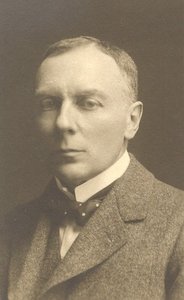
Robert Polhill Bevan
1865 - 1925 , United Kingdom
Quick Facts
- Artistic Movement Or Style: Fauvism, Divisionism
- Artists Or Movements Influenced By This Artist: ['Modern British Art']
- Artists Who Influenced This Artist:
- Paul Gauguin
- Velázquez
- Goya
- Renoir
- Date Of Birth: 1865
- Date Of Death: 1925
- Full Name: Robert Polhill Bevan
- Nationality: British
- Notable Artworks:
- The Farmhouse
- Ploughing on the Downs
- Queen's Grove
- The Cab Horse
- Place Of Birth: Hove, United Kingdom
Related Articles

Sir Alfred Munnings' Masterpieces: 25 Paintings That Define Equine Art | ArtsDot
Explore 25 iconic Sir Alfred Munnings paintings! Discover the beauty of British Impressionism, equine art & rural England. Find museum-quality reproductions and elevate your home decor with ArtsDot. Explore the full collection online.

The Enduring Legacy of Oil on Canvas: Technique, History & Aesthetic Impact
Explore the rich history & techniques of oil painting – from Renaissance masters to Impressionism. Discover pigments, layering methods, and why this timeless medium endures. Expert insights for artists & art enthusiasts.

Oil on Canvas: A Historical & Technical Exploration of a Timeless Artistic Medium
Explore the rich history & enduring techniques of oil painting on canvas. Discover the science behind its longevity, conservation practices, and contemporary relevance. Expert insights for art enthusiasts.
Bold Strokes & Powerful Visions: 10 Artworks That Command Attention | ArtsDot
Experience art's raw power! Explore 10 iconic paintings – Van Gogh, Kahlo & more – that define 'bold'. Discover the stories behind these expressive masterpieces and find museum-quality reproductions for your home at ArtsDot.com.

The Enduring Power of Painting: A Historical & Contemporary Exploration of Form and Emotion
Explore the rich history & enduring techniques of oil painting with ArtsDot. Discover masterpieces, learn about art collecting, and find authentic handmade reproductions crafted by skilled artists.