 Send
Send Share
Share
 Details

 Download
 Similars
 Diaporama
Following the Light of the Sun, I Only Discovered the Ground
 Black and White Photography
- Photo
- Contemporary Conceptual Art
 2014
2014- Contemporary
 la Biennale di Venezia
 Read More
Giclée / Art Print
Museum-quality giclée or canvas print with fast production and flexible finish options. ( Buy Hand Made Painting Buy Image)




































Pick from our preset sizes that match the artwork's original proportions.

You may enter your own dimensions to fit a specific frame or space. If your selected size does not match the original image's proportions, we will either crop the artwork or extend the image with a mirrored or solid-fill edge. A digital mockup will be sent for your approval before production begins.
Please note that the on-screen preview does not reflect the actual cropping or extension. Only the mockup will accurately show the final composition.
While custom sizes are available, we recommend selecting a dimension from the predefined list to preserve the original proportions.
Worldwide Delivery () in 2 weeks instead of standard 4/5 weeks. (27 August)

Free Worldwide Express Shipping

High-Quality Linen Canvas

Full Shipping Insurance

Customs Tax Refund Guarantee

True Color Matching Guarantee

60-Day Return Policy (Defects Only)

100% Money-Back Guarantee

Bulk Discount Offer
 Glass option is only available in size under 110 CM

Following the Light of the Sun, I Only Discovered the Ground
Giclée / Art Print
Reproduction Size
-


Total Price
$ 63
The Weight of Industrial Memory
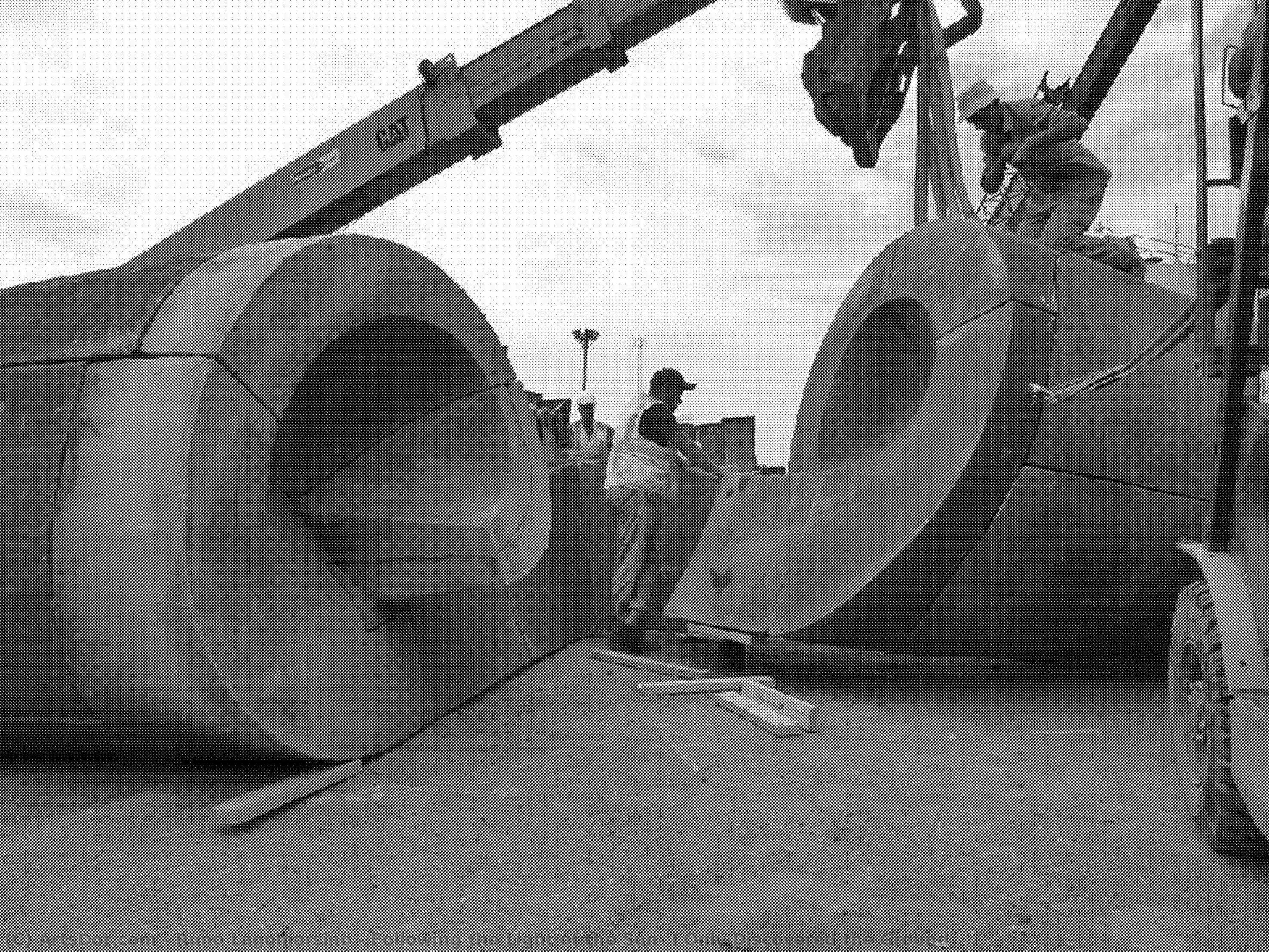
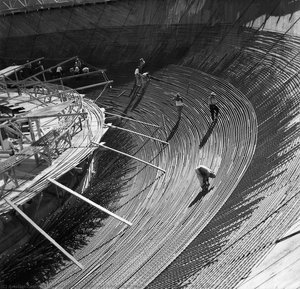
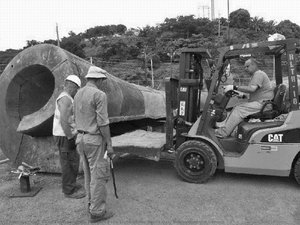
In the evocative monochrome photograph Following the Light of the Sun, I Only Discovered the Ground, Runo Lagomarsino invites us into a world where industrial labor and monumental scale converge to create a profound meditation on human effort. Captured around 2014, this striking black-and-white composition transcends mere documentary photography, offering instead a poetic glimpse into the mechanics of creation. The scene is dominated by the imposing presence of massive concrete forms and heavy machinery, their cylindrical shapes cutting through the frame with an architectural gravity. As we witness the construction process, there is a palpable sense of the immense energy required to shape the physical world, a sentiment that resonates deeply with anyone moved by the raw, unadorned beauty of industrial progress.
The artist utilizes a masterful command of tonal contrast to breathe life into this scene of heavy labor. By stripping away the distraction of color, Lagomarsino directs our gaze toward the interplay of light and shadow, where natural daylight carves deep, dramatic textures across the rough surfaces of concrete and metal. The geometric precision of the machinery—the straight edges of the forms and the circular silhouettes of the cylinders—creates a rhythmic, almost musical structure within the frame. This technical prowess ensures that every element, from the grit of the industrial setting to the subtle movement of the workers, contributes to a sense of monumental permanence, making it an ideal centerpiece for spaces that value strength, structural elegance, and sophisticated minimalism.
A Dialogue Between Permanence and Decay
Beyond its immediate visual impact, the artwork serves as a profound symbolic vessel for Lagomarsino’s broader explorations of history and identity. Born from a unique Swedish-Brazilian heritage, the artist often grapples with themes of displacement and the spectral residue of the past. In this piece, the massive, unfinished structures act as metaphors for the heavy, often cumbersome narratives of civilization itself—ideas and monuments that are too weighty to be easily discarded or forgotten. The photograph captures a moment of transition, where the raw materials of the earth are being transformed into something lasting, yet it simultaneously whispers of the ephemeral nature of all human endeavors.
For the discerning collector or interior designer, this work offers more than just aesthetic appeal; it provides an emotional anchor. It evokes a sense of quiet dignity and the "quiet gravity" of existence. Whether placed in a contemporary gallery setting or integrated into a curated residential collection, Following the Light of the Sun, I Only Discovered the Ground commands attention through its sheer scale and intellectual depth. It is a piece that invites long periods of contemplation, prompting viewers to reflect on the labor, the history, and the inevitable passage of time that shapes our shared landscape. Owning a high-quality reproduction of this work means bringing a fragment of this monumental dialogue into one's own environment, fostering an atmosphere of thoughtful, enduring sophistication.
Related Artworks

Artist Biography
Early Life and Formation: A Swedish-Brazilian Dialogue
Runo Lagomarsino, born in 1977 in Lund, Sweden, embodies a fascinating intersection of cultural heritage that profoundly shapes his artistic vision. His upbringing was uniquely marked by the legacy of exile; his parents were Argentinian émigrés with roots tracing back to Italian immigrants who fled Europe during World War I. This familial history—a narrative woven with displacement and the search for belonging—became an intrinsic element in Lagomarsino’s exploration of identity, migration, and the complexities of cultural memory. He didn't simply grow up *with* these stories; he lived within them, experiencing a repeated movement between Sweden and Brazil that instilled a deep sensitivity to the distances and proximities inherent in notions of “South” and “North.” This early exposure wasn’t merely biographical but fundamentally altered his artistic approach.
Lagomarsino's formal education provided a strong foundation for this evolving practice. He studied at the Academy of Fine Art Valand in Gothenburg, followed by the Malmö Art Academy in Lund, and culminated with the prestigious Whitney Independent Study Program in New York City. These experiences weren’t isolated steps but rather building blocks that allowed him to refine his conceptual framework and develop a diverse skillset encompassing collage, drawing, installation, performance, and video. The Whitney program, in particular, proved pivotal, fostering an environment of critical inquiry and experimentation that encouraged him to challenge conventional artistic boundaries.
Themes of Migration, Identity, and Colonial Echoes
At the heart of Lagomarsino’s work lies a persistent interrogation of power dynamics—historical, political, and cultural. He doesn't seek to simply *tell* stories but rather to re-articulate them, uncovering conflicting dependencies and complex events without reducing their inherent ambiguity. His installations, sculptures, and text-based works often employ strategies of displacement and transformation, questioning the very writing of history, particularly within the context of South America. This isn’t about constructing new narratives from a colonized perspective; it's about revealing the fractures and blind paths within existing ones.
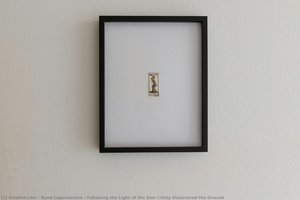
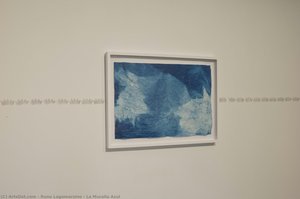
A recurring motif in his oeuvre is the exploration of everyday objects and materials as carriers of memory and meaning. He imbues these seemingly mundane elements with poetic resonance, challenging dominant narratives and inviting viewers to reflect on their own positionality. For example, works like ‘La Muralla Azul’ (The Blue Wall) demonstrate a captivating abstract expressionist series blending blue hues & Mediterranean echoes, reflecting colonial themes and evoking contemplation of urban landscapes. Similarly, ‘Following the Light of the Sun, I Only Discovered the Ground’ utilizes striking sun-paper drawings to explore colonial history and migration, creating a poignant blend of abstraction and social commentary.
Technique and Poetic Displacement
Lagomarsino's artistic process is characterized by what he describes as “precise and poetic displacements.” This isn’t about grand gestures or overt statements but rather subtle interventions that generate friction and reveal hidden layers of meaning. He often works with found objects, transforming their original context to create new associations and challenge preconceived notions. The act of displacement itself becomes a metaphor for the experience of migration—the disruption of familiar surroundings and the search for new connections.
His use of materials is deliberate and evocative. Neon tubes pilfered from museum exhibits, copper rings marking felled trees, illegally imported eggs – these aren’t arbitrary choices but rather carefully selected elements that carry symbolic weight. The video installation *More Delicate Than the Historians’ Are the Map-Makers’ Colors* (2012–13), for instance, features Lagomarsino and his father unpacking and throwing eggs at a monument in Seville, a gesture laden with historical and political implications. This work exemplifies his ability to blend personal narrative with broader social commentary.
Major Achievements and International Recognition
Lagomarsino’s artistic contributions have garnered significant international recognition. He has exhibited widely across Europe, the Americas, and Asia, participating in prestigious biennials such as Gwangju, Venice, Gothenburg, Ural, Prospect New Orleans, and São Paulo. His work is held in numerous public and private collections, including the Solomon R. Guggenheim Museum of Modern Art, Guangdong Museum of Art, Dallas Museum of Art, Kiasma Museum of Modern Art, Moderna Museet, and the Museo Reina Sofia.
Beyond exhibitions, Lagomarsino has received several accolades, including the Friends of Moderna Museet Sculpture Prize in 2019 and a DAAD artist-in-residence fellowship in Berlin. His curatorial work, such as the retrospective exhibition 'Lenke Rothman – Life as Cloth' at Malmö Konsthall, further demonstrates his commitment to fostering critical dialogue within the art world.
Historical Significance: A Contemporary Voice
Runo Lagomarsino’s work occupies a crucial space in contemporary art. He doesn’t offer easy answers or definitive statements but rather invites viewers to engage with complex questions of identity, migration, and cultural heritage. His ability to blend personal narrative with broader social commentary, coupled with his poetic use of materials and subtle interventions, sets him apart as a unique and compelling voice.
In an era marked by increasing globalization and displacement, Lagomarsino’s work resonates deeply with audiences worldwide. He challenges us to confront the legacies of colonialism, question established narratives, and recognize the inherent instability of language and representation. His art is not merely about reflecting on the past; it's about actively shaping our understanding of the present and envisioning a more equitable future.

runo lagomarsino
1977 - , Sweden
Quick Facts
- Artistic Movement Or Style: Installation Art
- Date Of Birth: 1977
- Full Name: Runo Lagomarsino
- Nationality: Swedish
- Notable Artworks:
- La Muralla Azul
- Following the Light...
- Elementary
- Place Of Birth: Lund, Sweden
Related Articles
Acrylic on Paper: A Modern Canvas for Contemporary Expression
Explore the versatility of acrylic painting on paper! Discover expert techniques, artist insights & archival practices for creating stunning contemporary art. Learn more at ArtsDot.

The Nuances of Graphite: Exploring Emotional Depth & Technical Mastery in Pencil Drawing
Explore the captivating world of graphite drawing! Discover its rich history, master essential techniques like chiaroscuro, and learn how artists evoke emotion through this timeless medium. Expert insights for art enthusiasts.
Acrylic on Paper: 10 Masterpieces That Redefined Modern Art | ArtsDot
Explore 10 legendary 'Acrylic on Paper' masterpieces by artists like Helen Frankenthaler & Gerhard Richter. Discover abstract expressionism, color field painting & the evolution of modern art. Find museum-quality reproductions for your home at ArtsDot.com.
The Enduring Power of Line: Exploring Themes & Techniques in Drawing Across Art History
Explore the rich history of drawing! Discover key techniques like linear perspective & iconic artists from the Renaissance to modern times. Enhance your art appreciation with ArtsDot.
The Alchemy of Graphite: An Expert Guide to Mastering Detail and Depth in Pencil Sketching
Unlock the secrets of graphite sketching with our expert guide for art students. Learn to master pencil grades, create realistic depth, and capture intricate textures through professional techniques designed to elevate your observational drawing skills.