

 Preview
 Send
Send Share
Share
 Details

 Download
 Similars
 X-Ray
X-Ray Diaporama
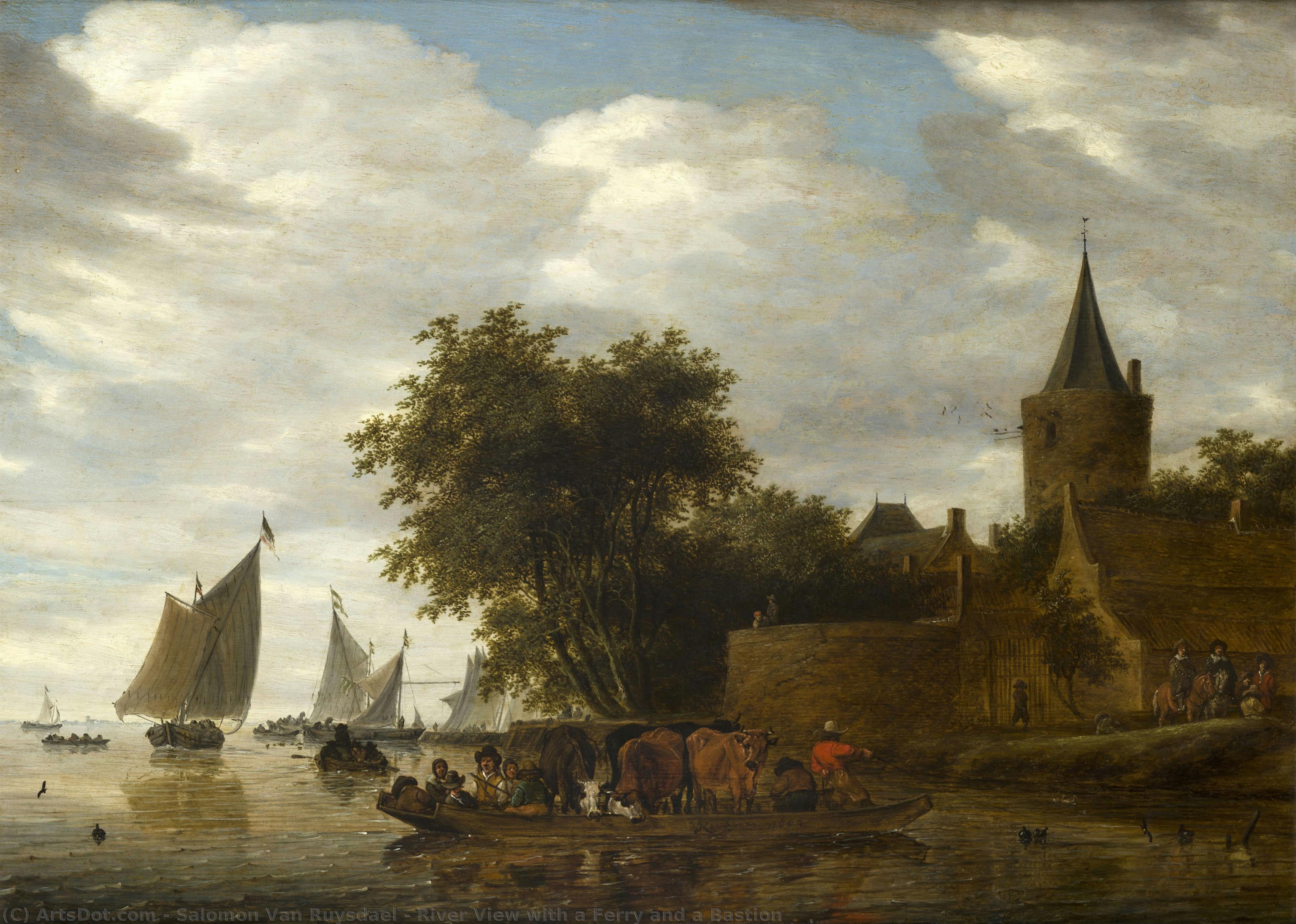
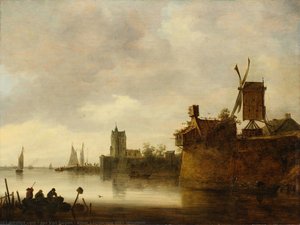
River View with a Ferry and a Bastion


 Read More
Purchase a high-resolution, enhanced digital image, far superior to the online preview.
Each file is meticulously prepared by our in-house specialists using advanced tools and expert manual retouching. We ensure every image has exceptional clarity, precise color accuracy, and fine detail.
The final file is delivered via email within 72 hours, optimized for immediate use in professional, editorial, and print environments. This is the same quality trusted by top-tier design studios, publishers, and galleries.
Digital Image
Download a high-resolution file for personal display, printing, and creative projects. ( Buy Print Buy Hand Made Painting)
Included in Every Digital Image Order
Expert Digital Delivery, Guaranteed
When you choose ArtsDot.com, you're not just getting an image - you're receiving a professionally enhanced digital artwork, crafted with precision and backed by a satisfaction guarantee. Here's everything that comes with your order, automatically:

Fast Email Delivery
Your high-resolution digital image file will be emailed to you within 72 hours of ordering - ready for immediate use.

AI-Enhanced Digital File
Your artwork is professionally optimized using advanced AI tools and manual editing, ensuring maximum detail, clarity, and color accuracy.

Free Lifetime Re-Delivery
Accidentally deleted or lost your file? No worries - we'll resend it to you anytime, free of charge.

No Import Fees - Ever
Enjoy your artwork instantly with zero customs, duties, or delivery fees - digital downloads are always tax-free.

Color Accuracy Guarantee
We ensure your digital image reflects the original colors as closely as possible using professional tools and color management.

60-Day Satisfaction Guarantee
If you're not satisfied with your digital image, we'll revise it or refund 100% within 60 days - no questions asked.

100% Money-Back Guarantee
Not satisfied? Get a full refund within 60 days of receiving your digital file - no questions asked.

Bulk Order Discounts
Buy 3 images, save 10% - Buy 5, save 15% - Buy 10+, save 20%. Great for creative projects, galleries, and agencies.
Collectible Description
A Serene Reflection of Dutch Prosperity
The Frans Hals Museum proudly showcases Salomon van Ruysdael’s “River Landscape with Ferry,” a captivating testament to the artistic sensibilities of the Dutch Golden Age. Painted in 1664, this monumental canvas transcends mere depiction; it embodies the spirit of a nation reclaiming its independence after decades of struggle against Spanish dominion—a moment etched into the collective memory and powerfully conveyed through Van Ruysdael’s masterful brushstrokes.The Painter's Vision: Atmosphere and Detail
Salomon van Ruysdael, born in Naarden around 1602, possessed an unparalleled ability to capture the essence of Dutch countryside—a skill honed by his father’s craft as a framemaker, fostering an appreciation for precision and meticulous observation. Unlike many artists of his era who prioritized grand narratives or dramatic compositions, Van Ruysdael focused on subtle nuances of light and shadow, creating landscapes imbued with palpable emotion. His technique – oil painting on canvas – is characterized by loose yet confident brushwork that builds up textured surfaces, conveying the rugged beauty of marshlands and waterways. The artist’s dedication to realism is evident in every detail—the reflections shimmering on the water's surface, the individual blades of grass swaying gently in the breeze, and the careful rendering of architectural elements like the fortified bastion.A Symbol of Resilience: Historical Context
“River Landscape with Ferry” isn’t simply a picturesque vista; it speaks to a pivotal moment in Dutch history. The Treaty of Münster, signed in 1648, formally ended the Eighty Years' War and secured the Republic’s autonomy—a triumph celebrated throughout Holland. Van Ruysdael skillfully incorporated this historical significance into his artwork, subtly suggesting the nation’s newfound confidence and optimism. The ferry itself serves as a powerful symbol of trade and connection, representing the burgeoning economic prosperity that followed liberation from Spanish rule.Composition and Color Palette: Harmony and Tranquility
The painting's composition is remarkably balanced, guiding the viewer’s eye across the expansive landscape towards the fortified town in the distance. The cloudy sky lends an air of contemplation, mirroring the mood conveyed by the muted greens, blues, browns, and ochres dominating the color palette—a harmonious blend that evokes a sense of nostalgia for rural life and bygone eras. Lines delineate edges and pathways, creating depth and perspective, while shapes – trees, water, boats – contribute to the overall organic feel of the scene.Emotional Resonance: A Legacy of Beauty
Ultimately, “River Landscape with Ferry” transcends its historical context to offer a profound emotional experience. It invites viewers to pause and appreciate the quiet grandeur of the Dutch countryside—a reminder that beauty can be found in simplicity and observation. This masterpiece continues to inspire admiration for its technical brilliance and artistic sensitivity, cementing Salomon van Ruysdael’s place as one of the most enduring figures within the canon of Dutch landscape painting.Related Artworks

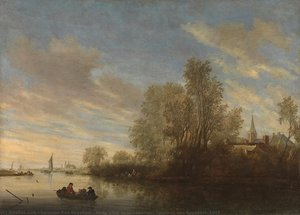
Artist Biography
The Subtle Master of Dutch Landscape: The Life of Salomon van Ruysdael
In the golden era of the seventeenth-century Netherlands, a period defined by unprecedented prosperity and artistic flourishing, Salomon van Ruysdael emerged as a painter of profound atmospheric sensitivity. Born around 1602 in Naarden, his life was deeply intertwined with the very fabric of the Dutch Golden Age. While history often casts a long shadow over his more famous brother, Jacob van Ruisdael, Salomon carved out a distinct and irreplaceable niche within the canon of landscape painting. His work does not merely depict the land; it captures the breathing essence of the Dutch countryside, where light and water perform a silent, eternal dance across the canvas.
The foundations of his artistry were laid in a household where craftsmanship and precision were paramount. His father, Jacob Jansz de Gooyer, was a skilled woodworker specializing in the intricate ebony frames that housed the era's most precious mirrors and paintings. This early exposure to the meticulous details of framing likely instilled in Salomon a lifelong reverence for texture and structural integrity. Though his formal education was surprisingly broad—encompassing the complexities of Latin and even medicine—his heart remained tethered to the visual world. By joining the prestigious Haarlem Guild of St. Luke in 1623, he entered an elite circle of creators, coming under the direct influence of masters such as Jan Porcellis and Esaias van de Velde. These mentors, champions of atmospheric perspective and observational realism, provided the technical vocabulary that Salomon would later use to compose his serene, water-centric vistas.
A Symphony of Water and Light
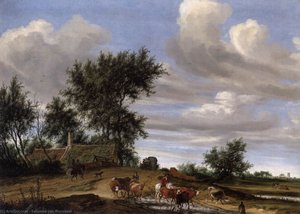
Salomon van Ruysdael’s true mastery lies in his ability to render the ephemeral qualities of the Dutch atmosphere. Unlike many of his contemporaries who sought out dramatic, sweeping vistas or turbulent storms, Salomon found his greatest inspiration in the quietude of inland waterways. His compositions often center on the rhythmic flow of rivers and the tranquil expanse of lakes, where the sky and water meet in a seamless transition of muted tones and soft light. In masterpieces such as River View near Deventer, one can observe how he utilizes a delicate palette to evoke the damp, cool air of the Netherlands, inviting the viewer to step into a moment of profound stillness.
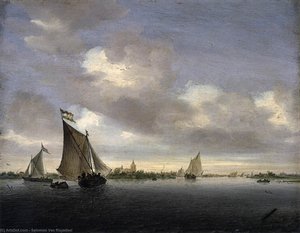
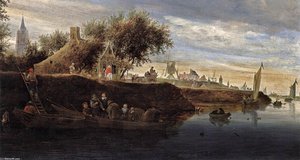
His technical prowess is particularly evident in his treatment of marine and riverine subjects. In works like Sailing Vessels on an Inland Body of Water, he demonstrates an unparalleled ability to capture the weight and movement of boats navigating through calm currents. The integration of human elements—such as the subtle presence of fishermen in River with Fishermen—is never intrusive; rather, these figures serve to provide scale and a sense of lived reality to the landscape. Through his brush, the water becomes more than just a surface; it becomes a mirror reflecting the shifting clouds and the soft, diffused light that characterizes the Dutch sky.
Legacy and Artistic Significance
The historical significance of Salomon van Ruysdael resides in his role as a pioneer of the atmospheric landscape. He moved away from the rigid, topographical depictions of earlier eras toward a more emotive, sensory experience of nature. His ability to blend the precision of still-life elements with the vastness of landscape painting created a unique aesthetic that resonated with the Dutch middle class, who sought art that reflected their own peaceful, industrious environment.
Today, his legacy is preserved in some of the world's most esteemed institutions, including the Museo Thyssen-Bornemisza. To study a Van Ruysdael is to undergo a lesson in patience and observation. His work remains a testament to the beauty found in the understated, reminding us that the most profound artistic truths are often found in the quietest reflections of a river or the softest glow of a departing sun. His contribution to the Dutch Golden Age remains an essential chapter in the story of how humanity learned to see the world not just as it is, but as it feels.
Salomon van Ruysdael
1602 - 1670 , Netherlands
Quick Facts
- Artistic Movement Or Style: Dutch Golden Age Landscape Painting
- Artists Or Movements Influenced By This Artist: ['Jacob Van Ruisdael']
- Artists Who Influenced This Artist:
- Jan Porcellis
- Esaias van de Velde
- Date Of Birth: Naarden, Netherlands (1602)
- Date Of Death: November 3, 1670
- Full Name: Salomon van Ruysdael
- Nationality: Dutch
- Notable Artworks:
- River landscape
- Ferry near Gorinchem
- View of Deventer
- Place Of Birth: Naarden

